Clear The Air News Blog Rotating Header Image

May, 2013:

[GAIA] Study on Utilization of Incineration Waste Ash Residues in Portland Cement Clinker

http://www.aidic.it/cet/10/21/127.pdf

Utilization of Incineration Waste Ash Residues in Portland  Cement Clinker

Charles Hoi King Lam*, John Patrick Barford, Gordon

McKay

Department of Chemical and Biomolecular Engineering , Hong Kong University of Science and Technology, Clear Water Bay, Hong Kong, China

keking@ust.hk

Conclusion

MSWI (municipal solid waste incineration) bottom ash and fly ash and sewage sludge ash are evaluated as raw materials for Portland cement clinker according to the chemical composition analysis. According to the phase and chemical composition of the clinker obtained, the MSWI bottom ash with up to 6 % addition in clinkers show acceptable phase compositions and many of the major phases which are comparable with ordinary Portland cement clinker. High phosphorus content and sulfur trioxide content in sewage sludge ash may suppress the formation of the main phases. Fly ash clinkers may lead to insufficient CaO for alite formation. A proper pre-treatment would be required to use fly ash or sewage sludge ash. The heavy metals are concentrated and stabilized in the clinker matrix with low leachability. Further tests on the physical properties of the clinkers should be taken to fully understand the feasibility of ash based clinker.

Acknowledgement

The authors would like to thank Green Island Cement Ltd for their financial support and technical advice.

Download PDF : 127

Watchdog steps up pressure on non-transparent Hong Kong charities

Published on South China Morning Post (http://www.scmp.com)

Home > Watchdog steps up pressure on non-transparent Hong Kong charities


Watchdog steps up pressure on non-transparent Hong Kong charities

Tuesday, 21 May, 2013, 12:00am

Lifestyle›Family & Education

CHARITY

Nora Tong life@scmp.com

Pressure is growing for greater transparency in the surprisingly murky world of charity finances, writes Nora Tong

If it feels as though you rarely venture out on weekends without being tapped for charitable donations by volunteers, you’re probably right. Non-profit groups have mushroomed – more than 7,000 organisations are registered as charities with the Inland Revenue Department – and many hit the streets on flag-selling drives.

But with so many groups seeking funds, it can be tough figuring out which cause to give to. Are the organisations all they’re cracked up to be and how much of the contribution really goes to people in need?

Bonita Wang Zejin found herself asking these questions a few years ago when a friend, whose birthday was approaching, urged their circle of friends to donate to a charity instead of spending on a gift.

“We had no clue where to donate to,” Wang says. “I found it odd there wasn’t a platform for the public to find out more about charities, when even for things like eating ice cream, you can go to [online listing] OpenRice for references.”

That was how she came to set up the charity watchdog iDonate in December 2010. Wang quit her job as an auditor and manager of a private equity fund and recruited a full-time analyst and a part-time programmer for her iDonate team. Together, they evaluate the operational efficiency and transparency of NGOs based on available data. Information is usually drawn from annual reports, often downloaded from the charity’s website, or from audited financial reports purchased from the companies registry information system.

Getting an accurate picture can be tough even for motivated teams like iDonate. There is no central authority that registers and monitors charities, and non-profits are not required to disclose donation amounts or financial information to the public.

Donors who wish to check a non-government group’s financial status and whether contributions are spent in line with its objectives will find that such reports aren’t uniformly presented. Some charities such as women’s empowerment group HER Fund, present a full audited financial report on their website. Others make just a few pages available. Some indicate through graphs and charts how donations are distributed – without revealing absolute figures. And there are those that do not disclose anything at all.

Depending on how they are established, charities are overseen by different government departments. Statutory bodies such as the Tung Wah Group of Hospitals and orphan welfare group Po Leung Kuk must maintain audited accounts of all transactions and be open for inspection by their directors or any person appointed by the chief executive of Hong Kong.

Maintaining transparency entails a cost, but if you think it is something worth doing, you will do it

Linda To, executive director, HER fund

A charity set up as an incorporated company – Save the Children Hong Kong, for example – is required to file annual returns with the Companies Registry. The report covers basics such as its address, board of directors and, where appropriate, any mortgage it takes out.

But unincorporated groups do not have to account for their spending at all.

Groups that secure tax-exempt status with the Inland Revenue Department are subject to periodic review, during which they may be asked to submit accounts and annual reports. Under this review process, charities set up as incorporated companies must submit audited accounts to the IRD, usually every four years. But unincorporated organisations just have to present self-certified accounts.

As Wang sees it, there is unacceptable lack of oversight, arguing that charities are obliged to be transparent about how funds are applied.

“Charities are exempt from taxation and should be accountable to the public,” she says. “Every member of the public should have free access to the audited account of a charitable group. Information on any related transaction – such as whether the charity is paying for the fundraising services provided by a company owned by a member of the charity’s board – should also be disclosed.”

That is why iDonate tries to evaluate the performances of the various charities. Adapting methods used by charity watchdogs in the United States, Wang’s team works out measures such as fundraising efficiency, proportion of fundraising expense, programme expenditure (including project workers’ pay), salaries (including general office staff) and administrative costs in relation to annual spending. The lower the proportion, the higher the score of a charity.

An NGO that devotes more than 85 per cent of its total expenditure on programmes will gain the full mark of 10 points, whereas one in which programme expenses make up only 49 per cent of the total will get 2.5 points.

In countries like the US, it is generally unacceptable for a charity to direct less than 60 per cent of its spending towards programmes, Wang says.

However, Christine Fang Meng-seng, chief executive of the Hong Kong Council of Social Service (HKCSS), finds that categorising different types of spending is not always clear cut. “Marketing expenditure is usually considered a type of administrative cost. But what if we’re talking about a charity that fights human trafficking and needs to spend more on public communication? Should this come under programme expenses?

“Some NGOs are reluctant to disclose financial information for fear it will be subject to simplistic comparisons and be misunderstood, since different people would interpret the information differently,” Fang says.

HKCSS, an umbrella group representing more than 400 charities, also manages an initiative called WiseGiving, which aims to inform the public about the work of charities, while monitoring and educating these organisations.

Fang maintains that charities have always had a degree of transparency. Groups receiving government subsidy must account for how it is spent and abide by certain rules. They also have to be accountable to donors, from private foundations to organisations such as the Jockey Club.

But as public demand for transparency grows, NGOs need to work to build trust, Fang says. This includes disclosing the sources of their income and how the resources are used to carry out their mandate, as well as governance issues. Charities should also account for specific activities such as street fundraisers.

Faced with a swelling morass of charities, the government began consultations two years ago to draft a Charities Law, led by a subcommittee under the Law Reform Commission.

The consultation paper has proposed changes from how to define and register a charitable organisation to policies on monitoring and regulating charities more effectively. Suggestions include the mandatory submission of financial accounts, with auditing depending on income levels, and the setting up of a regulatory body to issue fundraising permits and to monitor how those funds are used.

Fang believes such requirements will not only improve NGO transparency but also help the public better understand their work.

Linda To Kit-lai, executive director of the HER Fund, says upholding accountability is particularly important for charities like hers. The group derives income from fundraisers and private donations.

“Our existence depends on the support from our donors, who have every right to know how we are spending their money,” says To. “Maintaining transparency entails a cost, but if you think it is something worth doing, you will do it. We pay our auditor about HK$4,000 a year, and we have no hesitation paying that fee.”

However, a proposal to set up a commission as the sole regulatory body for charities is more controversial.

This commission would be empowered to investigate problematic charities; suspend or remove their trustees, directors and officers in cases of misconduct or mismanagement; and even deregister a charity when it fails to comply with legal obligations.

NGO leaders such as To worry about vesting too much power in one body. “There are no details with regards to the make-up of the commission. Will all members be pro-government? We need diverse voices,” she says.

Church groups conducting underground activities in the mainland are concerned about government interference and the possible suppression of charities, says Bernard Chan, who chairs the sub-committee drafting law recommendations. Although countries such as Britain have instituted such a law, Chan reckons it will be a challenge to do the same in Hong Kong amid a politically polarised environment.

“There’s a lack of trust in the government,” he says. “But maintaining the status quo [on how charities are monitored] cannot be the solution either.”

It may be a few years before there is a charity law in Hong Kong. In the meantime, Chan says civil society must hold charities to their mission. “[Pressure from] donors is an effective means to facilitate NGO transparency. I hope it won’t take a big scandal or crisis before we can work on the monitoring and regulation of charities,” he says.

life@scmp.com [1]

Topics:

LIFE

Charity

Transparency

Non-profit sector

iDonate


Links:
[1] mailto:life@scmp.com

Backchat

On Backchat, we’ll be talking about waste management after the government announced its blue print. What are the key issues and initiatives?  After 9.15am, Raymond Wong leaves People Power – why? (8.30am-9.30am, call in on 233 88 266, facebook or email backchat@rthk.hk)

8:30am-9:15am Blueprint for Waste Management (click to listen)

Dr. Jonathan Wong, Director, Hong Kong Organic Resource Centre/ Professor, Department of Biology, Hong Kong Baptist University (gee, Sino Forest disappeared !)

Christine Fong, Sai Kung District Councilor

Miranda Yip, Assistant Manager, Policy Officer, Friends of the Earth

http://programme.rthk.org.hk/channel/radio/programme.php?name=radio3/backchat&d=2013-05-21&p=514&e=218869&m=episode

listen to the program 0830 – 0915 yesterday

Blueprint for Waste Management
On Backchat, we’ll be talking about waste management after the government announced its blue print. What are the key issues and initiatives?  (8.30am-9.30am, call in on 233 88 266, or email backchat@rthk.hk)

8:30am-9:15am Blueprint for Waste Management

Dr. Jonathan Wong, Director, Hong Kong Organic Resource Centre/ Professor, Department of Biology, Hong Kong Baptist University

Christine Fong, Sai Kung District Councilor

Miranda Yip, Assistant Manager, Policy Officer, Friends of the Earth

Airline emissions deal uncertain ahead of EU’s September deadline

Published on South China Morning Post (http://www.scmp.com)

Home > Airline emissions deal uncertain ahead of EU’s September deadline


Airline emissions deal uncertain ahead of EU’s September deadline

Tuesday, 21 May, 2013, 12:00am

Business›Economy

Reuters in Montreal

China, US opposed EU’s carbon trading plan; deadline for new proposal is September

Hope is fading for a global deal to regulate the airline industry’s greenhouse gas emissions ahead of an Autumn deadline, even though failure could push the industry back to the brink of a trade war over the European Union’s emissions trading system.

Last November the EU suspended its controversial scheme to force all airlines to buy carbon credits for any flight arriving in or departing from European airspace.

The scheme had pitted European states against China, the United States, India, and others, who said it violated their sovereignty. The EU said it had to act, after more than a decade of inaction on the environmental impact of aviation.

European officials gave the United Nations’ agency that governs aviation, the International Civil Aviation Organisation (ICAO), more time to craft a compromise in the form of a global regulatory regime. They have vowed to bring their own programme back into force unless they see real progress by the ICAO Assembly, which runs from September 24 to October 4.

But there is still disagreement on how to charge for emissions from flights that cross borders; how to deal fairly with developing countries; and whether airlines, states, or both should be subject to regulation.

“Think of aviation as a microcosm of the big geopolitical process,” said Paul Steele, executive director of the industry group Air Transport Action Group, and one of the technical experts who has advised ICAO on the issue. The Group, a coalition of some 50 plane makers, airlines, and narrower associations like Airports Council International, wants a global emissions regime, not a messy “patchwork” of systems around the world.

Steele said lack of progress on the United Nations Framework Convention on Climate Change, the UN’s main climate treaty and home of the Kyoto Protocol, may be holding back talks at ICAO.

Take “common but differentiated responsibilities”, an argument that developed countries should shoulder most of the burden of cutting emissions.

That has been a key sticking point at ICAO. Steele said some countries fear that if they compromise at ICAO, it will prejudice broader talks ahead of 2015, when climate negotiators hope to clinch a new deal to cut emissions under the UN Framework Convention.

And so, even as aviation industry leaders urge ICAO to hammer out a deal, talks at a high-profile ICAO committee have effectively broken down, and a key member of the agency’s governing council has said a resolution may not be ready in time for the assembly. That could escalate the conflict. And while China partially lifted a retaliatory blockade of some US$11 billion in Airbus jet orders last month, a new chapter in the conflict could put those orders at risk.

Seeking to break the impasse, ICAO convened a new group, which Kerryn Macaulay, Australia’s council representative, recently said was to include “some of the decision-makers in government” who might be able to hash out compromises.

It was the creation of that “high-level group” that the EU cited when it suspended its scheme. It was just a new committee, but it was seen as a sign of good faith, and an opportunity to get a deal.

But as Macaulay told a conference hosted by the Air Transport Action Group in Montreal on May 13, the high-level group made little progress. Quite the opposite: “In some areas there has been a risk of reopening old issues that the council in fact was recently settled on.”

Topics:

Aviation

Emissions

EU Emissions Trading System

International Civil Aviation Organization


Bold vision of reclamation

Tuesday, 21 May, 2013, 12:00am

Comment›Letters

I refer to the report (“Unease over reclamation”, April 29), and would like to provide information on the vision and overall planning in the proposals for reclamation outside Victoria Harbour.

When identifying the five possible locations for reclamation, priority is given to near-shore reclamation that can be efficiently connected to existing roads and developed areas, and to man-made shorelines distant from existing communities, while avoiding ecologically sensitive areas.

Lung Kwu Tan is one such site that can be well integrated into existing transport infrastructure, providing an area of economic growth and job opportunities. Ma Liu Shui is a location that can provide land for much-needed housing and community facilities, hence addressing the pressing housing demand. Close to Sha Tin town centre, it can be easily linked with the existing railway. The site’s potential could be further enhanced by integrating with the land released by relocating the sewage treatment plant nearby into a rock cavern.(CTA: why not move Legco and Govt HQ from its prime site to a cavern and build the proposed incinerator on the current Admiralty site since it is so modern and clean and adjoining the sea?)

The two sites on Lantau have the merit of connecting with major economic and tourist infrastructure (for example, the airport, Hong Kong-Zhuhai-Macau bridge), (CTA: so we want more Mainland and other tourists ??) being in line with the HK2030 Study and the Revised Lantau Concept Plan to facilitate strategic economic development and supporting development of Tung Chung. On the other hand, Tsing Yi southwest, with its easy access to existing transportation nodes, has the potential of becoming a regional logistics node.(CTA: this guy needs testing for hallucinogens? – Shenzhen port will soon be world number 2 and Shanghai (world no 1 shipping port) are less expensive than Hong Kong and are closer to the manufacturing sources as are Mainland airports with their new runways and flight clearances.)

The above demonstrates that there are strategic thoughts and planning underpinning the reclamation proposals. It must be emphasised that we did not start from ground zero, as much planning has been done in the past: the Lantau concept plan, various infrastructural planning, and the studies for the tourism and logistics industries. All these guide and back our recommendations.(CTA: sorry no more room in teh street or in the hotels and the same-day tourists do not benefit the people, they benefit the tycoons)

The proposed artificial islands in the central waters between Lantau and Hong Kong Island represent a different proposition. They are envisaged as a long-term option for new development areas.(CTA – indeed they are intended to become the new ash lagoons for the daily 1,000 tonnes of ash from the SWC planned incinerator !) With fewer environmental constraints and high planning flexibility, they can become the urban extension (of our landfills) if a convenient and cost-effective transport system can be provided. We hope to receive public support for the next step on artificial islands: conducting studies on engineering feasibility, possible land uses and transport links, and carrying out assessment on the potential impact on the environment, marine ecology and traffic.

It is a bold vision that we hope to discuss with the public and gain their support.

http://rlv.zcache.com/in_god_we_trust_not_government_cards-r4db5701cc27e4f14a746af1c7504874b_xvuak_8byvr_512.jpg

Edwin K.H. Tong, head of civil engineering office, Civil Engineering and Development Department

Topics:

Reclamation

Development

Planning


Source URL (retrieved on May 21st 2013, 7:32am): http://www.scmp.com/comment/letters/article/1242316/bold-vision-reclamation

Plan aims to address city’s ‘grave problem’ with waste

Tuesday, 21 May, 2013, 12:00am

News›Hong Kong

ENVIRONMENT

Joyce Ng, Stuart Lau and Cheung Chi-fai

Government unveils blueprint for tackling waste, with a target of 40 per cent reduction in the amount sent to landfill by 2022

Plans to cut by 40 per cent the amount of rubbish each person in Hong Kong dumps in landfills by 2022 were unveiled yesterday as part of a blueprint for tackling the city’s “grave problem” with waste.

But officials are likely to face uphill battles in implementing the plans, with an incinerator and a waste charge – both bound to meet objections from residents and politicians – as two key components.

https://www.scmp.com/sites/default/files/styles/237x147/public/2013/05/21/12abca983f10e85df14377fc86e0071a.jpg?itok=jfM8J4hO[1]

“We have a grave problem about waste in Hong Kong,” Secretary for Environment Wong Kam-sing said.

“Our daily per capita waste load is higher than that of other developed cities in Asia, and our infrastructure to deal with it is incomplete. We need to urgently fill in the gaps.”

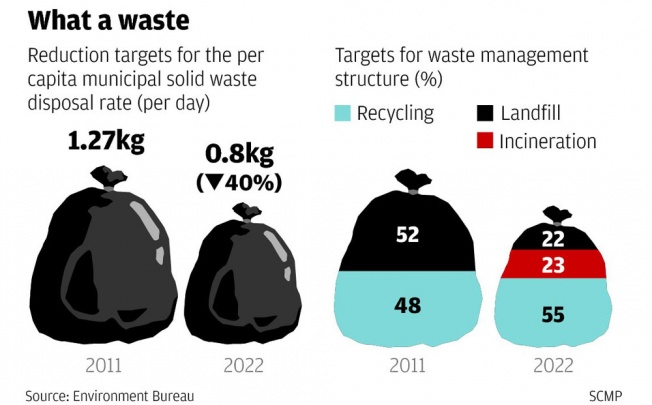
Under the “blueprint for sustainable use of resources”, the government aims to reduce the amount of waste dumped in landfills from 1.27kg for each person in 2011 to 1kg in 2017 and to 0.8kg by 2022.

Currently, 48 per cent of the city’s waste is recycled and the rest goes to three landfills, which will all be full by 2020.

The blueprint says that by 2022, the recycling rate will reach 55 per cent and expanded landfills will take 22 per cent, leaving the remaining 23 per cent to be burnt. The structure is similar to that in Seoul.

Of the range of measures he outlined at a press conference, Wong said incineration was the most crucial, while acknowledging uncertainty about it.

Lawmakers rejected a funding request by the previous government for an incinerator at Shek Kwu Chau, near Cheung Chau. The proposal has also been challenged in court and a verdict is pending.

Details of waste charging, which had been “the most effective means” for Taipei and South Korea to cut waste, would be released in the middle of this year, Wong said. To seek support for landfill expansion, needed before the incinerator was ready, he said a proposal would be put forward for odorous waste, such as that from sewage treatment and household garbage, to be dumped well away from residential areas.

The minister called on the community to participate to help cut waste at source, such as in kitchens.

But officials stopped short of explaining how food waste, the biggest component of landfill refuse – accounting for 40 per cent of it – would be reduced. They are seeking sites for two more recycling plants in addition to two that are planned, but it is unclear how much food waste these can process.

Angus Wong, policy advocacy manager of the World Green Organisation, said the blueprint hinged heavily upon incineration and waste charging.

“Given the political climate, both options are not necessarily well supported,” he said.

Friends of the Earth environmental affairs officer Celia Fung said the 40 per cent reduction target was aggressive but she did not see adequate infrastructure being proposed, especially for food waste. She also called for more support for the recycling industry.

Cyd Ho Sau-lan, chairwoman of the Legislative Council’s environmental panel, said the new targets were “not aggressive at all”, noting that the target recycling rate of 55 per cent in 2022 was still lower than the rate of 61 per cent in South Korea.

On average, Hong Kong people generate 1.36kg of waste each a day, compared to 0.77kg in metropolitan Tokyo, 0.95kg in Seoul, and 1kg in Taipei.

Comments: May 21st 2013 6:23am

No doubt they are using HK’s 7 million population to calculate the numbers and proposed reductions – but what about the tourists and their daily waste (133.192 per day) to the 7m HK number? Wong says Plan A is incineration whilst the rest of the world iow embracing plasma gasification. ‘There’s no Plan B if Govt loses the judicial review’ he states seemingly pressurizing the JR judge to hurry his verdict. Yet by weight after conversion by incineration, 22% bottom ash and 7% toxic fly ash remains that must be treated and landfilled (the Govt prefers to tell us only 10% by volume remains) but also tells us our landfills are full, so will they export the ash residues ? – no, they intend man-made islands in the sea near Cheung Chau as the new ash lagoons. A recent peer reviewed report from Spain shows increased deaths and cancers downwind of modern incinerators, Macau has commissioned a like investigation and in UK Imperial College is due to complete a similar investigation by April 2014. The Legco environmental panel knocked back incineration unanimously last year ; there is no reason for them to change their minds now. Wong and HKG need a Plan B which starts with mandatory separation at source and plasma gasification plants at our landfills.
www.waste-management-world.com/articles/2011/05/plasma-power-goes-large-at-landfill-mining-
HK Tourism 2012 Total 48,615,113 +16.0%
Mainland China 34,911,395 +24.2%
www.eturbonews.com/33231/hong-kong-tourism-16-percent


Links:
[1] https://www.scmp.com/sites/default/files/2013/05/21/12abca983f10e85df14377fc86e0071a.jpg

Gov’t unveils waste plan

May 20, 2013

The Government today unveiled a comprehensive 10-year management plan to tackle Hong Kong’s waste crisis.
The Hong Kong: Blueprint for Sustainable Use of Resources 2013-2022 analyses the challenges and opportunities for waste management in Hong Kong, and maps out strategies, targets, policies and action plans.
Speaking at a press conference, Secretary for the Environment KS Wong said the plan will reduce the per capita municipal solid waste disposal rate by 40% to 0.8kg by 2022.
The rate was 1.27kg per day in 2011, and the target for 2017 is 1kg.
“This is an ambitious target but it is also practical. The key to success lies in motivation.”
Mr Wong said a joint effort by the entire community will be needed to embrace an environmentally sustainable culture and waste less of the Earth’s resources.
The blueprint proposes policies and actions in three areas.
Policy and legislation, including municipal solid waste charges and producer responsibility schemes, aim to drive behavioural change to reduce waste at source.
Territory-wide campaigns, such as the Food Wise Hong Kong Campaign launched last Saturday, will discourage food waste and encourage recycling.
Lastly, waste-related infrastructure, including organic waste treatment facilities, waste-to-energy integrated waste management facilities and landfill extensions, will be enhanced.
The blueprint also aims for a more balanced structure for waste management, as opposed to the current practice of relying solely on landfills.
“We will encourage the public to reuse and recycle. Unavoidable waste will be turned into energy by modern technology while disposal at landfills will be the last resort,” Mr Wong said.
The Government expects that by 2022, waste recycling, modern incineration and landfill disposal in Hong Kong will account for 55%, 23% and 22% of waste management respectively, more closely matching the allocation structure widely adopted in advanced economies, he said.

Click here for the blueprint.

Download PDF : WastePlan-E

RTHK English News

http://rthk.hk/rthk/news/englishnews/news.htm?main&20130520&56&923008

Waste management blueprint unveiled

20-05-2013

audio

http://www.rthk.org.hk/rthk/radio3/hongkongtoday/images/Subpage_12.gifhttp://www.rthk.org.hk/rthk/radio3/hongkongtoday/images/Subpage_15.gif

Maggie Ho reports

http://www.rthk.org.hk/APSuppics/mfile_56_923008_1.jpg

The Secretary for the Environment Wong Kam-sing. RTHK file photo.

The government has rolled out a blueprint on waste management, with a target of reducing solid waste by 40 percent in ten years’ time.

But the action plan includes the construction of a major incinerator on the outlying island of Shek Kwu Chau.

An incinerator proposal has been challenged in the court and a ruling has yet to be made. Nonetheless the proposal is included in the government’s 10-year waste-reduction plan.

The Secretary for the Environment, Wong Kam-sing, who unveiled the blueprint, said there’s no plan-B if the government eventually loses the case.

Other measures announced by the government include a possible a waste-charging scheme.

There are also plans to expand three existing landfills as well as increasing the scale of food waste recycling.

Nature needs a voice in Hong Kong to protect Chinese white dolphins

South China Morning Post

Published on South China Morning Post (http://www.scmp.com)

Home > Nature needs a voice in Hong Kong to protect Chinese white dolphins


Nature needs a voice in Hong Kong to protect Chinese white dolphins

Saturday, 18 May, 2013, 12:00am

Comment›Insight & Opinion

Michael Lau

Michael Lau says the plight of the Chinese white dolphin in Hong Kong waters shows how development continues to take priority over conservation, with ecologists’ views increasingly ignored

It is difficult not to be amazed by the diversity of life forms when you venture into a tropical rainforest or dive into a coral reef. Locally, a trip to a mudflat, such as at Lung Mei at low spring tide, or to the Deep Bay wetlands in winter equally yields wonders.

Some 1.2 million species have been found and named by biologists but incredibly, it has been estimated that there are 8.7 million species sharing the earth with us. Clearly, our knowledge of biodiversity is limited, with some 86 per cent of the life on earth still awaiting our discovery.

The once-proposed Southwest Lantau and Soko Islands marine parks have yet to become reality

Ecologists are tasked to study, understand and sometime even predict – for example, in impact assessments – the complex relationships among plants, animals, fungi, bacteria, and the like, and the environment. This is an awesome task and the reason why ecologists often cannot give clear, definite answers.

Ecology is the cornerstone of conserving species because we need to understand their requirements and their interaction with other species and the environment before we can ensure their survival. This professional discipline provides critical information on the state of the environment and allows decision-makers to make informed choices on what development could be carried out and where it should be sited, in order to avoid a severe impact on our life-supporting system.

In recent years, however, the influence of ecology in major decision-making processes on development in Hong Kong seems to have weakened.

As an example, take the Chinese white dolphin, an apex predator and an indicator of the health of the marine environment. We have long-term data on the population in its primary habitats in Hong Kong waters based on Agriculture, Fisheries and Conservation Department-commissioned monitoring surveys. These expert surveys reveal a significant decline in dolphin numbers, from an estimated population of 158 in 2003 to 78 in 2011, a 50 per cent drop in less than 10 years.

There is a certain bitter irony when observing the popularity of this intelligent species among the Hong Kong public, when this is balanced with the fact that our development and other demands put us in direct competition with the dolphins for increasingly scarce resources and space. This competition has resulted in numerous threats to the dolphins.

Ever-increasing reclamation is the most significant threat right now. This is made worse by dredging, dumping water and noise pollution and a rise in vessel traffic – especially high-speed vessels. The dramatic population decline indicates that these threats have not been addressed effectively. The 17-year government-commissioned dolphin monitoring programme provides valuable information on the dolphins’ status, but the programme alone is not a conservation measure.

In Hong Kong, we have a good environmental impact assessment process, showing how impact from development projects should be avoided, minimised or mitigated to ensure developments do not have a major ecological impact. Judging from the continual decline of the Chinese white dolphin, however, the logical conclusion is that the mitigation measures of development projects in its habitat, in western waters, are not working.

One key component of the existing dolphin conservation plan is the Sha Chau and Lung Kwu Chau Marine Park, the so-called “dolphin sanctuary”. Given that the area is small and the dolphins inhabiting it venture out to surrounding waters that are not protected from development or habitat modification, its effectiveness as a sanctuary is somewhat hindered. This marine park should at least provide increased feeding opportunities for the dolphin population, by allowing fish and other food stocks to flourish. However, this objective is undermined by the fact that commercial fishing is still allowed with a permit within the marine park. The result is that the dolphins in this “sanctuary” are competing with fishermen for food.

The state of the Chinese white dolphin illustrates how far conservation measures lag behind development plans. The once-proposed Southwest Lantau and Soko Islands marine parks have yet to become reality. Another ironic example is that the Brothers Islands will be designated a marine park only after the completion of construction of the Hong Kong-Zhuhai-Macau bridge in 2016, long after any damage has been done.

As an ecologist, it is alarming to see decision-makers, without the relevant background, making offhand comments that grossly understate development projects’ impact or oversimplify conservation actions. We have well-trained, professional staff in the AFCD and Environmental Protection Department who should be duly consulted and listened to.

Outside the government, there are also experts in tertiary institutions and green groups who are happy to advise. But it appears that development is the golden rule and anything standing against it, even a scientific discipline such as ecology, has no place in the decision-making process.

If we are serious about saving the charismatic Chinese white dolphin, we should look at the threats seriously and address them. Since the threats result from human activities under the control of several different government departments, they should all agree on, formulate and implement a holistic and comprehensive dolphin management plan without further delay.

The Convention on Biological Diversity was extended to Hong Kong in 2011. The Aichi Biodiversity Targets, set out in the convention’s strategic plan for 2011-2020, set a clear goal: address the underlying causes of biodiversity loss by bringing biodiversity into the mainstream across governments and societies. To fulfil its obligations, the Hong Kong government should start integrating biodiversity values into development and planning processes.

Conservation and development should never be a zero-sum game. With a finite area of land and sea, and with global crises concerning water and climate looming, Hong Kong needs a more open dialogue on how we want to shape our environment and life.

In some ways, ecology is the only “voice” nature has to make itself heard by decision-makers. By strengthening this voice, we will not only reach informed, consensual decisions and create viable solutions for Hong Kong society, we will hopefully create a future for the Chinese white dolphin.

Dr Michael Lau is acting director of conservation at WWF-Hong Kong

Topics:

Chinese white dolphins

Animal preservation

Nature

Environment


Source URL (retrieved on May 18th 2013, 7:46am): http://www.scmp.com/comment/insight-opinion/article/1239930/nature-needs-voice-hong-kong-protect-chinese-white-dolphins

https://e02.optimix.asia/trackingdata?imgtag=1&opxUid=0&opxEventID=2022&opxClientID=87&opxcounter=1

Expanding carriers seek more space over Chinese skies

South China Morning Post

Published on South China Morning Post (http://www.scmp.com)

Home > Expanding carriers seek more space over Chinese skies


Expanding carriers seek more space over Chinese skies

Saturday, 18 May, 2013, 12:00am

Business›China Business

AVIATION

Bloomberg

Civil aviation a is rationed a meagre slice of the mainland’s air corridors, with military curbs worsening the congestion as carriers expand

China’s skies do not have enough space. The country’s air force controls airspace and allots only 20 per cent to civil aviation. With the mainland’s three biggest airlines planning to add at least 273 planes in the next three years, traffic congestion that already delays 25 per cent of flights is set to worsen.

https://www.scmp.com/sites/default/files/styles/486w/public/2013/05/18/b4.jpg?itok=6Rb5fzjN“At present, the limited air space resource has restricted the development of civil aviation,” said Li Jiaxiang, the head of the Civil Aviation Administration of China (CAAC). “We will strive to further open up the airspace,” he said in Beijing this week.

Air China, China Eastern Airlines, and China Southern Airlines have expanded their fleets as economic growth spurs air travel demand in the world’s most populous nation. The country is expected to have 4,200 commercial aircraft in 2020, compared with the current fleet of 2,001 with 46 airlines, Li said.

Civil aviation uses about a fifth of available routes of the nation’s total airspace, according to Shi Boli, who heads the department of Air Transportation Regulation at CAAC. The military controls about 52 per cent of airspace in the more densely populated east, according to a report by the official China News Service in June 2011. “We are working hard and the military is also trying to improve the management of airspace,” Shi said. “But, it could take some time to achieve some improvement.”

In the United States, military restrictions do not have much impact on civilian aviation because its airways tend to be in desert regions or over oceans, far away from the busy airport hubs in cities such as New York, said Kevin Hiatt, president of the Virginia-based Flight Safety Foundation. The military has also allowed its airspace to be used by civilian flights on occasions such as busy holiday periods, he said.

Airspace over Europe is managed as a single unit and segregated on a “dynamic basis according to the needs of users”, air traffic supervisory agency Eurocontrol said. In general, areas will only be reserved for military use at certain times and at certain altitudes.

The on-time performance rate of mainland airlines was about 74.5 per cent last year, Shi said. In the US, 82 per cent of the flights arrived on time last year, the Bureau of Transportation statistics said.

“People are hoping that the country’s new leadership can have a breakthrough in getting more airspace released to accommodate the rapid growth,” said Kelvin Lau, a Hong Kong-based analyst at Daiwa Securities. “Otherwise, delays will persist and hurt the airlines’ long-term growth prospects.”

People are hoping that the country’s new leadership can have a breakthrough in getting more airspace released to accommodate the rapid growth. Otherwise, delays will persist and hurt the airlines’ long-term growth prospects

Kelvin Lau, a Hong Kong-based analyst at Daiwa Securities

The country’s air force, which has controlled the airspace since the People’s Republic was established in 1949, has started gradually relaxing some of the curbs. It had begun to open low-altitude airspace and release more information about the availability of temporary routes, Xinhua reported in August last year.

Still, the pace is not quick enough to catch up with the airlines’ growth as the number of annual passengers has more than doubled in the past seven years, said David Wei, an aerospace analyst with Shanghai Securities. “The military has a bigger say in China’s airspace usage for historical reasons,” Wei said. “It has no incentive to concede the right unless the government wants it to.”

Airspace restrictions also forced airlines to fly longer distances on some routes, said Liu Jieyin, executive vice-president at Okay Airways, which operates flights between cities including Tianjin, Hangzhou and Sanya.

“This is still better than before when we had to wait on the ground for hours for the completion of military drills,” Liu said. “We couldn’t take proactive measures as we wouldn’t know about the drills until the last minute and couldn’t tell passengers the real reason either.”

Air China, Asia’s biggest carrier by market value, will receive 113 aircraft in the next three years, according to a company statement. China Eastern will add 93 planes in two years while China Southern will have 67 additions this year, the carriers have said.

“Tomorrow’s growth will further pressure the system,” said Will Horton, a Hong Kong-based analyst at CAPA Centre for Aviation, which advises airlines. “While reforms are gradually being made, the military seems impervious to the government’s wish for more airspace.”

Topics:

Aviation

Civil Aviation Administration of China

Aerospace


Source URL (retrieved on May 18th 2013, 6:51am): http://www.scmp.com/business/article/1240177/airspace

https://e02.optimix.asia/trackingdata?imgtag=1&opxUid=0&opxEventID=2022&opxClientID=87&opxcounter=1