Clear The Air News Blog Rotating Header Image

July, 2011:

Runways required

http://www.economist.com/node/18744513/print

Private investors can make airports bigger, but not big enough

WITH their crowds, delays and “retail opportunities”, airports

impart feelings that range from irritation to despair. The experience
is likely to get worse. Over the next 20 years the number of jets circling
the planet is set to double, but investment in airports probably
won’t. In Europe twice as many passengers are expected to
squeeze through 41% more capacity.
One reason why airports are grim is that many are state-owned. Of the world’s 30 busiest ones,
19 are state-owned and most of the rest are public-private
partnerships. In the past they were “administered rather than managed” to serve state-owned
airlines, says Andreas Schimm of Airports Council International (ACI), an umbrella body.
Governments now try to run airports on commercial lines, but few do it well. Privatisation could
help.
Incheon and Cheongju airports in South Korea are likely to seek private investors soon. So are
Munich, Moscow’s two smaller airports, France’s regional airports and a host of others. Even in
America, where complicated federal rules discourage either selling or buying airports, a scheme
to privatise Chicago Midway and four other airports is picking up speed again. In Brazil, however,
an effort to woo private cash to spruce up shabby airports before the football World Cup is
stalling.
An airport ought to be a sound investment. BAA, which runs Britain’s biggest airports, has coined
it. Eyebrows were raised when Macquarie, an Australian bank, bought Sydney airport in 2002.
But it quickly boosted revenues and profits. The “release value” of taking public assets private
can be enormous, says Peter Morris of Ascend, a consultancy.
Investors could now be more wary, however. Empty public coffers might encourage governments
to demand too high a price. The liberalisation of air travel has increased competition between big
hubs, especially in Europe and the Gulf. And the soaring growth of low-cost airlines has added to
the pressure. Budget carriers are far more flexible and ruthless than their full-fare competitors. If
business sags or landing fees rise, they will drop an airport as surely as a baggage-handler will
drop a bag marked “fragile”.
Privatisation can improve efficiency and service quality. But passengers may face other torments.
Airports earn just 18% of their revenues from airlines, according to ACI. The rest comes from
passenger fees, parking charges, rent from retailers and so on. Rather than squeezing airlines,
which can fly away, it is more tempting to go after passengers, who are hemmed in by metal
detectors and armed police.
Airlines grouch that landing fees always rise at privatised airports. Giovanni Bisignani, the boss of
IATA, a group that represents airlines, argues that the best airports are those with good
managers and tough regulators, and that ownership matters less. But regulations will surely have
to weaken to attract private money.
By some estimates $1 trillion of new investment will be needed over the next two decades to
match airport capacity to flight plans. Yet there are barely a dozen airport groups that might be
tempted to bid for the terminals and runways on the block. They are unlikely to raise enough
cash to keep pace with the rising volume of passengers. The queues will only grow longer.

WITH their crowds, delays and“retail opportunities”, airportsimpart feelings that range fromirritation to despair. The experienceis likely to get worse. Over the next20 years the number of jets circlingthe planet is set to double, butinvestment in airports probablywon’t. In Europe twice as manypassengers are expected tosqueeze through 41% morecapacity.One reason why airports are grimis that many are state-owned. Ofthe world’s 30 busiest ones, 19 are state-owned and most of the rest are public-privatepartnerships. In the past they were “administered rather than managed” to serve state-ownedairlines, says Andreas Schimm of Airports Council International (ACI), an umbrella body.Governments now try to run airports on commercial lines, but few do it well. Privatisation couldhelp.Incheon and Cheongju airports in South Korea are likely to seek private investors soon. So areMunich, Moscow’s two smaller airports, France’s regional airports and a host of others. Even inAmerica, where complicated federal rules discourage either selling or buying airports, a schemeto privatise Chicago Midway and four other airports is picking up speed again. In Brazil, however,an effort to woo private cash to spruce up shabby airports before the football World Cup isstalling.An airport ought to be a sound investment. BAA, which runs Britain’s biggest airports, has coinedit. Eyebrows were raised when Macquarie, an Australian bank, bought Sydney airport in 2002.But it quickly boosted revenues and profits. The “release value” of taking public assets privatecan be enormous, says Peter Morris of Ascend, a consultancy.Investors could now be more wary, however. Empty public coffers might encourage governmentsto demand too high a price. The liberalisation of air travel has increased competition between bighubs, especially in Europe and the Gulf. And the soaring growth of low-cost airlines has added tothe pressure. Budget carriers are far more flexible and ruthless than their full-fare competitors. If0Airport privatisation: Runways required | The Economist Page 1 of 2http://www.economist.com/node/18744513/print 04-Jul-11About The Economist online About The Economist Media directory Staff books Career opportunities Contact us Subscribe [+] Site feedbackCopyright © The Economist Newspaper Limited 2011. All rights reserved. Advertising info Legal disclaimer Accessibility Privacy policy Terms of use Helpfrom the print edition | Businessbusiness sags or landing fees rise, they will drop an airport as surely as a baggage-handler willdrop a bag marked “fragile”.Privatisation can improve efficiency and service quality. But passengers may face other torments.Airports earn just 18% of their revenues from airlines, according to ACI. The rest comes frompassenger fees, parking charges, rent from retailers and so on. Rather than squeezing airlines,which can fly away, it is more tempting to go after passengers, who are hemmed in by metaldetectors and armed police.Airlines grouch that landing fees always rise at privatised airports. Giovanni Bisignani, the boss ofIATA, a group that represents airlines, argues that the best airports are those with goodmanagers and tough regulators, and that ownership matters less. But regulations will surely haveto weaken to attract private money.By some estimates $1 trillion of new investment will be needed over the next two decades tomatch airport capacity to flight plans. Yet there are barely a dozen airport groups that might betempted to bid for the terminals and runways on the block. They are unlikely to raise enoughcash to keep pace with the rising volume of passengers. The queues will only grow longer.
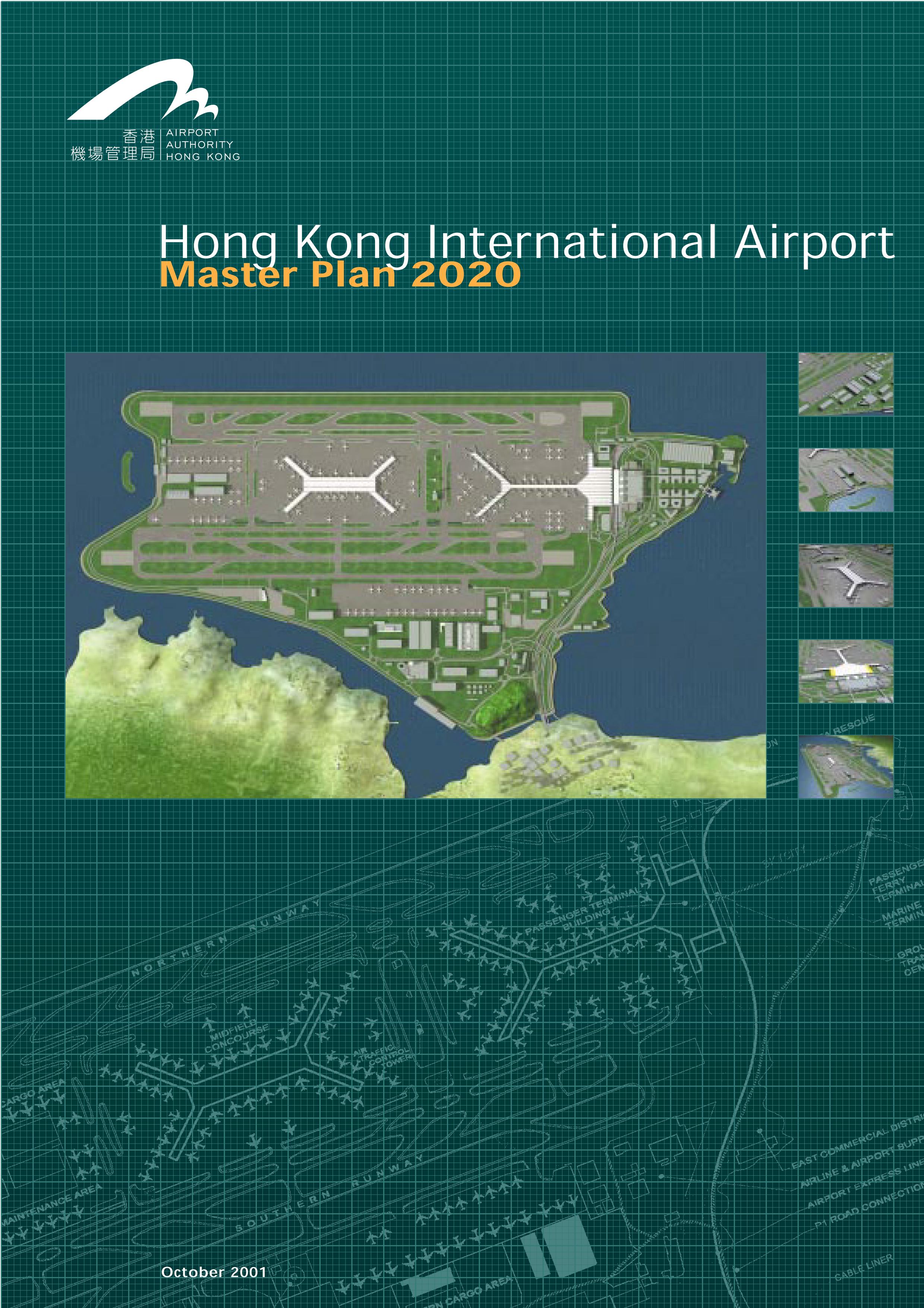
Hong Kong International Airport Master Plan 2020

Download PDF : MP2020

Let investors pay for airport plan

Philip Bowring says that if the financial projections for the third runway are to be believed, then the private sector and aviation industry should be willing to bear the risk  www.scmp.com

3 July 2011

Before legislators get carried away on the public relations wave created by the Airport Authority and Cathay Pacific  in support of spending HK$100 billion or so of public money on a new runway, they should consider the government’s abysmal records both in forecasting and infrastructure planning.

The nearest comparison to the airport proposal is container terminals. Remember how long the government insisted that new terminals at Tsing Yi/northwest Lantau were essential to keep up with trade growth and to retain Hong Kong’s position as the world’s top port? Of course, if planning by bureaucrats consists of drawing straight lines on graphs, that is the result. As late as 2008, it was still insisting on the need for CT 10 despite the massive container development across the border. It wasted a way-over-budget HK$3.7 billion on Stonecutters Bridge, which was justified on the grounds of developments that never happened. Hong Kong has now lost out to Shenzhen and Shanghai in container port throughput but do we now care that we missed out on more of these low-wage, polluting activities? Of course not.

There are plenty of other examples of wasted investment by bureaucrats with their straight-line growth charts.

Some aspects of aviation are high-value business compared with container handling, but not all. Simply acting as an interchange hub is of limited value-added, and, for low-end travel, Hong Kong should not try to compete with Pearl River Delta airports with their plentiful land and access to government largesse. The pollution issue is as serious for aviation as it is for shipping.

The government should also be reminded that the Airport Authority was supposed to be partly privatised and face the same financial disciplines and return expectations as other listed and privately owned or operated airports such as those in Beijing, Sydney, Frankfurt and London. So let’s see such a move in supposedly free-market Hong Kong before any decision is made on expansion. That would provide a sterner test of the claims in the authority’s financial and overall economic projections. If this is such a good deal, why not try to raise, say, HK$35 billion from an offering of new shares, giving outside investors a 50 per cent or so stake and the company an equity base of HK$70 billion, and borrow the rest as and when needed?

Meanwhile, one must wonder about returns on a much enlarged equity when, even now, its profits are hardly spectacular – HK$4.03 billion in 2010/11 on equity of HK$36.38 billion, or 11.1 per cent. The airport is little used at night and flight frequency is constrained by air traffic issues out of Hong Kong’s control. The ability to keep raising fees in line with inflation with a huge increase in capacity is also debatable, given the regional competition and the fact that Hong Kong’s charges are already high – suggesting that maintaining its position as a premium airport is more important than going after volume.

The authority’s overriding requirement is to “maximise value” for Hong Kong’s benefit. That means maximising its returns, not putting out contentious claims about its contribution to gross domestic product. That may justify expansion but let the private sector, and the aviation industry itself, bear the risk and reward.

The government’s so-called planning is no more than knee-jerk responses to particular vested interests – including those of its own departments. In total, the airport, express railway and bridge to Zhuhai and Macau constitute spending of about HK$200 billion at today’s prices. Officials justify them all not by the rate of return but by the general benefits of improving links with the mainland and the outside world.

Yet, quite extraordinarily, there is no logical connection between the three. The bridge links to the airport but, being only a road bridge, does not link to the existing airport rail line – another expensive, money-losing piece of publicly financed infrastructure. The ultra-expensive high-speed railway goes nowhere near the airport but, for reasons best known to vested interests, to the dense heart of Kowloon, a shopping and residential area more than a business district. It will take the high-speed train 20 minutes to reach the border – compared with 25 minutes by car from Central via the western tunnel – and only be of use to travellers going to middle-distance cities. The problem of border controls is brought up to support expanding Chek Lap Kok rather than making more use of delta airports, but the same argument is never used to show the futility of high-speed trains which cannot reach very high speeds over such a short distance.

Other mega projects sponsored by interest groups are already consuming large sums of money for pouring concrete. One is the cruise liner terminal, which will serve a tiny percentage of visitors at huge opportunity cost in terms of harbourfront land. Another is the sports stadium when the existing Hong Kong Stadium is only filled once a year. But with this government and its cronies, big vanity projects always take precedence over sports facilities for schools and the public.

Economics is about choosing how to use scarce resources. Unfortunately, Hong Kong’s HK$1.2 trillion reserves are not scarce enough to be used prudently or efficiently. They are now the plaything of officials and vested interests. Legislative Council, wake up to this fact. There may be justification for the new runway, but let investors decide. Aviation does not merit implicit public subsidy.

Philip Bowring is a Hong Kong-based journalist and commentator

Bus pollution After embarrassment over the additional NO2 produced by the particulate filter traps on buses Govt is now going to pay for SCR which should have been mandatory in the first place

Download PDF : LCQ18Busespollution

Sky-high marketing for runway plan kept secret

Former aviation chief says the public has a right to know what is being done with taxpayers’ money
Lana Lam 
Jul 03, 2011
The transparency of the Airport Authority is in question after the statutory body refused to reveal the marketing budget for its controversial third runway plan.

Peter Lok Kung-nam, who headed the Civil Aviation Department from 1990 to 1996, said Hong Kong people had the right to know how much was being spent on marketing “since they are using public money”.

The authority is wholly owned by the government and operates under the Airport Authority Ordinance.

Lok said the authority was jumping the gun by pouring millions of dollars into producing 21 videos that all supported the expansion plan. He estimated the production cost of the videos would “be in the millions” because “videos take ages to create, even just one minute”.

“[But] you are dealing with airports so this amount of money is peanuts,” he said.

“I’m not surprised … but it’s premature,” he said of the videos which feature high-profile personalities such as Cathay Pacific (SEHK:0293) chief executive John Slosar, transport sector lawmaker Miriam Lau Kin-yee, Ocean Park chairman Allan Zeman, Hollywood director John Woo Yu-sen and actor and Canto-pop singer Aarif Rahman.

The videos echo the sentiment in the authority’s written documents which state that Hong Kong’s overall competitiveness as a world city would be at risk if the third runway plan does not go ahead.  An authority spokeswoman refused to disclose the amount spent on the videos or reveal the name of the company that won a tender for the project. She also refused to reveal the total budget of the marketing strategy for the authority’s 2030 master plan which includes roving exhibitions, public forums and advertisements on TV and billboards.

She did confirm that all the interviewees appeared “on a voluntary basis at no cost to us”. The videos are currently screening on more than 100 monitors throughout the airport.  The authority has not spent any money on producing equivalent videos featuring local personalities who do not want the third runway.

One video production company in North Point provided a conservative quote for a half-day of filming for one video at HK$12,000, so 21 videos would total about HK$250,000.

Lok, who supports a third runway, but not at the existing site, said he was not surprised that the videos only presented one side of the argument and he criticised the authority for hiding vital information about the feasibility of the third runway plan.

“If you look at the technical report, there is a caveat laid down that this scheme requires very extensive revision with Pearl River Delta airspace which we share with several other airports,” he said. “To develop and implement the changes, we need to confer with Macau and mainland authorities. “If you fail to get their consensus, there’s no point talking about how much it’s going to cost or if it’s cost-effective. They have never mentioned this caveat in all the publicity, which I think is rather immoral.”

In documents for the master plan, the authority states its intention to ensure a “transparent, professional and objective planning process”.

Questions the Post sent to the authority on the spending several times last week went unanswered and at a public forum on the master plan yesterday, Howard Eng Kiu-chor, executive director of airport operations, did not take questions from the media.

lana.lam@scmp.com

http://www.thestandard.com.hk/news_detail.asp?we_cat=12&art_id=111926&sid=32674402&con_type=3&d_str=20110610&fc=7

” Sung believes too that what officials fear most is an environmental impact assessment unfavorable to the project.

The airport opened in July 1998. Seventy billion dollars of public and private money went for terminals, runways, taxiways, bays and ancillary facilities.

Another HK$34 billion went into the airport railway, and billions more on bridges, tunnels and expressways to make the Lantau site  accessible.

The all- in cost was HK$155 billion.”

http://www.chinadaily.com.cn/hkedition/2011-06/24/content_12764351.htm

” The diversification of firms such as Foxconn and the consequent drop in air cargo have taken place therefore mainly at the Hong Kong International Airport, and it probably explains the monthly declines in cargo turnover in April and May this year. If this truly is the case and the decline is structural instead of seasonal, one should expect further declines in air cargo shipments in the coming months and perhaps even years.  It may become a long-term declining trend if the metropolitanization process in the PRD region turns it into a service economy instead, thereby forcing most of the manufacturing activities to shift to places further away from the core areas of Guangzhou and Hong Kong. Thus Hong Kong’s airport will lose the local industry’s demand for air cargo freight from the region forever.

Hong Kong has to find new sources of demand to sustain its current operations and the new runway beyond the next 12 years. Even so, the competition will be very acute because of the large increase in capacity in the regional cluster of airports. Thus late expansion of the airport in Hong Kong is running counter to any conventional wisdom.

The author is head of China Business Centre, Hong Kong Polytechnic University. ”

http://www.chinadaily.com.cn/hkedition/2011-06/18/content_12727350.htm Hong Kong  China Daily

More studies demanded on third runway impact By Joseph Li (HK Edition) Updated: 2011-06-18 06:45

“Besides, the report does not take into account carbon emissions by vehicles passing by the airport’s vicinity, including Tung Chung and North Lantau, Choi said.

Samuel Hung, chairman of the Hong Kong Dolphin Conservation Society, said the authority has attempted to dismiss the impacts on the Chinese White Dolphins by modifying the document on dolphin movements that he had prepared for the Agriculture, Fisheries and Conservation Department.  The authority management finally apologized to the green groups. The environment groups responded that the authority should apologize to the public for having misled the people of Hong Kong.  ”

www.scmp.com

Emissions from aircraft will grow (Letters Page)

The 2 per cent aviation emissions figure Cathay Pacific  Mark Watson cites (“Aviation industry is committed to addressing climate change impact”, June 20) in response to my letter (“Emissions accelerating, not declining”, June 13) differ from the 3-3.5 per cent cited by the International Civil Aviation Organisation (ICAO) website.

The ICAO’s projected aircraft emissions growth of 3-4 per cent per year contrasts with Mr Watson’s planned halving of emissions by 2050. In 38 years, a 3.5 per cent exponential growth will quadruple, not halve, current emissions: 628 million tonnes of carbon dioxide (CO2) annually will become 2,512 million tonnes. Because aircraft engines release CO2, nitrogen oxides (NOx) and particulates into the stratosphere, their impact is amplified. Current contrail-generated cirrus clouds insulate the atmosphere adding an independent warming effect greater than all previous aircraft CO2/NOX emissions since we began flying. Also, the 70 per cent of improvement in aircraft fuel efficiency has already been achieved. To “radically reduce” that remaining 30 per cent of emissions is technically increasingly difficult.

Any future efficiency improvements are offset by the doubling of flights projected by the Airport Authority……………… I quote: “HK’s GDP forecast at compound annual growth rate (CAGR) of 3.4 per cent” (GDP doubles in 20 years); “Mainland’s CAGR at 7 per cent” (an unrealistic quadruple GDP increase over 38 years); “Air traffic demand doubling by 2030”, coincidentally, a 3.5 per cent annualised growth in demand. Where is this growth to come from? Cheap extractable oil, without which these growth projections are unfeasible, is almost exhausted.   If the authority’s growth projections are correct, aircraft emissions will rise exponentially, making climate change a major problem – or Peak Oil will terminate the 20th century infinite-economic-growth/business-as-usual model, making flying prohibitively expensive, thereby killing demand. Thus, a third runway either adds to climate change or is redundant.

Richard Fielding, Pok Fu Lam

http://sph.hku.hk/faculty_and_staff_detail.php?id=20

http://www.flyertalk.com/forum/cathay-pacific-asia-miles/1221482-third-runway-hong-kong-international-airport-going-needed-cathay-pacific-7.html#post16671845

Flyertalk discussion on the HK airport 3rd runway

http://www.baf.cuhk.edu.hk/research/aprc/activities/files/AirSpace.pdf

“The PRD region also does not have sufficient ‘air corridors’ for aircraft to fly en-route from one airspace to another. All these limitations plus the complex operating environment of PRD region have significantly reduced the flight operational efficiency and capacity in the rapid growing PRD region. According to the forecast by CAAC, the PRD region will experience around 200 million passenger with 1.76 million aircraft movement per annum by 2020. This is about three times as much as the current figures [CAAC, 2007]. The airports in the PRD have altogether 7 runways, with considerations to add 4 to 5 more in the foreseeable future. However, more runways do not necessarily provide more capacity if the airspace congestion issue cannot be solved. Furthermore, the military plays a significant role in the arrangement of airspace in China. In fact, any change in the civil airspace requires the approval of

the military. Figure 2 summarized the major issues of the PRD airspace congestion.”

Foxconn (iPad / Iphone) was a major user of HK aircargo services

http://deltabridges.com/news/shenzhen-news/shenzhen-foxconn-relocates-production-cut-costs

Shenzhen- Foxconn Relocates Production to Cut Costs

Posted Fri, 2010-07-02 14:14 by John Wieja

Taiwan’s high-tech giant Foxconn plans to move its major production line from Shenzhen to Langfang in North China’s Hebei province in an attempt to reduce labor costs, chinanews.com.cn reported Thursday.

Vincent Tong, spokesman for the corporation, says the relocation is estimated to be completed by the end of this year. After that, only a small part of its business will remain in Shenzhen.

He adds that the fees for the relocation could hinder performance in the first half, which has already witnessed a larger loss compared with the same period of the previous year due to price reduction, adjustment of product lines and spending on depreciation.

It is reported that Foxconn suffered a loss of $18.7 million in the first half of 2009.

The company started its relocation project in the mainland in 2007. Right now part of its product lines have been removed to northern areas of China and India.

-Asiaone, Yan Weijue