Clear The Air News Blog Rotating Header Image

Incineration – Solid Waste Disposal

Goldman Prize

http://www.goldmanprize.org/recipient/rossano-ercolini

Prize Recipient

Rossano Ercolini

2013 Europe

Italy

Sustainable Development

http://www.goldmanprize.org/sites/goldmanprize.org/files/2013_rossanoercolini_profile.jpg

In Italy and throughout Europe, incineration has been the leading approach to waste management. Consumerism and production has accelerated this trend, rapidly filling landfills and creating a bigger demand for incinerators.

In 1994, construction plans for an incinerator were proposed in a small town in Tuscany. Yet residents were not informed about the impact of the incinerator. Every year, incinerators remove thousands of tons of material from the recycling stream and burn them, releasing greenhouse gases into the atmosphere and leaving behind toxics that endanger the health of nearby residents.

Motivation
A teacher at an elementary school not two miles from the proposed incinerator, Rossano Ercolini had heard of cities like San Francisco that were successfully working to eliminate waste. He taught his students to recycle paper and replaced plastic water bottles and plastic utensils in the school lunchroom with pitchers, glasses and silverware.

When Ercolini heard about construction plans for the incinerator, he became concerned about the local residents’ health. He saw his responsibility as an educator to protect students’ well-being and inform the broader community about the incinerator’s risks as well as solutions to sustainably manage the town’s garbage.

Impact
Ercolini began organizing town hall meetings in his village, Capannori—the capital of Italy’s paper mill industry—where residents were able to ask questions and get clear answers about the whys and hows of recycling. He brought a bag of mixed waste and demonstrated how to sort out metal, glass and plastic to recycle and food scraps for composting and livestock feed. He brought in scientists, clergy, and other experts to share information about the dangers of incineration as well as the economic and environmental benefits of Zero Waste.

People began to see that it was indeed possible to manage waste without having to rely on incineration. Building on this momentum, Ercolini formed Ambiente e Futuro (Environment and Future) and began mobilizing street protests where citizens demanded authorities to stop plans for the incinerator. In response to the community’s concerns, Lucca’s regional government officials canceled the incinerator’s construction and put Ercolini in charge of developing a waste management plan. He went door to door to get the community’s input on alternatives to the incinerator, empowering them to propose solutions that would work for them. A year later, Capannori began implementing a new collection system that now recycles 82 percent of the city’s waste. The larger province of Lucca is now incinerator-free following the closure of two existing plants, and the government is committed to keeping incinerators out of the province.

Ercolini is also looking at the bigger picture, working with companies to use packaging that produces less waste. For example, he’s collaborating with Italy’s largest manufacturer of coffee products, Lavazza, to develop reusable versions of single-use espresso capsules. He is also promoting Zero Waste as an opportunity to create jobs, where young people are trained to refurbish durable goods or break them down to recover metals and other material.

Capannori became a springboard for the nation’s Zero Waste movement, which soon grew to include Naples—a strategic location given its dysfunctional waste collection system that left garbage piling up and burning on the streets. Ercolini successfully proposed the city to host Zero Waste International Alliance’s 2009 global meeting. A few months later, the city of Naples joined Capannori in adopting Zero Waste.

Thanks to the grassroots campaign led by Ercolini educating communities on the merits of Zero Waste, 40 incinerators have been scrapped or shut down and 117 municipalities (home to more than 3 million residents) have joined Capannori in adopting a goal of  Zero Waste. In November 2012, for the first time in Europe, the small but affluent region of Aosta passed a referendum banning incineration with overwhelming support from 90 percent of votersErcolini’s efforts have sparked the beginning of a Zero Waste network throughout Europe, with countries such as England, Estonia, Spain, and Denmark following Italy’s lead.
The incinerator is back

Published on South China Morning Post (http://www.scmp.com)

Home > Elsie Leung caught up in Rusal’s byzantine politics


Tuesday, 21 May, 2013, 12:00am

Business

LAI SEE HOWARD WINN

Howard Winn

The incinerator is back

So despite promises of a rethink, the Environmental Protection Department has included the Shek Wu Chau incinerator in its report, “Hong Kong: Blueprint for Sustainable Use of Resources 2013-2022”, released yesterday. There is a lot to applaud in it but it will disappoint green groups who’d been hoping that the government would take another look at the proposed technology as well as reconsider its location. There is a lack of public confidence here over incineration.

While there are numerous reports of incinerators being closed around the world because of environmental and public health concerns, it is true that modern incinerators produce fewer emissions. What is not so clear is the impact on public health of these lower emissions.

Those present at the recent public forum, which was part of the International Conference on Solid Waste 2013 – Innovation in Technology and Management, were told that modern incinerators did not pose a threat to public health. But this was from a panel most of whom appeared to be closely aligned to the incinerator industry. It was quite striking that no one spoke from a public health perspective.

It may well be that modern incinerators are completely harmless, but given the history of the industry, it would be good to see some documentation from a credible source outside the incinerator industry on the impact on public health from countries that use modern incinerators.

As for the location, several of the incinerator experts said privately that it seemed bizarre to put the incinerator on an island instead of closer to the users of the electricity it is supposed to generate.

Topics:

Lai See

Elsie Leung Oi-Sie

Rusal


Burden of disease attributable to air pollutants from municipal solid waste incinerators in Seoul, Korea: a source-specific approach for environmental burden of disease.

Sci Total Environ. 2011 May 1;409(11):2019-28. doi: 10.1016/j.scitotenv.2011.02.032. Epub 2011 Mar 21.

Burden of disease attributable to air pollutants from municipal solid waste incinerators in Seoul, Korea: a source-specific approach for environmental burden of disease.

Source

Department of Social and Preventive Medicine, Sungkyunkwan University, Suwon, Republic of Korea. kym6706@hanmail.net

Abstract

Few studies have attempted to quantify the integrated health burden, incorporating both mortality and morbidity as these factors pertain to air pollutants, on the population in the vicinity of the incinerators. The aims of this study are to estimate the attributable burden of disease caused by incinerators in Seoul, Korea and to present an approach based on source-specific exposure for the estimation of the environmental burden of disease (EBD). With particular attention on the development of a measurement means of the source-specific, exposure-based population attributable fraction (PAF), we integrated air dispersion modeling, Geographic Information Systems (GIS), the population distribution of exposure, and the exposure-response relationship. We then estimated the PAFs caused by additional concentrations of four air pollutants (PM(10), NO(2,) SO(2), and CO) emitted from four municipal solid waste incinerators (MSWIs) in Seoul in 2007. We, finally, estimated the attributable burden of disease, using the estimated PAF and the disability-adjusted life years (DALY) method developed by the Global Burden of Disease Group of the World Health Organization (WHO). The PAF for NO(2) to all-cause mortality was assessed at approximately 0.02% (95% CI: 0.003-0.036%), which was the highest among all air pollutants. The PAFs for respiratory and cardiovascular disease were 0.12% (95% CI: 0.01-0.16%) and 0.10% (95% CI: 0.04-0.16%), respectively. The sum of the attributable burden of disease for four pollutants was about 297 person-years (PYs) (95% CI: 121-472 PYs) when the incinerators observed to the emission standards. The attributable burdens of respiratory disease and cardiovascular disease were about 0.2% and 0.1%, respectively, of the total burden of respiratory disease and cardiovascular disease of Seoul citizens for the year 2007. Although the air emissions from one risk factor, an incinerator, are small, the burden of disease can be significant to the public health when population exposure is considered.

Copyright © 2011 Elsevier B.V. All rights reserved.

PMID:

21420146

[PubMed – indexed for MEDLINE]

can’t find version of this to read for free:

Policy makers should take into account the enormous burden of disease caused by toxic chemicals emitted from waste incinerator


Policy makers should regard the enormous burden of disease caused by waste incinerator emissions, 17 Nov 2011

By Pat Costner, Global Alliance for Incinerator Alternatives

In his letter to the editors of the scientific journal, Science of the Total Environment, Giovanni Ghirga of the International Society of Doctors for Environment warns, “Policy makers responsible for evaluating and managing air polluting sources should take into account the enormous burden of disease caused by toxic chemicals emitted from waste incinerator.”

Dr. Ghirga wrote his letter in response to the recently published study, “Burden of disease attributable to air pollutants from municipal solid waste incinerators in Seoul, Korea: a source-specific approach for environmental burden of disease,” by Kim et al. (2011). He noted that the authors of this study concluded that “the impact of the incinerators on citizens’ health was quite substantial.” However, Dr. Ghirga argued that the impact “could be worse if other important outcomes as subclinical neurotoxicity from lead, cadmium, mercury, antimony, arsenic, chromium, cobalt, copper, manganese, nickel, vanadium, and tin in children, were considered” and pointed to the continuing “silent pandemic of subclinical neurotoxicity described by Grandjean and Landrigan.

Dr. Ghirga also addressed endocrine disruptors, noting “A growing body of evidence suggests that numerous chemicals, emitted also from incinerators, may interfere with the endocrine system and produce adverse effects in humans …” In addition, he said, “For many toxic chemicals emitted from incinerator, i.e. arsenic, an accumulating number of investigations indicate that they affect the epigenetic status of cells and tissues …”

Dr. Kim replied to Dr. Ghirga’s letter, “We agree with Dr. Ghirga’s opinion that it could be worse if other
important outcomes as subclinical neurotoxicity from lead, cadmium, mercury, antimony, arsenic, chromium, cobalt, copper, manganese, nickel, vanadium, and tin in children, were considered,” and concluded, “We point out that policy makers should take into account the enormous burden of disease
caused by toxic chemicals emitted from waste incinerators.”

References

Ghirga, G., 2011. Policy makers should take into account the enormous burden of disease caused by toxic chemicals emitted from waste incinerator. Sci Total Environ 409: 5524.

Grandjean, P., and P. Landrigan, 2006. Developmental neurotoxicity of industrial chemicals. Lancet 16:2167–78.

Kim J., et al., 2011. Burden of disease attributable to air pollutants from municipal solid waste incinerators in Seoul, Korea: a source-specific approach for environmental burden of disease. Sci Total Environ 409: 2019–28.

Kim, Y.-M., 2011. Response to the letter to editor by Dr. Giovanni Ghirga commenting on ‘the burden of disease caused by toxic chemicals emitted from waste incinerator’. Sci Total Environ 409: 5525-6.

[GAIA] Study on Utilization of Incineration Waste Ash Residues in Portland Cement Clinker

http://www.aidic.it/cet/10/21/127.pdf

Utilization of Incineration Waste Ash Residues in Portland  Cement Clinker

Charles Hoi King Lam*, John Patrick Barford, Gordon

McKay

Department of Chemical and Biomolecular Engineering , Hong Kong University of Science and Technology, Clear Water Bay, Hong Kong, China

keking@ust.hk

Conclusion

MSWI (municipal solid waste incineration) bottom ash and fly ash and sewage sludge ash are evaluated as raw materials for Portland cement clinker according to the chemical composition analysis. According to the phase and chemical composition of the clinker obtained, the MSWI bottom ash with up to 6 % addition in clinkers show acceptable phase compositions and many of the major phases which are comparable with ordinary Portland cement clinker. High phosphorus content and sulfur trioxide content in sewage sludge ash may suppress the formation of the main phases. Fly ash clinkers may lead to insufficient CaO for alite formation. A proper pre-treatment would be required to use fly ash or sewage sludge ash. The heavy metals are concentrated and stabilized in the clinker matrix with low leachability. Further tests on the physical properties of the clinkers should be taken to fully understand the feasibility of ash based clinker.

Acknowledgement

The authors would like to thank Green Island Cement Ltd for their financial support and technical advice.

Download PDF : 127

Backchat

On Backchat, we’ll be talking about waste management after the government announced its blue print. What are the key issues and initiatives?  After 9.15am, Raymond Wong leaves People Power – why? (8.30am-9.30am, call in on 233 88 266, facebook or email backchat@rthk.hk)

8:30am-9:15am Blueprint for Waste Management (click to listen)

Dr. Jonathan Wong, Director, Hong Kong Organic Resource Centre/ Professor, Department of Biology, Hong Kong Baptist University (gee, Sino Forest disappeared !)

Christine Fong, Sai Kung District Councilor

Miranda Yip, Assistant Manager, Policy Officer, Friends of the Earth

http://programme.rthk.org.hk/channel/radio/programme.php?name=radio3/backchat&d=2013-05-21&p=514&e=218869&m=episode

listen to the program 0830 – 0915 yesterday

Blueprint for Waste Management
On Backchat, we’ll be talking about waste management after the government announced its blue print. What are the key issues and initiatives?  (8.30am-9.30am, call in on 233 88 266, or email backchat@rthk.hk)

8:30am-9:15am Blueprint for Waste Management

Dr. Jonathan Wong, Director, Hong Kong Organic Resource Centre/ Professor, Department of Biology, Hong Kong Baptist University

Christine Fong, Sai Kung District Councilor

Miranda Yip, Assistant Manager, Policy Officer, Friends of the Earth

Plan aims to address city’s ‘grave problem’ with waste

Tuesday, 21 May, 2013, 12:00am

NewsHong Kong

ENVIRONMENT

Joyce Ng, Stuart Lau and Cheung Chi-fai

Government unveils blueprint for tackling waste, with a target of 40 per cent reduction in the amount sent to landfill by 2022

Plans to cut by 40 per cent the amount of rubbish each person in Hong Kong dumps in landfills by 2022 were unveiled yesterday as part of a blueprint for tackling the city’s “grave problem” with waste.

But officials are likely to face uphill battles in implementing the plans, with an incinerator and a waste charge – both bound to meet objections from residents and politicians – as two key components.

https://www.scmp.com/sites/default/files/styles/237x147/public/2013/05/21/12abca983f10e85df14377fc86e0071a.jpg?itok=jfM8J4hO[1]

“We have a grave problem about waste in Hong Kong,” Secretary for Environment Wong Kam-sing said.

“Our daily per capita waste load is higher than that of other developed cities in Asia, and our infrastructure to deal with it is incomplete. We need to urgently fill in the gaps.”

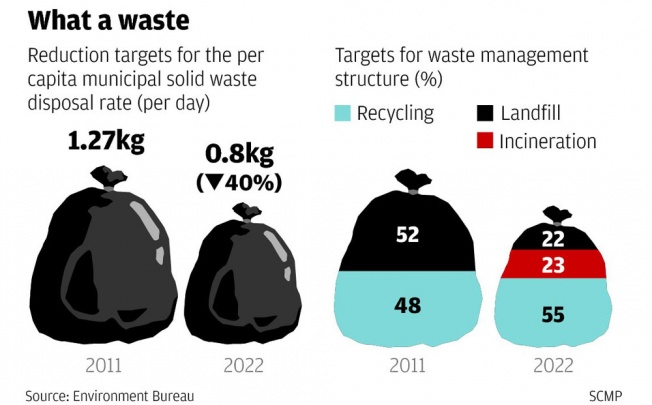
Under the “blueprint for sustainable use of resources”, the government aims to reduce the amount of waste dumped in landfills from 1.27kg for each person in 2011 to 1kg in 2017 and to 0.8kg by 2022.

Currently, 48 per cent of the city’s waste is recycled and the rest goes to three landfills, which will all be full by 2020.

The blueprint says that by 2022, the recycling rate will reach 55 per cent and expanded landfills will take 22 per cent, leaving the remaining 23 per cent to be burnt. The structure is similar to that in Seoul.

Of the range of measures he outlined at a press conference, Wong said incineration was the most crucial, while acknowledging uncertainty about it.

Lawmakers rejected a funding request by the previous government for an incinerator at Shek Kwu Chau, near Cheung Chau. The proposal has also been challenged in court and a verdict is pending.

Details of waste charging, which had been “the most effective means” for Taipei and South Korea to cut waste, would be released in the middle of this year, Wong said. To seek support for landfill expansion, needed before the incinerator was ready, he said a proposal would be put forward for odorous waste, such as that from sewage treatment and household garbage, to be dumped well away from residential areas.

The minister called on the community to participate to help cut waste at source, such as in kitchens.

But officials stopped short of explaining how food waste, the biggest component of landfill refuse – accounting for 40 per cent of it – would be reduced. They are seeking sites for two more recycling plants in addition to two that are planned, but it is unclear how much food waste these can process.

Angus Wong, policy advocacy manager of the World Green Organisation, said the blueprint hinged heavily upon incineration and waste charging.

“Given the political climate, both options are not necessarily well supported,” he said.

Friends of the Earth environmental affairs officer Celia Fung said the 40 per cent reduction target was aggressive but she did not see adequate infrastructure being proposed, especially for food waste. She also called for more support for the recycling industry.

Cyd Ho Sau-lan, chairwoman of the Legislative Council’s environmental panel, said the new targets were “not aggressive at all”, noting that the target recycling rate of 55 per cent in 2022 was still lower than the rate of 61 per cent in South Korea.

On average, Hong Kong people generate 1.36kg of waste each a day, compared to 0.77kg in metropolitan Tokyo, 0.95kg in Seoul, and 1kg in Taipei.

Comments: May 21st 2013 6:23am

No doubt they are using HK’s 7 million population to calculate the numbers and proposed reductions – but what about the tourists and their daily waste (133.192 per day) to the 7m HK number? Wong says Plan A is incineration whilst the rest of the world iow embracing plasma gasification. ‘There’s no Plan B if Govt loses the judicial review’ he states seemingly pressurizing the JR judge to hurry his verdict. Yet by weight after conversion by incineration, 22% bottom ash and 7% toxic fly ash remains that must be treated and landfilled (the Govt prefers to tell us only 10% by volume remains) but also tells us our landfills are full, so will they export the ash residues ? – no, they intend man-made islands in the sea near Cheung Chau as the new ash lagoons. A recent peer reviewed report from Spain shows increased deaths and cancers downwind of modern incinerators, Macau has commissioned a like investigation and in UK Imperial College is due to complete a similar investigation by April 2014. The Legco environmental panel knocked back incineration unanimously last year ; there is no reason for them to change their minds now. Wong and HKG need a Plan B which starts with mandatory separation at source and plasma gasification plants at our landfills.
www.waste-management-world.com/articles/2011/05/plasma-power-goes-large-at-landfill-mining-
HK Tourism 2012 Total 48,615,113 +16.0%
Mainland China 34,911,395 +24.2%
www.eturbonews.com/33231/hong-kong-tourism-16-percent


Links:
[1] https://www.scmp.com/sites/default/files/2013/05/21/12abca983f10e85df14377fc86e0071a.jpg

Gov’t unveils waste plan

May 20, 2013

The Government today unveiled a comprehensive 10-year management plan to tackle Hong Kong’s waste crisis.
The Hong Kong: Blueprint for Sustainable Use of Resources 2013-2022 analyses the challenges and opportunities for waste management in Hong Kong, and maps out strategies, targets, policies and action plans.
Speaking at a press conference, Secretary for the Environment KS Wong said the plan will reduce the per capita municipal solid waste disposal rate by 40% to 0.8kg by 2022.
The rate was 1.27kg per day in 2011, and the target for 2017 is 1kg.
“This is an ambitious target but it is also practical. The key to success lies in motivation.”
Mr Wong said a joint effort by the entire community will be needed to embrace an environmentally sustainable culture and waste less of the Earth’s resources.
The blueprint proposes policies and actions in three areas.
Policy and legislation, including municipal solid waste charges and producer responsibility schemes, aim to drive behavioural change to reduce waste at source.
Territory-wide campaigns, such as the Food Wise Hong Kong Campaign launched last Saturday, will discourage food waste and encourage recycling.
Lastly, waste-related infrastructure, including organic waste treatment facilities, waste-to-energy integrated waste management facilities and landfill extensions, will be enhanced.
The blueprint also aims for a more balanced structure for waste management, as opposed to the current practice of relying solely on landfills.
“We will encourage the public to reuse and recycle. Unavoidable waste will be turned into energy by modern technology while disposal at landfills will be the last resort,” Mr Wong said.
The Government expects that by 2022, waste recycling, modern incineration and landfill disposal in Hong Kong will account for 55%, 23% and 22% of waste management respectively, more closely matching the allocation structure widely adopted in advanced economies, he said.

Click here for the blueprint.

Download PDF : WastePlan-E

RTHK English News

http://rthk.hk/rthk/news/englishnews/news.htm?main&20130520&56&923008

Waste management blueprint unveiled

20-05-2013

audio

http://www.rthk.org.hk/rthk/radio3/hongkongtoday/images/Subpage_12.gifhttp://www.rthk.org.hk/rthk/radio3/hongkongtoday/images/Subpage_15.gif

Maggie Ho reports

http://www.rthk.org.hk/APSuppics/mfile_56_923008_1.jpg

The Secretary for the Environment Wong Kam-sing. RTHK file photo.

The government has rolled out a blueprint on waste management, with a target of reducing solid waste by 40 percent in ten years’ time.

But the action plan includes the construction of a major incinerator on the outlying island of Shek Kwu Chau.

An incinerator proposal has been challenged in the court and a ruling has yet to be made. Nonetheless the proposal is included in the government’s 10-year waste-reduction plan.

The Secretary for the Environment, Wong Kam-sing, who unveiled the blueprint, said there’s no plan-B if the government eventually loses the case.

Other measures announced by the government include a possible a waste-charging scheme.

There are also plans to expand three existing landfills as well as increasing the scale of food waste recycling.

GCC will now look at incinerator alternatives after it agrees to back planning refusal

http://www.stroudnewsandjournal.co.uk/news/10427738.print/

GCC will now look at incinerator alternatives after it agrees to back planning refusal

12:00pm Saturday 18th May 2013

By Chris Warne

GLOUCESTERSHIRE County Council will defend the decision of its planning committee to refuse permission for the £500 million Javelin Park incinerator project near Haresfield.

The authority’s planning committee unanimously opposed the controversial application in March and at a meeting at Shire Hall on Wednesday (May, 15) it was agreed that a cross-party working group should be established immediately to consider alternatives.

GCC’s Conservative administration signed a 25-year contract with Urbaser Balfour Beatty for the plant back in September and the company could still appeal the planning committee’s refusal.

But anti-incineration campaigners from GlosVAIN welcomed GCC’s commitment to support its planning committee in the event of an appeal as a ‘huge step forward’.

Campaigners did express disappointment, however, that the motion tabled by former Lib Dem leader Jeremy Hilton (Kingsholm and Wotton) was watered down.

The original wording of Cllr Hilton’s motion had said: “This council recognises that the waste incinerator project no longer has the support of this council following the outcome of the county council elections.”

And it added: “Mechanical Biological Treatment may be a suitable technology as an alternative to burning household waste.”

Labour leader Lesley Williams (Stonehouse) subsequently proposed an amended motion, omitting the reference to MBT and the outcome of the elections, which Conservative leader Mark Hawthorne (Quedgeley) said his party was prepared to back.

The revised motion, which was passed unanimously, called on the authority’s chief executive to “seek robust support to defend the unanimous planning committee decision in any appeal process that may take place in the future.”

It also said: “This Council should immediately establish a ‘Plan B’ cross-party working group to consider alternatives to the current proposals for a waste incinerator at Javelin Park.”

Sue Oppenheimer, chairman of GlosVAIN, said: “We are very pleased that there was enormous support to look again at options for waste and we hope that GCC will also approach UBB to assess whether they are prepared to look at other options which we understand the contract allows them to do.”

Speaking after the meeting Green Party Cllr Sarah Lunnon (Stroud Central) praised the new minority Conservative administration for seeking ‘to find a solution based on consensus rather than strong-arm tactics’.

Back

© Copyright 2001-2013 Newsquest Media Group

Site Logohttp://www.stroudnewsandjournal.co.uk

Click 2 Find Business Directoryhttp://www.stroudnewsandjournal.co.uk/trade_directory/

INCINERATOR

CTA SAYS:

Then of course there is the 5-7% toxic fly ash (that needs treatment) which means approx 28-30% by weight of what is thermally converted remains as ash that needs daily disposal, ad infinitum.

The ENB’s Elvis AU prefers to state that waste is reduced 90% BY VOLUME by incineration.

Of course the waste management policy relates to stage 2 and stage 3 phases which means THREE INCINERATORS – so where is the recycling ? Currently 48% of local paper etc recycling is claimed – 99% of this is EXPORTED daily to China earning money for Government. With incineration there is no incentive to recycle; indeed they need to be guaranteed feedstocks or they issue their most dioxin emissions on shut down and startup.

From: dereklui@epd.gov.hk [mailto:dereklui@epd.gov.hk]
Sent: 02 February, 2012 14:04
To: James Middleton
Cc: “I[KM]2″@epd.gov.hk; “E[KM]1″@epd.gov.hk; “SI[KM]1″@epd.gov.hk; “S[IP]1″@epd.gov.hk
Subject: Fw:
轉寄: FW: E(12/0072) IWMF

Dear Mr Middleton,

Thank you for your email dated 26.01.2012.

You mention that you find the estimated  22% of bottom ash is low since most UK plants have approximately 25-30% ash to MSW ratios.   On this, you may wish to note that there has been a general downwards trend of % bottom ash production to waste input over the last few years in UK. The following table summaries the recent information from some incineration plants in the UK.

Plant

Year

% of input

Chineham

2010

21.4

Cleveland

2009

21.5

Bolton

2009

22.0

Dudley

2010

23.0

SELCHP (London)

2007

22.9

Regarding your question on whether it is the intention to create a new ash lagoon / landfill on the proposed south Cheung Chau island reclamation to handle subsequent disposals after the existing WENT Landfill is filled up, we understand that the proposed south Cheung Chau island reclamation is one of the many options of reclamation which are under public consultation at present.  We consider that the extension of three existing landfills is the most viable way forward with respect to provisions for waste residue disposal in the short to medium term.   We would keep in view of the option of marine landfill sites for longer term development, noting that consideration of this option would require further assessments of the complex technical issues.

Regards,
Derek LUI
E(IP)12/IPG
EPD


From: enquiry@epd.gov.hk [mailto:enquiry@epd.gov.hk]
Sent:
Tuesday, January 10, 2012 16:21
To:
James Middleton
Subject:
Re: E(12/0072) IWMF


Dear Mr Middleton,


Thank you for your email dated 09.01.2012.


Further to the auto-reply, I would like to inform you that our colleagues are processing your request and may need a few more days to come back to you.


Please let me know if you do not hear from us after about 5 working days.  Thank you.


Yours sincerely,

Emily IP

Enquiry/KMU

Environmental Protection Department

“James Middleton” <dynamco@netvigator.com>

09/01/2012 14:24

To

“EPD HKG” <enquiry@epd.gov.hk>

cc

Subject

E(12/0072) IWMF


IWMF Shek Kwu Chau


Dear Sir,
http://www.epd.gov.hk/eia/register/report/eiareport/eia_2012011/EIA/EIA_PDF/S6b_Waste_SKC.pdf

We find your estimates low since most UK plants have approximately 25-30% ash to MSW ratios.


We note the initial flyash and bottom ash will be disposed of at WENT landfill.


Thereafter is it the intention to create a new ash lagoon / landfill on the proposed south Cheung Chau island reclamation to handle subsequent disposals since the capacity of WENT would be insufficient moving forwards ?


Kind regards

James Middleton

Chairman

www.cleartheair.org.hk


Operation Phase

6b.4.1.48 As discussed in Section 2, the IWMF would comprise (a) an advanced thermal

incineration plant of about 3,000 tpd capacity and (b) a demonstration-scale mechanical

treatment (MT) plant of about 200tpd or less for mixed MSW.  The wastes to be

generated from the thermal incineration plant and the MT plant are discussed below.

Incineration By-products

6b.4.1.49 The main waste type to be generated during the operation of the thermal incineration

plant would be bottom ash, fly ash and air pollution control (APC) residues.  For treating

3,000 tpd of mixed MSW, it is estimated that approximately 660 tpd (22%) of bottom ash and

120 tpd (4%) of fly ash and APC residues would be generated from the thermal incineration

plant.

6b.4.1.50 The bottom ash is considered to be inert provided that the combustion systems in the

incinerator are designed and operated correctly
, and would be disposed of at landfill.  Fly
ash and APC residues from the flue gas stream can also be disposed of at landfill after

proper treatment.
The pollution load in fly ash and APC residues would likely be higher
and more readily leachable than that in bottom ash. Cement solidification or chemical

stabilization would be adopted to pre-treat the fly ash and APC residue to ensure that

they would conform to the proposed Incineration Residue Pollution Control Limits and

leachability criteria shown in Table 6b.7 before disposal


6b.4.1.52 To confirm that the bottom ash, and the treated fly ash and APC residues of the IWMF

would not contain elevated levels of heavy metals and as a precautionary measure, it is

proposed that TCLP tests be carried out for each batch of bottom ash, treated fly ash and

APC residues to be disposed of at WENT Landfill
at the initial stage of the IWMF
operation (i.e. for a period of 6 months)
. If the test results confirm that heavy metals or
pH are not of concern, the TCLP test can be deleted or reduced to half-yearly intervals.


6b.4.1.54 The estimated amount of refuse would be about 185 tpd. Most of the refuse will be

diverted to the incinerators of the IWMF for combustion. Only a small amount of

undersize, non-combustible inert refuse (about 23 tpd), which contains glass, sand, etc.,

will be disposed of at the WENT Landfill.


Table 6b.8 Summary of Waste Generation from Operation of the IWMF

Waste Product Quantity Disposal Route

Incineration by-products

Bottom Ash

660 tpd

Comply with proposed Incineration Residue

Pollution Control Limits prior to disposal to

WENT landfill

Fly ash and APC Residue

120 tpd

(240 tpd after

cementation)

MT by-products

Refuse from MT

Pre-treatment would be applied (e.g. cement

solidification) for compliance with proposed

Incineration Residue Pollution Control Limits

prior to disposal to WENT landfill.

162 tpd

Refuse (e.g. badly contaminated textiles, wood

and residual paper, plastics etc.) to be diverted

to the incinerators of the IWMF for combustion.

23 tpd

Undersized, non-combustible inert refuse (e.g.

glass, sand, residual metals etc.) to be disposed

at WENT landfill.


Table 6b.10 Materials used in the IWMF Operation with Land Contamination

Potential

Material

Expected Annual

Consumption / Production

Estimated Quantity to be

Stored On-site

Chemicals Consumption

Slaked lime 12,065 tonnes 496 tonnes

Ammonia water (25%) 4,015 tonnes 165 tonnes

Activated carbon 383 tonnes 31 tonnes

Kerosene 283 m

3

Caustic soda 206 tonnes 8,466 kg

Hydrochloric acid 83 tonnes 3,411 kg

Sulfurous acid 3,906 kg 161 kg

Production of Incineration By-products

Bottom Ash 240,900 tonnes 3,300 m

Fly ash & APC residues 43,800 tonnes 600 m