Clear The Air News Blog Rotating Header Image

Vehicle

HK must fast-track switch to electric buses

SCMP

Thomas London says Hong Kong is overlooking a ready-made opportunity to improve air quality – it should catch up with the latest technology in electric buses being developed and produced over the border

Aug 13, 2012

Hong Kong has recently experienced record-breaking smog levels. The Environmental Protection Department said that roadside pollution in 2011 was the worst on record. Clear the Air, a local non-governmental organisation working for improved air quality, reports that the city’s greenhouse-gas emissions have jumped 14 per cent from 1990 to 2005 and that vehicles are the second greatest contributor to air pollution. The Hedley Environmental Index estimates that this past month’s pollution will mean 154 premature deaths in Hong Kong.

Hong Kong is unusual among developed-world cities both in the poor quality of its air and the many easy opportunities to cut pollution. Replacing the city’s ageing diesel-powered bus fleet with electric buses would effectively cut vehicular emissions, improve air quality and alleviate subsequent health complications. Hong Kong’s solution for where to source such a vehicle lies just across the border.

Mainland China has prioritised the development of electric and hybrid vehicles in response to its growing dependence on foreign oil. The government announced annual subsidies of up to 2 billion yuan (HK$2.5 billion) for fuel-saving vehicles, including electrics and hybrids, in an attempt to foster growth in the industry and eventually put five million alternative energy vehicles on Chinese streets by 2020. Hong Kong can benefit from this initiative, utilising the funds used to develop the mainland’s electric vehicle industry.

Shenzhen’s BYD, the company famed for being one of the world’s largest rechargeable battery manufacturers and winning financial backing from Warren Buffett, released an all-electric bus this past year. The K9 is fuelled by both solar power and a rechargeable lithium iron phosphate battery – one three-hour charge gives the bus a 250-kilometre range in urban settings.

This vehicle is fully capable of handling the routes and distances covered by the current bus fleet and would immediatelyminimise carbon emissions and noise pollution.

The Hong Kong government has acknowledged the potential of integrating electric vehicles, establishing a benchmark to make 30 per cent of private vehicles either hybrids or fully electric by 2020. The Transport Department is considering deploying electric buses from Kowloon Motor Bus. However, the vehicle’s range is a minuscule 10 kilometres, meaning these buses cannot be used on regular routes.

Money is not an issue. Last financial year, the government amassed a budget surplus of more than HK$73 billion. In fact, initial funding to implement the switch to public electric buses had been previously allocated. Leung Chun-ying’spredecessor, Donald Tsang Yam-kuen, prioritised an electric bus fleet, setting aside HK$180 million for the transition during his final policy address as chief executive. Furthermore, the Pilot Green Transport Fund has set aside HK$300 million to promote more sustainable transport solutions.

Many regions already recognise the benefits of operating all-electric public buses. Governments in Copenhagen, Frankfurt, Helsinki, Amsterdam and Ontario are all slated to integrate the K9 into their transport systems. Chinese cities, including Changsha, Shaoguan, Xian and most notably Shenzhen, have effectively put the bus through its paces. The fleets have collectively travelled over five million kilometres without major incident. The K9 is ready for Hong Kong.

Partnering with BYD would strengthen Hong Kong’s ties with mainland Chinese businesses and neighbouring Shenzhen. If successful, the partnership would encourage other mainland companies to invest and develop for the Hong Kong market. It may even boost public sentiment towards the ability of the Chinese private sector to benefit Hong Kong.

The new bus fleet would serve as an example of Chinese innovation and cutting-edge technology, a notion that too many dismiss as non-existent.

The Leung administration could use a political victory. Leung has the opportunity to illustrate his commitment to the city’s health and long-term sustainability while facing what one would assume to be little political opposition. Introducing the new fleet would promote Hong Kong as a modern, forward-thinking city. In short, pursuing this initiative would provide a much-needed easy win for the administration.

Hong Kong has a unique chance to illustrate its commitment to green technology and sustainability. Few cities are as fortunate to have a massive budget surplus, close economic ties with the world’s largest exporter, and new political leadership eager to improve its reputation. Even fewer are presented with a simple way to address one of its most significant problems.

Hong Kong must introduce electric buses to abate roadside pollution and overall emissions. Get smoggy diesel buses off the road now so that Hong Kong’s people can once again smell the scent of Asia’s most fragrant harbour.

Thomas London is a Princeton-in-Asia fellow at the Asia Business Council

Tour buses add to gridlock in TST East

District councillor wants to redirect buses carrying mainland tourists to unused depot in Mody Road
Tiffany Ap
Aug 12, 2012

It has become an all too common sight in Tsim Sha Tsui East. Traffic comes to a standstill as buses stop to let a stream of tourists alight.

Outside the Mody Road DFS Galleria, which is popular with mainland shopping tours, bus drivers sit in their vehicles waiting for their passengers to finish their hours of shopping.

Vehicles trying to get around double-parked buses veer into lanes meant for oncoming traffic, raising safety concerns.

The situation could get worse in January, when a huge new duty-free store opens on the site of the recently closed ClubBboss, beside the DFS Galleria in Chinachem Plaza.

Yau Tsim Mong district councillor Kwan Sau-ling says she has received numerous complaints from residents and business owners about the gridlock created by illegally parked tour buses.

Last year, Kwan saw an opportunity to redirect the influx of tour buses to a government bus depot at the other end of ModyRoad.

It was built in 2007 to relieve the ageing Star Ferry bus terminus, but plans to raze that terminus and build a piazza dragged on, meaning the new depot sat empty for five years.

The controversial piazza plan was declared dead on Thursday, but instead of using the Mody Road depot for tour buses, the government plans to make it a rest area for buses serving 14 local routes.

Kwan’s proposal to turn the depot into a coach park for private tour companies did not garner enough support from her fellow councillors.

She said it would be next month before she could introduce the proposal for the district council to consider again.

“It’s a waste,” Kwan said. “Giving public buses that structure is redundant since the Star Ferry terminus and a terminus in Science Museum Road can accommodate buses used on the public routes comfortably.”

Kwan said allocating the Mody Road depot for tour buses would solve congestion in the area’s main shopping hubs in Chatham Road and Mody Road.

“If the tour-bus companies are violating parking regulations, this is something the police should look into,” she said.

“They are after convenience. They want to drop tourists off at the doorstep because they’re afraid they will wander off somewhere else to shop, [in stores where the tour guides do not receive a commission].

“In Mody Road there’s a Wing On, there’s the Empire Centre, there’s a few places to go shopping.”

In addition to violating parking regulations, buses often idle their engines, which environmental groups say highlights weaknesses in the anti-idling law passed last December, which exempts any bus with at least one passenger on board.

Record-high pollution levels last week, which prompted the government to warn vulnerable people to stay indoors, have put a renewed focus on sources of pollution.

Roadside emissions are the second largest contributor to air pollution and pose a particularly dangerous threat since the exhaust comes out at street level, according to the Clean Air Network.

Amy Ng, a volunteer with local green group Clear the Air, said that although people complained about the air quality, they were hesitant to act. The problem did not seem urgent enough, or people did not believe it affected them.

“It doesn’t seem that bad. People aren’t dropping like flies. Maybe your sinuses get irritated or you develop a cough. But unless you have asthma or you have elderly people or children with you, it’s not really a concern for most people,” she said.

“But when the tour bus is idling, the bad air goes back into the bus. They think they’re breathing in clean air but they’re not.”

Tourists are more interested in getting back to the air-conditioned comfort of the buses than keeping the city’s air clean.

Outside the DFS Galleria, tired shoppers often return to sit on their bus and the coaches’ engines idle for fifteen minutes or more.

One shopper on a day-tour from Shenzhen complained: “There’s nowhere to sit in the mall and outside is too hot.”

The shopper, who had her eight-year-old daughter in tow, said: “She’s tired, so we’ll wait on the bus.”

Ng said the issue of air quality needed to be addressed from the point of view of vehicle design and urban planning, not just the legal aspect.

“Back in the ’70s, when Hong Kong was experiencing weather just as hot as we have now, they installed fans. The windows of the buses opened. Nowadays, you can’t even open the windows,” she said.

tiffany.ap@scmp.com

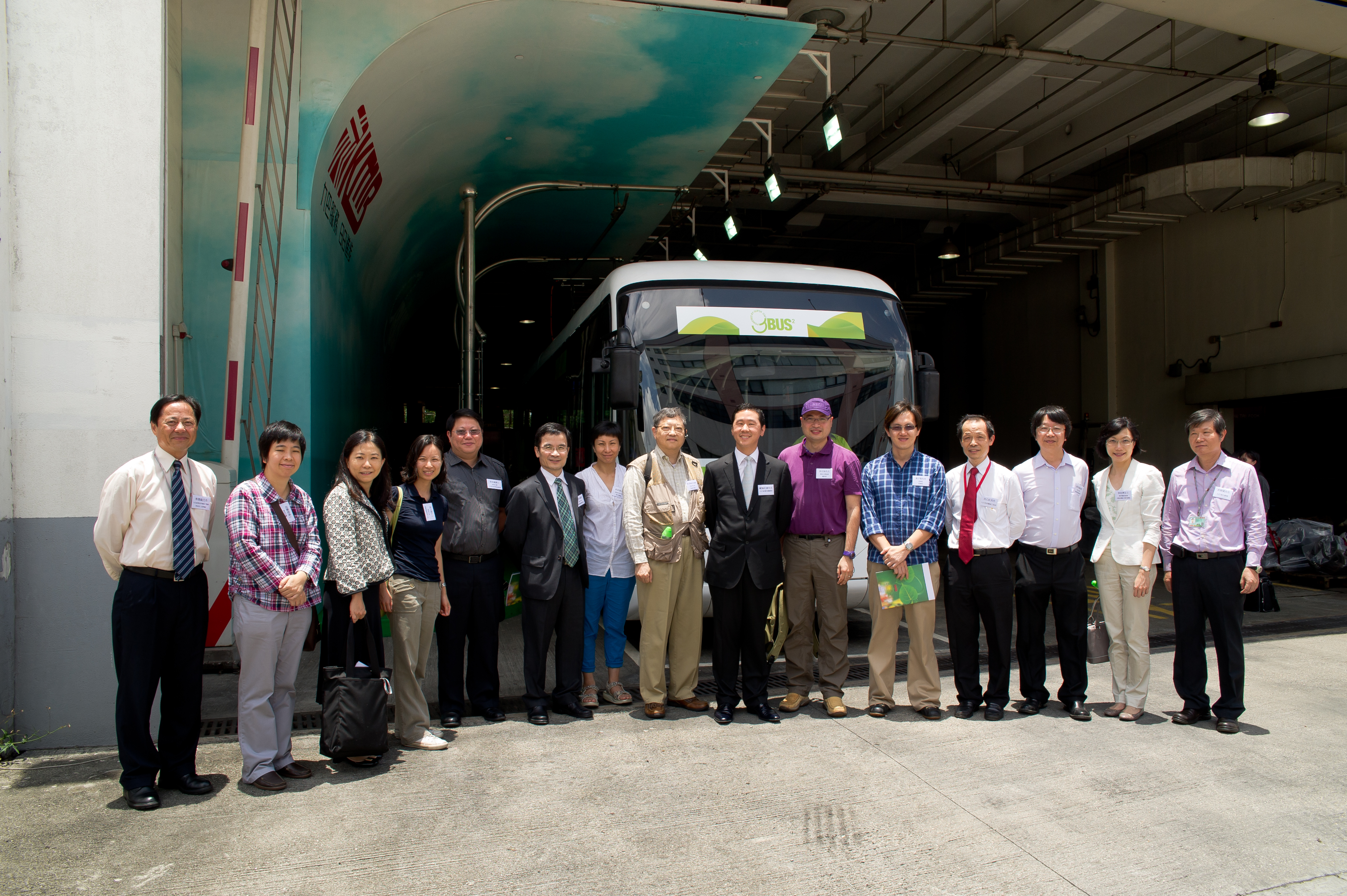
On-board Experience of gBus2

From: Adelaide Wong EAS <adelaide.wong@kmb.hk>
Date: 11 August, 2012 9:47:36 GMT+08:00
To: “vicechair@cleartheair.org.hk” <vicechair@cleartheair.org.hk>
Subject: On-board Experience of gBus2

Dear Mr Town

We would like to thank you for taking part in the gBus2 visit on 16 July 2012, and are pleased to enclose a thank you letter and some photographs taken on the day for your records.

If you have any queries, please call me on  2786 8906.

Thanks and best regards

Ms Adelaide Wong

External Affairs Section

KMB

download PDF : hppscan31

Proposed parking scheme should be rejected

SCMP letter

Jul 25, 2012

While drivers welcome government plans to introduce new features at parking meters, such as allowing fees to be paid via mobile phone, pedestrians and residents of districts with chronic traffic congestion are appalled.

The Legislative Council paper on the trial scheme says that on-street “parking spaces are provided to cater for short-term parking needs. These parking spaces are normally metered to discourage prolonged parking.” Currently allocated times are 30 minutes to two hours, depending on conditions in the district.

Allowing drivers to use remote payment methods will encourage them to hog meters for hours on end, causing further congestion on our streets and will make life easier for valet parking operators monopolisingpublic facilities for private commercial purposes. The Transport and Housing Bureau will promise to supervise the parking meters to curtail abuse, but we have heard that before.

Not a single ticket has been issued for violation of the anti-idling engine legislation in more than six months. Street-side parking is the most popular option because of convenience and low fees, HK$2 for 15 minutes, undercutting higher rates at off-street car parks. Instead of encouraging drivers to park street side, officials should be taking measures to reduce on-street parking to generate new lanes and introduce multifold increases in meter charges that reflect the high cost of land. Forcing drivers into off-street parking facilities would reduce both air and noise pollution and make our streets more spacious and pleasant.

The focus of the bureau is as usual all on the convenience of motorists: “We will examine how the new generation of parking meters could allow greater flexibility in the charging mechanism and parking time arrangements to better serve the needs of the motorists.” No mention of benefits for the long-suffering pedestrian.

The streets belong to everyone and it is high time that what is best for the majority be the priority when implementing new measures. Instead of spending significant amounts on upgrading meters, that will never be recouped because of the low fees, our transport officials should concentrate on introducing congestion pricing to inner city districts to encourage goods deliveries to be executed outside peak hours and to discourage unnecessary incursions.

Hopefully, the members of the next Legco Transport Advisory Committee will get their priorities right and reject proposals inconsistent with the general public interest.

Mary Melville, Tsim Sha Tsui

Kandi Technologies Bags Largest Single Electric Vehicle Order Ever

http://www.altenergystocks.com/archives/2012/07/kandi_technologies_bags_largest_single_electric_vehicle_order_ever_1.html?utm_source=feedburner&utm_medium=feed&utm_campaign=Feed%3A+AlternativeEnergyStocks+%28AltEnergyStocks.com%29

Tom Konrad CFA

Description: KD501The Kandi KD501 Mini-EV to be leased in Hangzhou. Photo by Marc Chang.

The city of Hangzhou just signed a strategic cooperation agreement with KandiTechnologies(NASD:KNDI) and nine other companies to supply 20,000 electric vehicles (EVs) for the city’s “pilot” EV leasing program.Kandi is the only EV supplier to take part; other companies involved will supply the batteries (Air Lithium (Lyoyang) Co. Ltd.) and charging by the local utility. The utility will fund construction of a charging and battery swap station network as well as paying for the batteries.

The batteries will serve a dual use for grid stabilization, or Vehicle to Grid (V2G) technology. The batteries will be financed by charges to electricity customers because of this dual use. So, in addition to this being the largest EV sale ever announced, the project is also effectively the largest scale trial of the use of EV batteries for V2G. V2G is a concept much talked about in academic circles, but so far if has only seen small scale pilot projects in the West. Part of the problem with implementing V2G is typically the split incentives between battery owners and the utility. Battery owners naturally worry about reduced performance of their very expensive battery packs if they are used for V2G. The Hangzhou project neatly avoids this conflict of interest because the utility owns the batteries, and the EVs are only available for lease.

Financial Impact for Kandi

The program will begin in August, and is scheduled to be completed by the end of 2013. We can expect Kandi to sell EVs at a rate of over 1000 per month during implementation. Kandi’s revenues for each vehicle will be around $6800 per EV. Kandi’s gross margins are about 25% on its existing off-road vehicle business, and observers of the company tell me Kandi would be unlikely to undertake a project if it earned substantially less than that. We can expect an increase in gross profit of about $1300 to $1700 per vehicle, or about $0.70 per share annual gross profit, most of which will flow through to earnings.

Kandi is already profitable, with trailing earnings of $0.20 per share (EPS), so we can expect total EPS for 2012 is likely to be around $0.40 per share, and EPS for 2013 is likely to be around $0.80 per share based just on this deal and zero growth in the company’s existing business. The existing off road vehicle business has been growing rapidly, and additional EV orders seem likely, so $0.40 and $0.80 EPS in 2012 and 2013 should be considered a lower bound on earnings, which will most likely be higher.

China’s Aggressive EV Goals

Kandi’s rapid earnings growth could continue if Kandi manages to grab a decent share of the 500,000 EVs by 2015 and 5,000,000 EVs by 2020 goals set by the central government.

China is currently behind in implementing these EV adoption goals, largely because of the high cost of EVs from Kandi rivals such as BYD (OTC:BYDDY), and lack of charging stations. The Hangzhou pilot project, with its rapid, utility-financed build-out of charging stations and inexpensive mini-EVs from Kandi seems designed to address both these problems.

Kandi’s mini-EVs may be just what the Chinese government ordered.

Disclosure: Long KNDI

This article was first published on the author’s Forbes.com blog, Green Stocks.

DISCLAIMER: Past performance is not a guarantee or a reliable indicator of future results. This article contains the current opinions of the author and such opinions are subject to change without notice. This article has been distributed for informational purposes only. Forecasts, estimates, and certain information contained herein should not be considered as investment advice or a recommendation of any particular security, strategy or investment product. Information contained herein has been obtained from sources believed to be reliable, but not guaranteed.

Kandi Technologies Bags Largest Single Electric Vehicle Order Ever was posted on AltEnergyStocks.com.

過檔龍躉懸浮粒子多十倍

東方日報
(2012年7月16日)【本報訊】巴士業內人士及巴士迷將龍運售予九巴的舊車稱為「過檔龍躉」,由於車齡十多年,巴士行車表現及排放廢氣甚受關注。環保團體健康空氣行動指出,這批「龍躉」是歐盟二期舊車,排放的懸浮粒子數目較歐四、歐五型多出十多倍,應盡快退役,如今竟由機場路線轉到市區污染環境,絕對是危害市民的健康。汽車業人士亦指,九巴是年年賺大錢,應盡力縮短車隊平均車齡,不應該為求盈利而將巴士「用到最後一分一秒」。健康空氣行動項目經理陳方盈表示,龍運對外宣稱會購置新巴士,令人誤以為巴士公司願意負起社會責任,淘汰已十多年的舊巴士,但實際上是轉售到另一巴士公司繼續營運,她批評這種手法「完全呃人」,「巴士公司咁樣做,係誤導市民同政府,唔係正當做法,希望九巴檢討。」她說歐二巴士排放標準在一氧化碳、氮氧化物等排放量,比歐五標準高出兩、三倍,即使加裝過濾器,懸浮粒子排放量仍是高量。

E(12/1466) Euro 6 subsidy by Dutch Govt (HKG still has Euro II and III polluting bus trash on its roads)

—–Original Message—–
From: charleswu@epd.gov.hk [mailto:charleswu@epd.gov.hk]
Sent: 26 June, 2012 09:18
To: James Middleton
Cc: paulwong@epd.gov.hk; enquiry@epd.gov.hk
Subject: Fw: E(12/1466) Euro 6 subsidy by Dutch Govt (HKG still has Euro II
and III polluting bus trash on its roads)

Dear Mr. Middleton,

Thank you for your suggestion.

As franchised buses are one of the major sources of roadside air pollution
at busy corridors, in the 2010-11 Policy Address the Chief Executive
announced that the Government plans to designate pilot low-emission zones
(LEZs) in busy districts such as Causeway Bay, Central and Mong Kok. We
will increase as far as possible the ratio of low-emission franchised buses
running in these zones from 2011, with the target of having only
low-emission buses in these zones by 2015.  Upon the Government’s request,
the relevant franchised bus companies have deployed low-emission buses to
routes serving the pilot LEZs as far as practicable since 2011.

As regards the trial of hybrid bus, in the 2010-11 Policy Address, the
Chief Executive announced that the Government will fund the full cost of
procuring six hybrid buses for use by the franchised bus companies along
busy corridors to test the operational efficiency and performance of these
buses under Hong Kong conditions and to collect operational data.  The
franchised bus companies are now in the process of procuring suitable
hybrid buses and the buses will be put on road for trial in early 2014.

Electric buses do not have tailpipe emissions.  Replacing conventional
franchised buses with electric buses can substantially improve roadside air
quality, particularly along busy corridors.  It is the Government’s
ultimate policy objective to have zero emission buses running across the
territory.  Further to trial of hybrid buses, the Chief Executive proposed
in his Policy Address last October to earmark $180 million for franchised
bus companies to purchase 36 electric buses for trial runs on a number of
routes to assess their performance in different conditions.  We are now
seeking funding from the Finance Committee of the Legislative Council for
the trial of electric buses by the franchised bus companies.

As for existing buses, the Government is conducting a trial together with
the franchised bus companies on retrofitting Euro II and III franchised
buses with selective catalytic reduction devices to reduce their nitrogen
oxides emissions.  Together with the diesel particulate filters already
installed on the buses, this could upgrade the emission performance of the
buses to the level of Euro IV or V buses.  Subject to satisfactory trial
results, we will fully fund the retrofit of the devices on Euro II and III
buses, and bus companies will bear the subsequent operational and
maintenance costs.

Thank you for your concern on the environment.

Regards,

Charles C.K. WU

Environmental Protection Officer

—– Forwarded by Paul KC WONG/EPD/HKSARG on 20/06/2012 09:31 —–

“James Middleton”    <dynamco@netvigator.com>      To
<paulwong@epd.gov.hk>
cc
19/06/2012 19:17                 <kswong@rlphk.com>
Subject    RE: E(12/1466) Euro 6   subsidy by Dutch Govt (HKG
still has Euro II and III
polluting bus trash on its roads)

Dear Paul
that is the wrong way round
Government could stipulate clean air zones for Nathan Rd , Central and
Causeway Bay very quickly, with political will, sadly lacking from this
lame duck administration and current pathetic minister for the
enviroprevarication

Make the law and the bus companies will comply, as simple as that, even
Donald Tsang’s brother at Citybus NWFB would  have to comply once his
brother vacates in 11 days and the new Minister actually does some work
instead of 60 overseas trips in 59 months away from Hong Kong, including
his last jaunt to Europe to visit a Scottish distillery with associated
hangers on , trips paid for from the public purse.

Meanwhile testing electric buses is pointless for HK’s terrain and aircon
needs – we need double deck hybrids like London where the small Euro 5
engine and the brakes charge the batteries.

James

From: paulwong@epd.gov.hk [mailto:paulwong@epd.gov.hk]
Sent: 19 June, 2012 17:07
To: dynamco@netvigator.com
Cc: “E[KM]1″@epd.gov.hk; “SI[KM]1″@epd.gov.hk; enquiry@epd.gov.hk;
vanessaau@epd.gov.hk
Subject: Fw: E(12/1466) Euro 6 subsidy by Dutch Govt (HKG still has Euro II
and III polluting bus trash on its roads)

Dear Mr. Middleton

Thank you for your email.

When we tighten the vehicle emission standards in Hong Kong, we will make
reference to the international practice and the availability of compliant
vehicle models in Hong Kong. Starting from June 2012, all newly registered
heavy duty vehicles including franchised buses in Hong Kong are required to
comply with Euro V emission standards. The European Union will implement
the Euro VI emission standards for heavy duty vehicle in phases starting
from 2013 and fully implement in 2014.  At the moment, there is no Euro VI
heavy duty vehicle available in Hong Kong. We will continue to monitor the
Euro VI vehicle model supply situation in Hong Kong and decide to introduce
the Euro VI emission standards in Hong Kong as soon as possible.

For franchised buses, as the latest commercially available models in Hong
Kong are Euro V buses at this stage, the franchised bus companies are
currently procuring Euro V buses for replacement.

Thanks
Paul Wong
Assistant Environmental Protection Officer

—– Forwarded by EPD_Enquiry/EPD/HKSARG on 14/06/2012 14:48 —–

EPD_Enquiry/EP
D/HKSARG

Dear James Middleton,

Thank you for your email dated 13.06.2012.

I would like to inform you that our colleagues are processing your request
and may need a few more days to come back to you.

Please let me know if you do not hear from us after about 5 working days.
Thank you.

Yours sincerely,
Enquiry/KMU
Environmental Protection Department

“James Middleton” <
dynamco@netvigator.com>

To
13/06/2012 19:52                “EPD HKG” <enquiry@epd.gov.hk>
cc
<kswong@rlphk.com>
Subject
E(12/1466) Euro 6 subsidy by Dutch Govt
(HKG still has Euro II and III polluting
bus trash on its roads)

Dear EPD,

We note that replacement buses in Hong Kong under franchise agreements must
be of the Best Available Current Technology.

Does Hong Kong have Euro 6 diesel ?

Are new diesel buses here mandated to be Euro 6 compliant, given the
projected lifetime of the vehicles  ?

If not why not ?

Yours sincerely,
James Middleton
Chairman
www.cleartheair.org.hk

Dutch subsidy for Euro VI trucks and buses In the Netherlands, heavy-duty
vehicles(trucks and buses) that meet the new Euro VI standards will be
subsidised by up to 4500 euro each in 2012 and 2013.
The Euro
VI standards will become mandatory for all new heavy-duty vehicles from
2014.
Tests by the Dutch environment consultancy TNO have shown that the new Euro
VI engines can reduce emissions of nitrogen oxides (NOx) by more than
90 per cent in real driving conditions, as compared to Euro V and earlier
Eurostandard engines.
Source: Dutch government press release, 30 May 2012.
Link:
http://www.rijksoverheid.nl/nieuws/2012/05/30/subsidie-voor-schoonste-truck
s-en-bussen.html

“The sulphur content of ship fuels will be cut to 0.1% from 2015 in the
Baltic Sea and the North

Sea, and to 0.5% from 2020 in other EU waters. As a result, emissions of
sulphur dioxide

from shipping in Europe will come down by more than 80 per cent.”

Hong Kong has no rules governing the use of  bunker fuel which varies
between 2.75 – 4+% sulphur ,

no Emissions Control Area legislation (ECA).

The local HKG Environmental Prevarication Department  passes the
responsibility to China to enact ECA legislation in Hong Kong waters

leaving only volunteer action by the Fairwinds Charter members to burn Low
Sulphur Diesel at anchor in HKG port.  Yet vehicular ULSD is rightly

limited to parts per million.

31% of HKG’s particulates and 25% of local NOx and Sox come from marine
emissions.

E(12/1466) Euro 6 subsidy by Dutch Govt (HKG still has Euro II and III polluting bus trash on its roads)

From: paulwong@epd.gov.hk [mailto:paulwong@epd.gov.hk]
Sent: 19 June, 2012 17:07
To: dynamco@netvigator.com
Cc: “E[KM]1″@epd.gov.hk; “SI[KM]1″@epd.gov.hk; enquiry@epd.gov.hk; vanessaau@epd.gov.hk
Subject: Fw: E(12/1466) Euro 6 subsidy by Dutch Govt (HKG still has Euro II and III polluting bus trash on its roads)
Dear Mr. Middleton

Thank you for your email.

When we tighten the vehicle emission standards in Hong Kong, we will make reference to the international practice and the availability of compliant vehicle models in Hong Kong. Starting from June 2012, all newly registered heavy duty vehicles including franchised buses in Hong Kong are required to comply with Euro V emission standards. The European Union will implement the Euro VI emission standards for heavy duty vehicle in phases starting from 2013 and fully implement in 2014.  At the moment, there is no Euro VI heavy duty vehicle available in Hong Kong. We will continue to monitor the Euro VI vehicle model supply situation in Hong Kong and decide to introduce the Euro VI emission standards in Hong Kong as soon as possible.

For franchised buses, as the latest commercially available models in Hong Kong are Euro V buses at this stage, the franchised bus companies are currently procuring Euro V buses for replacement.

Thanks
Paul Wong
Assistant Environmental Protection Officer

—– Forwarded by EPD_Enquiry/EPD/HKSARG on 14/06/2012 14:48 —–

EPD_Enquiry/EPD/HKSARG

14/06/2012 14:48

To “James Middleton” <dynamco@netvigator.com>
cc
Subject Re: E(12/1466) Euro 6 subsidy by Dutch Govt (HKG still has Euro II and III polluting bus trash on its roads)Link

Dear James Middleton,

Thank you for your email dated 13.06.2012.

I would like to inform you that our colleagues are processing your request and may need a few more days to come back to you.

Please let me know if you do not hear from us after about 5 working days. Thank you.

Yours sincerely,
Enquiry/KMU
Environmental Protection Department

“James Middleton” <dynamco@netvigator.com>

13/06/2012 19:52

To “EPD HKG” <enquiry@epd.gov.hk>
cc <kswong@rlphk.com>
Subject E(12/1466) Euro 6 subsidy by Dutch Govt (HKG still has Euro II and III polluting bus trash on its roads)

Dear EPD,

We note that replacement buses in Hong Kong under franchise agreements must be of the Best Available Current Technology.

Does Hong Kong have Euro 6 diesel ?

Are new diesel buses here mandated to be Euro 6 compliant, given the projected lifetime of the vehicles  ?

If not why not ?

Yours sincerely,

James Middleton

Chairman

www.cleartheair.org.hk
Dutch subsidy for Euro VI trucks and buses
In the Netherlands, heavy-duty vehicles(trucks and buses) that meet the new Euro
VI standards will be subsidised by up to 4500 euro each in 2012 and 2013. The Euro
VI standards will become mandatory for all new heavy-duty vehicles from 2014.
Tests by the Dutch environment consultancy TNO have shown that the new
Euro VI engines can reduce emissions of nitrogen oxides (NOx) by more than
90 per cent in real driving conditions, as compared to Euro V and earlier Eurostandard
engines.
Source: Dutch government press release, 30 May 2012.
Link: http://www.rijksoverheid.nl/nieuws/2012/05/30/subsidie-voor-schoonste-trucks-en-bussen.html

“The sulphur content of ship fuels will be cut to 0.1% from 2015 in the Baltic Sea and the North

Sea, and to 0.5% from 2020 in other EU waters. As a result, emissions of sulphur dioxide

from shipping in Europe will come down by more than 80 per cent.”

Hong Kong has no rules governing the use of  bunker fuel which varies between 2.75 – 4+% sulphur ,

no Emissions Control Area legislation (ECA).

The local HKG Environmental Prevarication Department  passes the responsibility to China to enact ECA legislation in Hong Kong waters

leaving only volunteer action by the Fairwinds Charter members to burn Low Sulphur Diesel at anchor in HKG port.  Yet vehicular ULSD is rightly

limited to parts per million.
31% of HKG’s particulates and 25% of local NOx and Sox come from marine emissions.

UCLA Professor Sues for Firing over Diesel Pollution Study Whistleblowing

http://reason.com/blog/2012/06/14/ucla-professor-sues-for-firing-over-dies

Dr. James Enstrom

A California epidemiologist who lost his job with UCLA not long after challenging the science behind claims that diesel pollution was responsible for 2,000 deaths a year in the state is suing to get his job back.

The American Center for Law and Justice (ACLJ) announced today it had filed suit Wednesday in Los Angeles against UCLA officials for violating Dr. James Enstrom’s constitutional rights:

“The facts of this case are astounding,” said David French, Senior Counsel of the ACLJ. “UCLA terminated a professor after 35 years of service simply because he exposed the truth about an activist scientific agenda that was not only based in fraud but violated California law for the sake of imposing expensive new environmental regulations on California businesses. UCLA’s actions were so extreme that its own Academic Freedom Committee unanimously expressed its concern about the case.”

Dr. Enstrom, a research professor in UCLA’s Department of Environmental Health Sciences, published important peer-reviewed research demonstrating that fine particulate matter does not kill Californians. Also, Dr. Enstrom assembled detailed evidence that contends powerful UC professors and others have systematically exaggerated the adverse health effects of diesel particulate matter in California, knowing full well that these exaggerations would be used by the California Air Resources Board (CARB) to justify draconian diesel vehicle regulations in California. In addition, the complaint argues that he exposed the fact that the lead author of the key CARB Report used to justify the diesel regulations did not have the UC Davis Ph.D. degree that he claimed. Instead, according to the suit, this “scientist”bought a fake Ph.D. for $1,000 from a fictional “Thornhill University.”

Finally, Dr. Enstrom discovered that several activist members of the CARB Scientific Review Panel on Toxic Air Contaminants have exceeded the legislatively mandated three-year term limits by decades. The suit contends that shortly after Dr. Enstrom revealed this systematic wrongdoing, UCLA not only issued a notice of termination, it denied him any compensation for his work by systematically and wrongfully looting his research fund accounts. Dr. Enstrom worked for more than a year without pay as he in good faith appealed his wrongful termination using UCLA procedures. Ironically enough, the fake “scientist” was only suspended for his misconduct while Dr. Enstrom was terminated for telling the truth.

The legally inclined can read the lawsuit here [pdf].

Reason.tv interviewed Dr. Enstrom in 2011 and detailed the controversy, as well as the economic disaster California truckers face in the wake of CARB’s diesel guidelines.

On Tuesday, the World Health Organization waded into the subject matter, releasing a study declaring diesel fumes a carcinogen akin to second-hand smoke, so it’s possible truckers in other states (or countries) may soon be fighting this fight as well.

Hat tip to Adam Kissel of the Foundation for Individual Rights in Education (FIRE) for the Twitter tip. FIRE has beenheavily involved in both covering and assisting Enstrom’s fight.

UPDATE: UCLA has posted their response here.

Finding raises diesel cancer fears

HK Standard

Diesel fumes cause cancer, the World Health Organization declared yesterday.

Mary Ann Benitez and Choya Choi

Thursday, June 14, 2012

Diesel fumes cause cancer, the World Health Organization declared yesterday.

The conclusion, announced after a week-long meeting of a panel organized by the International Agency for Research on Cancer in Lyon, France, may make vehicle exhaust gases as important as a public health threat as secondhand tobacco smoke.

Before this, diesel exhaust had been categorized as “probable carcinogen” to humans.

But now the agency, which is the WHO cancer arm, has made a definitive determination that diesel exhaust does cause cancer.

“Based on sufficient evidence, exposure [to diesel exhaust] is associated with an increased risk for lung cancer,” a statement from the IARC and the WHO said.

“It’s on the same order of magnitude as passive smoking,” Kurt Straif, director of the IARC was quoted as saying by Associated Press.

“This could be another big push for countries to clean up exhaust from diesel engines.”

Straif said there may be many cases of lung cancer connected to the contaminant.

He said the fumes affected groups including pedestrians on the street, ship passengers and crew, railroad workers, truck drivers, mechanics, miners and those operating heavy machinery.

Reclassifying diesel exhaust as carcinogenic puts it into the same category as other known hazards such as asbestos, alcohol and ultraviolet radiation.

A spokesman for the Environmental Protection Department said the government has been “closely monitoring” the WHO study on the health effects of diesel engine emissions.

“As diesel vehicles emissions are the main source of pollution and have adverse effects on public health, the government has enforced a series of measures to control and reduce the emissions of diesel vehicles,” he said.

But Clear the Air chairman James Middleton did not mince words about the “failed” tenure of outgoing Secretary for the Environment Edward Yau Tang-wah.

“He has made 60 overseas trips in 59 months, presumably seeking a source of clean air for Hong Kong during his failed portfolio tenure,” Middleton said.

“His recent Greentech jaunt to Europe where he visited a polluting incineration plant and a Scottish distillery will be of doubtful use to Hong Kong’s environmental problems.

“Roadside pollution has increased during his tenure.”