Clear The Air News Blog Rotating Header Image

August, 2013:

Come clean on waste disposal strategy

dynamco Aug 13th 2013 8:00am

Charlie Chan is naïve: “Netherlands is at the forefront of safe & eco-friendly methods of waste disposal” How can burning trash that could be recycled be deemed Eco friendly when peer reviewed reports show increases in child deaths, birth abnormalities & cancer increases with proximity to incinerators?
Recently the ENB paraded a panel of pro incinerator individuals whose businesses or funding relied on same. An executive on the panel from Netherlands based W2E Afval Energie Bedriff was inflamed when it was revealed his organization was the 484th most polluting enterprise in the whole of the EU.
43% of our daily MSW is food waste at 80-90% water content with less than 4 MJ/kg calorific value, the wettest in the world whereas Europe food waste is 30% water. Combustion needs >7 MJ/kg so needs to add feedstocks w/ higher calorific value thus defeating recycling. Stonecutters plant (2.7 million m3 per day capacity by 2016) could handle all of HKG’s 3,300 m3 daily food waste if pulped before adding to the sewage system.
To build the intended 3 incinerators a confirmed longterm quantity of daily feedstock is required hence the ENB reticence to share the fuel for the bonfire. Dioxin emissions from burn temperature drop are highest on burner startup & shutdown hence the need to ‘keep on burning’. Of course once we have waste charging & source separation laws & a viable local recycling setup we might have to import MSW to keep the burners burning & manmade islands as ash lagoons.

South China Morning Post

Published on South China Morning Post (http://www.scmp.com)

Home > Letters to the Editor, August 13, 2013


Letters to the Editor, August 13, 2013

Tuesday, 13 August, 2013, 12:00am

Comment› Letters

Come clean on waste disposal strategy

I agree with Frank Lee (“Viable waste management plan snubbed [4]”, August 5) that the government’s waste disposal plans leave much to be desired both in transparency and positive action.

Green Island Cement’s offer to incorporate waste disposal into the production cycle at its plant in Tuen Mun is infinitely better than expanding landfills, and is obviously ecologically preferable to the ill-considered Shek Kwu Chau reclamation.

I was also alerted by your report highlighting Cheung Kong Infrastructure’s acquisition of a stake in the largest producer of electricity by waste burning in the Netherlands (“CKI eager to enter new industries as profit grows [5]”, July 26).

The Netherlands is at the forefront of safe and eco-friendly methods of waste disposal.

This begs the most obvious question – why is Li Ka-shing’s Power Assets (formerly Hongkong Electric) not burning waste (or planning to) at its Lamma power station?

Naturally the same question could be asked about CLP Power’s operations.

On the one hand the Environmental Protection Department appears to be weak-kneed in the face of hostile opposition, while on the other hand it seems to be stubbornly empire-building and bureaucratically avoiding systems outside its own direct day-to-day control.

I think it is overdue for the department to come clean on the matter of waste disposal.

Charlie Chan, Mid-Levels


Source URL (retrieved on Aug 13th 2013, 7:16am): http://www.scmp.com/comment/letters/article/1296268/letters-editor-august-13-2013

Links:
[1] http://www.scmp.com/business/money/markets-investing/article/1294823/hong-kong-taxi-licences-hit-record-high-almost-us1m
[2] http://www.scmp.com/comment/letters/article/1266267/letters-editor-june-22-2013
[3] http://SCMP.com
[4] http://www.scmp.com/comment/letters/article/1294371/letters-editor-august-5-2013
[5] http://www.scmp.com/business/companies/article/1290764/cki-eager-enter-new-industries-profit-grows

https://e02.optimix.asia/trackingdata?imgtag=1&opxUid=0&opxEventID=2022&opxClientID=87&opxcounter=1

Pollutionwatch: Beware of wind from the cities

http://www.theguardian.com/environment/2013/aug/11/pollutionwatch-ozone-heatwave

Pollutionwatch: Beware of wind from the cities

  • gary-fuller

·

Pollution graphic

During 2012 aircraft measurements tracked London’s air pollution plume as it drifted north west across Buckinghamshire and Oxfordshire. Data from Anna Font and Ben Barratt, King’s College London and NERC

Despite the longest spell of hot weather for seven years, July’s smog was around 25% less than the 2003 and 2006 heatwaves. This wasn’t due to better air pollution management, but to the favourable airflow; the 2003 and 2006 events brought hot polluted air from continental Europe; the 2013 heatwave was dominated by Atlantic air, which then circulated over the UK. During this time the accumulation of air pollution from our towns and cities caused widespread breaches of World Health Organisation guidelines for ground-level ozone. This was worst in Richmond, west London, on the 17th due to the accumulation of pollution as air travelled slowly across the city.

Many people worry about living downwind of a large factory or incinerator but there is less concern about living downwind of a major city. In the 1980s a ring of monitoring sites in the home counties found that ground-level ozone was 20% higher downwind of London. Air pollution from cities in Europe often reaches southern England while more northern parts of the UK can also receive air pollution from the densely populated Midlands and London. But city air pollution travels further than this. Preliminary results from a Norwegian study suggest that 4% of the black carbon deposited in the Arctic comes from London. It is accepted that cities need to do more to protect their own populations from air pollution but they also need to reduce their air pollution footprint on the people and environment around them.

http://www.atmos-chem-phys-discuss.net/12/26351/2012/acpd-12-26351-2012.html

The dispersion characteristics of air pollution from world’s megacities

M. Cassiani, A. Stohl, and S. Eckhardt
1-NILU, Norwegian Institute for Air Research, 2027, Kjeller, Norway

Abstract. Megacities are extreme examples of the continuously growing urbanization of human population that pose (new) challenges to the environment and human health at a local scale. However, because of their size megacities also have larger-scale effects and more research is needed to quantify their regional and global scale impacts. We performed a study of the characteristics of plumes dispersing from a group of thirty-six of world’s megacities using the Lagrangian particle model FLEXPART and focusing on black carbon (BC) emissions during the years 2003–2005. BC was selected since it is representative of combustion-related emissions and it has a significant role as a short-lived climate forcer. Based on the BC emissions two tracers were modeled; a purely passive tracer and one subject to wet and dry deposition. These tracers allowed us to investigate the role of deposition processes in determining the impact of megacities’ pollutant plumes. The particles composing the plumes have been sampled in space and time. The time sampling allowed us to investigate the evolution of the plume from its release up to 48 days after emission and to generalize our results for any substance decaying with a time scale sufficiently shorter than the time window of 48 days. The physical characteristics of the time averaged plume have been investigated and this showed that although local conditions are important, overall the latitude of the city is the main factor influencing both the local and the regional-to-global dispersion of the megacities’ plumes. We also repeated the calculations of some of the regional-pollution-potential metrics previously proposed by Lawrence et al. (2007), thus extending their results to a depositing scalar and retaining the evolution in time for all the plumes. Noteworthy our results agreed well with the previous results despite being obtained using a totally different modeling framework. For the environmental impact on a global scale we focused on the export of mass from the megacities to the sensitive polar regions.

We found that the sole city of Saint Petersburg contributes more to the lower troposphere pollution and deposition in the Arctic than the whole ensemble of Asian megacities. In general this study showed that the pollution of urban origin in the lower troposphere of the Arctic is mainly generated by northern European sources. We also found that the deposition of BC in the Antarctic due to megacities is comparable to the emissions generated by local shipping activities. Finally multiplying population and ground level concentration maps, we found that the exposure of human population to megacities pollution occurs mainly inside the city boundaries and this is especially true if deposition is accounted for. However, some exceptions exist (Beijing, Tianjin, Karachi) where the impact on population outside city boundary is larger than that inside city boundary.

Citation: Cassiani, M., Stohl, A., and Eckhardt, S.: The dispersion characteristics of air pollution from world’s megacities, Atmos. Chem. Phys. Discuss., 12, 26351-26400, doi:10.5194/acpd-12-26351-2012, 2012.

Troubled Leung government’s land policy on shaky ground

Sunday, 11 August, 2013, 12:00am

Comment›Insight & Opinion

Philip Bowring

Philip Bowring says C.Y. Leung’s bad appointments and shattered credibility will make land-use proposals harder to pass, but tough and unpopular decisions will have to be taken

Land is the root of all evil – at least in Hong Kong. It had been hoped by many, myself included, that with his background in the property market as a surveyor, C.Y. Leung would be able to bring some coherence to land policy. Instead he brought into his government a clutch of individuals now known for property price boosterism and New Territories land speculation.

Three officials – Barry Cheung Chun-yuen, Franklin Lam Fan-keung [1] and Henry Ho Kin-chung – have now departed under clouds which cast serious doubt on Leung’s judgment in appointing them in the first place. A fourth, the most important, Paul Chan Mo-po [2], hangs on despite overwhelming evidence of his lack of judgment. Impropriety and illegality are not the same. Chan’s refusal to quit is having a negative impact on the administration and showing Leung to be incapable of leading. He should have sacked Chan immediately. Instead, he treats him like a protected species. Is he a member of the Party, or the Freemasons?

The damage to the government is immense because decisions about land are needed for the benefit of the community at large and must be explained coherently. Above all, the public must believe that decisions are being made in their interest, not those of vested interests, be they the Heung Yee Kuk, individuals in government, big developers or voters in districts.

Leung’s appointments record and absence of leadership will make land-use decisions harder than ever to push through either the Legislative Council or broader opinion. Leung has even managed to offend the property tycoons for the wrong reason – the taxes on non-resident purchases, which treat a symptom, not a cause. His focus on more public housing, rather than making cheaper private housing cheaper, also increases the social divide and creates greater dependence.

Clearly Hong Kong needs more housing – though not as much as bloated population projections imply. Some land needs to be converted to residential use. So start with making more efficient use of what is already developed, or at least no longer rural.

The most obvious case in point is the unsightly semi-urban sprawl in the New Territories, which is a very inefficient use of land and is largely the product of the grip the kuk has on the administration, blocking reform of the village house policy and encouraging both New Territories bigwigs, such as by Lau Wong-fat with his land parcels, and others, such as Chan and his family, to speculate on land-use prospects.

There are lesser issues, too, like conversion of old factories in residential areas. Of course there are infrastructure and transport issues to consider, but the main stumbling blocks are the government’s reluctance either to take on vested interests or to see land prices fall.

Some sacred cows are going to have to be sacrificed. It is now largely forgotten that in 1975 even cricket-playing colonial officials booted the Hong Kong Cricket Club out of what is now Chater Garden and moved it to Wong Nai Chung Gap. The Hong Kong Golf Club simply cannot hang on to all that land in Fanling with infrastructure on its doorstep. Let it keep the main course and club facilities and maybe also a nine-hole one and offer alternative courses. There may be a possibility of more courses on Kau Sai Chau, where there are now three public ones, or other locations.

Golf is the most land-intensive of all sports. Here, the community is woefully lacking in sports facilities. So what that Singapore has more golf courses? Singapore cannot begin to compare with Hong Kong’s wonderful swimming, sailing, windsurfing, diving, hiking, canoeing, hang-gliding opportunities and so on. We should play to our strengths, especially when there are so many golf courses just across the border.

The Nimby attitudes are not just with the golfing elite but evident on other key issues such as incineration. The effort to push through a giant incinerator at Shek Kwu Chau is simply a response to local opposition to the Tuen Mun location. But better still would be if Hong Kong followed the example of other cities and had tough recycling laws and several smaller incinerators.

Tokyo has had a compulsory recycling system since 1964, limiting the amount of incineration and sharing the burden – there are 23 in Tokyo, almost one for each ward. Singapore has five. As it is, officials here refuse to discuss options, including the advanced plasma systems which have very low emissions, or the Green Island Cement proposal offering an alternative to incineration. The public naturally suspects pecuniary interests, not the public interest, are again at play.

A government too indecisive to introduce a waste separation and charging system is also bound to face protests against expanding a stinking landfill near a residential area. Now we are told more consultations are need so we can have a consensus on waste charging! What nonsense. It simply shows that officials either lack an effective plan, or lack the confidence that they can sell it to the public and legislature.

For that they must blame themselves and their supposed leader. Burden-sharing is the answer to Nimbyism. What is striking is how little progress Hong Kong has made in these areas since Leung came to office. The bottom line is that the government knows it is not trusted.

Philip Bowring is a Hong Kong-based journalist and commentator


Links:
[1] http://www.scmp.com/topics/franklin-lam-fan-keung
[2] http://www.scmp.com/topics/paul-chan-mo-po
[3] http://www.scmp.com/news/hong-kong/article/1250816/now-icac-asked-investigate-barry-cheung
[4] http://www.scmp.com/news/hong-kong/article/1293810/paul-chans-aide-henry-ho-resigns-after-report-family-also-owns-land

· cy_land.jpg

Leung’s appointments record and absence of leadership will make land-use decisions harder than ever to push through either the Legislative Council or broader opinion. Photo: Felix Wong

Veolia’s Hazardous Waste Incinerator in China Received Penalty

索 引 号: 000014672/2013-01280

分类: 环境管理业务信息\环境行政处罚和行政复议

发布机关: 环境保护部

生成日期: 2013年08月01日

名  称: 责令改正违法行为决定书(惠州东江威立雅环境服务有限公司违反危险废物经营许可证管理制度)

文  号: 环法[2013]69号

主 题 词:

责令改正违法行为决定书(惠州东江威立雅环境服务有限公司违反危险废物经营许可证管理制度)

惠州东江威立雅环境服务有限公司:


Written decision shall be ordered to correct violations (Huizhou Dongjiang Veolia Environmental Services Ltd. violated hazardous waste operating license management system)

Huizhou Dongjiang Veolia Environmental Services Ltd:

Business license registration number: 441300400008332

Organization Code :77402216-6

Legal representative: Zhang Wei Yang

Address: Huidong County, Guangdong Province town of stone Laos Nam Leung

Huizhou Dongjiang Veolia Environmental Services Limited environmental law case, I commissioned to investigate China Environmental Monitoring Station, is now reviewing end.

First, the facts and evidence of environmental law

My Department issued your company’s “hazardous waste operating license” (ID: G4413230016) Annex Article 22 requires incinerator flue gas treatment must take comprehensive measures should be consistent with its flue gas emissions, “hazardous waste incineration pollution control standards” ( GB18484-2001), Article 24 requires the plant noise should follow the “industrial enterprises environmental noise emission standards” (GB12348-2008).

September 2012, the China Environmental Monitoring Station of your company perform “hazardous waste operating license” supervisory monitoring the situation and found that your company’s waste incinerator dioxin concentration 2.0ng/m3, exceeding 3 times; mercury and its compounds emission concentration of 0.24mg/m3, exceeding 1.4 times; arsenic, nickel and its compounds emission concentration of 2.77mg/m3, exceeding 1.8 times; boundary daytime excessive noise 4.7dB (A).

The above facts, there is China National Environmental Monitoring Center March 25, 2013 “on the submitted 2012 <hazardous waste management units supervisory monitoring work report> Letter” (terminus of Han [2013] No. 50) 2013 June 3 Day “2007-2012 hazardous waste management units supervisory monitoring results are summarized and analysis” as evidence.

Your company the violation of the “hazardous waste operating license management approach” Article 15 of the Covenant.

Second, make corrections based, species

“Hazardous waste operating license management approach” pursuant to article XVII, people’s governments above the county level environmental protection departments found that hazardous waste management units in business activities in non-compliance with the conditions of the original issuing circumstances should be ordered to deadline for correction.

According to the above provisions, the ministry decided to instruct your company on September 30, 2013 to complete the rectification to ensure your company in accordance with the “hazardous waste operating license” provisions in the relevant business activities.

Third, be ordered to correct the performance

I commissioned the China Environmental Monitoring terminus and the Guangdong Provincial Environmental Protection Office of your company to correct violations of the situation after the implementation of administrative enforcement inspectors. Please your company on September 30, 2013 will be reported in writing to correct my department.

If your company fails to rectify or after rectification still fails to meet the original licensing conditions, the Department will be based on “hazardous waste operating license management approach” the provisions of Article 28 to impose administrative penalties on your company.

Fourth, apply for administrative reconsideration or bring an administrative lawsuit route and duration

If your company refuses to accept the decision, you can receive the decision within sixty days from the date of my department to apply for administrative reconsideration; also in receipt of this decision within three months from the date of administrative proceedings according to law.

Fails to apply for administrative reconsideration, nor bring an administrative lawsuit to the people’s court, not the implementation of this decision, the Department will apply for the people’s court for enforcement.

Department of Environmental Protection

August 1, 2013

Cc: Guangdong Provincial Environmental Protection Bureau, China National Environmental Monitoring Center

http://www.mep.gov.cn/gkml/hbb/qt/201308/t20130805_256948.htm

The Ministry of Environmental Protection ordered that Veolia must correct its problems by September 30, 2013.

The order shows that in an irregular monitoring in September 2012, the MEP found the gas dioxin emission of Veolia’s hazardous waste plant in Huizhou City, Guangdong Province reached 2.0ng TEQ/m3 (3 times higher than national standard). Mercury and arsenic concentration in gas were also higher than national standard.

索 引 号: 000014672/2013-01280

分类: 环境管理业务信息\环境行政处罚和行政复议

发布机关: 环境保护部

生成日期: 2013年08月01日

名  称: 责令改正违法行为决定书(惠州东江威立雅环境服务有限公司违反危险废物经营许可证管理制度)

文  号: 环法[2013]69号

主 题 词:


责令改正违法行为决定书(惠州东江威立雅环境服务有限公司违反危险废物经营许可证管理制度)

惠州东江威立雅环境服务有限公司:

营业执照注册号:441300400008332

组织机构代码:77402216-6

法定代表人:张维仰

详细地址:广东省惠东县梁化镇石屋寮南坑

惠州东江威立雅环境服务有限公司环境违法一案,我部委托中国环境监测总站进行调查,现已审查终结。

一、环境违法事实和证据

我部核发你公司的《危险废物经营许可证》(编号:G4413230016)附件第二十二条要求焚烧炉烟气必须采取综合处理措施,其烟气排放应符合《危险废物焚烧污染控制标准》(GB18484-2001),第二十四条要求厂区噪声应符合《工业企业厂界环境噪声排放标准》(GB12348-2008)。

2012年9月,中国环境监测总站对你公司执行《危险废物经营许可证》情况进行监督性监测时发现,你公司焚烧炉废气二噁英排放浓度为2.0ng/m3,超标3倍;汞及其化合物排放浓度为0.24mg/m3,超标1.4倍;砷、镍及其化合物排放浓度为2.77mg/m3,超标1.8倍;边界昼间噪声超标4.7dB(A)。

以上事实,有中国环境监测总站2013年3月25日《关于报送2012年度〈危险废物经营单位监督性监测工作报告〉的函》(总站分函〔2013〕50号)、2013年6月3日《2007—2012年危险废物经营单位监督性监测结果汇总与分析》等为证。

你公司的上述行为违反了《危险废物经营许可证管理办法》第十五条第一款的规定。

二、责令改正的依据、种类

《危险废物经营许可证管理办法》第十七条第三款规定,县级以上人民政府环境保护主管部门发现危险废物经营单位在经营活动中有不符合原发证条件的情形的,应当责令其限期整改。

根据上述规定,我部决定责令你公司于2013年9月30日前完成整改,确保你公司按照《危险废物经营许可证》的规定从事有关经营活动。

三、责令改正的履行

我部委托中国环境监测总站和广东省环境保护厅对你公司改正违法行为的情况实施行政执法后督察。请你公司于2013年9月30日前将改正情况书面报告我部。

如你公司逾期不整改或者经整改仍不符合原发证条件,我部将依据《危险废物经营许可证管理办法》第二十八条的规定对你公司实施行政处罚。

四、申请行政复议或者提起行政诉讼的途径和期限

你公司如对本决定不服,可以在接到本决定书之日起六十日内向我部申请行政复议;也可以在接到本决定书之日起三个月内依法提起行政诉讼。

逾期不申请行政复议,也不向人民法院提起行政诉讼,又不履行本决定的,我部将依法申请人民法院强制执行。

环境保护部

2013年8月1日

抄送:广东省环境保护厅,中国环境监测总站。

—

毛达

历史学博士(环境史研究方向)

北京师范大学化学学院 博士后

MAO Da

Ph.D (Environmental History)

Postdoctoral Fellow, School of Chemistry, Beijing Normal University

Airport suffers under rival masters

Letters to the Editor, August 10, 2013

Saturday, 10 August, 2013, 12:00am

Comment› Letters

Airport suffers under rival masters

I refer to the letter by Keith Moran (“Air-traffic controllers the key element [4]“, July 27) which refers to Albert Cheng King-hon’s column (“Hong Kong must exhaust all other options before building third runway [5]“, July 19).

They both showed there is no genuine need for a third runway at Hong Kong airport, but there must be more efficient take-offs and landings.

The present problem is created by the fact that the Civil Aviation Department operates flight movements while the airport property is run by the Airport Authority. It has dual roles as property developer and property management company.

As a property developer and management company, the more property the authority holds the better, as it can also collect more rent. But unlike a genuine developer, developments are all financed by taxpayers and airport users, while the so-called profits are credited to the authority. And being a typical government department, the Civil Aviation Department is not interested in creating more work for its staff, which by its own standards are already overworked.

The department and authority will never work together because they have different vested interests, one in doing as little as possible and the latter empire-building and paying airport staff high salaries. They will not work together unless forced to.

This can only be achieved by having a government think tank do an independent study. This is necessary as studies for more developments at the airport have been financed or sponsored by the authority. Without an independent review, billions in public money will again be wasted, which is what happened with the building of Terminal 2.

It is full of empty restaurants which serve as airport staff canteens, and shops for staff and Tung Chung residents, all built with taxpayers’ money.

The authority’s overstaffing and high salaries must also come under the spotlight.

Dora Li, Admiralty


Links:

[4] http://www.scmp.com/comment/letters/article/1291662/letters-editor-july-27-2013
[5] http://www.scmp.com/comment/insight-opinion/article/1285499/hong-kong-must-exhaust-all-other-options-building-third

Keeping Hong Kong’s taxi and minibus fleet clean for cleaner air

gfim Aug 9th 2013
10:38am

Freda – the initiatives you describe are an excellent step forward, but why are buses still allowed to belch big clouds of black diesel smoke up and down our roads? Stand on the curb anywhere the large public transport buses ply their routes and it only takes one or two buses for anyone to realize that most are far from any reasonable standard – I’m fairly sure that even the Euro IV buses may have been Euro IV when they left the factory but are certainly no longer up to standard. The tour buses are even worse, especially as they grind up Hong Kong’s many hills. All the money and effort invested in cleaning up the LPG and petrol fleet are wasted if the diesel fleet is not properly monitored. Given the limited amount of government money (and political will) to address air pollution, perhaps we could get more “bang for the buck” if more attention were paid to forcing old diesel buses off the road (hopefully to a recycling center and not resold to some developing nation to pollute their air!).

dynamco Aug 9th 2013
1:05pm

www.scmp.com/article/979468/idling-engines-ramp-pollution

all this has been revealed in SCMP one year ago so this study just regurgitates the info

HKG for several years has used Euro V diesel which is 0.001% sulphur. Our major polluter in Hong Kong is SHIPPING. OGVs use bunker fuel that is between 2.75%-4% sulphur content.
Yet we have no Emissions Control Area for shipping in place (USA ECA is 200 nautical miles from shore) where only low sulphur fuel oil can be used by the ships which all have dual tanks.
HKG’s developer friendly overbuilt shoulder to shoulder buildings also create urban canyons preventing the dispersal of pollutants.

As for polluting buses perhaps we should direct the query to Bowtie & Edward Yau during whose tenure our roadside pollution became worse than when they started; perhaps also ask Donald Tsang’s brother who is the guiding light at Citybus / NWFB as to why there was no crackdown on polluting buses which are actually mobile advertising billboards running 95% empty for 80% of the day on major thoroughfares instead of having hybrid electric shuttle buses operating on Nathan Rd, Central and Causeway Bay.

South China Morning Post

Published on South China Morning Post (http://www.scmp.com)

Home > Keeping Hong Kong’s taxi and minibus fleet clean for cleaner air


Keeping Hong Kong’s taxi and minibus fleet clean for cleaner air

Friday, 09 August, 2013, 12:00am

Comment›Insight & Opinion

Freda Fung

Freda Fung welcomes government efforts to ensure emission control devices in taxis and minibuses are well maintained, so as to cut pollution

Last week, the Environmental Protection Department announced details of a subsidy programme to replace catalytic converters and oxygen sensors on taxis and minibuses that are run on liquefied petroleum gas, and said that a more rigorous emission-testing regime for petrol and LPG vehicles will be implemented next April.

It is encouraging to see the government putting its money where its mouth is – taxis and minibuses are a major source of roadside pollution, contributing to 39 per cent of nitrogen oxides and 55 per cent of hydrocarbon emissions in urban corridors; and nearly all taxis and two-thirds of minibuses are powered by LPG.

Ironically, a decade ago, LPG taxis and minibuses were hailed as a clean alternative to diesel. At that time, the government offered incentives for taxi and minibus owners to replace their diesel vehicles with LPG ones. So why have these “clean” vehicles now become a source of choking pollution? Lack of maintenance is the root cause.

Taxis and minibuses typically clock over 140,000 kilometres and 100,000 kilometres a year respectively. This means they are driven, respectively, over 13 times and nine times more than an average private car. While the fuel they burn is cleaner than diesel, these vehicles still need to rely on emission control devices (such as catalytic converters and sensors) to keep emissions low. But with such high usage, their emission control devices need more frequent repairs or replacement.

The current mandatory annual emissions tests for petrol and LPG vehicles are not capable of identifying those with excessive emissions and do not measure nitrogen oxide emissions, as a recent Civic Exchange study discovered. So vehicles with defective catalytic converters (80 per cent of LPG taxis and 45 per cent of LPG minibuses) can still have their licences renewed.

The LPG story illustrates well why an inspection and maintenance programme is a critical part of Hong Kong’s vehicle emissions control efforts.

For all the control measures – whether it is encouraging replacement of dirty trucks, retrofitting buses with nitrogen oxide after-treatment devices, or establishing low emissions zone for buses – the new or retrofitted vehicles need to be maintained well in order for the control devices to remain effective.

Therefore, following the good example of upgrading the petrol and LPG vehicle emissions test, the government should start developing an improved emissions-testing programme for another important pollution source: diesel trucks and buses.

And, as important as it is to keep in-use vehicles clean and well maintained, it is equally important that new vehicles become cleaner over time. To achieve that, we urge the government to set up a timetable for enforcing world-class vehicle emission standards, such as Euro 6 standards, or the world’s strictest standards, adopted in California.

This would enable Hong Kong to reap the benefits of the most advanced emission-control technologies being used on the cleanest cars and trucks.

We hope that, with a concerted effort to control emissions from new and in-use vehicles, the goal of improving roadside air quality and reducing public health risks can be met by the end of the decade.

Freda Fung, a consultant with Civic Exchange, is director of Fung Research Limited


Source URL (retrieved on Aug 9th 2013, 1:06pm): http://www.scmp.com/comment/insight-opinion/article/1295291/keeping-hong-kongs-taxi-and-minibus-fleet-clean-cleaner-air

Legco to vote on landfills next year: Lam

Thursday, 08 August, 2013, 7:48pm

News›Hong Kong

DEVELOPMENT

· f84846143b2d274258db0c0002b74bdd.jpg

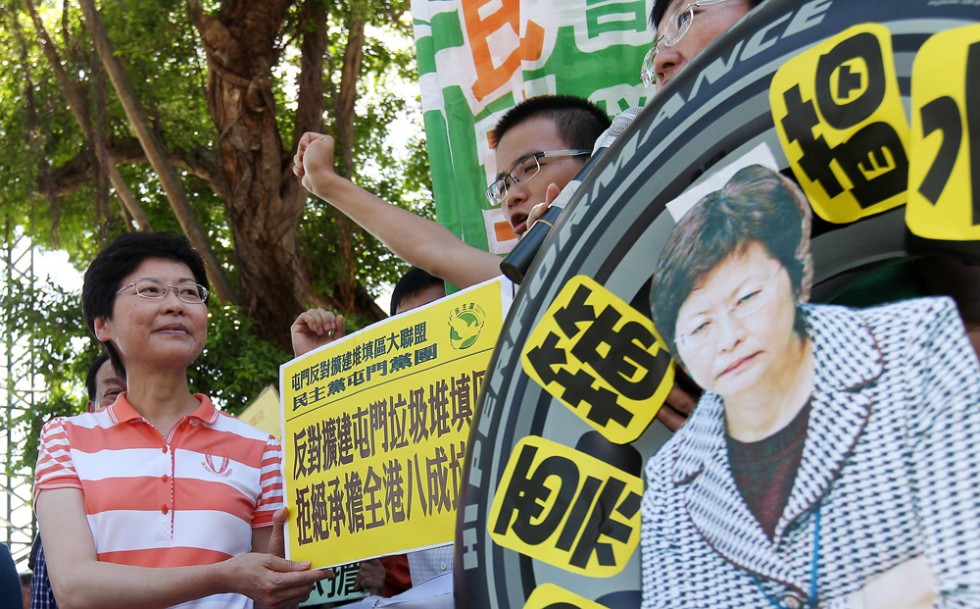
Villagers living near the Tuen Mun landfill were keen to voice their opinions when Carrie Lam (left) visited. Photo: K.Y. Cheng

Carrie Lam visits affected villages to canvass support and hear views of disgruntled residents

The government hoped to reapply for funding to expand the city’s three landfills early next year, Chief Secretary Carrie Lam Cheng Yuet-ngor said yesterday after visiting two villages close to the Tuen Mun facility.

The proposals to extend the Tuen Mun, Tseung Kwan O and Ta Kwu Ling landfills would be tabled in the Legislative Council together. The government tried to seek funding for the expansion from Legco last month, but withdrew the Tseung Kwan O plan amid strong opposition. Lawmakers decided to defer scrutiny of the other two sites.

Lam said this was the first of a series of visits to places affected by the landfills to hear residents’ concerns.

She and Secretary for Environment Wong Kam-sing talked to representatives from Ha Pak Nai village in Yuen Long and Lung Kwu Tan village in Tuen Mun.

Lam said the visit was to fulfil her earlier pledge that she and Wong would visit the three districts most affected by the proposed extension. “We will continue to do these visits and also to engage the stakeholders and to talk with the three district councils,” she said.

However, the visitors were greeted by dozens of protesters when they arrived at the villages and residents said they would oppose any expansion.

Lung Kwu Tan village representative Lau Wai-ping said residents had made multiple complaints about how the landfill was polluting the sea and producing foul smells, but the government had not addressed their concerns properly.

He hoped the government could understand the impact of the landfill on the lives of the villagers.

Ha Pak Nai village representative Cheng Wai-kwan said their village was only 300 metres from the landfill, and residents had endured foul smells for years. “Stopping the expansion is our only request,” he said.

Lam said she recognised the residents’ concerns about the expansion plans. She hoped to work on laws banning unmodified trucks, which leaked, from accessing the three landfills; allowing only construction waste at the Tseung Kwan O landfill; and increasing incentives for people to use refuse transfer stations in the summer.

Topics:

Tuen Mun landfill


Source URL (retrieved on Aug 9th 2013, 6:35am): http://www.scmp.com/news/hong-kong/article/1295289/landfill-plans-will-be-retabled-2014-says-chief-secretary-carrie-lam

Protest as top officials visit landfill

http://rthk.hk/rthk/news/englishnews/news.htm?hightlight&20130808&56&941014

08-08-2013

audio

http://www.rthk.org.hk/rthk/radio3/hongkongtoday/images/Subpage_12.gifhttp://www.rthk.org.hk/rthk/radio3/hongkongtoday/images/Subpage_15.gif

Wendy Wong reports

audio

http://www.rthk.org.hk/rthk/radio3/hongkongtoday/images/Subpage_12.gifhttp://www.rthk.org.hk/rthk/radio3/hongkongtoday/images/Subpage_15.gif

Chief Secretary Carrie Lam

http://www.rthk.org.hk/APSuppics/mfile_56_941014_1.jpg

Protest against landfill extension. Photo: RTHK.

Dozens of villagers living near a landfill in the north-west New Territories have staged a protest as the Chief Secretary, Carrie Lam, and the Environment Secretary, Wong Kam-sing, visited the site.

The villagers have been complaining about the landfill’s stench and are strongly opposed to its planned expansion.

Speaking after meeting the villagers, Mrs Lam, said the visit showed the government was committed to addressing their anxieties.

Lung Mei activist confident on judicial review for artificial beach plan

Thursday, 08 August, 2013, 3:35pm

News›Hong Kong

ENVIRONMENT

Ernest Kao ernest.kao@scmp.com

The first hearing for a judicial review request over the government’s decision to allow an artificial beach near Tai Po is to begin as early as Monday morning, says an activist group.

Ho Loy, a member of Save Lung Mei Alliance who is asking the court to stop beach construction, had applied for leave for judicial review at the High Court in June on grounds of a flawed environmental impact assessment by the government.

“We are very confident that the court will grant leave to us as all our indications have been based on pure science and fact,” said Ho, who is filing the request under her name. “I am sure the court will make a fair and impartial judgment.”

Ho, whose separate application for legal aid has yet to be approved, said she expected the legal campaign to be prolonged but “winnable” and expected initial legal fees to be upwards of about HK$200,000. She said she did not expect a result until after September.

“We had intended to push for a later court date, but lawyers from the opposition refused and we are now being forced to appear before court next week,” Ho said. “If the court case takes longer, we do expect legal fees to increase…possibly to about HK$1 million or more.”

The alliance on Thursday called on supporters to donate HK$300 each for the legal campaign. It said it hoped to gather at least 1,000 donations.

https://www.scmp.com/sites/default/files/styles/236w/public/2013/08/08/photo_2.jpg?itok=cNodsFbj

Ho is also asking the court to order new environmental assessments for the project, which began in June. The assessments would evaluate measures to protect nearly 200 marine species said to inhabit the site, including the rare Hippocampus kuda species of spotted seahorse.

A 200-metre artificial beach is to be built on the site for HK$200 million.

But a marine and ecological impact assessment by the Civil Engineering and Development Department in 2006 concluded that Lung Mei “contained mainly low-quality habitats”. The assessment was commissioned by the Environmental Protection Department.

“The environmental assessments were not serious, not to mention the huge amount of conflict of interest,” said Roy Tam Hoi-ping of Green Sense. “Impact assessments paid for by the government or by developers can never be conducted independently.”

Alliance member Paul Zimmerman said: “If we cannot raise enough money then Loy will have to make the decision whether she wants to continue or not… but this will be better judged after the first court hearings and when the legal aid application has been completed.”

Topics:

Lung Mei beach


Source URL (retrieved on Aug 8th 2013, 5:55pm): http://www.scmp.com/news/hong-kong/article/1295254/lung-mei-activist-confident-judicial-review-artificial-beach-plan

Top officials face landfill protest

08-08-2013

http://www.rthk.org.hk/APSuppics/mfile_56_940931_1.jpg

Opposition to landfill expansion. File photo.

Villagers living near a landfill in the north-west New Territories plan to demonstrate later today when the Chief Secretary, Carrie Lam, and the Environment Secretary Wong Kam-sing visit.

The villagers have been complaining about the landfill’s stench and strongly oppose its proposed expansion.