Clear The Air News Blog Rotating Header Image

July, 2013:

Violent clashes over plan for incinerator in Guangzhou

Published on South China Morning Post (http://www.scmp.com)

Home > Violent clashes over plan for incinerator in Guangzhou


Violent clashes over plan for incinerator in Guangzhou

Saturday, 20 July, 2013, 12:00am

NewsChina

· 14666f5435456738cc318cb16adafc5c.jpg

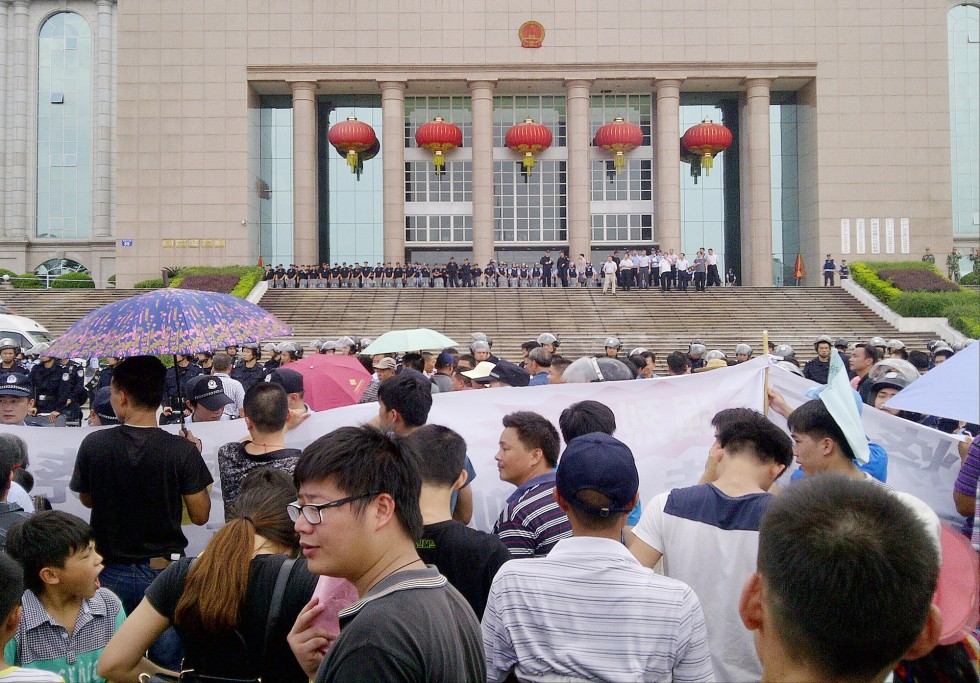
Protesters outside the government headquarters. Photo: Mimi Lau

CIVIL UNREST

Suspected protest leaders rounded up after four injured in running battles with police as thousands take to the streets of Guangzhou

Riot police rounded up about a dozen people late last night in a raid on Qianjin village, Guangzhou, the site of a planned incinerator, after violent clashes earlier in the day.

Officers moved in hours after police used force to disperse thousands of protesters in Huadu district following a series of running battles. At least four protesters were injured during protests involving as many as 10,000 people at times.

It was the third large-scale rally in two weeks to fight the proposed refuse incinerator in Shiling township, a national hub for leather-goods manufacturing.

Villagers said the riot police who took part in last night’s raid were armed with helmets and shields and that they took away suspected leaders of the protest.

Despite a heavy police presence, protesters broke through police barricades at about 11am to enter Huadu Plaza, an open area outside the district government headquarters. They then marched along some of Huadu’s busiest roads, bringing traffic to a halt in many areas.

Chanting slogans and waving banners, demonstrators claimed the incinerator would “damage their health” and turn Shiling into a “death zone”.

Things got violent after the crowd returned to the Huadu district government headquarters at about 2.30pm and called on district officials to respond to their demands. Some protesters pushed on police lines while others threw water bottles and hit police with sticks.

Police injured at least four men with batons and arrested another man. Two of the injured men appeared to be unconscious and required medical attention.

Protesters lowered the national flag to half-staff outside the government headquarters.

At 5.30pm, police began to use force to disperse the some 2,000 protesters left in the plaza, chasing them with batons. It was cleared by 6pm.

Protesters said the city should learn a lesson from Likeng village in the city’s Baiyun district. Residents there complain that the air, ground and water supply have been severely polluted by two incinerators there.

“If we don’t keep on fighting, there will be no home to go back to,” said a 30-year-old Shiling bag maker. “We don’t want to be the next Likeng, move the incinerator elsewhere and work on other ways to reduce garbage.”

Such environmental protests have been on the rise across the mainland. The Huadu clashes come just days after large protests in the Guangdong city of Jiangmen forced local officials to cancel plans for a uranium processing plant.

Some of yesterday’s protesters said they had been warned not to take part.

Huadu officials announced plans to locate the incinerator in Qianjin village earlier this month. The project is expected to be finalised on August 30, with an environmental assessment ready in February, and construction to start in June next year.


Source URL (retrieved on Jul 20th 2013, 6:13am): http://www.scmp.com/news/china/article/1286568/violent-clashes-over-plan-incinerator-guangzhou

http://www.youtube.com/watch?v=fzeeSMRR_9k

Friends of the Earth board acts to calm waters after resignation

Published on South China Morning Post (http://www.scmp.com)

Home > Friends of the Earth board acts to calm waters after resignation


Friends of the Earth board acts to calm waters after resignation

Tuesday, 04 June, 2013, 12:00am

NewsHong Kong

ENVIRONMENT

Cheung Chi-fai chifai.cheung@scmp.com

Friends of the Earth board appoints interim CEO to appease staff worried about governance

Friends of the Earth’s board of governors will not ask its chairman to take over the group’s top administrative post after the former head resigned amid mistrust between the board and staff.

https://www.scmp.com/sites/default/files/styles/486w/public/2013/06/04/nsdfjkhsdjkghsdfkg.jpg?itok=4W7nNzo7Chan May-ling resigned as chief executive without explanation last Friday after serving in the role for two years.

Her sudden departure has raised fears over how the group is being governed.

The chairman, Robert Yeung Man-kin, told staff of the decision yesterday in a move that might ease tension, at least temporarily.

Yeung said Merrin Pearse, head of communications and strategy, would be acting CEO until Chan’s successor was found through an open recruitment process.

Staff cautiously accepted the appointment as a compromise until the group’s annual general meeting on 20 June, when a new chairman will be elected.

Last Friday Yeung, a former oil firm executive, said he was on good terms with Chan.

But he did not directly respond to allegations about her departure that were widely reported the next day.

It is believed staff are angry that some board members are too hands-on in daily operations.

But Yeung denied there was too much intervention.

“There is neither over-managing nor micro-management,” he said.

Media reports also mentioned the performances of particular board members, with one being branded a “tumour” on the organisation by another member.

Board member Carlos Lo Wing-hung yesterday confirmed the “tumour” talk in what he described as a “free discussion” among members.

“It is just a generic analogy and is of the speaking style of a particular board member,” he said.

Lo also defended the board’s performance, saying its members had a legitimate right to set the visions and missions for the staff to follow.

“It is difficult to define excessive intervention. The board is always the driver of the organisation,” he said.

Lo also confirmed the board had discussed the possibility of asking a board member to be acting chief executive officer because it could be arranged quickly.

But Ng Cho-nam, a director of the Conservancy Association, said an overlap between the management and board was not desirable.

“Checks and balances might be compromised if there is an overlap,” he said.

Ng said the Hong Kong Council of Social Service had guidelines for its member welfare groups so that such overlap could be avoided.

There was also similar advice from the Independent Commission Against Corruption.

Ng said there needed to be a sound structure that could both avoid over-relying on particular individuals in running the group and too much rigidity that prevented experienced people from contributing to the group continually.

Friends of the Earth Hong Kong was established in 1983.

The group now has about 12,000 members.

Topics:

Friends of the Earth


Pollution threats stir delta residents to action

Published on South China Morning Post (http://www.scmp.com)

Home > Pollution threats stir delta residents to action


Pollution threats stir delta residents to action

Saturday, 20 July, 2013, 12:00am

NewsChina

PEARL BRIEFING

He Huifeng

Following a series of pollution threats, residents could be in for a long battle for the environment

Pearl River Delta residents haven’t had to worry too much about serious pollution threats, but that all changed this month.

Xu Qiaoyin , a teacher and native of Jiangmen , now living in Shenzhen, is among a growing number of delta region residents increasingly worried about toxic risks affecting what they call “our dear home”.

“I would have thought that contamination was only the concern of the backward and developing hinterlands. And suddenly, overnight, we find all kinds of pollution on our doorstep,” Xu said.

Xu’s fears are not groundless as Guangdong residents see one pollution crisis after another affect the land they harvest, the air they breathe and the water they drink.

On July 6 the Hejiang River, a tributary of the Pearl River – a drinking source for the delta – was found to contain excessive amounts of heavy metals thallium and cadmium after a large number of fish died. Since then, the county government has warned the water utility and residents not to drink or catch fish from the river.

The news triggered fear among residents of several cities in the delta because the Hejiang River’s source is in neighbouring Guangxi autonomous region and flows into the Xijiang River, a main artery of the Pearl River that provides most of the water for Zhuhai , Zhongshan , Guangzhou and Macau.

Local authorities apologised for the river pollution in a public statement to residents on July 10 and assured them that the water supply to the delta was still safe for consumption.

Although thallium and cadmium are toxic and samples indicated that the concentration of thallium was 0.00022 milligrams per litre, or 1.2 times the allowed maximum level, Zhou Quan , director of the environment inspection bureau of the Guangdong Environmental Protection Department, told Guangzhou Daily that, “China has the strictest standards for thallium in surface water, 20 times stricter than Japan’s limit. Water in the Hejiang River still falls within Japan’s standards for drinking water.”

“Fish turned up dead in the river. But it’s still safe to drink for Japanese,” lamented Wu Qianxing , a Guangzhou native. “I’m just speechless after the official’s comments.”

In June, residents in the delta were informed that nearly half the rice they bought in local markets could contain excessive levels of cadmium, mostly from neighbouring Hunan province.

Now they might have the same worries about vegetables. Some 28 per cent of the soil in the Pearl River Delta contains heavy metal pollutants, according to a report submitted by the Guangdong Land and Resources Bureau to the provincial people’s congress on July 10.

The report says 50 per cent of the land in Guangzhou and Foshan, both industrial hubs in the delta, is contaminated. This explains previous reports that vegetables in the region had excessive levels of heavy metals.

“I used to think that locally grown food and vegetables tasted better, and were fresher and healthier. Now, I worry when shopping at the wet market,” said teacher Xu. “I don’t know whether the vegetables I buy are grown on poisoned land. I’m going to feed them to my three-year-old daughter.”

To ease growing public concerns over soil pollution, Chen Shaomeng , deputy head of the agricultural bureau in Shaoguan in northern Guangdong, issued a statement saying that rice with excessive amounts of cadmium was not considered “poisoned” and that it would be safe for consumption after a year or two.

As well as concerns over polluted rivers and farmland, residents took to the streets in Jiangmen on July 12-13 to protest about air quality after authorities announced plans for a 37-billion-yuan (HK$46.5 billon) uranium fuel processing plant.

Residents of Guangzhou, Shenzhen, Hong Kong and Macau said they took part in the rallies because they all breathe the same air in the delta. “My parents received calls from relatives in Jiangmen and went back by high-speed rail that weekend to fight for our hometown,” Xu said.

The many young protesters tried to get the attention of the overseas media. “Thanks to Hong Kong and Macau media, they helped us to have our voices heard in the outside world,” one demonstrator said.

After the protests, authorities decided to suspend the uranium processing plan.

Residents protesting against environmental degradation could be in for a long fight.


Hong Kong set to plug into Italy’s Tazzari Zero electric car

Published on South China Morning Post (http://www.scmp.com)

Home > Hong Kong set to plug into Italy’s Tazzari Zero electric car


Hong Kong set to plug into Italy’s Tazzari Zero electric car

Saturday, 20 July, 2013, 12:00am

BusinessCompanies

VEHICLES

· 059c02ee2dac0d257e9c4e0f83501125.jpg

The Tazzari Zero is now a fully fledged electric car. Photo: SCMP

Anita Lam anita.lam@scmp.com

Aficionados of tiny two-seater cars will have a new option by the end of this month when a small local dealer introduces the Italian Tazzari Zero electric vehicle to the city.

Although the model debuted in 2009, no local dealer wanted to bring it to Hong Kong. Despite its cute appearance, a top speed of 95km/h and a range of 145 kilometres on one charge – comparable to those of Mitsubishi’s i-Miev and Daimler’s Smart Car – the vehicle could be registered only as a quadricycle, which is not allowed on highways.

But Fortune Dragon, the local dealer that will launch an updated version of the lithium-battery-powered vehicle on Friday, said the carmaker, an Italian firm with a background in aluminium casting and other engineering services, finally upgraded one of its models into a full-blown passenger car last year.

That means it passed crash tests and met more stringent safety standards.

While the revised model is priced at a hefty HK$350,000, the dealer said the fuel cost was as low as 15 HK cents per kilometre – about a tenth of an average power-saving petrol vehicle.

The Zero is controlled mainly by pressing buttons. A green button on the dashboard is used to switch gears, and four other buttons provide various driving modes – race, economy, standard and rain – that offer different throttle characteristics.

Drivers who have tested the car have given mixed reviews about its performance.

Electric-powered vehicles remain a niche market in Hong Kong, despite various incentive programmes and increasing government efforts to build more chargers.

As of the end of April, only 443 of the 700,000 registered vehicles in the city were run purely on electricity.


Source URL (retrieved on Jul 20th 2013, 6:30am): http://www.scmp.com/business/companies/article/1286579/hong-kong-set-plug-italys-tazzari-zero-electric-car

Avoiding waste and recycling are the best way to solve Hong Kong’s environmental challenges

Published on South China Morning Post (http://www.scmp.com)

Home > Avoiding waste and recycling are the best way to solve Hong Kong’s environmental challenges


Avoiding waste and recycling are the best way to solve Hong Kong’s environmental challenges

Saturday, 20 July, 2013, 12:00am

CommentLetters

I refer to the letter by J. R. Paine (“HK needs not one, but three incinerators [1]“, July 13).

· scmp_09jul13_ns_recycling6_sam_3684a_36879193.jpg

Activist says recyclers are swamped by waste. Photo: Sam Tsang

Friends of the Earth (HK) has been lobbying the government to focus on reducing the generation of waste through appropriate policies, namely, waste charging, producer responsibility and landfill bans.

The crux of our waste problem is our disposal mentality, where we tend to dispose and buy again, rather than save things for reuse.

As a result, Hong Kong generates more waste per capita than other comparable jurisdictions such as Tokyo and Seoul.

In the full spectrum of waste management, we need to reduce, reuse and recycle our waste (which rank higher in the waste management hierarchy), so as to reduce its volume before any thermal treatment or disposal of it at landfills (which rank lower). Our government’s past documents state the benefits of focusing on upper-level methods of the waste management hierarchy, though it seems it is still concentrating on lower-level strategies.

Incineration is one method of reducing the volume of waste, but if we do not implement meaningful waste avoidance policies, the city will rely heavily on thermal treatment methods that destroy many useful recyclable materials by turning them into ash (which requires landfill disposal).

With a little planning, these recyclables can instead be retained as raw materials available for reuse by different industries.

Singapore is a classic reference for us to consider, as it relies heavily on incineration and does little on waste avoidance, and still claims to have reached a recycling rate of 58 per cent in 2010. Singapore’s four incinerators service a current population of only about 5.3 million.

The reason for industrial solid waste and glass being dumped in Hong Kong’s landfills is mainly because there is a lack of waste avoidance policies, coupled with our government not providing subsidies to recyclers to recover low-value recyclables such as glass.

Glass should not be dumped into landfills, as used glass can be recycled to make new glass-based products.

Whether landfills are on land or at sea, they have a limited lifespan. However, if we control our seemingly unquenchable desire for consumption, and design products for recycling ease, these are the most effective and eco-friendly solutions to our growing waste challenges.

Edwin Lau Che-feng, director, general affairs, Friends of the Earth (HK)


Links:
[1] http://www.scmp.com/comment/letters/article/1281426/letters-editor-july-13-2013

VIDEO: Biorefinery Turns Starbucks Waste in Sustainable Products in Hong Kong

http://www.waste-management-world.com/articles/2012/08/video-biorefinery-turns-starbucks-waste-in-sustainable-products-in-hong-kong.html

VIDEO: Biorefinery Turns Starbucks Waste in Sustainable Products in Hong Kong

http://www.waste-management-world.com/etc/designs/default/0.gif

Sponsored by

http://imagec14.247realmedia.com/RealMedia/ads/Creatives/default/empty.gif/0

Biorefinery National Meeting & Exposition of the American Chemical Society30 August 2012

A new ‘biorefinery‘ intended to transform biowaste into key building blocks for the manufacture of renewable plastics, laundry detergents and scores of other everyday products has been successfully tested using waste from Starbucks in Hong Kong.

A report on the project – launched in cooperation with the Starbucks restaurant chain (NASDAQ: SBUX), which was seeking a use for spent coffee grounds and stale bakery goods – was made the 244th National Meeting & Exposition of the American Chemical Society.

“Our new process addresses the food waste problem by turning Starbucks’ trash into treasure – detergent ingredients and bio-plastics that can be incorporated into other useful products,” explained Carol S. K. Lin, Ph.D., who led the research team at the City University of Hong Kong.

The idea took shape during a meeting last summer between representatives of the nonprofit organisation called The Climate Group and Lin at her laboratory at the City University of Hong Kong.

The Climate Group reportedly asked Lin about applying her transformative technology, called a biorefinery, to the wastes of one of its members – Starbucks Hong Kong. To help jump-start the research, Starbucks donated a portion of the proceeds from each purchase of its “Care for Our Planet Cookies” gift set.

A new kind of biorefinery

According to Lin her team already had experience in developing the technology needed to do it – a so-called biorefinery, which can convert plant-based materials into a range of ingredients for biofuels and other products.

“We are developing a new kind of biorefinery, a food biorefinery, and this concept could become very important in the future, as the world strives for greater sustainability,” added Lin.

“Using corn and other food crops for bio-based fuels and other products may not be sustainable in the long-run. Concerns exist that this approach may increase food prices and contribute to food shortages in some areas of the world. Using waste food as the raw material in a biorefinery certainly would be an attractive alternative,” she continued.

Lin went on to describe the food biorefinery process, which involves blending the baked goods with a mixture of fungi that excrete enzymes to break down carbohydrates in the food into simple sugars. The blend then goes into a fermenter where bacteria convert the sugars into succinic acid.

Succinic acid topped a U.S. Department of Energy list of 12 key materials that could be produced from sugars and that could be used to make high-value products ― everything from laundry detergents to plastics to medicines.

Biorefinery Turns Starbucks Waste in Sustainable Products in Hong KongAdded benefits

In addition to providing a sustainable source of succinic acid, the new technology could have numerous environmental benefits, said Lin.

For example, Hong Kong produces nearly 5000 tonnes of used grounds every year. Currently, this waste is incinerated, composted or disposed of in landfills. Lin’s process could potentially convert these piles of foul-smelling waste into useful products.

Additionally, Lin claimed that the carbon dioxide that is produced is reused during the biorefining process, and that because succinic acid and its products (such as bio-plastics) are made using bakery waste as a renewable feedstock, they are sustainable alternatives to products made using petroleum.

The method isn’t just for bakery waste – Lin said she has also successfully transformed food wastes from her university’s cafeteria and other mixed food wastes into useful substances with the technology.

According to Lin the process could become commercially viable on a much larger scale with additional funding from investors.

“In the meantime, our next step is to use funding we have from the Innovation and Technology Commission from the Government of the Hong Kong Special Administrative Region to scale up the process,” she said. “Other funding has been applied to test this idea in a pilot-scale plant in Germany.”

The scientists acknowledged support from the Innovation and Technology Commission in Hong Kong, as well as a grant from the City University of Hong Kong.

A video of Lin explaining the technology at the National Meeting & Exposition of the American Chemical Society can be seen below:


Video streaming by Ustream

€310m Hong Kong & Macau Waste Management Contracts for SITA

http://www.waste-management-world.com/articles/2013/07/310m-hong-kong-waste-management-contracts-for-sita.html

€310m Hong Kong & Macau Waste Management Contracts for SITA

19 July 2013

By Ben Messenger
Managing Editor

http://www.waste-management-world.com/etc/designs/default/0.gif

http://imagec14.247realmedia.com/RealMedia/ads/Creatives/default/empty.gif/0

€310m Hong Kong & Macau Waste Management Contracts for SITA SUEZ Environnement

SITA Waste Services has won two new 10 year contracts in Hong Kong, worth around €110 million, while one of its subsidiary companies has renewed a €200 million contract in Macau – also over 10 years.

According to SITA – a subsidiary of SUEZ Environnement (Paris: SEV, Brussels: SEVB) – the contracts include the management of the North Lantau Transfer Station, worth €35 million and the marine transportation of dewatered sludge, worth €75 million, while the Macau contract is for cleaning services.

Under the 10-year contract for North Lantau, which started in June 2013, Sita Waste Services will manage waste for the largest of Hong Kong’s islands, including the waste of Hong Kong International Airport, Disneyland Park and Tung Chung New Town.

With a current design treatment capacity of 650 tonnes of municipal solid waste per day, the company said that the transfer station will see its throughput almost double to 1200 tonnes a day in the next few years after completion of upgrading works.

The dewatering contract has been awarded by a new client for SITA, Hong Kong’s Drainage Services Department (DSD1), and has been awarded to the 50-50% partnership between SITA Waste Services and ATAL Environmental.

Under the contract the company explained that two self-propelled ocean going vessels will be designed and constructed for transferring and transporting dewatered sludge from the Waste Water Treatment Plant to the sludge Treatment Facilities.

These new vessels will feature built in diesel-electric hybrid engines, which the company said are more efficient and environmentally friendly.

SITA said that it has already gained over 15 years’ experience in marine transfer of containerised waste while operating and managing six other transfer stations in Hong Kong.

Engineering and the contract will commence on 1 November 2013.

€310m Hong Kong & Macau Waste Management Contracts for SITAMacau

SITA Waste Services, via its subsidiary Companhia de Sistemas de Residuos de Macau (CSR), has also been re-awarded the contract for the provision of urban cleaning services and waste collection and disposal in Macau for a further 10 years.

The contract represents an overall revenue of more than €200 million and will start in November 2013.

Under this contract, SITA said that it will support the community to improve the quality of life of Macau’s residents by reducing waste generation and further increasing the recovery of recyclable waste.

SUEZ ENVIRONNEMENT said that it has operated in Hong Kong for over twenty years now, and currently operates two landfill sites handling over 7000 tonnes of waste per day, six transfer stations and seven rehabilitated landfills. It also offers collection, composting and recycling services.

“China’s need for professional waste management services is growing rapidly,” commented Jean-Louis Chaussade, CEO of SUEZ ENVIRONNEMENT.

Read More

SUEZ Backs Organic Wastes to Renewable Chemicals Firm in UK
Redcar, UK based Solvert, which is developing technology to recycle organic wastes into renewable chemicals, has been backed by an investment from French environmental services giant, SUEZ Environnement and its subsidiary, SITA UK.

SITA Wins Contracts for 3 Waste Transfer Stations in Hong Kong
SITA Waste Services has won two contracts in Hong Kong for the redevelopment and operational management of three waste transfer stations

VIDEO: Biorefinery Turns Starbucks Waste in Sustainable Products in Hong Kong
A new ‘biorefinery‘ intended to transform biowaste into key building blocks for the manufacture of renewable plastics, laundry detergents and scores of other everyday products has been successfully tested using waste from Starbucks in Hong Kong.

Paraguay Paraguayan landfill orchestra makes sweet music from rubbish

http://www.guardian.co.uk/world/2013/apr/26/paraguayan-landfill-orchestra-music

http://www.youtube.com/watch?v=UJrSUHK9Luw

landfillharmonic

Paraguayan style recycling

recycled orchestral instruments

Govt urged to subsidise recyclers

http://rthk.hk/rthk/news/englishnews/news.htm?hightlight&20130719&56&936379

Govt urged to subsidise recyclers

19-07-2013

http://www.rthk.org.hk/APSuppics/mfile_56_936379_1.jpg

Calls to government to subsidise waste recycling industry. File Photo

A green group and recycling companies, have urged the government to directly subsidise the industry.

Friends of the Earth says 9,000 tonnes of waste is being dumped in landfills every day, and a quarter of it is recyclable.

The group’s Director of General Affairs, Edwin Lau, says many companies only choose to recycle higher value materials.

He said the governmenet should subsidise these firms to process low-value waste. He said this could help alleviate the burden on the territory’s landfills.

Hong Kong must exhaust all other options before building third runway

Published on South China Morning Post (http://www.scmp.com)

Home > Hong Kong must exhaust all other options before building third runway


Hong Kong must exhaust all other options before building third runway

Friday, 19 July, 2013, 12:00am

CommentInsight & Opinion

Albert Cheng

Albert Cheng suggests ways the Airport Authority could raise its handling capacity, not least by better co-ordinating its airspace traffic

The Airport Authority recently ran newspaper advertisements to pave the way for its plan to build a third runway and engage the public over the ongoing environmental impact assessment of the project.

I have always objected to a third runway, mainly because the airport still has not fully utilised the capacity of the existing two runways. Building a third runway is not only a waste of resources; it will also seriously affect the nearby natural environment.

The problem stems from the fact that the director general of civil aviation is trying to play safe and has thus limited aircraft movements to 64 flights per hour for the two-runway system. By 2015, aircraft movements are expected to reach 68 per hour.

This is way below international standards. Take Heathrow for example. Its two runways handle up to 80 aircraft movements per hour.

If only Hong Kong could shake off its conservative management mindset, the airport could almost certainly immediately increase its runway capacity to reach international standards. That way, we could save resources and wouldn’t need a third runway.

In fact, when the airport was still under construction, a British aviation consultant set the hourly aircraft movements at 75. But civil aviation chief Norman Lo Shung-man said aircraft movements could only reach 68 by 2015, rejecting what the consultant had said.

What could be the reasons for these restrictions? One is that our airport cannot increase the hourly aircraft movements due to our restricted airspace. In other words, the airspace congestion problem is not caused by a traffic bottleneck on the runways, but by the limited airspace.

Former civil aviation chief Albert Lam Kwong-yu said previously that the Hong Kong and national aviation authorities had already reached a consensus on how to manage the airspace to the north of the airport. But the current chief appears to have rejected this consensus and chosen a regressive path instead.

That’s why we should look again at the option of expanding air space in the north.

I also wonder about the Airport Authority’s motives for building a third runway. It seems motivated by a sense of grandeur, rather than practicality, and is looking to expand to secure its existence.

A third runway won’t really resolve the problem; even this new runway would not be fully utilised.

Another reason why the runways are underutilised is the lack of professional talent. The civil aviation department blames a lack of locally trained air traffic controllers for not being able to raise the number of aircraft movements.

This is a rather backward-looking attitude. If we have a shortage of controllers, why not recruit overseas professionals? With more air traffic controllers, we can boost runway capacity and the airport would be able to handle more aircraft movements.

Lo and his department just seem full of excuses and are resistant to change.

Another point worth focusing on is synchronising our computer communication system with that of the mainland aviation authority. Hong Kong uses the American Raytheon system at the air traffic control centre, while the mainland uses the French Thales system.

If we can synchronise our computer systems, no doubt we would be able to further enhance communication and help boost traffic capacity.

I am not blindly objecting to airport expansion, but cost effectiveness is important.

At present, our airport is rather busy and congested mainly because of a lack of areas to park aircraft. To resolve this, we don’t need a third runway, but rather a third terminal to increase parking spaces.

With the mainland’s rapid economic development, the role of Hong Kong’s airport as an international aviation hub will gradually diminish, as it is replaced by the airports in Guangzhou and Shenzhen as economic expansion focuses on the Pearl River Delta.

Even if our airport is not replaced completely, the shift of focus will lessen our role and competitive edge. That’s why building a third runway would be ineffective and would only create a white elephant.

Hong Kong needs development, but not ineffective development that ultimately turns into wasteful white elephants and stirs public opposition and discontent.

We should focus our resources and strengths to further enhance our development advantages. We need to always be one step ahead in our mindset to remain in a leading position. To increase our competitiveness and advantages doesn’t mean expansion.

A sensible approach is to increase our airport’s hourly aircraft movements to 75 and build a third passenger terminal as soon as possible. Big is not always effective – substance is far more important.

Albert Cheng King-hon is a political commentator. taipan@albertcheng.hk [1]


Links:
[1] mailto:taipan@albertcheng.hk