Clear The Air News Blog Rotating Header Image

January, 2012:

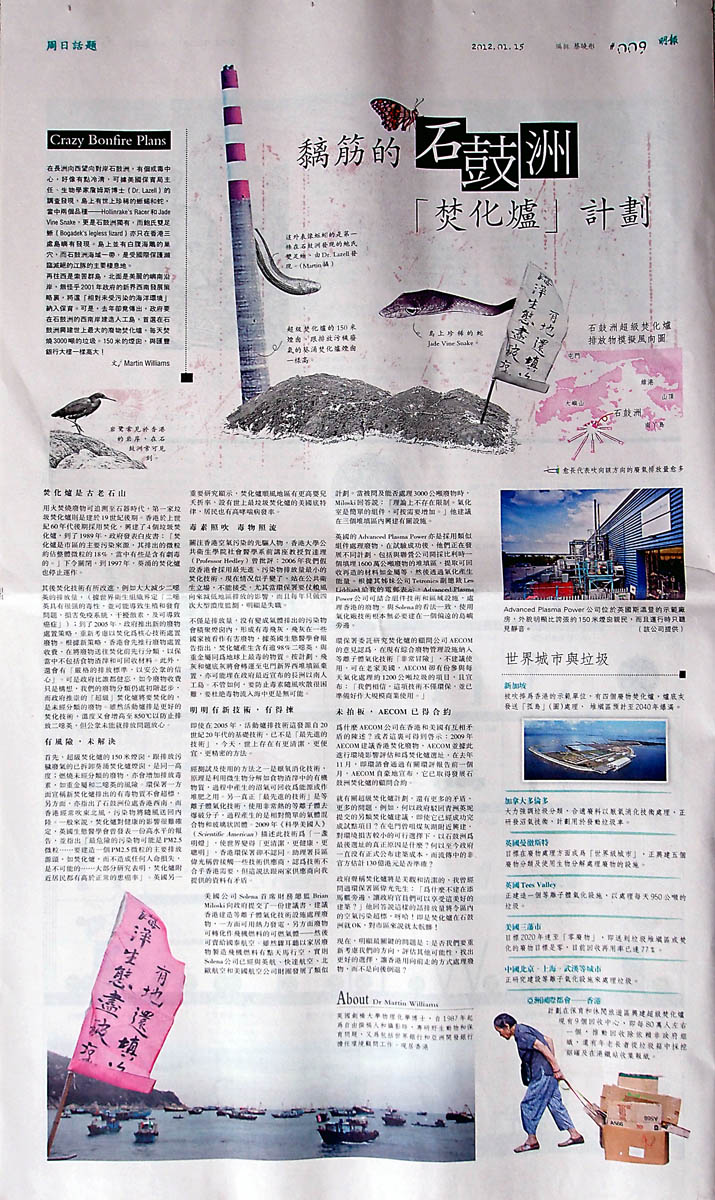
Crazy Shek Kwu Chau “Bonfire” Plans

Ming Pao – 15 Jan 2012

Crazy Shek Kwu Chau “Bonfire” Plans

If you’re on Cheung Chau, look west across the harbour, and you’ll see a small island: Shek Kwu Chau. It appears deserted, but hosts a drug rehabilitation centre.

Wildlife surveys led by US biologist Dr James Lazell, director of the Conservation Agency, have discovered reptiles including two snakes – Hollinrake’s Racer and a sub-species of Jade Vine Snake – that are unique to the island, along with Bogadek’s legless lizard, which is known from only three Hong Kong islands. This is one of perhaps eight nesting sites for white-bellied sea-eagle in Hong Kong. Waters along the west coast are key haunts of Hong Kong’s small population of Indo-Pacific finless porpoise, which the International Union for the Conservation of Nature classes as Vulnerable to global extinction.

With the Soko Islands further west, and the beautiful south coast of Lantau to the north, it’s not surprising that in 2001 a government development strategy for the southwest New Territories included a plan to “protect and conserve the relatively unspoilt marine environment while providing recreational and educational opportunities to the public in these areas”.

Yet there was a surprise last year, when the government determined that Shek Kwu Chau was the preferred location for building one of the world’s largest waste incinerators, burning 3000 tonnes of waste per day. Plans call for this to be on an artificial island, constructed just off the southwest coast of Shek Kwu Cha, in prime porpoise habitat. It will be an industrial site with a 150-metre chimney – almost as tall as the HSBC Bank Building.

The incinerator plans have met widespread opposition for a host of reasons, including the damage to wildlife and fisheries, severe impact on scenery in a beautiful area, and massive financial cost. Seventeen groups including Friends of the Earth, Greenpeace Hong Kong, Green Sense and the Living Islands Movement have signed a joint statement outlining their concerns. Plus, incinerator technology is dated, likely threatening public health – and there are cheaper, cleaner, more sophisticated ways to deal with Hong Kong’s waste than simply setting fire to it.

Incineration Dates from the Stone Age

Incineration – using fire as a means of waste disposal – dates back to the Stone Age. The first waste incinerators were built in the late 19th century.

From the late 1960s, Hong Kong turned to incineration to reduce the volume of waste sent to landfills. Four waste incineration plants were built, but in 1989 a government white paper on pollution noted, “Incinerators are a major source of pollution in the urban areas. They account for approximately 18% of all respirable particulates emitted into the atmosphere of the territory and can be a source also of trace quantities of highly toxic substances.” The incinerators were phased out, with the last of them – at Kwai Chung – ceasing operation in 1997.

Incinerator technologies have since improved, such as through greatly reducing emissions of dioxins which, according to the World Health Organization, “are highly toxic and can cause reproductive and developmental problems, damage the immune system, interfere with hormones and also cause cancer”. In 2005, the Hong Kong government published a strategy for dealing with waste, with plans including use of “state-of-the-art technology to treat unavoidable waste in a cost-effective, yet environmentally sustainable, manner”. Conveniently forgetting the 1989 white paper, this announced the core technology would be incineration.

According to the strategy, Hong Kong would first introduce charging for waste disposal; and before waste was sent to the incinerator it would be sorted, so would not include food waste or recyclable materials. Plus, there would be “stringent emission standards that command public confidence”.

It seems the government has since proven even more forgetful. Waste charging remains just an idea, we have little waste separation, and the incinerator will burn predominantly unsorted waste.  Though the government makes much of the incinerator using a moving grate for better burning, plus temperatures of around 850C to safeguard against dioxins, there is strong public concern instead of confidence concerning the likely emissions.

Potential Health Hazard

Even the incinerator’s planned design seems cause for concern – as it’s 150 metre chimney will be the same height as the chimney of the dirty and demolished Kwai Chung Incinerator Plant. Burning unsorted waste will increase the risks of emissions including toxins such as heavy metals and dioxins. Though the Environmental Protection Department claims there will be low levels of toxins, it also highlights the fact that Shek Kwu Chau is in southwest Hong Kong, so prevailing northeasterly winds will often blow away from the territory.

As so often with air pollution, it can be hard to be certain about health impacts of waste incinerators. The British Society for Ecological Medicine has produced one of the best reports on the issue, outlining a host of potential and likely problems, and noting, “probably the most dangerous pollutant of all is the PM2.5 particulate … it is not possible to build a major source of PM2.5 particulates, such as an incinerator, without lives being lost… The majority of studies around incinerators have shown excesses of cancers.”

In the UK, a major study will soon begin assessing evidence suggesting there are significantly higher rates of infant mortalities in areas downwind of incinerators. Other apparent health effects include high rates of asthma around the world’s largest waste incinerator, in Detroit, US.

“In 2006 we assumed that any incineration technology adopted in Hong Kong would be state-of-the-art and ensure that pollutant emissions were minimized to the greatest possible extent,” comments one of Hong Kong’s staunchest campaigners for cleaner air, Professor Anthony Hedley, former Chair Professor of Community Medicine at the University of Hong Kong. “This now appears not to be the case and is unacceptable from a public health viewpoint.  This is especially so, given that the EPD is apparently defaulting to depending on air movement to mitigate the impact of emissions locally and will only monitor mass concentrations four times a year.”

It is not only the emissions that are cause for concern. Pollutants that don’t escape as gases will be trapped in the chimney, forming fly ash so toxic that in many jurisdictions it is treated as hazardous waste. According to the British Society for Ecological Medicine, fly ash contains over 98% of dioxins produced by an incinerator together with heavy metals, “making it some of the most toxic material on the planet”.

Plans call for the fly ash plus ash from below the flames to be dumped in the West New Territories Landfill, north of Tuen Mun. Yet there are suspicions that the government’s recently announced plan for a possible artificial island south of Cheung Chau is at least partly to create a more suitable site for dumping the ash. No matter where the ash is headed for, it will be hard to prevent it being blown by the wind, and surely impossible to prevent the toxins escaping into coastal waters over time.

Alternative Technologies: Tried and Tested, and World-changing

Even in 2005, moving grate incineration was far from “state-of-the-art technology”; it was based on techniques first developed in the 1920s. Today, it seems even more primitive – and there are cleaner, cheaper, more sophisticated ways of treating waste.

One way that’s tried and tested is called anaerobic digestion. This involves using micro-organisms to break down organic matter such as food waste – creating methane that can be burnt to produce energy, along with compost. But partly as Hong Kong has little need for compost, its development is rudimentary here.

Another way is truly “state-of-the-art”, and is based on using extremely hot plasma to blast molecules apart, resulting in relatively simple gas mixtures and glassy solids. In 2009, Scientific American described plasma gasification as “lighting in a bottle”, and featured it among “20 Ways to Build a Cleaner, Healthier, Smarter World”.

The Environmental Protection Department seems determined that plasma gasification will not build a cleaner Hong Kong. Deputy director Elvis Au says they have contacted a few technology suppliers, which indicated they cannot meet Hong Kong’s needs.

This assertion conflicts with information from two suppliers. Brian Miloski, Chief Financial Officer of US company Solena, has submitted a proposal to build plasma arc facilities that would treat all Hong Kong waste, using heat to generate electricity, and combining components of the resulting gas to create jet fuel – which could be bought by Cathay Pacific. Though creation of jet fuel from domestic waste seems futuristic, Solena is already working on plans for similar plans together with British Airways, Qantas, SAS, and a consortium of American Airlines. Asked if the process can treat 3000 tonnes of waste per day, Miloski replied, “There is no theoretical limit. The gasification chambers are simple modular and you add on as many as you need.” He advises building the facilities at the three landfills.

UK based Advanced Plasma Power adopts a similarly modular approach to waste treatment. After successful trials with a demonstration plant, they are developing projects including a joint venture to mine over 16 million tonnes of waste from a Belgian landfill, extracting recyclable material such as metal and using gasification to create energy. According to an email to me from Les Liddiard, vice president of sister company Tetronics, Advanced Plasma Power can treat Hong Kong waste, using a combination of modular approach and regional facilities. Just as with Solena, there’s no need to build the gasification plants beside a remote island

The EPD’s consultant for the incinerator project, Aecom, considers that, “scaling up the plasma gasification technology for adoption in the present IWMF [Integrated Waste Management Facility] project would be very risky and hence not advisable.” And yet … in the US, Aecom is involved in a project to gasify about 1200 tons of waste per day, and announced, “We believe that this technology is not only environmentally friendly but ready for large-scale commercialization.”

Contradictions, Questions and Politics

Why such contradictory statements by Aecom in Hong Kong and the US? Well, you might want to consider this: in 2009, Aecom advised that Hong Kong should use incineration; Aecom then conducted the environmental impact assessment to select the site for the incinerator; and in November last year – a month before the environmental impact assessment process was complete – Aecom proudly announced it had been awarded a consultancy contract for developing the incinerator.

There are more contradictions, more questions, regarding the mega incinerator plans. For instance, why has the government dismissed an alternative incineration proposal by Green Island Cement, even though it has conducted a successful pilot project? What are the real reasons Shek Kwu Chau is considered a suitable site for a mega incinerator, especially as the alternative – at Tsang Tsui, near Tuen Mun, is lagoons with power plant ash, of minimal environmental value? Why has no official construction cost been given, and are unofficial estimates of HK$13 billion accurate?

The government claims the incinerator will be attractive, and clean. I once asked Elvis Au: “So why not build it beside Tamar, so government officials can enjoy looking at it?” He replied that the emissions would make the area’s air quality worse than permitted by the Air Quality Objectives. Aha, so this means the incinerator is ok for Shek Kwu Chau, but too dirty for the city.

Now, the key question to ask is surely: Is this time to reconsider our direction, assess possibilities, and find better options, so Hong Kong shows the way forward for waste treatment, not the way backward?

World Cities and Waste

Singapore

Touted as a role model for Hong Kong, with four waste incinerators, and ash sent to a landfill “island” that will be full by 2040.

Toronto, Canada

Strong emphasis on separation of waste, with suitable materials processed by anaerobic digestion. Producing biogas, and aims to use this to power waste trucks.

Manchester, UK

Aiming to become a “world-class city” in terms of waste treatment, building five centres for separation and biological treatment of waste.

Tees Valley, UK

About to build a plasma gasification facility to treat 950 tonnes of waste per day.

San Francisco, US

Adopting a “zero waste” strategy, in which nothing would go to landfills or be incinerated. Currently recovers 77 percent of the materials it discards, with goal of zero waste by 2020.

Hong Kong, Asia’s World City

Plans to build mega-incinerator in beautiful area earmarked for conservation and leisure tourism. Nine recycling centres – around one per 800,000 people, with waste separation and recycling partly reliant on non-governmental organizations, and elderly ladies digging cans from waste bins and collecting newspapers at subway stations.

Dr Martin Williams

I have a PhD in Physical Chemistry from Cambridge University, UK; obtained this through conducting experiments in which used a strong electrical discharge to blast apart water molecules, and followed reactions with a laser. Lived in Hong Kong since 1987, working mainly as freelance writer and photographer specialising in wildlife and conservation issues, as well as environmental consultant, including for World Bank and the Asian Development Bank.
Should Hong Kong build a third airport runway?

http://www.smartplanet.com/blog/global-observer/should-hong-kong-build-a-thi
rd-airport-runway/1999

By Vanessa Ko | December 31, 2011, 12:03 AM PST

HONG KONG – Airport Authority Hong Kong said Hong Kong International Airport
will need to add a new runway – it’s third – in order to meet future demands
of cargo and passenger traffic.

But its proposal will cost taxpayers $17 billion, after factoring in
inflation, making it the city’s most expensive infrastructure project yet.

Critics are calling for a thorough environmental assessment before any
decision is made, but time constraints will make such a report unlikely: the
government will decide over the next few months whether to give the proposal
the green light.

Hong Kong’s airport has the most world’s most air-cargo traffic and last
year was third in terms of international air passenger flow, behind London
and Paris.

The two existing runways are expected to be saturated in use by 2020 if a
third one is not added. The new runway would be built on reclaimed land
extending from the airport’s location on Lantau Island.

To further bolster the proposal, the AAHK announced on Thursday that a
survey of the public found three quarters of respondents support the
three-runway plan – a “clear consensus,” as the AAHK said in a statement.

Few question that the addition is necessary for Hong Kong to maintain its
hub status. It is estimated that the project would also help bring in $117
billion in economic benefits over 50 years until 2061. These benefits
include the creation of thousands of jobs.

But critics say overall benefits are diminished by environmental drawbacks.

The Civic Party, a liberal democratic party, has called for a detailed
environmental assessment. Such a study would measure the effect that
construction and dredging might have on surrounding waters (populated by
rare dolphins that are cute to boot) as well as the level of noise pollution
for residents in the area.

WWF in Hong Kong has questioned whether evolving carbon-tax rules might
lower the expected demand for flights, and has expressed concern over
increased greenhouse gases as a result of busier aviation traffic.

Photo: Wikimedia Commons/Toyotaboy95

Start your week smarter with our weekly e-mail newsletter. It’s your cheat
sheet for good ideas. Get it.

Comments
Donald Tsang empire building – never mind the air we breathe

The PRD mega companies like Foxconn have moved out to Chongqing and Hubei.
PRD workers from Jan 1st will have a pay increase mandated again. The
aircargo that used to come from PRD to world airports via HKG is now far
reduced. The aircargo in 2011 was down 18+% on the previous year.They intend
to build a fast rail tunnel between HK airport and Shenzhen airport. This is
a good idea since Shenzhen has more domestic flights than HK to China
airports. Meanwhile UPS has based its asian hub at Shenzhen airport 50 kms
from HK. Shenzhen’s second runway is in operation and they are building a
third. Federal Express asian hub is in Guangzhou which intends to have 5
runways. In order to fuel the HK airport with cargo the HK Govt decided on
another white elephant (beyond the white elephant fast rail to nowhere 30kms
east of Guangzhou) – that is the HK Zhuhai Macau road traffic only bridge.
This is to connect the HK Government’s (through its full owned subsidiary
Airport Authority of Hong Kong) 55% joint venture stake in Zhuhai airport
which has no international flights. Meanwhile all the landing slots in the
PRD are controlled by China’s military and HKG has failed so far to get any
approval of additional landing slots from them.
For the first time in years (because the HK Civil Aviation Authority refuses
to hire skilled competent air traffic controllers from overseas) there were
three near misses on Chep Lap Kok approaches in 2011. Meanwhile HK has the
eighth worst PM2.5 particulate matter suspended in air, in the world already
and Tsang has done next to zero to rid Hong Kong of its pathetic air quality
other than to further pander to the construction tycoons.

Rare Chinese white dolphin gets DNA bank

http://www.mysinchew.com/node/69034

Description: http://www.mysinchew.com/files/preview/292x300..1401201218.jpg

A Chinese white dolphin or Indo-Pacific humpback dolphin, nicknamed the pink dolphin, swims in waters off the coast of Hong Kong. Photo courtesy: AFP

HONG KONG, January 14, 2012 (AFP) – A Hong Kong conservation group said Saturday it has set up a DNA bank for the rare Chinese white dolphin, also known as the pink dolphin, in a bid to save the mammals facing a sharp population decline.

There are about 2,500 Chinese white dolphins in the Pearl River Delta region, the body of water between Macau and Hong Kong, with the majority of the mammals in Chinese waters and the rest in Hong Kong.

But experts say their number has dropped significantly in the past few years due to overfishing, an increase in maritime traffic, water pollution, habitat loss and coastal development.

In a bid to save the dwindling population, the Ocean Park Conservation Foundation Hong Kong said it had joined hands with a Chinese university to set up a DNA bank, which will also spearhead a genetic research project.

“We hope to offer the scientific community a standardised genetic analysis platform to assess the sustainability of Chinese white dolphin populations,” Judy Chen, the foundation chairwoman said in a statement.

“The collected data will provide important reference to governments in the region for developing critical strategies of Chinese white dolphin conservation,” she added.

The biological samples of these dolphins will be sent to the DNA bank to investigate the environmental impacts on the mammal, the statement said.

The Chinese white dolphins, a sub-species of the Indo-Pacific humpback dolphins, are unique for their pink skin. They are listed as “near threatened” by the International Union for Conservation of Nature.

The mammal was the official mascot at the handover ceremony when the former British colony returned to Chinese rule in 1997, while dolphin watching is a favourite tourist attraction in Hong Kong.

Its population in Hong Kong has dropped from an estimated 158 in 2003 to only 75 in 2010, according to the Hong Kong Dolphin Conservation Society.

Is Hong Kong’s pollution driving expats away?

Saturday 14 January 2012

Telegraph.co.uk   http://www.telegraph.co.uk/expat/expatnews/9004912/Is-Hong-Kongs-pollution-driving-expats-away.html

The news that air pollution levels in Hong Kong were at a record high last year comes as little surprise to the expats who live in its smog

Description: A ferry crosses Hong Kong harbour under heavy smog

A ferry crosses Hong Kong harbour under heavy smog Photo: Paul Brown/Rex Features

By Leah Hyslop

9:20AM GMT 11 Jan 2012

2 Comments

According to a report published in The South China Morning Post earlier this week, air quality in Hong Kong was 10 times worse last year than in 2005, with pollution levels recorded at three roadside monitor stations above the “very high” mark more than 20 per cent of the time.

Such heavy pollution has obvious implications for the health of Hong Kong’s residents, who it is feared are at an increased risk of everything from respiratory problems to cancer, but also casts a shadow over the city-state’s future as a top international business centre.

Hong Kong is home to thousands of expat workers, many filling crucial positions in its thriving banking and finance sector, but the relentless grey haze which hangs over the former British colony could be increasingly driving those who can afford it to settle elsewhere.

Last year, a report from office supplier Regus revealed that an astonishing three-quarters of companies in Hong Kong saw pollution as a problem in recruiting and retaining international talent, while a survey by the American Chamber of Commerce in Hong Kong found that nearly half (48 per cent) of its members knew of professionals who had left to escape the contaminated air.

Sylvia, a British banker who did not wish to give her full name, claims to know many expats who have returned to their home countries because of pollution, or asked for transfers to other major Asian hubs such as Singapore – largely, she says, due to health concerns.

“A friend of mine used to get plenty of headaches and migraines when he lived in Hong Kong for a few years; when he returned to the US the migraines stopped overnight,” she explains. “Another friend’s husband has a job here in Hong Kong but since his wife and daughter have asthma, they live in Singapore and he commutes here during the week.”

For those expats who choose to remain in Hong Kong, the desire to escape the smog often dictates where they live. Teacher Linda Kernan, originally from Kent, has ended up seeking refuge on one of Hong Kong’s outlying islands, where there are no cars. Even so, on some days from her flat she can barely see the high rise buildings just a few miles away over the sea.

“The air quality does seem to be getting worse,” she says. “When I arrived here 17 years ago, there were many more days with a blue sky but now they are few and far between. Before Christmas I had to spend about five hours walking around with a friend, waiting for his evening flight. When we walked through town I could feel my throat getting steadily worse and by evening it was painful to talk. It starts with a prickly throat and develops into a sore throat if you stay on the busy roads.

“I have four years left to retirement, and I would love to stay in Hong Kong, but I think I will have to put my health first and leave.”

So why exactly is Hong Kong’s pollution so bad? A reason often cited is its location at the mouth of China’s Pearl River Delta region, a booming economic centre home to over 70,000 factories, but the city’s own industrial emissions, heavy traffic and tall buildings which trap contaminated air in a so-called “canyon effect” are also major factors. The government has taken some steps to combat the problem in recent years – including introducing a ban on leaving stationary vehicles’ engines running for more than three minutes – but local pressure groups such as the Clean Air Network insist that more changes are necessary.

How much damage the pollution issue could end up wreaking on Hong Kong’s attractiveness as a business centre is subject to hot debate. Sylvia admits that there is a long-term risk that “Hong Kong will lose top talent and industry to its rival Singapore,” but believes that even if many expats leave, the economy will not be seriously hurt.

“There’s hundreds of Westerners arriving every day,” she says simply. “The downturn in Europe means there are more and more people seeking work, and more companies relocating their staff here. Hong Kong’s economy has always been better than most; it experiences downturns but then it recovers very quickly.”

Hans Leijten, the regional vice president for Regus in East Asia is not so sure however. “Singapore is seen as a much greener and cleaner alternative, and it is gaining a competitive edge particularly when it comes to expats with families,” he warns.

“While Hong Kong’s economy and job market are still extremely strong and it remains a top destination for expatriates, the quality of the environment and its effect on their health is certainly weighing heavily on the minds of those working there.”

Cut methane and soot to curb warming: scientists

South China Morning Post – 14 Jan 2011

Pollution reduction measures would lead to US$6.5tr in annual gains from fewer deaths, less global warming and increased crop yields

An international team of scientists says it has figured out how to slow global warming in the short run and prevent millions of deaths from dirty air: Stop focusing so much on carbon dioxide.

They say the key is to reduce emissions of two powerful and fast-acting causes of global warming – methane and soot.

Carbon dioxide is the chief greenhouse gas and the one world leaders have spent the most time talking about controlling.

Scientists say carbon dioxide from fossil fuels like coal and oil is a bigger overall cause of global warming, but reducing methane and soot offers quicker fixes.

Soot is also a big health problem, so dramatically cutting it with existing technology would save between 700,000 and 4.7 million lives each year, according to the team’s research published online on Thursday in the journal Science.

Since soot causes rainfall patterns to shift, reducing it would cut down on droughts in southern Europe and parts of Africa and ease monsoon problems in Asia, the study says.

Two dozen scientists from around the world ran computer models of 400 different existing pollution control measures and came up with 14 methods that attack methane and soot.

The idea has been around for more than a decade and the same authors worked on a United Nations report last year, but this new study is far more comprehensive.

All 14 methods – capturing methane from landfills and coal mines, cleaning up cook stoves and diesel engines, and changing agriculture techniques for rice paddies and manure collection – were being used efficiently in many places, but not universally adopted, said the study’s lead author, Drew Shindell of Nasa.

If adopted more widely, the scientists calculate that would reduce projected global warming by 0.5 degrees Celsius by 2050.

Without the measures, the global average temperature is projected to rise nearly 1.2 degrees in the next four decades. But by controlling methane and soot, the increase is projected to be only 0.7 degrees.

It also would increase the annual yield of key crops worldwide by almost 150 million tonnes.

Methane comes from landfills, farms, drilling for natural gas, and coal mining.

Soot, called black carbon by scientists, is a by-product of burning and is a big problem with cooking stoves using wood, dung and coal in developing countries and in some diesel fuels worldwide.

Reducing methane and black carbon is not the very best way to attack climate change, air pollution, or hunger, but reducing those chemicals are among the better ways and work simultaneously on all three problems, according to Shindell.

And shifting the pollution focus does not mean ignoring carbon dioxide. Shindell said: “The science says you really have to start on carbon dioxide even now to get the benefit in the distant future.”

The new research won wide praise from other scientists, including a conservative researcher who held a top post in the George W. Bush administration. “So rather than focusing only on carbon dioxide emissions, where we have to make a trade-off with energy prices, this strategy focuses on ‘win-win-win’ pathways that have benefits to human health, agriculture and stabilising the Earth’s climate,” said University of Minnesota ecology professor Jonathan Foley, who was not part of the study. “That’s brilliant.”

John Graham, who oversaw regulations at the Office of Management and Budget in the Bush administration and is now dean of public and environmental affairs at Indiana University, said: “This is an important study that deserves serious consideration by policymakers as well as scientists.”

The study even does a cost-benefit analysis to see if these pollution control methods are too expensive to be anything but fantasy. They actually pay off with benefits that are as much as 10 times the value of the costs, according to Shindell. The paper calculates that as of 2030, the pollution reduction methods would bring about US$6.5 trillion in annual benefits from fewer people dying from air pollution, less global warming and increased crop production.

A case of too little too late on dirty air

South China Morning Post – Lai See 13 Jan 2012

The latest report from Civic Exchange on Hong Kong’s air quality, “Air Quality: Report Card of the Donald Tsang Administration (2005-2012)”, is a damming indictment of the chief executive’s efforts to improve Hong Kong’s noxious air.

It points to a litany of half measures, outright failures, dilatoriness, evasion and poor governance. You do not get a sense from reading this report that the government is in any hurry to do anything meaningful about improving the quality of the air we breathe. The impression is one of a government bending over backwards not to improve it. Its prevarication over the introduction of new air quality objectives (AQOs) being one example.

Hong Kong’s were set in 1987 and at the time were close to those of the World Health Organisation. The AQOs set the limits for emissions above which public health is impaired. The WHO has since revised its guidelines twice, while Hong Kong has implacably retained the outdated AQOs. The effect of this, the report says, is that the WHO guidelines are frequently exceeded in Hong Kong at the roadside by a factor of four or five times.

Unsurprisingly this has impacted on public health. According to the Hedley Index, which uses a peer-reviewed methodology to measure the effect of air pollution on health, smog has directly resulted in some 7,240 premature deaths, 528,388 avoidable hospital bed days and 49.26 million avoidable doctor visits from January 2005 to December 2011. The index assesses the cost of the dirty air to Hong Kong at HK$15.43 billion during the period. These figures have not been challenged by the government or medical practitioners.

The government makes much of its one big success, which is in sharply lowering sulphur dioxide emissions that was achieved by making Hong Kong’s power companies fix scrubbers to power stations. The government tries to pretend that Hong Kong’s air pollution is largely a regional problem and can only be solved in collaboration with officials in the Pearl River Delta. In so doing, it seeks to sidestep the issue that the most concentrated air pollution occurs at street level largely as a result of dirty engines in buses and trucks. The Hong Kong government can solve this issue. Instead, it drags its feet and wastes time with watered down idling-engine legislation.

One point the Civic Exchange reports spells out very clearly is that government reluctance to introduce new air quality objectives is largely because they would make it impossible to proceed with new infrastructure projects such as the Hong Kong-Zhuhai-Macau bridge, the third runway and possibly the new incinerator. This is because each project requires an environmental impact assessment (EIA) report that has to be approved, and the AQOs are a key part of these reports. The EIA for the bridge had to be finished to secure approval, but it will be harder to fudge EIAs in future, Civic Exchange warns. The impression given by the government is that it is playing a kind of administrative game, but seems oblivious to the harmful effects of air pollution on public health. In stark contrast to the Hong Kong government’s approach of seeking to avoid setting targets as a basis for policy, the mainland has recently set aggressive new AQOs with a view to driving policy. Civic Exchange has a second report entitled, “Principles and Measures To Improve Air Quality Policy Recommendations for a New Administration”. Find both atwww.civic-exchange.org

Pollution data released after outcry over smog

South China Morning Post – 13 Jan 2012

Authorities in smog-plagued Beijing yesterday began releasing hourly readings of three major air pollutants, in an apparent bid to appease residents angry about the government’s prolonged secrecy over the city’s deteriorating air quality.

The move coincided with a pledge by Mayor Guo Jinlong to tackle smog-causing pollutants, notably PM2.5 – hazardous fine respirable particles with a diameter of less than 2.5 microns – and ozone.

Guo also promised to publish hourly PM2.5 data this year, after a national outcry sparked by persistent smog in major cities since October.

However, environmentalists pointed out that health-threatening pollutants PM2.5 and ozone were still absent from the pollution disclosure.

Pollution readings of sulphur dioxide, nitrogen dioxide and PM10 – large particles less than 10 microns in diameter – are now on a local government-sponsored website of the Municipal Environmental Monitoring Centre. Before yesterday, only daily pollution readings were published.

It comes just a day after local authorities banned media coverage of PM2.5, after apparently being embarrassed by pollution at the start of a government conference. Smog hit Beijing on Tuesday morning, coinciding with the opening of this year’s session of the Municipal People’s Political Consultative Conference.

Pan Shiyi , a property tycoon and congress representative, was confused by the media ban, which came as PM2.5 apparently became the focal point at the meeting.

“Air quality concerns everyone, and that’s exactly what congress representatives should discuss,” he said.

He said releasing PM2.5 data was the start of the process of educating the public about the reality of pollution levels. “Everyone can help tackle the problem after we know how serious the pollution has become.”

Severe air pollution has hit major mainland cities since October.

HK lags behind Beijing on air pollution: lobby

South China Morning Post – 13 Jan 2012

Think tank Civic Exchange says mainland is more aggressive in moving to tackle smog, which has put pressure on city to act on standards for particles

Hong Kong is lagging behind the mainland when it comes to tackling air pollution, a think tank says in a summary of Chief Executive Donald Tsang Yam-kuen’s performance in office.

The conclusion from Civic Exchange came after the environment minister said on Wednesday that the city would measure pollutants smaller than 2.5 micrometres (PM2.5) at all its monitoring stations by March, a week after Beijing pledged to make similar data publicly available.

Former lawmaker Christine Loh Kung-wai, of Civic Exchange, said the mainland’s recent launch of a consultation to upgrade air quality objectives had put pressure on the Hong Kong government, which had yet to update its 24-year-old objectives despite Tsang’s pledge to do so last year.

“The mainland is much more aggressive than Hong Kong in dealing with setting air quality objectives,” she said. “This has happened because Hong Kong’s senior officials lack the understanding and courage to set demanding [objectives] and to use them as a tool to address the epidemic of public health impacts.”

Beijing will publish its PM2.5 data by January 23, Xinhua reported last week. The announcement came after the US embassy in Beijing began releasing its own PM2.5 readings via Twitter.

Civic Exchange’s head of environmental strategy, Mike Kilburn, said though many mainland cities would take years to reach the new emissions targets – released recently for public consultation – the central government had set targets with the aim of driving down pollution levels.

By contrast, Hong Kong set less stringent targets that were easier to achieve, perhaps for political reasons, Kilburn said.

Citing figures from the University of Hong Kong’s Hedley Environmental Index, Loh said more than 7,200 local deaths had been connected to air pollution in the seven years Tsang had been at the city’s helm.

Dr Wong Ming-chit, of the School of Public Health at HKU, agreed with the group’s conclusion that the administration’s ability and commitment to improve air quality – roadside and shipping pollution in particular – was questionable.

“These are problems that haven’t been solved for many years. And these are pressing issues because people’s health is at stake,” he said. “When you think about it, several thousands deaths is a big number. The public panic even when several people die from bird flu.”

The Environmental Protection Department last week revealed that roadside air pollution levels last year were the worst on record.

A consultation on updating Hong Kong’s standards ended two years ago and the government vowed to put the new objectives before the legislature as soon as possible.

PM2.5 refers to suspended particles of 2.5 micrometres or less in diameter. They are smaller and more dangerous to health than PM10, for which the department publishes measurements on its website.

These smaller particles enter the lungs and contribute to many health problems including acute respiratory symptoms and child bronchitis, cause premature death owing to their toxicity, and cause cardiovascular illnesses, according to various studies.

adrian.wan@scmp.com

Clear skies over HK vital for our future

South China Morning Post – 13 Jan 2012

Nothing is more evident than roadside air pollution. We can see and smell when it is poor and our lungs can tell us how bad it is. The Environmental Protection Department’s annual update showing the worst-ever levels in Hong Kong’s busiest districts therefore comes as little surprise. It is disappointing that government assurances and measures are having limited impact and updated targets are still not implemented.

Officials contend there is little they can do. Their reason for the Air Pollution Index being above the “very high” level of 100 for 20 per cent of the time at monitoring stations in Central, Causeway Bay and Mong Kok has been put down to unfavourable weather conditions, worsening background pollution and ageing vehicles. Those figures, 10 times worse than in 2005, continue a worrying trend, particularly for respirable suspended particles and nitrogen dioxide. Blaming low rainfall, sunny days and industrial activity beyond our borders, as the department has done, simply avoids the reality: that the highly polluted air is largely of our own making.

Authorities know exactly what creates the pollution and what must be done to stop it. They know it is mostly caused by Hong Kong’s two electric power stations, harbour traffic and vehicles, especially those that use diesel. But as the watering-down and weakening of the recently implemented legislation on idling vehicle engines indicates, the financial interests of companies are being put ahead of the public. Unless there is a change of priorities, our air will continue to worsen and our health and well-being will suffer.

There are all manner of laws, regulations and guidelines. Authorities have pledged to table new air quality objectives to lawmakers, but the targets are years overdue and on some key pollutants are even less stringent than those set by Beijing’s Ministry of Environmental Protection. As the think tank Civic Exchange has pointed out in two reports assessing the environmental performance of Chief Executive Donald Tsang Yam-kuen’s administration, officials lack the courage to tackle the problem, while those on the mainland are aggressive.

Still, the level of some pollutants has been markedly reduced. Transport companies are being encouraged to take old, highly polluting vehicles out of service and power firms are gradually switching to cleaner fuel. But the measures are obviously not enough.

A telling sign that the government is dragging its feet is a reluctance to adopt standards set by the World Health Organisation 24 years ago. Our city does not lack the financial resources to meet the WHO’s latest goals, nor is there any excuse for a delay. Hong Kong’s reputation and image in part rest on our skies being clear, but there is an even more pressing reason: our health and future are at stake.

Neighbours mull legal bid to stop incinerator

South China Morning Post – Jan 13, 2012

Group warns of ‘last resort’ action as proposed rubbish plant off Lantau Island nears approval

A group of Cheung Chau residents are threatening a legal challenge against a government plan to erect a rubbish incinerator off Lantau Island, as the project nears one of its last remaining hurdles next week.

Tom Hope, a retired lawyer who lives in Cheung Chau, said a judicial review would be a “last resort”, and that the residents still had other action planned to stop the project. The proposal was endorsed by the Advisory Council on the Environment last month and is slated for discussion by the Executive Council and the Town Planning Board next Tuesday.

“We want the government to stop and reconsider other options because there is still time to look at the technology, which seems to be a solution,” Hope said. “The government cannot be doing something wholly unreasonable.

“The primary reason for the incinerator is to alleviate landfills,” he said. “But the incinerator they are proposing will dispose hundreds of tonnes of ash while burning 3,000 tonnes of rubbish a day. There is alternative technology available.”

The technology favoured by the group, plasma arc gasification, has been tried in Canada, Britain and elsewhere. But Hope said one supplier told him the government does not want to explore it.

The Environmental Protection Department said in a statement it had considered other technologies, like plasma gasification, but they were “not suitable because of drawbacks” including an inability to handle a variety of rubbish.

The residents also criticised officials for failing to implement a waste-management plan laid down in 2005, which emphasised waste reduction and recycling over incineration.

The government proposes reclaiming 16 hectares of sea just south of Lantau near Shek Kwu Chau to serve as a site for the incinerator. It would be able to incinerate 3,000 tonnes of rubbish a day and will have a small mechanical sorting facility.

The reclamation would require the loss of 31 hectares of marine habitat, but the government promises to create a 700-hectare marine park between Shek Kwu Chau and the Soko Islands to make up for the damage.

The residents question the environmental impact assessment’s claims that plant emissions would have little effect on Lantau communities because southwesterly winds prevail only 8 per cent of the year. The group says Observatory data shows such winds prevailed 16 per cent of the time over the past two years.

joyce.ng@scmp.com

The incinerator would be built on Shek Kwu Chau.