Clear The Air News Blog Rotating Header Image

Global

New trash cans with smaller openings on the way

The Food and Environmental Hygiene Department (FEHD) will be introducing new trash cans Monday, a statement on the government’s website said.

The new design includes smaller openings for trash and bigger warning notices on the containers telling the public not to discard refuse beside or on top of the bins and to dispose of bagged refuse properly at refuse collection points, it said.

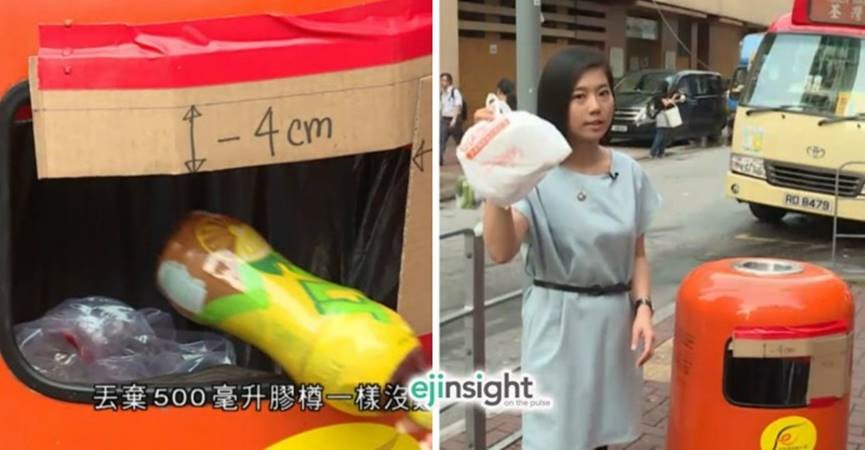
The openings have shrunk from 370 millimeters x 190mm to 230mm x 150mm, the FEHD said.

Smaller openings mean the new trash cans will accept only small pieces of garbage, but not a typical plastic grocery bag of trash. Photos: i-Cable

Smaller openings mean the new trash cans will accept only small pieces of garbage, but not a typical plastic grocery bag of trash. Photos: i-Cable

The department will also introduce, later this year, 70-litre trash cans, with openings reduced in size from 290mm x 190mm to 205mm x 130mm.

An FEHD spokesman reminded the public that it is an offense to deposit waste beside or on top of the containers.

Offenders are liable on conviction to a maximum fine of HK$25,000 (US$3,218) and imprisonment for up to six months.

They may also face a HK$1,500 fine under the Fixed Penalty (Public Cleanliness Offences) Ordinance, the spokesman said.

However, some citizens are disappointed by the change, i-Cable reported.

Far from discouraging people from indiscriminately dumping garbage, the new design will encourage them to litter, they said.

The FEHD also said it is considering further reducing the number of litter containers placed on the streets in various districts later this year, as a similar move last year had a satisfactory result.

Chloe Chow contributed to this article.

http://www.ejinsight.com/20160607-new-trash-cans-with-smaller-openings-way/

Hong Kong drivers caught in surprise police blitz complain over ‘unfair’ fines … despite being illegally parked

Week-long, city-wide crackdown on illegal parking begins

Drivers in Central blackspots were caught out on Wednesday as ¬police launched a week-long, ¬city-wide crackdown on illegal parking.

Those expecting the leniency they were accustomed to were in for a surprise; they ended up complaining that the operation was “unfair”, as police enforced HK$320 fines only minutes after the drivers parked their vehicles ¬illegally, and without warning.

While traffic police swooped on blackspots, the uphill battle against illegal parking was evident as it was back to business as usual when the officers moved on.

A Filipino professional driver was one of those given a ticket for waiting for his boss in a restricted area on Lyndhurst Terrace at around 1pm.

The driver, 56, who refused to give his name, said he had parked there almost every day for the past few years as his boss would have lunch nearby.

“[This is] the first time I have got a ticket in this area. I have worked as a driver in Hong Kong for 20 years,” he said, adding that he was unaware of the police ¬operation, which was announced last week, and questioned whether he had even broken the law.

“This is an open area. There is no sign. Suddenly they came and gave me a ticket … no warning,” he said.

He said the officer, who spoke in Cantonese – a language the driver was not fluent in – would only tell him “it is ticketing time”.

Police have vowed to be tough during the seven-day operation.

Their focus is on double-parking and stopping in restricted zones.

Central and Kowloon Tong – notorious for traffic congestion as a result of illegal parking – were among areas targeted on Wednesday.

A local woman was given a ticket for double parking at noon on the same road in Central where the Filipino driver was caught out.

“I am not familiar with this area,” she said.

“I parked here for just two minutes to pick up some stuff for my kids. Then I got a ticket.”

The officer involved told the woman “even one minute would not work”, as her car was blocking others from turning.

On Wellington Street, the Post saw an officer take only two minutes to ticket a white BMW.

In Yau Ma Tei, a 57-year-old driver and his 44-year-old passenger were arrested for disorder in a public place after they were allegedly uncooperative and yelled at the police officer who fined them for illegal parking.

The driver, surnamed Lam, parked his car outside 3 Waterloo Road.

But in Kowloon City, another notorious blackspot, drivers ¬defied the crackdown with rampant double and triple parking.
________________________________________
Source URL: http://www.scmp.com/news/hong-kong/law-crime/article/1961561/hong-kong-drivers-caught-surprise-police-blitz-complain

Hong Kong to charge glass recycling levy

Fee aimed at ending wholesale dumping in landfills to have major impact on bars and restaurants

Thirsty Hongkongers may have to pay more for drinks sold in glass bottles after the imposition of a levy aimed at ending wholesale dumping of the ¬containers in landfills was given the legislative green light on Friday.

The move – that will have a significant impact on bars and restaurants across the city – targets ¬manufacturers and importers.

Lawmakers yesterday passed an amendment bill to start charging the levy from 2018. The amount has yet to be finalised, but the government has proposed charging HK$1 for every one-litre bottle. The money earned would be used to hire a contractor to collect and process glass bottles.

The majority of lawmakers supported the ¬move, with only five opposing it, including the Liberal Party’s Tommy Cheung Yu-yan, who ¬represents the catering sector.

According to official statistics, the city threw away 204 tonnes of glass containers a day in 2014, ¬accounting for about 2 per cent of solid waste ¬produced daily.

Cheung said he supported protecting the ¬environment, but questioned the effectiveness of the levy in reducing waste and increasing the number of bottles being recycled.

“The government should think about giving tax rebates to caterers and retailers to encourage them to bring glass bottles back [for recycling],” he said.

Cheung warned that the additional cost due to the levy could trickle down to restaurants and bars.

The Liberal Party’s Vincent Fang Kang, who also voted against the proposal, said the levy alone would not solve the problem as there were not enough supporting services in place to deal with the waste.

“Perhaps the government could give incentives, for example in terms of land, tax or loans, to attract foreign and local investors to put money into the glass recycling industry,” he said.

Fang also accused the government of doing little to educate the public about recycling glass.

Lawmaker Wu Chi-wai of the Democratic Party said while he supported the levy, the government should also come up with initiatives to encourage ¬recycling at the community level.

The food and beverage industry is worried about the ¬impact on business.

“If the levy is too high, the costs could be passed on to restaurants and supermarkets, which could in turn increase prices for customers. This could affect business,” Simon Wong Ka-wo, chairman of the Federation of Restaurant and Related Trades, said.

“The HK$1 per one-litre bottle proposed earlier might not seem a lot for a bottle of wine, for example, but for a bottled drink that costs, say, HK$10, the levy would be 10 per cent the price of the drink.”

But Wong said a lower levy could also be ¬problematic. “If the revenue from the levy is not big enough to cover the costs of the recycling, this could lead to a possible future levy on restaurants and supermarkets,” he said.

Wong said his group would seek discussions with the government on details of the scheme.

A bar manager in Central said the levy would ¬likely affect her bar’s profit level.

“It could cost more for us to buy drinks [from ¬distributors] but we can’t charge the customers too much or they won’t come. So that means we will have to make less money,” she said.

Despite the prospect of higher prices for bottled drinks, bar customers did not seem to be worried.

One customer said possible price increases after the levy was enforced would not deter him.

“A small bottle of beer is already HKD$50-$60; how much more can they charge [with the levy]? The levy won’t stop me from heading to the bars to enjoy myself,” he said.

While various voluntary recycling schemes have been introduced over the years, there is no citywide, mandatory recycling scheme for glass bottles.

Official figures show only 1,500 tonnes of glass waste was recovered from 55,000 tonnes generated in 2011.

As of March this year, there were about 1,300 ¬recycling points in residential areas and another 580 in public areas across the city.

The government said it would expand the ¬recycling network in the future.

________________________________________
Source URL: http://www.scmp.com/news/hong-kong/economy/article/1956861/hong-kong-charge-glass-recycling-levy

Biodiversity steering committee ends three years of work ‘disappointed’

Environment Undersecretary Christine Loh Kung-wai apologised to committee members and said she hoped the work their work would continue

Members of a steering committee tasked with preparing the city’s first biodiversity action and strategy plan (BSAP) have ended three years of work without receiving a draft report from the government.

Disappointed members – whose terms expire this month – had expected a draft before their final meeting on Friday but were presented only with a summary of the public consultation results and a rough outline of what the report would cover.

Members pointed out that their 2013 letter of appointment had tasked them with “steering the formulation process”, “consider recommendations” and to “ratify the final draft of the BSAP” before its submission to policymaking bodies.

“We were asked to ratify the document. This was the task we were given and we need to know if our task had been truncated and why,” said member Paul Zimmerman.

Member Ruy Baretto was concerned that the committee was missing out on a crucial step of the process and called on the authorities to present a final draft to them for scrutiny at another meeting. “We are being pushed off the boat before the boat reaches the harbour and this is unacceptable,” he said.

Professor Jim Chi-yung added: “We are all quite disappointed because members had expected a draft report today but all we got was a table of contents.”

Agriculture Fisheries and Conservation Department assistant director Simon Chan Kin-fung believed there may have been some “confusion” with their roles. This was followed by an apology by Environment Undersecretary Christine Loh Kung-wai.

“We could not have given the so-called ratification to another body that is outside the government’s usual framework of dealing with policy,” Loh said. “I hope members will accept our apology and be willing to go on with the process in place.”

Loh also said there were no plans to extend members’ appointments and that the government was ready to finish the report and commence ministerial-level discussions.

She expected the final report to be published within the year.

The government received 2,444 submissions to a three month public consultation, which ended last month. Of these, 126 were individual submissions – most of which came from green groups – 85 were group submissions and 2,231 were standard “templates” submissions.

According to the department’s summary, “many” supported the extension of protected areas and there was “general support” for enriching urban biodiversity.

It acknowledged that green groups demanded 10 per cent of Hong Kong waters to be marine protected areas and that local communities emphasised the need to “respect land rights”. “Some” requested for the review of relevant legislation and policies.

To implement the BSAP plan, the AFCD has been allocated with HK$150 million to spend up to 2019. An advisory body and inter-departmental working group would also be formed to oversee its implementation.

Sadiq Khan to more than double size of London’s clean air zone

New mayor of London calls air pollution ‘our biggest environmental challenge’ and plans to bring the increased ultra low emission zone into force early

https://www.theguardian.com/environment/2016/may/13/sadiq-khan-to-double-size-londons-clean-air-zone-pollution

The new mayor of London Sadiq Khan has made his first major policy announcement, unveiling plans to substantially increase the size of London’s clean air charging zone to tackle the capital’s illegal air pollution levels.

The Ultra Low Emissions Zone (ULEZ) – which could also now come into force earlier than planned – will require drivers of the 2.5m oldest and dirtiest vehicles to pay a charge. Owners of cars that fail to meet the standards will pay a £12.50 charge, separate to the congestion charge.

The scheme is intended to act as an incentive to drivers to use cleaner vehicles or alternative transport to reduce the levels of nitrogen dioxide, a toxic gas produced by diesel vehicles.

Under Khan’s plans, which will now be subject to a public consultation, the ULEZ will stretch from the north to south circular roads in London rather than just the much smaller congestion charge zone in central London as currently planned. Officials said the area covered will more than double in size.

Khan said his predecessor, Boris Johnson, had been too slow to act and had left the city a “laughing stock” internationally, and the government had been “hopelessly inactive” on the issue. Officials said the ULEZ, under a consultation to be published within weeks, could now come into force as soon as 2019 rather than the original plan of 2020.

“I have been elected with a clear mandate to clean up London’s air – our biggest environmental challenge,” Khan said at a school in east London. He said London had only acted on pollution in the past after emergencies, such as the Great Smogs of the1950s: “But I want to act before an emergency, which is why we need big, bold and sometimes difficult policies if London is to match the scale of the challenge.”

The mayor’s office also said an extra charge on the most polluting vehicles would be brought in from 2017, which would be administered by the congestion charge system but be separate to the congestion charge. It is not yet clear what that charge will be.

Khan chatted with pupils and sowed seeds with them at a rooftop garden of a primary school in Aldgate, which is situated on a busy road packed with cars and buses. Sir John Cass’s Foundation is equipped with its own pollution sensors as well as one from the wider London Air Quality Network, decorated with a design created by schoolchildren.

“For me it can’t be right that this school on three occasions last year has to make the call whether to allow children to play in the playground breathing in this dangerous stuff or play indoors,” Khan told the Guardian.

He said the issue was very personal to him because of his asthma, but also as a father of two daughters, and as someone with nephews and nieces. “At the age of 45 I’ve been diagnosed with asthma. All the experts say that one out of three people who have asthma could be because of air quality.”

Khan said that under eight years of Boris Johnson the city’s reputation had gone from: “being one of the world-leading cities [in terms of air pollution], according to people around the world, to being at best mediocre.” He added the city had gone from having an earlier reputation for leadership on climate change and air quality but was now “a laughing stock around the world.”

A study by King’s College London last year found that nearly 9,500 people in the capital die early because of air pollution. Earlier this year it took parts of London just one week to breach annual limits, and a major global study by the World Health Organisation on Thursday found the city breached its guideline limits for two harmful types of particulate pollution.

Alan Andrews of ClientEarth, which has sued the government over the illegal pollution levels in London and other cites, said the mayor’s plan was a “hugely positive announcement”.

“We will have to wait and see if the detail of the mayor’s proposals matches his ambition. With air pollution causing over 9,000 deaths a year in London it is vital that all options to solve this problem are on the table. It will be crucial that the ULEZ ensures vehicles meet the most stringent emission standards when driving on London’s roads, not just in discredited laboratory tests,” he said.

“Today’s announcement, coming so early in the new mayor’s term, should send a clear message to the UK government that ambitious and bold action is needed. The government must now up its game so that the whole country can breathe cleaner air.”

Caroline Russell, Green party London Assembly member, said: “While I warmly welcome the mayor’s intention to expand the ULEZ to the north and south circular, it’s essential that all outer London boroughs should also have the ability to opt in right from the beginning.”

But Friends of the Earth said that while it welcomed such a swift plan and expanded ULEZ, Khan was sending mixed messages by clearing an obstacle to City Airport’s expansion earlier this week. “It is confusing that this announcement comes in the same week that Sadiq Khan has removed a key hurdle in the expansion of City Airport which will only add to London’s dirty air woes,” said its campaigner, Sophie Neuburg.

Barcelona is creating massive, pedestrian-friendly “superblocks” to combat pollution

Pedestrians will soon have more options in Barcelona.

Pedestrians will soon have more options in Barcelona.

http://qz.com/687254/barcelona-is-creating-massive-pedestrian-friendly-superblocks-to-combat-pollution/

Air pollution, noise, and pedestrian accidents plague Barcelona. Like many modern urban areas, the Spanish city has consistently failed to meet air quality standards set by the World Health Organization, and studies attribute more than 3,500 deaths per year in Barcelona to the city’s polluted air. High noise levels from traffic and tourists, as well as scores of pedestrian injuries and deaths, have pushed city officials to create a bold plan they hope will set an example for the rest of the world.

“Superblocks” are at the core of the new plan, which was first outlined in a 102-page report in 2014. By limiting cars and buses to main thoroughfares in the city, urban planners are hoping to encourage people to walk and bicycle more than they do now. Barcelona will add 200 km (124 miles) of bike path to the city’s current total of 100 km (62 miles), and will reroute busses so that all residents have a bus stop within 250 meters of their home.

More room for pedestrian activities.(Urban Mobility Plan of Barcelona PMU, 2013-2018)

More room for pedestrian activities.(Urban Mobility Plan of Barcelona PMU, 2013-2018)

Barcelona’s “Urban Mobility Plan” will be implemented in phases, and starts by targeting the most congested neighborhoods. The Eixample neighborhood, which was built in the mid-1800s to relieve the density of the overcrowded Old City, will be the first to adopt superblocks, according to The Guardian. The neighborhood has only 1.85 square meters of green space per inhabitant, far below the WHO’s suggestion of 9 square meters (97 square feet), while the rest of Barcelona has only 6.6 square meters (71 square feet) of green space per inhabitant, on average.

An aerial view of the Eixample neighborhood.(Alhzeiia/Wikimedia Commons, CC BY-SA 2.0)

An aerial view of the Eixample neighborhood.(Alhzeiia/Wikimedia Commons, CC BY-SA 2.0)

Eixample, which literally means “expansion,” is composed of distinctive octagonal blocks. Nine of these blocks, housing 5,000 to 6,000 people total, will make up one superblock in the city’s new plan. The internal intersections, devoid of cars, will become municipal squares. Each superblock will contain 160 of these squares, which will add a lot of green space.

“This plan sums up the essence of urban ecology,” Janet Sanz, a city councillor for ecology, urbanism and mobility, told The Guardian. “Public spaces need to be spaces to play, where green is not an anecdote—where the neighborhood’s history and local life have a presence.”

Why air pollution is damaging more than just your breathing

The worse the pollution gets, the higher the costs multiply for business

Air pollution caused some 1.6 million people in China to die prematurely in 2013, according to research presented at the American Association for the Advancement of Science (AAAS) early this year.

The University of Hong Kong’s School of Public Health found that air pollution caused some 2,000 premature deaths in Hong Kong and public health costs amounted to HK$27 billion in 2015.

And late last year, severe smog caused the government to issue Beijing’s first ever pollution “red alert”, closing down schools.

Most of us are well aware of the health effects brought by airborne pollution and the resulting costs this brings with it. But less known is the psychological effect it has on our behaviour, and consequently our performance in the workplace.

Such psychological effect is seldom considered when assessing pollution’s true economic impact.

In a recent research study. My research colleagues and I examined the effect of air pollution on workplace behaviour in the city of Wuhan in central China – a country infamous for having some of the most dangerously polluted urban environments in the world.

In our study we focused on a behavioural theory that essentially says that an individual’s self-control draws upon a limited pool of mental resources, one that can be used up and needs opportunities to restore.

Air pollution can drain our self-control resources psychologically, causing a range of conditions including insomnia, feelings of anxiety or even depression.

Through a study of 161 full-time employees across different industries, our research examined how pollution affects two kinds of behaviour – organisational citizenship behaviour and counterproductive workplace behaviour.

Organisational citizenship behaviour relates to employee actions that contribute towards the functioning of the firm, but are optional and not specifically part of their job.

Some might label it “going above and beyond the call of duty” which includes actions such as willingness to be helpful to others, to engage with their team beyond their job scope, or to take action that protects or improves the firm’s image.

The second behaviour is just the flipside. Counterproductive behaviour includes a range of negative employee actions such as working on personal matters during work hours, as well as rudeness, hostility or even outright bullying towards colleagues. A common term for this might be “deviance at the workplace”.

In our research we asked participants to record daily diary entries rating their perception of pollution levels, their level of mental resource depletion as well as organisational citizenship and counterproductive workplace behaviours.

We found a clear link between high air pollution and decreased levels of organisational citizenship behaviour. Likewise increased pollution saw a corresponding and marked increase in counterproductive workplace behaviour.

Taking into account variations for gender and age, we observed that air pollution leads to a decrease in self-control resource, which in turn leads to increased counterproductive and decreased organisational citizenship behaviours. Specifically the data gathered showed that the severity of air pollution accounted for an average of around 10 per cent of an individual’s daily self-control resource depletion.

The impact of air pollution makes us less giving or engaged at work and more deviant.

Moreover, in line with ego depletion theory it is apparent that both the direct physiological impact of air pollution and the individual’s own perception of its severity act to deplete resources affecting self-control.

A worker may experience little or no health effects from pollution while another in the same office may suffer badly. Likewise one individual’s perception of what constitutes “severe” pollution may be very different from another.

An essential factor in determining an individual’s ability to manage the effects of drained self-control resources is the support they receive – or feel they receive – from those around them. For example, demonstrations of active support from the firm can go some way to replenish an employee’s mental resource pool.

Indeed our study also found that the negative effects of air pollution on employees’ behaviour were mitigated when organisational support was high – i.e. when the employee perceived that their supervisor or firm was concerned for their well-being.

We also came across firms taking active steps to tackle the immediate effects of pollution, such as installing more effective air filters in their offices.

Similarly supportive firms might provide additional work breaks or the option to work from home on high pollution days, or they may provide easier and better access to
healthcare.

While this favours an argument that firms should do all that they can to support employees exposed to severe air pollution, all of this comes with a cost to the firm.

The worse the pollution gets, the higher the costs multiply for business – so at a broader level the best option would obviously be if there were no pollution at all.

By conducting studies like ours we can better understand the true social and economic implications of pollution, and in turn add weight to the financial argument for stronger and more effective policies to tackle pollution at source.

And in turn, create a cleaner and healthier environment for Hong Kong and China’s next generation to grow up in.

Sam Yam Kai Chi is Assistant Professor of Management & Organization at the National University of Singapore (NUS) Business School.

Source URL: http://www.scmp.com/business/article/1942630/why-air-pollutiondamaging-more-just-your-breathing

ENB Landfill Lies

Download (PDF, 444KB)

Why electric cars aren’t the best route to truly sustainable transport in Hong Kong

Evan Auyang says a green transport policy must include steps to curb the huge growth in vehicle numbers, adopt more technology, and promote walking and cycling

Hail the adoption of electric cars in Hong Kong! Already a bestseller in the city, electric car maker Tesla recently announced it will soon launch a more affordable model. Crowds lined up at Tesla’s three showrooms across Hong Kong, even though the car won’t be ready until 2017. “It is very important to accelerate the transition to sustainable transport,” declared Telsa’s chief executive officer Elon Musk.

Is Hong Kong finally moving towards a more sustainable transport system? The government is certainly doing its share to promote the adoption of electric vehicles, having built more than 1,000 charging points across the city and offering tax incentives for the purchase of the cars. Indeed, Financial Secretary John Tsang Chun-wah personally leads the Steering Committee on the Promotion of Electric Vehicles, which includes six other secretaries (or their representatives), including the environment, transport and development secretaries, as well as business leaders in the sector. This indicates the importance the government places on the issue.

And let’s not forget, Hong Kong is No 1 in the world in terms of adoption of public transport. Ninety per cent of motorised journeys are made on public transport such as railways, buses and minibuses. This, coupled with the continued building of railways and the introduction of electric buses, plus increasing adoption of private electric cars, must mean Hong Kong is heading towards having the most sustainable transport system in the world, right?

Not quite.

Hong Kong lags significantly behind the rest of the world in at least three areas of sustainable transport policymaking: road space and congestion management; adoption of technology; and embracing cycling and walking as a popular means of longer-distance transport.

First, Hong Kong does not have a good vision of road space usage. This is clear from the worsening congestion on our roads, which is spreading beyond the traditionally busy areas such as Central. Now, traffic jams are common in Kowloon East (supposedly the emerging second central business district), Sha Tin, Tseung Kwan O, Tuen Mun and even Yuen Long.

The cause is the unprecedented rise in the number of vehicles on the roads in recent years, particularly private cars. From 2006 to 2016, the number of private cars has increased by 46 per cent, from 390,000 to 570,000, while the population has risen by less than 7 per cent. This alone accounts for 95 per cent of the increase in the total number of vehicles over the past 10 years. Hong Kong’s road building averages less than 1 per cent (in kilometre terms) per year. This means the number of vehicles is growing much faster than our roads can accommodate.

The impact of uncontrolled vehicle growth cannot be underestimated. As congestion mounts, the road-based public transport system (that is, buses and minibuses), which carries 50 per cent of public transport users, deteriorates in performance. Indeed, average bus speeds have fallen significantly in recent years. Because railways cannot reach all areas of Hong Kong and are generally deemed uncomfortable during peak hours, this would spur the increasing adoption of private cars. A vicious cycle is then produced, of even more vehicles on the road and even more desire to own a car for comfort and convenience. In fact, this is precisely what has been happening in the past few years.

Roads are like the blood vessels of a city – when they clog, economic activity slows. It’s possible to think of a handful of cities that have never lived up to their potential, such as Beijing, Bangkok and Mumbai, as the best international talent does not wish to live in severely congested cities.

Second, Hong Kong has been slow to adopt many sustainable transport and “smart city” practices. While it is truly world-class in its ability to build infrastructure, the city is not at the forefront in the adoption of IT-enabled demand-management tools. For example, many cities have heavily invested in smart information technology systems to control traffic flows, with major roads managed by sensors and cameras. Illegally parked cars are ticketed from traffic control rooms rather than relying on physical enforcement. In Hong Kong, illegal parking takes up 60 per cent of traffic police time.

In congestion-conscious cities like London, smart systems have been implemented to automatically manage traffic flows along major corridors on a real-time basis. Where traffic flows are determined to be less than optimal, algorithms automatically adjust the phases of traffic signals.

Singapore has already established working groups to look into driverless vehicles. By utilising the research and development know-how of the private sector, it is on the cusp of launching a pilot driverless bus service as well as on-demand private driverless car services and shuttles. For Hong Kong to be a truly world-class city, we need to get to the cutting edge of technological adoption, and research and development.

Third, Hong Kong has yet to embrace the truly green options of walking and cycling. Globally, international cities have implemented new policies to promote these non-motorised forms of transport. Cities are now increasingly aware that walking is actually the most efficient and greenest way to travel short distances and, as a result, have invested heavily in widening pavements and closing off vehicle lanes to create green space.

Pedestrianisation around New York’s Times Square has led to a dramatic fall in motorised traffic, while also cleaning up the air and allowing more tourists to take a pleasant stroll and shop in the area. Politically, this was very difficult initially, but citizens embraced the idea soon after it was implemented.

We must recognise that true sustainable transport goes well beyond just applauding the increased adoption of private electric vehicles and upgrading the city’s bus fleet and polluting diesel trucks. A more holistic approach is needed to imagine, then create, greener urban spaces for our future. It takes planning and execution. Moreover, it takes vision, knowledge and political courage to generate the right discussions to enable even small steps to be taken.

Evan Auyang is a board director of the independent think tank Civic Exchange

Source URL: http://www.scmp.com/comment/insight-opinion/article/1940692/why-electric-cars-arent-best-route-truly-sustainable

Hong Kong urged to improve ventilation and use cleaner vehicles to combat cancer threat from pollution

Experts suggest remedies for the city after study highlights health risk from tiny airborne particles

http://www.scmp.com/news/hong-kong/health-environment/article/1941358/hong-kong-urged-improve-ventilation-and-use

A better ventilated city, cleaner vehicles and more pedestrianised areas are among the suggestions by experts to minimise exposure to pollutants after a study confirmed a link between tiny particles in the air and a higher risk of death from multiple cancers.

They also advised the public to maintain a healthy lifestyle.

The study by the University of Hong Kong and the University of Birmingham revealed that the risk of dying from any cancer rose by 22 per cent for every 10 micrograms per cubic metre of increased exposure to PM2.5 – the fine airborne particulates that are small enough to enter the lungs.

According to Clean Air Network, PM2.5 concentrations were highest in Yuen Long and Causeway last year, with annual average readings clocking in at 30 and 37 micrograms per cubic metre of air respectively.

The reading in Central from 7pm to 8pm reached 51 – more than double the World Health Organisation limit of 25.

Other districts with consistently high levels included Tuen Mun, Kwun Tong and Kwai Chung.

HKU’s Dr Thach Thuan Quoc, co-lead author of the study, said while it was difficult for people to avoid PM2.5 there were ways to reduce exposure.

“Air pollutants are everywhere,” said Thach. “Staying on higher floors would help, but that’s related to one’s financial condition.”

Edward Ng Yan-yung, a professor of architecture at Chinese University, said: “Air pollutants could be blown away with a better ventilated city. There should be more space between buildings.”

Ng said space mattered more than height, and wind should enter from the side to blow away air pollutants. Cleaner vehicles would also reduce the source of emissions of the pollutants.

And developing a more specific air pollution alert could prevent people from going to polluted areas.

Clean Air Network chief executive Patrick Fung Kin-wai said the only practical short-term measure residents could take was to avoid heavily polluted areas as much as possible.

“Long-term measures will require changes in transport and planning policy, establishing more low-emission zones and developing more pedestrianisation,” he said.

Dr Stephen Chan-lam, associate professor in oncology at Chinese University, said it was time the government took serious action to tackle air pollution. He advised the public to maintain good health through regular exercise and a balanced diet.

“But while there are unpreventable factors behind cancer such as age, sex, and gene factors, inhaling polluted air is a preventable cause,” Chan said. “The government should review its cancer prevention strategies.”