Clear The Air News Blog Rotating Header Image

China

Govt Optimistic Over Pollution Targets

RTHK – 13-01-2009

The government says Hong Kong is on track to meet targets set for reducing emissions by next year. It said three out of four pollutants – including nitrogen oxide – had already been cut to near these levels. Sulphur dioxide emissions remain high, but the Deputy Director of Environmental Protection, Carlson Chan, told legislators that new systems being installed by the power companies could more than halve such pollution. However, the chairwoman of Legco’s sub-committee on air quality, Audrey Eu, said progress would depend to a great extent on what action is taken on the mainland.

Birth Defects Caused By Environmental Pollution

Stephen Chen, SCMP – Updated on Jan 09, 2009

One-tenth of all birth defects in Jiangsu, one of the mainland’s richest provinces, are caused by environmental pollution, and half of the remaining cases are at least partly related to the environment, according to a five-year medical study in 13 cities.

From 2001 to 2006, the number of birth-defect cases on the mainland rose by 50 per cent to 1.2 million, but there has been no large-sample study to explain why it happened. The biggest data pool on the issue was amassed by the Jiangsu Birth Defects Intervention Programme, which tracked more than 26,000 pregnant women from 2001 to 2005.

The team, led by Hu Yali of Nanjing University, will receive the Chinese Medical Science and Technology Award in Beijing today for its findings, the Chinese Medical Association confirmed yesterday.

Researchers found the most prevalent defect was congenital heart disease. The disease, closely related to air pollution, is often fatal and difficult to detect. The situation is particularly severe in some hospitals lacking proper equipment and trained staff.

Cleft lip was the second-most-common condition and also related to air pollution. Unlike heart disease, the defect can be detected by ultrasound and is not fatal, but many parents chose to abort fetuses with the condition, fearing that it might lead to some other, more severe defects.

The third most frequently reported disease was congenital hydrocephalus, or excessive fluid in infants’ brains, which, according to some overseas studies, is sometimes a result of vehicle exhaust emissions.

“Birth defects have become the single biggest killer of mainland infants,” Dr Hu was quoted by the Nanjing Morning Post as saying.

Jiangsu’s defect rate, about 1 per cent, is about one-sixth of the national average. In poorer provinces, or areas with heavy industry, the figure is much higher. But mainland studies about the relationship between the environment and birth defects have been limited.

A 2007 study carried out in Taiyuan , capital of coal-rich Shanxi , showed that the abundance of small particles in the air, a major contributing factor to the mainland’s air pollution, was a significant reason for miscarriage, birth defects and neonatal deaths.

A study by the Shenzhen Maternal and Child Health Institute last year found that the city’s birth-defect rate was higher than the national average, indicating that birth defects did not necessarily go down as income increased. Urban dwellers typically make more money than people outside cities.

Health education was an effective way of countering the problem, the Jiangsu study found. The children of workers, farmers, poorly educated people and low-income groups were the most at risk of birth defects, the study said.

A programme involving more than 3,000 families in the province showed that even simple education about precautionary measures could dramatically increase would-be parents’ awareness of the dangers, helping doctors make correct diagnoses and take preventive measures.

The mainland was in desperate need of key intervention technology and standardised practice, Dr Hu said. In one district of Wuxi , only 15 couples took premarital medical tests in 2005 after the government abandoned mandatory testing – a change that raised the risk of birth defects. Medical personnel also needed better education and training, the study said.

Workable Solution: China Wants Better, Cleaner Industry For Tomorrow, But Needs Jobs And Stability Today

Joseph Cheng, SCMP – Updated on Jan 08, 2009

The Guangdong leadership has been promoting industrial upgrading in the Pearl River Delta for many years, and this is perceived as the inevitable path of economic development. The processing factories in the delta are mainly labour-intensive manufacturing; their products are low value-added with minimum technological content. They are also responsible for the region’s environmental pollution. Hence, their demise is considered progress.

In the last two or three years, labour shortages in the delta have been pushing up wages, and industrial land is in short supply. The Guangdong authorities are also eager to tackle the issue of environmental protection, as pollution has had an adverse impact on the quality of life. These are obvious intermediate and long-term trends, and are not unexpected.

In early 2007, the Guangdong leadership began to take active steps not only to promote industrial upgrading, but to exert pressure on the processing factories in the delta as well. Hong Kong businessmen in the region felt the pressure.

Their plight was exacerbated by other developments. China’s export boom and huge trade surpluses pushed the yuan higher, and the Bush administration in the US, as well as other western governments, exerted pressure on Beijing to further appreciate its currency.

The Labour Contract Law was scheduled to be fully implemented at the start of 2008, which added a range of pension and insurance expenditure to the wages bill. Most processing factories operate at very low profit margins, sometimes only 3 per cent to 5 per cent, and it was natural that some had to cut back, relocate or even close down.

The Guangdong policy was in line with the central government’s broad economic development strategy. The Chinese leadership endorsed the approach. The new Guangdong Communist Party secretary, Wang Yang , appealed to local cadres to “adopt new thinking and to further liberate their thoughts”. However, when the impact of the global financial crisis began to be felt in late summer last year, the situation became different.

The crisis has certainly worsened the situation. Many processing factories have stopped operating, and millions of migrant workers have lost their jobs. Some have begun to return to their villages.

There are over 200 million migrant workers in China, according to Ministry of Agriculture assessments; 10 per cent of them losing their jobs means more than 20 million unemployed. The fact that factories are closing down has also generated a lot of labour disputes; migrant workers who have not received all their wages and benefits have joined street protests. This has affected social stability.

From the Guangdong leadership’s point of view, an economic downturn may be a good opportunity to accelerate industrial upgrading, as demonstrated by past experience in Japan. Developing more advanced, innovative industries and weeding out backward processing factories would raise Guangdong’s international competitiveness.

The Guangdong authorities are, therefore, inclined to keep with the existing policy, and are reluctant to help the labour-intensive small and medium-sized industrial enterprises.

The return of migrant workers to their villages, again, will not cause serious social and economic problems for Guangdong as most of these low-wage, unskilled workers come from less-developed neighbouring provinces. In fact, their departure will reduce pressure on Guangdong’s social services.

The central government, on the other hand, has a national, macro view. The current leadership accords the highest priority to stability. For many years, it has been trying hard to maintain an annual growth rate of 8 per cent or more.

The objective is to offer employment to new entrants in the labour market, as well as underemployed rural workers. Keeping a low unemployment rate is essential to maintaining social stability.

The promotion of industrial upgrading and reducing pollution in the coastal provinces have been supported by Beijing.

In the past decade, some labour-intensive industrial enterprises in the Yangtze River Delta have moved to central provinces. Less-prosperous Jiangxi province, for example, has been actively attracting factories to relocate there to boost its own industrialisation.

At this stage, however, the central government is more concerned with containing unemployment and ensuring social stability. Premier Wen Jiabao now advocates state support for small and medium-sized enterprises, for fear that their failure would cause only more unemployment.

Hence, this has become an issue to be negotiated between Guangdong and Beijing – but whose outcome will affect Hong Kong businessmen in the Pearl River Delta.

Joseph Cheng Yu-shek is a professor of political science at City University of Hong Kong

I Thought It Got Easier To Breathe Back There In August!

James Fallows, The Atlantic – 07 Jan 2009 12:34 pm

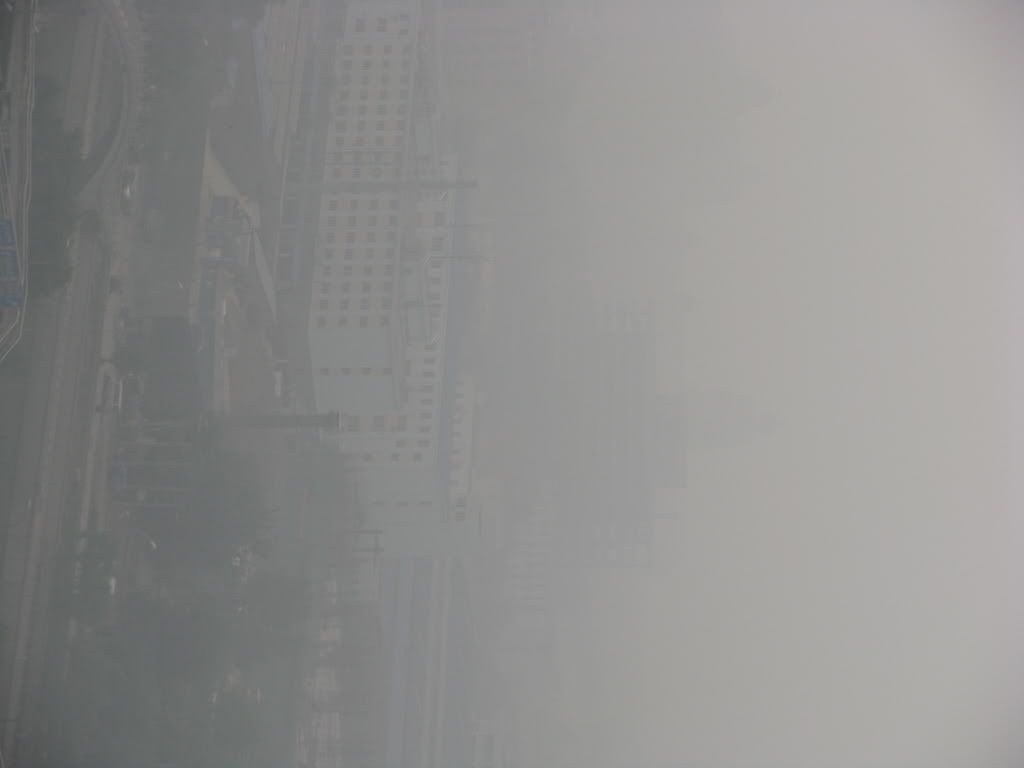
As attentive readers may recall, the air in Beijing through the six months before the Olympic games was almost unbelievably horrible. Lest we forget: this was the view out my window in mid-June, which was not that different from how it had been day upon day through the spring and early summer.

http://i142.photobucket.com/albums/r96/jfallows/IMG_3823.jpg

But even as I was wheezing my way around town and truly getting depressed by no view of sun and sky (and being told by a doctor that I should stop smoking, when I’d never started), I was reporting in the Atlantic on plans to get things cleaned up by the time of the Olympics. The first two days of the Games looked pretty bleak — but then a line of thunderstorms moved through, and the air looked far better, and the environmental threat to the Games was averted.

Since then, the air in Beijing has seemed better — not all of the time, God knows, but more than before. How much of the improvement is due to factories being shut down because of the recession? (They must have been running 40 hours a day in the spring, given how bad things were then.) How much because of typically strong late-fall winds blowing in from the northwest? How much an actual long-term change? I don’t know.

But, courtesy of a tip from an engineer at NASA, here is new evidence that all the anti-pollution steps taken because of the Olympics really did make a difference in air-quality measures in August — and, it seems, some of the time since then.

The NASA map below will make more sense if you read the full report, here. Highlight version: the deep red west of Shanghai and north of Hong Kong (where Shenzhen and Dongguan are), plus through the central coal-and-factory belt in places like Shanxi province, is a bad sign. The light green around Beijing is relatively good! (The red zone on the coast just east of Beijing is the city of Tianjin.)

297375main_beijing08_HI.jpg

As the NASA report says of Beijing’s special Olympic anti-pollution rules:

During the two months when restrictions were in place, the levels of nitrogen dioxide (NO2) — a noxious gas resulting from fossil fuel combustion (primarily in cars, trucks, and power plants) — plunged nearly 50 percent. Likewise, levels of carbon monoxide (CO) fell about 20 percent.

Why does this matter? Because it shows that corrective steps can improve even the most hopeless-seeming environmental disasters. It’s worth trying to do something, rather than just hunkering down in bed and trying to take very, very shallow breaths — my strategy in the months from April to July.

In other words, Yes We Can.

Perfect Partnership To Tackle Climate Change

Trevor Houser, SCMP – Updated on Dec 23, 2008

The current economic crisis cast a pall over climate change talks held this month in Poland. With American home values and retirement savings falling, and Chinese unemployment figures rising, observers worry that neither America nor China – the world’s two largest polluters – will have much appetite to cut emissions.

The paradox here is that the crisis presents a unique opportunity for the US and China to strike a deal that would lay the groundwork for a global climate agreement. Indeed, one of the main goals of the most recent biannual meeting of the US-China strategic economic dialogue was to begin work under the 10-year energy and environment co-operation framework, created earlier this year.

This initiative comes after a decade in which America abstained from international efforts to address climate change, concerned that if it acted but China didn’t, the world would fail to meet its emission-reduction targets and US industry would be disadvantaged.

China has countered that its historic and per capita emissions remain well below US levels, and that to cap aggregate national emissions at the same level as the US would imply a personal carbon budget in San Francisco five times greater than in Shanghai.

Economically, the US and China are mirror images, opposite sides of a massive global imbalance. Americans spend too much and save too little, leaving a US$250 billion trade deficit financed by other countries, notably China, whose firms and citizens save too much and consume too little, leaving a surplus of goods and capital that flows abroad.

This macroeconomic imbalance is reflected in the nations’ carbon footprints. In the US, more than 70 per cent of carbon dioxide emissions come from consumer-related activities. In China, more than 70 per cent of emissions are industrial.

In terms of brokering a climate deal, this imbalance is good news. It suggests a framework for reducing emissions that respects the development needs of China’s households, addresses US firms’ competitiveness concerns, and adheres to the principle of “common but differentiated responsibilities” embedded in international negotiations.

In recognition of its outsized historic and per capita emissions, the US should agree to economy-wide emission cuts in line with domestic climate laws under consideration. China should be excused of consumer-related obligations for now, but assume pledges on industrial production.

If China consolidates its energy-intensive manufacturing, thereby freeing up investment capital for lighter manufacturing and services, then it will emerge from the crisis with a growth model that pollutes less and employs more. If the US and China can find agreement on these issues in the midst of crisis, they will pave the way for success when climate negotiators meet again next year in Copenhagen.

Trevor Houser is a visiting fellow at the Peterson Institute for International Economics in Washington. Copyright: Project Syndicate

Campaign To Clean Up Gets Lost In The Smog Of Bureaucratic Resistance

Martin Zhou, SCMP – Updated on Dec 22, 2008

Despite years of small-scale experiment and debates, the mainland leadership has yet to implement a sound system that ensures sustained political and economic motivation for governments and enterprises to go green.

The much-talked about Green GDP – a device initiated to tie environment protection to officials’ promotion – has apparently been thrown out of the window because of resistance from bureaucrats, especially local officials.

Similarly, development of the fledgling emission trading markets intended to reward corporate China’s green innovation has stalled.

“To me, it all comes down to an independent credible mechanism to precisely quantify the environment impact of economic activities,” said Luo Jianhua, the general secretary of China Environment Service Industry Association.

So far, the maths involved to measure the extent of pollution is not always untainted. Authorities have repeatedly discovered data on the volume of contaminated water processed in treatment plants – one major indicator of local officials’ environmental achievement – is tampered with, as sensor makers collude with unscrupulous officials to produce equipment that deliver findings to the officials’ favour.

“As a result, environment inspectors now turn to electricity consumption to determine exactly how much water has been purified,” Mr Luo said. “But such dirty tricks do invoke a lot of concern over moral risk in the sector.”

The domestic trading in pollutants has also been hampered by the absence of a complete legal framework. Three major emission trading markets in Beijing, Tianjin and Shanghai had been launched in the past year, but none has begun operation in earnest.

For example, the first to be set up, Beijing Environment Exchange, had before its August inauguration promised to provide clearing service for trading of credits backed by a cut in emission of sulphur dioxide, the main airborne pollutant from coal burning – and CDO, a measure of water pollution. China has set overall caps for annual CDO and sulphur dioxide emission, making the markets possible.

But one environmental official said the business was still in the preparatory stage as there was much to clarify on how the underlying assets of those emission credits in the market was being defined.

Counting The High Cost Of Growth – Economic Success Has Led To A Growing Environmental Crisis, Experts Warn

Shi Jiangtao in Beijing, SCMP – Updated on Dec 16, 2008

Undeterred by the cold, a few dozen people gathered outside the Chaoyang District Court in Beijing last month to wait for a trial that was probably their last chance for redress on a government decision they say threatens the health of thousands of people.

Representing more than 15,000 residents of three housing estates in the Wangjing area, they opposed the building of a high-voltage substation next to their subdivisions.

“We don’t want pollution in our backyards,” they said.

Their suit was just one of hundreds of thousands of anti-pollution campaigns and protests across the mainland every year, a sign of rising of public awareness of environmental issues and the legacy of three decades of breakneck economic growth.

Whether in cities or rural areas, more environmentally aware people are fighting the scourge of pollution, according to Xu Kezhu of the China University of Politics and Law’s Centre for Legal Assistance for Pollution Victims.

“It also shows the extent of China’s environmental problems,” Professor Xu said.

“People used to be indifferent about pollution on their doorstep. But now they know about its adverse impact on their health and the environment, they cannot sit by and endure further suffering.”

While Beijing has good cause to celebrate 30 years of reform and opening and its robust economy despite the global recession, it cannot overlook the unfolding environmental crisis confronting the country. Pollution and other environmental problems have become the biggest byproduct of China’s economic leap forward in the past three decades.

Air pollution is common in almost every mainland city, with China accounting for 20 of the 30 cities with the worst air in the world, according to the World Bank.

Severe pollution has contaminated 90 per cent of the country’s rivers and lakes, leaving more than 360 million people living without access to clean water.

While more than 70 per cent of water in the Yellow, Huai and Hai rivers is considered “too polluted for human use”, the Yangtze River, China’s longest, which absorbs more than 40 per cent of the country’s total waste water – most of it untreated – is turning “cancerous”.

Algal outbreaks have repeatedly hit offshore waters and 75 per cent of the more than 20,000 lakes and reservoirs on the mainland, according to the Ministry of Environmental Protection. The Bohai Sea area, the site earmarked for the country’s next economic powerhouse, will be dead in about 10 years because of 1.6 billion tonnes of sewage from Beijing, Tianjin and Hebei dumped into it every year, according to People’s Daily.

Environmental Protection Minister Zhou Shengxian has labelled environmental disasters threats to social stability.

Mr Zhou’s ministry acknowledged there were about 51,000 pollution-related protests in 2005 and it dealt with 580,000 cases of environmental complaints in 2006.

Pollution also takes a heavy physical toll on people. According to an unpublished World Bank report, 750,000 mainlanders die prematurely every year as a result of air and water pollution. The Chinese Academy of Environmental Planning put the air-pollution death toll in 600 mainland cities in 2004 at about 358,000 and its health bill at 152.7 billion yuan (HK$173.2 billion).

“China has made the kind of economic advances in three decades that required 100 years in western countries. But China also has suffered a century’s worth of environmental damage in 30 years,” Environmental Protection Vice-Minister Pan Yue said.

The obsession with “develop first and clean up later” had caused the near-breakdown of the nation’s resources and environment, and the people’s lives were in great danger, he said.

When the new leadership made pledges to clean up water and air and provide people with a better environment, few doubted the sincerity of President Hu Jintao and Premier Wen Jiabao to stop heedless development. They introduced an automated system to monitor big polluters, published a blacklist of the top 6,000 polluters and threatened to halt tax incentives and deny bank loans to energy-intensive metals, energy and cement industries. They even started calculating the environmental cost of the mainland’s much-praised economic leap forward by coming up with a “green GDP” report.

An incomplete calculation of the environmental costs in 2004 showed that pollution caused more than 510 billion yuan in economic losses, or 3 per cent of gross domestic product, according to the mainland’s first green-GDP report, released in 2006.

“But more realistic estimates put environmental damage at 8 to 13 per cent of GDP each year, which means that China has lost almost everything it has gained since the late 1970s due to pollution,” Mr Pan said.

The environmental price tag of the mainland’s runaway development has apparently embarrassed its leaders, including Mr Hu, who lent his support from the outset of the research scheme, and sparked fierce resistance among development-minded local authorities.

The resistance was part of the reason Beijing failed to meet annual commitments in 2006 as part of a five-year plan to slash energy consumption by 20 per cent and curb pollution emissions by 10 per cent by 2010. But rather than reining in local officials who favoured economic development over pollution control, or encouraging much-needed supervision, Beijing’s disappointing prescription has been to stall further announcements of related statistics.

The decision to shelve the green-GDP calculations came ahead of a political reshuffle at the Communist Party’s congress last year that further cemented Mr Hu’s grip on power. Analysts said that despite his talk about conservation, Mr Hu could not afford to let environmentalism disrupt his political agenda.

Elizabeth Economy, director for Asia studies at the Council on Foreign Relations, said China’s leaders paid more attention to their political image than to conservation.

Mr Hu has pushed the lofty ideas of the “scientific concept of development” and the need to build a harmonious society against the backdrop of a harsh reality of economic woes, social tensions and environmental damage, but few people are impressed.

“There will be no harmonious society without a harmonious environment,” said US field biologist George Schaller, who first visited China in the early 1980s for panda research.

Analysts have also cautioned against expecting too much of the State Environmental Protection Administration’s elevation to a full ministry, saying the move could hardly reverse pollution and degradation.

Given the mainland’s thirst for growth, environmental watchdogs can only at best stop pollution getting worse, they say. Poor law enforcement, local protectionism and rampant corruption are also hampering Beijing’s cleanup effort.

China is reaching a crisis point, experts warn. The question is: Can the country bring its runaway pollution under control before it’s too late?

China “Cancer Village” Pays Ultimate Price For Growth

Reuters By Emma Graham-Harrison and Vivi Lin – Thursday, December 11, 2008

Once an isolated haven, the Chinese village of Liukuaizhuang is now a tainted hell, surrounded by scores of low-tech factories that are poisoning its water and air, and the health of many villagers.

One in fifty people there and in a neighbouring hamlet have been diagnosed with cancer over the last decade, local residents say, well over ten times the national rate given in a health ministry survey earlier this year.

Many fear they are paying for the country’s breathtaking economic expansion with their lives, as surrounding plants making rubber, chemicals and paints pour out health-damaging waste.

“They asked in the hospital whether my family had a history of cancer. I said: ‘No, in the last three generations no one had it’,” one villager told Reuters, pulling out his x-rays and doctor’s diagnosis that he had lung cancer. “It must have a lot to do with the pollution here.”

Three decades of reforms and opening up since 1978 have transformed China from a rigidly ideological backwater into the world’s fourth largest economy, lifting millions out of poverty, but not without a price.

Nationwide there are dozens of places like Liukuaizhuang, where factories have blackened streams, poisoned farmland and choked the air.

Just 120 kilometres south of Beijing, Liukuaizhuang was a quiet village before the dramatic economic boom was kicked off by a series of low-key Communist reforms on Dec 18, 1978.

Twenty years later almost 100 chemical plants were scattered across what used to be farmland and thirty years on someone in almost every family is dead or dying of cancer — the youngest just seven years old — according to a local activist.

Officials agree that the area, dubbed a “cancer village” in domestic media, had a huge pollution problem, although they insist cancer rates are below the national average and all the worst-offending factories are now shuttered.

“The factories were not far from homes and to a certain degree influenced the normal life of the villagers,” said the Communist Party spokesman for the county, Huo Junwei.

“(But) we think figures provided by individuals exaggerate pollution problems in our area,” he said. “For several years we have been looking into whether there is a link between cancer and chemical production and have not yet got a scientific answer.”

QUESTIONS AND SILENCE

In recent years, national leaders worried about the mixed legacy of chasing economic expansion at almost any cost have stepped up calls for a more equitable society and cleaner industry nationwide.

But the pollution around Liukuaizhuang was so rampant that a crackdown driven partly by health concerns began in 2003, long before greener growth became a ubiquitous government mantra.

And activists say waste water and toxic gasses are certainly causing some illness there, even if an apparent link with cancer has not been proved.

“Pollutants including heavy metals like mercury and lead have already got into the food chain and all these chemicals will affect the normal function of cells,” said Gao Zhong, an environmental economist with a non-governmental organisation that works to clean the country’s polluted water.

Wong Tze-wai, an environmental health expert at the Chinese University in Hong Kong, said it would be premature to assume a link, but authorities should look into whether the number of cancer cases in the village was abnormally high, and if so, why.

“It’s important to investigate. We know that many industrial chemicals are carcinogenic and it is not unlikely that they can get into the eco-system,” he told Reuters.

The village’s richer inhabitants have backed that view by moving away, locals say, leaving behind the old, poor and ill. Some cannot afford even the most basic health precautions.

“We don’t have enough money to clean the water we drink. We put it all in a basin and let the pollutants sink,” said the daughter-in-law of one lung cancer sufferer.

All are reluctant to discuss the illness as they say health benefits were cut to victims who spoke out in the past, as well as one activist, Wang Dehua, who was jailed for several years.

“A lot of journalists came and went, but it did not change the situation at all,” said one middle-aged liver cancer patient whose husband was also diagnosed with cancer recently. Like all the other interviewees she refused to be named.

CLEAN REVOLUTION?

Some hope may ironically come from the global economic crisis, which is threatening so many Chinese jobs, as the world slowdown has dented demand for the products churned out from the country’s factories and so cut their waste.

The villagers say some of Liukuaizhuang’s bare bones factories, where paint is mixed in open drums in fume-filled warehouses guarded by vicious dogs, have already gone bust.

The crisis has also spurred Beijing to line up a multi-billion dollar stimulus package. Activist Gao hopes some of the cash will be spent on cleaner technology.

“Now we are facing financial turmoil. There is a good way to stimulate domestic demand and also keep society stable, which is to improve the environment to invest more into this so … the country will be able to develop with quality,” he said.

However there is also a risk that Beijing’s leaders, facing rising unemployment and the social problems caused by a slowing economy, will relinquish environmental goals and ease pressure on the heavy industries that have created so much of both the country’s growth and its pollution.

Many in the “cancer village” fear the clean up is too late for them but they cling to hope that it will save their children and grandchildren from terminal illnesses.

“Of course I am worried, but what is the use of being worried?” said a lung cancer patient.

“We have to save our concern for the next generation.”

(Additional reporting by Tan Ee Lyn in Hong Kong)

Smog Chokes Beijing Despite Traffic Caps

Shi Jiangtao in Beijing, SCMP – Updated on Dec 09, 2008

Beijing saw some of its worst air pollution in the past six months yesterday, with its skyline engulfed in a blanket of smog.

This followed a brief respite during the Olympic Games, when prolonged traffic bans were put in place to clear the air.

The air pollution index, which measures air quality from noon to noon, reached 169, considered “slightly polluted” by national standards. Statistics from the Beijing municipal environmental protection bureau showed 27 out of 28 monitoring stations across the capital recorded figures designated as “slightly polluted” or “polluted”.

It was the third highest pollution level recorded since the Beijing Olympics, and came just days after the authorities declared Beijing had reached a self-imposed target number of clear-sky days for this year, thanks to the capital’s all-out effort to cut pollution ahead of the Games.

The capital cleared its smog-plagued air just in time for the Olympics with a series of temporary measures, such as pulling half the city’s 3.3 million cars off the road, halting construction and closing factories.

But with success comes higher public expectations for good air quality, prompting questions over the government’s ability to stamp out pollution, analysts said.

Choking smog had returned to the city of 17 million soon after strict anti-pollution regulations were lifted at the end of the Paralympics in September.

Under pressure, city authorities adopted a watered-down version of the Olympic traffic rules, banning private cars from roads on one weekday every week.

But the new restrictions have not worked.

The air pollution index reached 176 on October 18 and hit a six-month high of 186 on November 12.

Zhu Tong , an environmental expert at Peking University, said the existing restrictions did little to reduce emissions of airborne particles and sulfur dioxide from tens of thousands of coal-fired boilers, the main source of pollution in winter.

“Beijing still has a long way to go to convert coal-fuelled boilers and use clean energy,” Professor Zhu said.

He said stagnant weather conditions, meaning little wind or rainfall, had also worked against anti-pollution efforts.

Environmentalists and local residents have long cast doubts over the lasting environmental impact of the Olympics and the authorities’ promise that clear skies would remain after the Games.

Last week, Beijing said it had reached its target number of 256 “blue-sky days” this year, compared with 100 clear-sky days in 1998.

The central government has spent more than 150 billion yuan (HK$169 billion) in the past decade to clean up pollution in the capital.

Brown Clouds Over Asia Pose New Threat To Planet: UN

CBC News | Thursday, November 13, 2008

A polluted Hong Kong island skyline is seen in September 2008. High to very high pollution levels were recorded in various districts in the territory at the time.

A polluted Hong Kong island skyline is seen in September 2008. High to very high pollution levels were recorded in various districts in the territory at the time. (Bobby Yip/Reuters)

A brown haze of soot, particles and chemicals that hangs over parts of Asia is darkening cities, melting glaciers in the Himalayas and making weather systems more extreme, the United Nations said Thursday.

Scientists who have studied the thick brown clouds, which they estimate to be more than three kilometres thick, said the haze stretches from the Arabian Peninsula to China and the Western Pacific Ocean. It is officially known as atmospheric brown clouds.

The scientists, who come from China, India, Europe and the U.S., said in a new report commissioned by the UN Environment Program that the brown clouds are aggravating the impact of climate change caused by greenhouse gases in some regions.

They said they are issuing the warning now about the brown haze because it is a “serious and significant” environmental challenge facing the planet that poses a threat to human health and food production.

“Imagine for a moment a three-kilometer-thick band of soot, particles, a cocktail of chemicals that stretches from the Arabic Peninsula to Asia,” Achim Steiner, UN undersecretary general and executive director of the program, said during a news conference on the findings.

“All of this points to an even greater and urgent need to look at emissions across the planet, because this is where the stories are linked in terms of greenhouse emissions and particle emissions and the impact that they’re having on our global climate,” he said.

The brown clouds have darkened 13 cities in Asia, including Beijing, Shanghai, Bangkok, Cairo, Mumbai, New Delhi and Tehran, “dimming” sunlight in some places by as much as 25 per cent.

The brown clouds, produced by the burning of fossil fuels, wood and plants, form particles like black carbon and soot that absorb sunlight and warm the air, enhancing the greenhouse effect.

Mask for warming impact

Scientists, however, said the brown clouds also “mask” the warming impacts of climate change by an average of 40 per cent because they contain particles that reflect sunlight and cool the earth’s surface.

According to the report, the phenomenon has been studied closely in Asia, but it is not unique to the region, with brown clouds seen over parts of North America, Europe, southern Africa and the Amazon Basin.

The scientists said the brown clouds are having a negative impact on air quality and agricultural production in Asia with risks to human health increasing. Health problems associated with the brown clouds include cardiovascular and respiratory diseases.

Veerabhadran Ramanathan, head of the scientific panel that is carrying out the research and a professor at the Scripps Institution of Oceanography at the University of California in San Diego, said the huge cloud masses can cross continents in the space of three to four days.

It’s not a regional issue, but a global one, he said.

“The main message is that it’s a global problem. This is not a problem where we point fingers at our neighbours. Everyone is in someone else’s backyard,” Ramanathan said.

He said one of most serious problems noted in the report is melting of the Hindu Kush-Himalaya-Tibetan glaciers, which provide the head-waters for the major river systems including the Ganges, Brahmaputra, Mekong and Yangtze rivers.

The Ganges basin, for example, is home to more than 400 million people and holds 40 per cent of India’s irrigated croplands.

He said the melting has “serious implications for the water and food security of Asia.”

The Chinese Academy of Sciences estimates that the glaciers have shrunk five per cent since the 1950s and the volume of China’s nearly 47,000 glaciers has fallen by 3,000 square kilometres over the past quarter century.

The brown clouds also have helped decrease the monsoon season in India. The weather extremes caused by the clouds may have also helped to reduce production of crops such as rice, wheat and soybean, according to the report.

Ramanathan said he hopes the report “triggers” an international response to the problems of greenhouse gases and brown clouds and the “unsustainable development” that underlies them both.

“The new research, by identifying some of the causal factors, offers hope for taking actions to slow down this disturbing phenomenon,” he said.