Clear The Air News Blog Rotating Header Image

Roadside

SCMP: Average hours of unhealthy air in Hong Kong up on last year

from Ernest Kao of the SCMP:

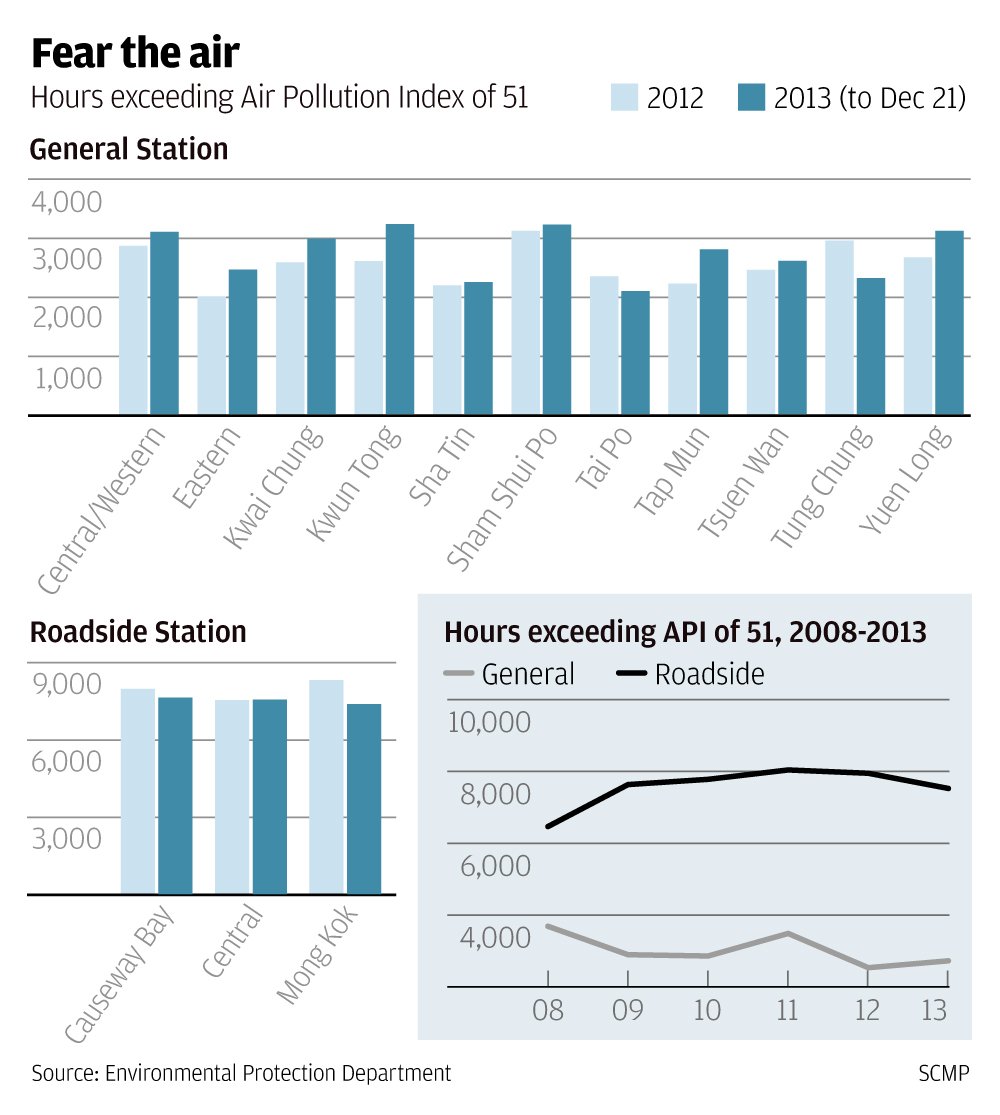
Hong Kongers endured an average of 2,727 hours of unhealthy air this year, surpassing last year’s figure with a week to spare.

The Post examined hourly air pollution index (API) data from the Environmental Protection Department’s 11 general air quality monitoring stations and three roadside stations.

From January 1 to December 21, the average number of hours of high, very high or severe air pollution recorded by each general monitoring station rose 7.6 per cent from last year’s 2,534.

The API measures concentrations of major air pollutants such as carbon monoxide and respirable suspended particulates in a range of 0 to 500. Readings above 51 are "high" - acceptable in the short term but beyond long-term health standards. "Very high" is above 100, indicating air that is unhealthy in both the short term and the long term. "Severe" readings are above 200. (SCMP)

(more…)

Bloomberg: Hong Kong’s Pollution Near 6-Month High (Nov 2013)

from David Ingles, reporting for Bloomberg on the high levels of air pollutants in Hong Kong’s air last month.

Jason Lerwill, an air specialist at Renaud Lifestyle Products (retailers for air purifier systems), mentions three major contributors to air pollutants in the city: shipping in the Pearl River Delta, roadside pollution, and factory emissions across the border. Christine Loh, undersecretary for the environment, speaks enthusiastically about policies to reduce vehicle emissions, but mentions nothing about shipping and factory emissions.

4 Nov 2013

Science Daily: Air Pollution Puts the Health of School Children at Risk

from Science Daily:

A recently completed study by The Hong Kong Polytechnic University (PolyU) on 310 children in 12 schools across the territory found the air pollution level along the traveling routes from home to schools and particulate levels outside school both at a very high level, and most of the school children have lung function weaker than the predicted levels.

The study was done by Dr Hung Wing-tat, Professor Frank Lee Shun-cheng and Ms Lee Sin-hang of the University’s Department of Civil and Environmental Engineering. They found that children in only two out of twelve surveyed schools have lung function better than predicted levels, whilst children in the remaining ten schools have lung function weaker than the predicted levels.

The study also found that carbon dioxide levels inside five of the twelve school classrooms are found to be higher than the stipulated good class level of HK Indoor Air Quality (HKIAQ), probably due to the presence of full class of students within the monitoring period.

PolyU researchers also collected information about the traveling patterns of these 310 school children and then monitored the air pollution level along the traveling routes of the subjects. About 48% of school children go to school on foot, the second most popular choice is the school bus (24%). They found that both PM10 and PM2.5 levels in various transportation modes are high.

It is worth noting that PM2.5 levels far exceed the stipulated health levels of WHO safety level of 75 µg/m3 (24 hours average) and the situation in school buses is worst. The total volatile organic compound (TVOC) levels in all transportation modes far exceed the good class level of HKIAQ and the situation in school buses is worst.

The study also found that allergic rhinitis is very common among local school children (ranging from 13% to 59.3% in schools). Allergic rhinitis is found to be related to tobacco smoking household, incense burning at home and molds at home. However, molds and mildews are common (25.9% to 62.5%) in household because of the humid weather.

Children in tobacco smoking households also have significantly poorer lung function. The study found high percentages of smokers in the households, ranging from 25.0% to 69.6%. One of the key findings is that Lung function of school children, FVC and FEV1 are found to be negatively co-related with PM10 levels in classrooms at 0.05 significant levels. It is critical to suppress the level of PM10 in classroom to protect the health of school children.

Pulmonary function tests were conducted on surveyed school pupils to assess their lung function, which was measured by a spirometer in this study.

The above story is based on materials provided by The Hong Kong Polytechnic University.

19 Nov 2013

SCMP: Idling engine ban has failed to clear the air

from Ernest Kao of the SCMP:

A law banning idling engines has come under fire for having only a minimal impact on improving air quality, nearly two years after it was introduced.

Lawmakers said the Motor Vehicle Idling Ordinance had not stopped idling engines, which caused pollution and were a nuisance to pedestrians.

Environment chief Wong Kam-sing defended the ban, which came into effect in December 2011, saying it had reduced the number of complaints about roadside discomfort caused by hot exhaust fumes and noise pollution.

Environment bureau statistics show that in the past two years, 3,070 idling vehicles were timed but only 86 fines were issued. Most were handed out to drivers of non-franchised buses and private vehicles.

The number of idling engine complaints had dropped 40 per cent, from 1,802 last year to about 1,000 this year. (SCMP)

(more…)

China to reduce coal usage for power generation to battle smog and related health issues; could spell end for viable coal production

On the back of the smog that hit Northeastern China last month, the SCMP ran an editorial on serious health concerns seeping throughout China:

The prevalence of smoking in China tends to fudge the contribution of air pollution to the growing incidence of respiratory disease. A couple of examples that emerged this month are timely reminders of the cost of China’s rapid development. In one, an eight-year-old girl has become the nation’s youngest lung-cancer patient, with doctors linking her illness to environmental factors. Dr Feng Dongjie of the Jiangsu cancer hospital says the girl lived on a busy road where she inhaled dust, including superfine particles considered to be the most lethal component of smog.

The other example recalled the saying that a picture is worth a thousand words, except in this instance it was the lack of a picture. The smog that hung over many Chinese cities, including Beijing, last month was so bad in the northeastern city of Harbin , where visibility fell to below three metres, that even public security surveillance cameras could not penetrate thick layers of particles. The immediate concern for the authorities is safeguarding national security though a street surveillance network. They should also be deeply worried about the effects of smog on the public’s health as they are insidious and, if and when the air clears, will linger much longer.

The 'lack of a picture' tells a thousand words: buildings are seen through thick haze in downtown Shanghai. (SCMP/Reuters)

(more…)

Howard Winn/SCMP: Air pollution continues to plague streets of HK; health costs pile up

Howard Winn, in his column for the SCMP, has tirelessly written articles for consecutive weeks to promote awareness over the continued poor state of air quality on the streets of Hong Kong; its slow but deadly and very costly effects on the health of Hong Kong’s citizens, especially children; and the lack of action and evidence of aptitude from the Hong Kong government in dealing with this matter:

How much longer for action on roadside pollution?

The Environmental Protection Department issued a statement yesterday morning pointing out that its air pollution indices at roadside air quality monitoring stations reached a “very high” level. However, turning to the Hedley Environmental Index (HEI), we see that it described air pollution over Hong Kong more graphically as being “very dangerous”.

The HEI is linked to World Health Organisation (WHO) guidelines which indicate the levels beyond which air pollution begins to affect health.

In Causeway Bay, the hourly concentration of nitrogen dioxide at 5pm was 259ìg/m3 (micrograms per cubic metre), compared with the WHO guideline average level for a 24-hour period of 140ìg/m3 – i.e. 85 per cent over the WHO limit. At the roadside in Central, the nitrogen dioxide level was 338ìg/m3. The PM10 respirable particles were 99ìg/m3 and 105ìg/m3 at Causeway Bay and Central respectively, compared with the WHO short-term guide of 50ìg/m3.

Levels of the much more dangerous PM2.5 particles, which can enter the lungs, were also dangerously high at 65ìg/m3 and 61ìg/m3 in Causeway Bay and Central, compared with the WHO guideline of 25ìg/m3. These figures are way above WHO guideline levels.

(more…)

Air pollution recognized as carcinogenic, also linked to prenatal development problems

The World Health Organization (WHO) has finally reported that air pollution causes cancer: vehicle, industrial and other forms of emissions fill the air with a toxic cocktail of chemicals and particulate matter. Meanwhile, the Guardian also reports that air pollution, combined with an environment of heavy traffic, increases the likelihood of babies being born with low birthweight, which leads to other health problems. With Hong Kong suffering from both problems, the government will need to put its foot down to improve the situation if it is serious about improving its citizens’ health.

When pollution strikes hard: Air quality in March 2010 (left), compared to better days. (WSJ)


Click here for more coverage:

Will ‘measurement’ of pollutants in HK take extraterritorial sources into consideration?

Cheung Chi-fai of the SCMP reports that Hong Kong will be linking up with the World Health Organisation (WHO) to ‘develop a mechanism to measure changes in air quality and public health’ to help the city improve its environment. The plan, if it could be called one at all at this time, is extremely vague, but even if it becomes the best-laid of plans, it would run into a fundamental problem: the basis of the study is an investigation about the city’s clean air policies, but some of the worst air pollutants come from outside the city’s jurisdiction. For example, ocean-going vessels passing through Hong Kong’s nearby shipping channels use bunker fuels with 2.75 to 4% sulphur content, significantly higher than the 0.005ppm(0.0000005%) of Euro5 diesel fuel; prevailing easterly winds blows sulphur compounds and respirable suspended particles (RSP) into Hong Kong, a situation worsened by the density of urban structures that helps to trap air particles within its confines. The many incinerators on the Shenzhen side of the border also figures to be a major factor in Hong Kong’s air quality.

This ‘plan’ would need more serious thinking if it intends to be anywhere near producing true analysis of Hong Kong’s air quality.

Click here to read the SCMP report:

SCMP Editorial: Time for action in battle to clear roads of polluting vehicles

A revised government plan for improving air quality by getting the 84,000 dirtiest, or pre-Euro IV commercial diesel vehicles off our roads is going to take a year longer – until 2020 – despite an increase of HK$3 billion, or more than 33 per cent, in the cost to taxpayers. Lawmakers, understandably, put up a fight for the original deadline of 2019, but Legco’s environmental affairs panel was right in the end to unanimously endorse the revised scheme.

Devised to help meet tougher air-quality objectives to take effect next year, the plan is cash-incentive-based and therefore depends ultimately on the co-operation of fleet and vehicle owners. The transport trades criticised the original terms, asking for more money, more flexibility and more time, while green groups wanted early implementation. The industry may be seen to have prevailed in the revised plan. But if it works the community will be the real winner in a battle against air pollution in which we badly lag international benchmarks.

The government originally proposed ex gratia payments ranging from 10 per cent to 30 per cent of a vehicle’s replacement cost, with retirement deadlines beginning in 2016 and ending in 2019 for Euro III vehicles. Raising the subsidies to a range of 27 to 33 per cent and extending retirement deadlines by a year will, hopefully, meet the concerns of some in the trade that the terms were harsh on livelihoods. This will raise the estimated cost from HK$8.7 billion to HK$11.7 billion.

In addition, the new approach will limit the service life of newly registered vehicles to 15 years. Officials say these measures and the retrofitting of 1,400 franchised buses with diesel emission controls should significantly reduce roadside pollution, including tiny airborne particles most harmful to health, towards the end of the decade. Given that more than 3,000 people are estimated to die prematurely each year because of bad air, we trust the government has struck the right balance of carrot and stick. For the sake of our health it is time for action, not more talk.

5 Oct 2013

from: http://www.scmp.com/comment/insight-opinion/article/1324793/time-action-battle-clear-roads-polluting-vehicles

KMB argues improving bus and road efficiency more impactful than changing out old fleet

In response to Ernest Kao’s article in SCMP on the benefits of replacing older buses in Hong Kong’s bus fleet, KMB’s representative Evan Auyang wrote in to SCMP, asking instead for help and support in bus route reorganisations and improvements in transport efficiency of roads. Which would of course, by his own admission, cost “nothing” (to KMB) and by extension increase their profitability.

Below is his letter, published in SCMP’s letters on 2 Oct 2013:

I refer to the report, (“Removing old buses saves lives, says study“, September 17).

We at KMB would say that it is not only realistic, but also desirable, to remove older buses from Hong Kong’s roads. This is not only good for the environment, but also good for our economy.

However, there is a more cost-effective way to do this: remove buses by improving efficiency. While replacing buses is financially costly, pushing efficiency costs nothing, with impact as large (if not larger) than technological upgrades.

The fact is that we have simply too many buses inefficiently serving several urban areas of Hong Kong. For example, in the five districts of Kowloon alone (Sham Shui Po, Kowloon City, Kwun Tong, Wong Tai Sin, Yau Tsim Mong), KMB has nearly 1,000 buses dedicated to serve these areas. Many routes are not only duplicated with the MTR, but also minibus routes and KMB’s own routes.

According to KMB, tackling route and road congestion should take priority over replacing old buses. (SCMP)

The government is currently working with bus operators to reorganise bus routes for greater efficiency, but the progress is far too slow. With only 5 per cent of the network reorganised after nine months of intense consultation and lobbying work with the districts, it would take over 10 years to complete this exercise if the decision-making after consultations could not be expedited.

Moreover, route reorganisation itself is insufficient to tackle the inefficiencies of road-based public transport.

While the government has shown great foresight in building up a world-class railway system as the backbone of Hong Kong’s public transport system, there is insufficient investment and policy support to ensure road-based mass transport is efficient to complement the railway system.

Our roads are increasingly congested with no signs of abatement.

For example, 99 per cent of KMB’s bus routes experienced an increase in journey times at an average of 16 per cent during the past five years. Average bus speeds could be increased by 25 per cent in our city, which would translate into a reduction of over 1,000 buses on our roads while keeping the same service frequencies and at faster journey times. Picking this “low-hanging fruit” means that we can simply remove these buses without needing to upgrade them.

In high-density international cities such as London, Singapore, Seoul and Taipei, there is policy focus on mass transport efficiency. Average bus speeds are always monitored and simple actions such as traffic enforcement at “black spots” have been effective.

Evan Auyang, deputy managing director, KMB