Clear The Air News Blog Rotating Header Image

Health

HK’s pollution forces clean-air campaigner out

pic-anthony-j-hedleyLast updated: April 23, 2010

Source: South China Morning Post

Anthony Hedley leaves city to help his breathing problems

Hong Kong’s leading authority on air quality is leaving the city to escape its dirty air.

Professor Anthony Hedley, of the community medicine department at the University of Hong Kong, will be moving to the Isle of Man – a self-governing British Crown dependency in the Irish Sea.

The 69-year-old professor, who is one of those most committed to the fight against air pollution in Hong Kong, said he needed to avoid the city’s dirty air to keep his respiratory symptoms under control.

He said: “I need to reduce my exposure to polluted air because I know from experience that my respiratory symptoms subside quickly when I am in cleaner air. Because of my medical history, I now want to avoid the biological stress which comes directly from breathing the polluted air in Hong Kong.”

Hedley said he suffered respiratory symptoms such as coughing and phlegm, which were aggravated by the poor air quality in Hong Kong. He said he planned to continue working with his colleagues at the university, but mainly electronically.

Prentice Koo Wai-muk, a Greenpeace campaigner, yesterday said: “It is certainly a great loss for Hong Kong. Professor Hedley is an authority on air pollution and public health, while many other experts like to focus on the sources of air pollution. He is also very active in expressing his views on air quality. Now we shall lose a voice.”

Koo said he appreciated Hedley’s commitment to study Hong Kong’s air quality while away from the city but feared he might lose touch.

“We can still tell him via e-mails that Hong Kong’s air pollution index is 100, or 140. But, a mere figure can be meaningless. You have to be here to know how bad it is and its impacts,” Koo said.

Friends of the Earth director Edwin Lau Che-feng said the air quality locally should have been greatly improved if the government had listened to Hedley’s advice.

Over the past two decades, the professor has campaigned for measures to control emissions of air pollutants from road traffic, shipping, and power plants.

But he said he was disheartened by the government’s inertia. “One of my biggest regrets is that we have not been able to move on the issue.”

In a statement yesterday, the Enviornmental Protection Department described Hedley as “our good comrade on combating air pollution” and said “we can assure him and all others who have concerns on our air quality that we would continue taking our best efforts to improve our air quality, both for our citizens’ health and for our competitiveness”.

Hedley has been chair professor of community medicine at the University of Hong Kong since 1988.

He and his university team launched the Hedley Environmental Index in 2008 to provide real-time measurements of the health and financial impacts of air pollution in Hong Kong.

The index showed that so far this year health care and lost productivity related to air pollution illnesses has cost the city about HK$572 million. The index also showed a total of 1.88 million doctor visits and 248 premature deaths because of air pollution over the same period.

A respected figure in the field, the professor was also appointed to the Advisory Council on Environment and the Environmental Impact Assessment subcommittee from 1996 to 2002. He was a member, and later chairman, of the Hong Kong Council on Smoking and Health from 1994 to 2002.

Widely regarded as his farewell lecture, Hedley will speak on Wednesday at a forum organised by Civic Exchange and Clean Air Network.

Traffic-related air pollution tied to stroke death

REUTERS APRIL 6, 2010

Of 3320 men and women who lived in a specific south London region and had a first stroke between 1995 and 2005, Dr. Ravi Maheswaran, at the University of Sheffield, andcolleagues found more deaths among those exposed to higher estimated traffic-related pollution over more than a decade.

Photograph by: Photos.com, canada.com

NEW YORK – Traffic-related air pollution may be linked to a higher death rate among people who initially survived strokes, hint study findings from the United Kingdom.

Of 3320 men and women who lived in a specific south London region and had a first stroke between 1995 and 2005, Dr. Ravi Maheswaran, at the University of Sheffield, and colleagues found more deaths among those exposed to higher estimated traffic-related pollution over more than a decade.

Maheswaran’s team used 2002 estimates of two common traffic pollutants — nitrogen dioxide and small, inhalable particles called particulate matter — linked to breathing difficulties and other health problems.

Their report, in the journal Stroke, shows risk of dying increased 28 percent when nitrogen dioxide levels rose by just 10 micrograms per 3 square meters of air. A likewise increase in particulate matter increased death risk by 52 percent, they report.

All of the areas were typical of London. The low-pollution areas typically did not have major roads running through them. The higher pollution areas had levels of nitrogen dioxide that the U.S. Environmental Protection Agency consider the U.S. average.

The researchers report more deaths in the higher polluted neighborhoods – 975 of 1659 patients, or about 59 percent, in high nitrogen dioxide neighborhoods and 967 of 1658 patients, or about 58 percent, in high particulate matter areas.

That compared to 881 of 1661 patients, or about 53 percent, in an area less polluted by high nitrogen dioxide, and 889 of 1662 patients, or about 53 percent, in an area less polluted by high particulate matter.

Risk for death remained higher with greater air pollution exposure after the investigators took into account a number of other factors associated with stroke death including age, gender, ethnicity, smoking and alcohol use, high blood pressure, heart disease, and diabetes.

If future investigations show air pollution causes death among stroke patients, a 10 microgram reduction in nitrogen dioxide exposure – about a 10 percent decrease from the average in the highest pollution areas — “would be associated with a 22 percent decrease in mortality after stroke,” Maheswaran and colleagues write.

It’s unclear why stroke patients may be more vulnerable to the long-term effects of air pollution, notes Dr. Jiu-Chiuan Chen, at the University of Southern California Keck School of Medicine, in Los Angeles, in a related editorial. However, some studies have linked living near high levels of traffic pollution to clogged arteries.

SOURCE: 109.567743v1 Stroke, published online March 25, 2010.

Of 3320 men and women who lived in a specific south London region and had a first stroke between 1995 and 2005, Dr. Ravi Maheswaran, at the University of Sheffield, and colleagues found more deaths among those exposed to higher estimated traffic-related pollution over more than a decade.

Pall of filth casts shadow over marathon

logoLast updated: March 25, 2010

Source: The Standard

The organizer of the Standard Chartered Marathon is worried about the record high air pollution in the city, which he fears could hit next year’s event.

The organizer of the Standard Chartered Marathon is worried about the record high air pollution in the city, which he fears could hit next year’s event.

The air pollution index hit a choking 500 on Monday – the highest reading since 1989 when the government launched the index.

Worsening air pollution has also played a part in preventing Hong Kong’s elevation in the latest Location Rating report published yesterday by ECA International.

The report ranks countries according to the living standards they can offer expatriates.

Regional director Lee Quane said that air pollution continues to be the dominant factor that makes Hong Kong a harder location for foreigners to adapt to living in.

Hong Kong Amateur Athletic Association chairman Kwan Kee said he is worried about air pollution endangering runners in the annual Standard Marathon.

“A lot of education is needed to teach runners about how to cope with different weather conditions and how to take care of themselves,” said Kwan. “We will do our best to provide runners with updated information about the temperature, humidity and the air index.”

However, he said that because of the unpredictable weather, even a change in the date of the run might not help.

He is looking at areas of improvement suggested by the runners of this year’s marathon, held on February 28.

“The route, date and the opening hours for the roads will all affect the organization of the coming marathon, and we are in discussions with various government departments to work on this,” Kwan said.

The champion of the women’s full marathon, Mok Chi-ling, hopes the date of the race can be changed to some time in January, when the weather should not be as bad.

Even though she had trained hard for the event, she was unable to run as well as she had hoped to. Humidity was the main problem, not the air temperature, she said.

“The high humidity causes more energy to be exerted because of dehydration, and you need to drink a lot of water to replace this,” she said.

“I have become more worried because of the worsening air pollution. A marathon requires a lot of physical exertion especially after the 30-kilometer mark, and breathing will be very difficult if the pollution is bad.”

Mok added that she copes with the pollution by training in the mornings, when the weather is better and there are fewer cars around to contribute to the worsening air pollution.

Written by Kaylene Hong

Pollution robs people of up to nine years

pot-kettleFirst published: March 22, 2010

Source: Tobacco Reporter

Pollution in the UK is causing people to die up to nine years prematurely, according to a report by the Commons Environmental Audit Committee reported by BBC News.

The report said the UK should be ‘ashamed’ of its poor air quality, which was contributing to conditions such as asthma, heart disease and cancer.

Pollutants such as ozone, nitrogen oxides and particulate matter from transport and power stations have been blamed for contributing to early deaths.

Particulate matter is estimated to reduce people’s lives by an average seven to eight months, while in pollution hotspots vulnerable residents, such as those with asthma, could be dying up to nine years early.

Air pollution also leads to damage to wildlife and agriculture, with ground-level ozone estimated to reduce wheat yields in the south of Britain by 5-15 per cent.

“Air pollution probably causes more deaths than passive smoking, traffic accidents or obesity, yet it receives very little attention from government or the media,” said committee chairman, Tim Yeo.

Air quality index may grade risks to health

canadian-scaleLast updated: March 24, 2010

Source: South China Morning Post

Canadian pollution alert model considered

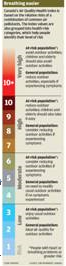
The government is studying a Canadian air pollution alert system as an alternative to the existing outdated system, which does not indicate the direct health impact of various pollutants.

This emerged as the choking sandstorm that had blanketed the city since Sunday night – pushing the air pollution index off the top of a 500-point scale and forcing some pilots to use autopilot to land at the airport because of poor visibility – slowly dispersed in the face of a southeasterly wind.

A person familiar with the situation said a group of health scientists commissioned by the Environmental Protection Department to study improvements to the alert system submitted a framework for a new system last year. But the proposal has been put on hold pending the results of a review of air quality objectives enacted 23 years ago.

The recommended system is modelled on the Canadian Air Quality Health Index, which has a scale of 1 to 10 and shows four categories of health risks from low to very high. It is still not clear, however, whether this is the only proposal being considered or whether the government will incorporate contingency plans to discourage polluting activities on days of high health risks.

The city’s 15-year-old air pollution index (API) is calculated based on the readings of the maximum level of any one of five selected air pollutants – sulphur dioxide, nitrogen dioxide, ozone, respirable suspended particles and carbon monoxide.

Whenever that maximum reading exceeds the level of the air quality objectives, the API will rise to a level of over 100, categorised as “very high”. Different levels also carry different health advisories.

“What is flawed in this system is that the index only informs people about the excessive levels of a particular pollutant. It also implies there is a safety level and does not tell people the actual health impacts,” a person familiar with the study said.

The main feature of the proposed system is that the health impact for each of the chosen air pollutants would be quantified based on past studies, such as the extra number of hospital admissions when the a particular pollutant is above a certain level. The aggregated impact of all pollutants would then be converted into indexes, which could be grouped into different health risk categories.

Dr Wong Chit-ming, a biostatistician at the University of Hong Kong, said under the Canadian system any index value above zero was a clear indication that people were suffering from the impact of air pollution.

Wong said such a system was better because it took into account the total impact of multiple pollutants rather than just one and could avoid overexaggerating the index when a single pollutant skyrocketed in unusual circumstances.

“Had this been adopted, the pollution reading of the sandstorm might have not been so high.”

At the peak of the sandstorm, 10 of the 14 monitoring stations went off the top of the 500-point scale. Several stations were still above 400 at 8am and above 300 at 2pm, but all but one, Eastern District, had dropped below 200 by 8pm.

Written by Cheung Chi-fai

Now there can be no more pollution excuses

124771008967299_11Last updated: March 23, 2010

Source: South China Morning Post

The government has finally got the wake-up call on air pollution that it has for so long had coming. Hazardous levels to the limits of the index yesterday prompted officials into urgent meetings. For years they have done as little as possible to meet concerns, but the choking red particles are impossible to disregard. A quirk of nature or not, this time the promised action has to be given priority and taken.

If authorities had our interests at heart, timely warnings would have been issued. Instead, predicted air pollution levels were grossly underestimated and the alert for a sandstorm that had been known about for days was posted while we slept. A system proposed three years ago by the Sustainable Development Council, but never adopted, should have been in place telling us to stay at home and not go to school or work. Hundreds of thousands of vulnerable elderly and young people and those with heart and lung problems have been unnecessarily exposed to dangerous pollution levels.

There has been no shortage of consultations, pledges, part-measures and rhetoric over the past decade. A large proportion of the population has made its views known. Solutions have been offered and calls for prompt action made. But all we have to show for the effort are increasingly worse roadside readings.

At the heart of the problem is a lack of government will. It refuses to force the power and transport companies polluting the environment to take concerted action. The schemes offered up are voluntary with few incentives. As a result, the majority of our electricity still comes from highly-polluting coal and oil, cargo ships and ferries burn the worst pollutants of all, bunker fuel, and an unreasonably large number of old diesel buses and trucks – about one-third of the fleet – remain on our roads.

The fruits of this neglect were yesterday on plain show for us and visiting businesspeople and tourists to breathe and see and for the world to witness. Authorities are not at fault for the freak sandstorm and wind conditions, but they are directly to blame for the pollutants that mixed with the particles that created never-imagined readings. We were told to avoid going outdoors, and schools advised to cancel sports activities. This is a knee-jerk response to circumstances that were known about, but handled poorly due to a lack of policy.

Overgrazing in the mainland’s northwest has created the deserts from which the sandstorms have come. We are powerless to deal with this environmental degradation; the central government is struggling to revegetate lost farmland and forests. But pollution of our own making is quite another matter. Legally-binding policies and better use of the government’s considerable resources will make a difference.

The dust will gradually dissipate. Authorities have finally made the air pollution forecasts they should have two or so days ago. The day the index was breached will go down in collective memory. There is no better jolt for a government that has been complacent about the biggest threat to our city’s health. The right mindset has been lacking; now there can be no more excuses.

HK air pollution hits unhealthy levels

pollution-in-hong-kongLast updated: March 22, 2010

Source: South China Morning Post

Hong Kong’s Air Pollution Index (API) hit high and unhealthy levels on Monday – particularly in Mong Kok and some parts of Hong Kong Island, a spokesman for the Environmental Protection Department (EPD) said.

Roadside air pollution in Central, Causeway Bay and Mong Kok climbed to particularly high levels.At 5.41pm, the reading at a roadside station in Causeway Bay soared from 410 to 495, while readings in Central and Mong Kok, climbed to 376 and 458, respectively.

The highest recorded on Monday afternoon at the general monitoring station in Tsuen Wan was 434, while other districts, such as in Eastern, Sha Tin, Tai Po and also recorded air pollution levels of around 400.

An API reading of between 0-50 meant the air pollution did not pose a health threat to people, according to the EPD’s website. But when the API is at 101-200, people with heart and respiratory illnesses may find their symptoms are aggravated. When the API is between 201-500, even healthy people may suffer eye irritation, coughing, phlegm and sore throats.

The city’s pollution is being made worse by a large sandstorm moving south from Northern China.

“Because the sandstorm is very strong and the easterly monsoon wind is blowing the sands and dust toward Hong Kong, Taiwan and Japan, [there is] a high concentrations of air pollutants in Hong Kong,” said EPD assistant director Mok Wai-Chuen on local radio on Wednesday.

“But with south-easterly wind arriving in Hong Kong later on Tuesday, we expect the situation to improve on Tuesday or Wednesday,” he added.

Hong Kong’s pollution levels would remain high for most of Monday, he added.

Clear the Air chairman Christian Masset said the sandstorm was now affecting 16 provinces in China. “These are very exceptional events”, he told local radio.

Environment Secretary Edward Yau Tang-wah advised people with heart and respiratory illnesses to be careful.

“People should try to use more public transport instead of driving their own cars, quit smoking, stop idling car engines. We would also ask power companies to try to shift to cleaner energy. We will continue to monitor the situation to inform the public about developments,” Yau told reporters.

Yu Wai-cho, a doctor with Princess Margaret Hospital’s Department of Medicine and Geriatrics, advised people should avoid heavily polluted areas or doing strenuous exercise.

The Education Department also appealed to schools to cancel or delay sports events until the situation improved. Environment Secretary Edmund Yau said the government was monitoring the air pollution situation.

Northern China is experiencing its strongest sandstorm this year. The sky glowed on Saturday and a thin dusting of sand covered Beijing, causing workers and tourists to muffle their faces in Tiananmen Square. The city’s weather bureau gave air quality a rare hazardous ranking.

The current air quality was very bad for everyone’s health, China’s national weather bureau warned. It said people should cover their mouths when outside and keep doors and windows closed.

Written by Regina Leung, Kylene Wu and Associated Press

Air pollution level hits record high in Respirable Suspended Particulates

chinaairpollution-001preview1See the graph and real-time camera monitoring from the Hedley Environmental Index Air Pollution Tracker, Hong Kong’s  unofficial and  real air pollution index.

The toxic legacy of Texaco-Chevron in Ecuador – Sign the petition

ecuador-true-cost-of-chevron

Support justice for the rainforest communities of Ecuador!

Over three decades of oil drilling in the Ecuadorian Amazon, Texaco (now Chevron) dumped more than 18 billion gallons of toxic wastewater into the rainforest, creating an environmental tragedy experts call “the Amazon Chernobyl.” This systematic contamination has left tens of thousands of local indigenous people and campesinos suffering an epidemic of cancer, miscarriages, birth defects and other ailments. The residents of the rainforest region, known as the Oriente, have filed a monumental lawsuit to hold Chevron accountable, and an international solidarity campaign is supporting their demand for justice.

Help us pressure Chevron to do the right thing in Ecuador. For a good, informative background on the issue, watch this watch this 60 Minutes investigation called “Amazon Crude.” Then, join me by signing the petition to incoming CEO John Watson, urging him to do the right thing in the Ecuadorian Amazon by funding a full-scale environmental clean up.

You can also this recent article in influential Washington news outlet Politico, detailing the ways in which Chevron’s aggressive attempts to evade responsibility for its mess in the Amazon are increasingly backfiring.

The Clean Up Ecuador Campaign at Amazon Watch is working hard to secure justice for the rainforest communities of Ecuador. Check out ChevronToxico.com to learn more about how you can help.

(more…)

Bad atmosphere

bad-airLast updated: March 16, 2010

Source: South China Morning Post

Life has not been the same since my meeting on Friday with indoor air consultant George Woo. I had always thought of air pollution in terms of grey skies, cross-harbour visibility and diesel fumes. The roadside readings are bad today, so I must stay off the streets as much as possible, my subconscious would tell me. Horror of horrors: I just learned that sitting at an office desk – what most of us do for our working day – can be as bad, perhaps worse, for our health.

Woo has been campaigning for five years to get people to think about pollution in this way. I phoned him after a friend, just diagnosed with allergic bronchitis, wondered whether his cough and itchy eyes could have something to do with the quality of air in his office on Hong Kong Island. The irritations seemed to be worse at peak traffic times. Then my friend smuggled the specialist, his assistant and two pieces of hand-held equipment into the building at 6.30pm for an hour of tests.
(more…)