Clear The Air News Blog Rotating Header Image

Global Warming

Paris climate summit: Any deal reached on carbon emissions simply won’t be good enough

Kevin Rafferty says despite high expectations, whatever the final outcome of the UN conference, it is unlikely to be sufficient to stop dangerous global warming

There is good news and bad news from the circus of world leaders meeting in Paris for the next two weeks to try to save the planet and all of us on it from rising temperatures that will make life on earth unbearable.

The good news is that there is increasing hot air about a global agreement to reduce carbon emissions to try to slow global warming. The bad news is that any deal will not be enough.

The world is still divided into squabbling, often bitterly nationalistic countries, whose immediate or short-term interests are opposed to any global ideals

It is not merely a question of too little, too late: there are substantial unresolved scientific, economic, political and moral issues at stake, which require a global solution, but the world is still divided into squabbling, often bitterly nationalistic countries, whose immediate or short-term interests are opposed to any global ideals.

The meeting is starting on Monday in Paris [2]. Finally, except in US Republican circles, which are trying to silence scientists from scaring people with hard facts, the message is getting through that the world can’t go on living if we chuck carbon dio­xide and other pollutants into the atmosphere.

This year will be the hottest on record, according to the World Meteorological Organisation, and the world is on course to reach the significant milestone of 1 degree Celsius above the pre-industrial era.

In spite of the gloom, some scientists optimistically believe that “Science Superman” will ride to the rescue in the nick of time. Rapid development of electric cars could transform transport by replacing polluting cars, lorries and buses with clean green energy.

The cost of renewable energies, like solar power, is coming down, giving hope that in the foreseeable future, renewable non-polluting energy may replace the power plants that spew poison into the atmosphere. If transport and energy production go green, surely there is hope for humanity!?

The world’s governments have finally woken up to the dangers and opportunities of climate change. More than 180 of the 196 parties which have gathered in Paris, representing 97.8 per cent of global greenhouse gas emissions, have submitted pledges to reduce their carbon emissions, known as the “intended nationally determined contributions”, or INDCs.

“Green Planet” has become a buzz phrase. Big Western, Chinese and Japanese companies are salivating at the prospect of US$90 trillion in energy infrastructure business over the next 15 years. Optimists assert that if leaders in Paris signal they are serious about a green earth, business will deliver.

Such is the momentum that Timmons Roberts of the Brookings Institution declared that “2015 has been an unexpectedly positive year for climate change efforts, as the long-floundering UN process has finally begun to deliver some of what is needed”.

Roberts conceded that it’s not enough: “What do the INDCs add up to? Not enough reductions, unfortunately.” The world is still headed to 3.5 degrees Celsius, 3.1 degrees, or 2.7 degrees of warming above pre-industrial levels, “depending on the assumptions one uses in projections”, he said.

INDCs are indicators, not binding. John Kerry, the US secretary of state, has ruled out any agreement signed and sealed, knowing that a formal deal would have to be passed in the US Senate, where the Republicans would kill it. Still to be resolved is who will pay for cuts in developing countries’ emissions. With 45,000 delegates, lobbyists, media and other hangers-on in Paris, any agreement will be a baby step forward.

The US could and should be named and shamed for acting with no thought for the consequences of its selfishness, especially on poor and vulnerable countries.

So should other major polluters. China recently revealed that it was burning 17 per cent more coal than previously disclosed. The increase in carbon dioxide involved is more than Germany’s annual emissions from fossil fuels. It was also unhealthily appropriate that, on the eve of the Paris talks, Beijing issued a warning of high smog levels.

India, third in carbon dioxide emissions with 2.4 billion tonnes (behind China and the US), is on track to be at least the second biggest emitter by 2030 or even the biggest without dramatic measures.

The Paris pledges are in terms of emissions per unit of gross domestic product growth, so a rapidly growing country could meet its pledges and still increase total emissions.

India has been aggressive in what chief economic adviser Arvind Subramanian calls resistance to “the West’s carbon imperialism”. This accuses the West of hypocrisy in pumping mega tonnes of greenhouse gases into the atmosphere over the past 250 years to put the planet at risk, and then trying to handicap today’s rapidly developing countries because of their heavy reliance on coal.

Chinese and Indians would be dicing with disaster for themselves and the planet if they ape wasteful Western ways, even if they don’t go the greedy hog into meat diets, with meat requiring far more resources to produce than vegetables.

Chinese and Indians would be dicing with disaster for themselves and for the planet if they ape wasteful Western ways

Let’s not forget a dishonourable mention for Japan, which pledged 1.3 trillion yen (HK$82 billion) a year to help developing countries fight global warming (and help its own companies to good business). Environment minister Tamayo Marukawa last week declared that coal technology exports “remain a priority” for Japan: surely she understands that clean coal is an oxymoron.

Maverick economist Bjorn Lomborg suggests that all the huffing and puffing in Paris is indeed a lot of hot air. If all the INDC promises are fully met by 2030 and then extended for 70 years, he claims, “the entirety of the Paris promises will reduce global temperatures by just 0.17 degrees Celsius”. Lomborg advocates pouring money into renewable energy, though it is doubtful whether it will yield big enough benefits worldwide before it is too late.

Many scientists have cast doubt on optimistic computer models suggesting that the temperature rise can be restricted to 2 degrees. Some claim that the only way to go is massive geoengineering, such as mirrors to deflect the sun or other large-scale interventions in the earth’s natural systems to counteract climate change. But such measures could be costly and might set off dangerous chain reactions.

The problem is that greenhouses gases are already swirling in the atmosphere. Temperatures a couple of degrees higher may not seem much, and have led to warped jokes about Greenland as the world’s farming leader and permanent sun tans for the rest of humanity.

Even a 2-degree temperature increase will trigger rising sea levels, engulfing Pacific island countries and invading Bangladesh and cities like Miami, New York, Guangzhou, Shanghai and Mumbai. Deserts will grow and millions of hectares of fertile farmland will disappear.

One basic problem that Paris exemplifies is that we are one earth, and damage to a small corner of the planet comes to haunt us all, but leadership is narrow, national and selfish. Another is that the much revered market solution does not come with any guarantees about caring for our common home.

The biggest problem for the broken leadership of the earth is that the time for action was the day before yesterday, but the way that leaders are talking, they might reach a workable agreement the day after the tomorrow that never comes.

Kevin Rafferty is a journalist and commentator, former professor at Osaka University, and author of a briefing book for delegates at the 2008 UN climate change conference in Poznan


Source URL: http://www.scmp.com/comment/insight-opinion/article/1885172/paris-climate-summit-any-deal-reached-carbon-emissions
`Perfect storm’ coming in 85 years

http://www.thestandard.com.hk/news_detail.asp?we_cat=4&art_id=162898&sid=45508430&con_type=1&d_str=20151105&fc=7

A “perfect storm” could see sea levels surge by six meters and flood the Cross-Harbour Tunnel by the end of the century.

Hong Kong-based World Green Organisation made the claim yesterday and said this situation would cripple the SAR’s infrastructure.

While Hong Kong has been able to dodge most super typhoons in recent years, rising sea levels, high tides with heavy rain and storm surges make for a perfect storm.

“We have constructed a perfect storm scenario, which is possible by the end of the century,” said WGO chief executive William Yu Yuen-ping.

Their prediction is based on the fifth assessment report from the Intergovernmental Panel on Climate Change, a United Nations-backed international organization for climate change assessment.

“As the concentration of carbon dioxide in the air has almost reached a level that makes the temperature increase by two degrees, this climate change may lead to extreme weather around the world,” Yu said.

Using Tai Po Kau as an example, if a storm similar to 2013’s Typhoon Usagi hit Hong Kong at the end of the century, the sea level will rise six meters, flooding the Cross-Harbour Tunnel.

If there is a storm similar to Typhoon Haiyan which killed 6,000 people in the Philippines in 2013 sea levels could rise by eight meters.

This would exceed the drainage capacity of infrastructure such as gasworks and power plants. Fifteen percent of Hong Kong is considered lowland area. This includes Sheung Wan, Tai O and Sai Kung. These places will be more prone to flooding in the future, Yu said.

He said according to Hong Kong Observatory data, Typhoon Hagupit in 2008 caused sea levels to rise 3.53 meters at Victoria Harbour a situation that occurs once in 50 years.

However, this may drop to once in five years during the middle of this century and even every year at the end of the century.

Cities, not nations, will lead fight against climate change, international expert says in Hong Kong ahead of crunch talks

It is cities, not nations, that will play a bigger role in preventing the world’s temperatures from rising more than two degrees following landmark climate talks in Paris, according to an official from a global network on climate change.

Government leaders and representatives from around the world will meet in the French capital at the end of this month and into December with hopes of producing a legally binding agreement to cap global warming.

“The mayors of the world are those in the best position to take the actions needed, and they [already] are,” said Zachary Tobias, head of sustainable communities at the C40 Cities Climate Leadership Group, which involves more than 80 cities worldwide. He was speaking on the sidelines of the World Green Building Council Congress in Hong Kong last week, which focused on sustainable city development.

Research by the leadership group – which started with 40 cities a decade ago but has since grown to a network of 80 including Hong Kong – shows that cities have increased the rate at which they are tackling climate change by a scale of “260 per cent since 2011”. Those actions will be delivered over the next five years.

“This is critical as actions made from the treaty made at COP21 in Paris won’t kick in till 2020,” he added. The organisation advises and provides technical support to cities on how to achieve their sustainable goals and replicate successes of other cities.

“Cities are very much action-oriented. Mayors get elected and re-elected on whether garbage is picked up in their cities. National governments are not, for the most part.”

Tobias pointed to the “carbon locked-in effect”, which refers to investments or policy decisions being made to date that “locked-in emissions” which had consequences for the future.

Scientists have found that to keep global warming within two degrees – the pre-industrial average that experts claim is necessary to stave off the most serious effects of warming – total global carbon emissions cannot exceed 1,000 gigatonnes.

As of 2012, about 80 per cent of this budget has already been committed by policy decision in infrastructure globally, Tobias said. About a third of the remaining 20 per cent will be locked in by infrastructure decisions made in urban areas in the net five years, largely in the “global south”, or developing cities of the world.

“Based on the business as usual trajectory, the remaining 20 per cent of the carbon budget will be locked-in based from decisions that will be made in the next five years,” he said. “The carbon locked-in effect means that mayors are in a position today to impact what is going to happen tomorrow. The decisions made today re going to be much cheaper than in the future.”

“By choosing low-carbon objectives, power, buildings, industry and transportation sectors over less efficient technologies in the near term, the investment cost needed would four times less over the long-term.”

And the built environment will naturally be the area where local governments could focus their efforts on – particularly in existing private buildings – given that the entire sector is responsible for around 30 per cent of global greenhouse gas emissions, said Bruce Kerswill, chairman of the World Green Building Council.

“With the right government incentives,” said Kerswill. “It’s been recognised that the biggest impact can be made with the lowest cost in the least amount of time”. The council has set a target for all newly constructed buildings to be “net zero” in emissions by 2050.

Source URL: http://www.scmp.com/news/hong-kong/health-environment/article/1875147/cities-not-nations-will-lead-fight-against-climate

Acid News: Air pollution and its effects on health and the environment

Download (PDF, 1.13MB)

‘Merchants’: The selling of doubt

http://www.qconline.com/radish/merchants-the-selling-of-doubt/article_e3e8182d-6013-50bf-9a96-74b442e3d08d.html

Based on the book by Naomi Oreskes and Erik M. Conway, the new film “Merchants of Doubt” sheds light on the sleight of hand used by climate-change deniers, using a magician demonstrating card tricks to illustrate the metaphor.

The sowing of doubt about the validity of scientific data didn’t start with global warming. “Merchants” — by Robert Kenner, who directed “Food, Inc.” — cites the debate over the safety of cigarettes, when the tobacco industry publicly denied for years that its product was harmful until the release of its own internal documents revealed a carefully concealed coverup.

Since the tobacco industry push-back, public-relations flacks have honed their tack of either flat-out denying incontrovertible scientific evidence, or insisting that data is insufficient, ambiguous, or otherwise not convincing enough to act upon.

Before zeroing in on climate change, “Merchants” looks at manufacturers of flame-retardant products, which got fired up by big-tobacco tactics, but took them further. Chemical companies created front groups such as Citizens for Fire Safety to push for fire-retardant upholstery, which did not protect against fire, and proved to be carcinogenic.

The culmination of doubt-peddling currently plays out in the ongoing discussion about global warming, which scientists almost unanimously agree is largely caused by human activity: fossil-fuel burning, woodlands reducing, and more that increases the level of carbon dioxide in the atmosphere. The evidence continues to grow.

Unlike with the tobacco industry, climate-change deniers are not solely motivated by financial interests. Instead, “Merchants” puts them into two camps: financial and ideological.

The fossil-fuels industry trots out its experts — some of whom may be scientists in fields not familiar with climatology — to testify before Congress, opinionate in the media, or otherwise spread their contrarian message. As spin doctors, most are more effective at communication than real experts who engage in academic speak.

For example, “Merchants” interviews former salesman Marc Morano, an amusing if amoral pundit-for-hire who brags about working to debunk global warming just for the thrill of it. Morano cops to getting his kicks from debating qualified experts while getting his message across with more readily digestible sound bites.

“I’m not a scientist. I just play one on TV,” he quips. “Communication is about sales. Keep it simple; people will fill in the blanks with their own, I hate to say it, bias … with their own perspectives, in many cases.” Assessing the role he and his like fill, Morano adds, “We’re the negative force; we’re just trying to stop stuff.”

The other camp is dominated by Cold War veterans fixated on communism and anti-government ideologues who deny climate change simply because they don’t want government to wield its power to reduce it. As one of them colorfully puts it, “Environmentalists are like watermelons — green on the outside, red on the inside.”

While many deniers stick to the story that climate change is a hoax, some of the more practical people have proved adaptable: changing their rationale to deal with growing evidence. First, they claimed the Earth wasn’t warming. Then, they said that even if it were, humans can’t be blamed — it’s just cyclical. And now, they say that no matter what’s causing it, there isn’t anything that can be done about it anyway.

“Merchants” manages to find a couple former doubters who have switched sides: The Skeptic Society founder Michael Shermer, who ultimately decided that “you have to follow the science; data trumps politics,” and former Congressman Bob Inglis, who lost his re-election bid to a Tea Party member for siding with the enemy, but maintains “there are things we can do to change. The lie is that we can’t do it.”

The recurring theme of a magician relying on misdirection to work a trick runs through “Merchants.” Distraction is the key, warns Naomi Oreskes, co-author of the source book. “It’s all about preventing people from looking where the real action is, which is in the science.”

“Merchants of Doubt” is available on disc from Netflix; as video on demand from iTunes, Vudu and PlayStation; and, along with the book, from area libraries

DOE event marks beginning of landmark ecosystem experiment

https://ornl.gov/news/doe-event-marks-beginning-landmark-ecosystem-experiment

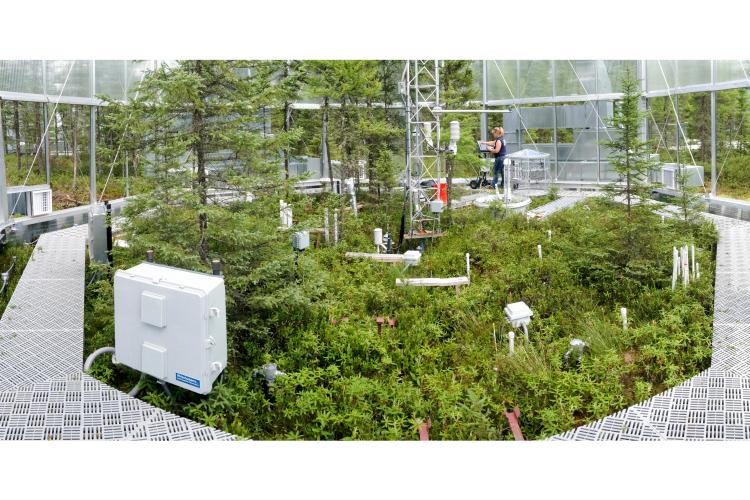
By controlling the temperature and the amount of carbon dioxide in the test chambers, scientists hope to learn how microbial communities, moss populations, various higher plant types and some insect groups respond.

By controlling the temperature and the amount of carbon dioxide in the test chambers, scientists hope to learn how microbial communities, moss populations, various higher plant types and some insect groups respond.

Scientists are getting a glimpse of the future with a Department of Energy large-scale experiment designed to answer questions about how carbon-rich peatlands will respond to projected warming of the climate and increases in atmospheric carbon dioxide.

SPRUCE, which stands for Spruce and Peatland Responses Under Climatic and Environmental Change, was launched today at the experiment site about 25 miles north of Grand Rapids. Among those attending the ceremony were Gary Geernaert and Daniel Stover of DOE’s Office of Biological and Environmental Research; Thomas Schmidt, assistant director for research, U.S. Department of Agriculture Forest Service Northern Research Station; and Martin Keller, associate laboratory director of Energy and Environmental Sciences at DOE’s Oak Ridge National Laboratory in Tennessee.

The site consists of about seven acres of raised bog in the peatlands of the Chippewa National Forest. The natural spruce bog in northern Minnesota contains more than 10,000 years of carbon accumulated from peatlands and answers to questions related to the predicted warming of ecosystems.

Ten open-topped transparent enclosures – 12 meters in diameter by 8 meters high — are the laboratories for the experiments to assess the ecological responses. The enclosures, superimposed on a belowground corral that isolates the peatland, will host measurements of microbial communities, moss populations, various higher plant types and some insect groups.

“The SPRUCE experiment continues ORNL’s involvement in environmental change studies that are conducted in the real world at scales relevant to an ecosystems stature, biodiversity and biogeochemistry,” said Paul Hanson, who leads the project and is a member of ORNL’s Environmental Sciences Division and Climate Change Science Institute.

With the ability to control heating of the air and soil within the enclosures to a depth of two meters, scientists hope to gain an understanding of the possible effects of projected higher temperatures on vegetation and ecosystems.

While peatlands cover about 3 percent of Earth’s land surface, they contain up to 33 percent of the global soil carbon pool. Although that carbon dioxide has been trapped in the cold oxygen-poor environment for thousands of years, warming conditions threaten to see peatlands release large amounts of carbon dioxide and methane. This occurs through a combination of enhanced decomposition and aeration of surface peats.

“SPRUCE is the first experiment to test the combination of warming and elevated carbon dioxide on carbon-rich peatland ecosystems,” said Randy Kolka, team leader and research soil scientist with the Forest Service, a partner in the project.

“Peatlands contain a disproportionate amount of carbon compared to other ecosystems, and understanding their sensitivity to climate change will be critical to predict what happens to the balance between carbon stored in peatlands and the amount of carbon dioxide and methane in the atmosphere.”

The location in the peatlands of the Marcell Experiment Station, part of the Chippewa National Forest, was carefully selected by a team led by Hanson, who recalled how SPRUCE came about.

“SPRUCE represents ORNL’s response to a 2008 directive from DOE to take our group’s expertise in large-scale manipulations off of the Oak Ridge Reservation into a new ecosystem important to the global carbon cycle,” Hanson said.

Now, through SPRUCE, scientists from ORNL, the Forest Service, other DOE laboratories and universities can conduct experiments that couldn’t be done before.

UT-Battelle manages ORNL for the DOE’s Office of Science. The Office of Science is the single largest supporter of basic research in the physical sciences in the United States, and is working to address some of the most pressing challenges of our time. For more information, please visit http://science.energy.gov/.

Scientist: Exxon Knew of Climate Change in 1981, Lied

July 9 2015

Mike Harrison

It wasn’t until 1988 when climate change entered into the public spotlight in full force, after climate scientist James Hansen told Congress that the burning of fossil fuels was causing global warming due to a buildup of greenhouse gas in the atmosphere.

“Exxon first got interested in climate change in 1981, because it was seeking to develop the Natuna gas field off Indonesia”, Bernstein wrote in an email response to an inquiry from Ohio University’s Institute for Applied and Professional Ethics. Billionaire industrialists Charles and David Koch, meanwhile, were outed by a 2010 Greenpeace report revealing they spent significantly more than ExxonMobil between 2005 and 2008 on virtually the same groups.

Exxon, however, did not push through with its development of the Natuna gas field because of the projected implications for the environment. “They may take what appears to be altruistic positions to improve their public image, but the assumption underlying those actions is that they will increase future profits”, Bernstein wrote in 2014.

But despite these warnings and other scientific evidence known at the time, Exxon publicly refused to acknowledge climate change for over 10 years and continued to provide financial support for climate denial.

When the company discovered that the reserve of natural gas was 70 percent carbon dioxide-the primary greenhouse gas and a main driver of climate change-it abandoned the project, Bernstein says. After spending almost a year reviewing a wide range of internal corporate and trade association documents pried loose by leaks, lawsuits and Freedom of Information Act (FOIA) requests, UCS researchers have compiled a broader tale of deceit. “Natural resource companies – oil, coal, minerals – have to make investments that have lifetimes of 50-100 years”. While many compare the case to the tobacco industry denying the dangers of smoking, she argues “this is an order of magnitude greater moral offense, in my opinion, because what is at stake is the fate of the planet, humanity, and the future of civilization”. It did question – legitimately, in my opinion – the validity of some of the science. “I am here to talk to you about the present”, he said. The company has since reportedly invested millions in climate change denial. “We have been factoring the likelihood of some kind of carbon tax into our business planning since 2007″.

A new report reveals that some of the top carbon polluters were fully aware of the reality of climate change but continued to spend tens of millions of dollars to promote contrarian arguments they knew to be wrong. The Guardian has reported that even efforts by members of Exxon’s founding family, the Rockefellers, failed to convince the company to move away from denial and toward clean energy in 2004.

Exxon deliberately deceived the public about the human impact on climate change for almost three decades, launching its campaign to deliberately spread misinformation years before global warming became a hot-button issue, according to a new report.

http://celebcafe.org/scientist-exxon-knew-of-climate-change-in-1981-lied/

CASE STUDY: Dr. Willie Soon, a Career Fueled by Big Oil and Coal

Download (PDF, 424KB)

Climate change could undermine the last 50 years of health advances

http://www.telegraph.co.uk/news/earth/environment/climatechange/11692264/Climate-change-could-undermine-the-last-50-years-of-health-advances.html

Without major reforms climate change could trigger a discontinuity in the long-term progression of humanity, academics warn in The Lancet.

Waves like these at Ilfracombe are likely to become more common Photo: Paul Grover/Telegraph

Waves like these at Ilfracombe are likely to become more common Photo: Paul Grover/Telegraph

Climate change threatens to undermine the last 50 years of advances in medical health, scientists have warned as they published a major report outlining the threat of global warming.

The authors from University College London and the University of Cambridge called for major policy changes to cut pollution including phasing out coal-fired plants and investing in green cities, energy and transport.

Without major change they say climate change could be ‘sufficient to trigger a discontinuity in the long-term progression of humanity.’

In the report, published in The Lancet, the authors argue that the risk to human health posed by climate change has been widely underestimated and that flooding, droughts and heatwaves are likely to have a much greater impact.

Current predictions by the World Health Organisation suggest that 250,000 people a year could die worldwide by 2030 as a direct result of climate change but they do not take into account factors such as that the population is ageing and will be more vulnerable.

Food shortages or displacement of people is also likely to lead to civil unrest and wars.

“Climate change has the potential to reverse the health gains from economic development that have been made in recent decades – not just through the direct effects on health but through indirect means such as increased migration and reduced social mobility,” said Professor Anthony Costello, Director of the UCL Institute for Global Health.

Droughts like in California will become more widespread

Droughts like in California will become more widespread

Professor Hugh Montgomery of UCL’s Institute of Human Health and Performance added: “Climate change is a medical emergency. It thus demands and emergency response using technologies that are available right now.

“It’s not our grandchildren, it’s us and our children, and in this country as well as abroad.”

The report calls on governments to phase out coal-fired power plants and improve cities to promote healthy, greener lifestyles, making them better places to walk and cycle to cut pollution and obesity. They also recommend insulating more homes and buildings to cut energy use and cold-related deaths and disease.

Politicians should also bring in carbon pricing to push up the price of high carbon goods and services to make people change their behaviour, while reducing the cost of other taxes such as VAT, boosting investment or cutting the price of low-carbon technology.

This could mean the cost of flying going up, perhaps with a hike in air passenger duty for flights after the first flight a person takes in a year, pushing up the prices of the “short hop, short-term, leisure travel, stag-parties in Barcelona”.

Professor Paul Ekins, director of the Institute for Sustainable Resources, University College London, said: “That sort of thing could become quite a bit more expensive, such that people would think twice about doing that.”

People would have more money in their pockets from cuts to other taxes and if they “really valued those stag nights in Barcelona, they can still do it but they’d have to give up more in order to have it”, he suggested.

Burrowbridge on the Somerset Levels during the 2014 floods

Burrowbridge on the Somerset Levels during the 2014 floods

The health sector needed to take action too on clean energy, finding ways to deliver health services to patients without them having to drive to hospitals or switching asthma sufferers over to inhalers which do not use greenhouse gases, the commission said.

An estimated one trillion US dollars (£630 billion) would be needed each year up to 2050 to tackle climate emissions from energy, on top of the 105 trillion US dollars (£66 trillion) which would be required anyway for the energy system up to mid-century.

But with people spending 6.8 trillion US dollars (£4.3 trillion) a year on health, and with the “kind of health risks coming down the line if we don’t stick to 2C, that is a very good precautionary investment”, Prof Ekins said.

Cutting air pollution as part of efforts to tackle climate change, for example by reducing transport emissions or coal-fired power stations, in the EU alone could save 38 billion euro (£27 billion) a year by 2050 due to reduced deaths, the report said.

And the experts warned climate change was not a distant problem that would happen somewhere else but an “immediate and grave threat” that, like a patient who was gravely ill, needed action straight away with the technology available.

The new Lancet report on health and climate change, which follows on from a previous commission convened on the issue in 2009, is published in the build-up to key United Nations talks in Paris in December on securing a new global climate treaty.

POPE: Take action to protect our planet and solve climate change

Friend,

The Pope has done something remarkable. Just a few hours ago, Pope Francis released his much-anticipated encyclical, commanding the faithful to take action to protect our planet and solve climate change now.

The Pope’s message calls on all of us to stop abusing the Earth’s resources and make the sacrifices necessary to combat climate change – before it’s too late. Now is the time to make the courageous, ambitious choices we need to protect our planet.

Throughout his encyclical, Pope Francis makes clear: We have to do more to safeguard our common home, like reducing our consumption, tackling pollution and greenhouse gases, and transitioning to clean energy. If we don’t, we’ll face grave consequences that put our ecosystem and human life at risk, especially for less-developed countries.

Earth Day Network is joining Pope Francis in calling on world leaders to take bold action against climate change. Stand with us and add your name today!

An encyclical is one of the most important documents a Pope can issue, reserved for only the most pressing global matters. With his encyclical on climate change, Pope Francis makes clear that addressing climate change is a matter of social justice – and that all of us must do our part to care for the world we inhabit.

I had the honor of meeting Pope Francis on Earth Day, and I was struck by how deeply he cares about protecting the poor from the devastation of climate change. But a culture of consumerism and waste is putting our planet and its most vulnerable inhabitants at risk, and we must turn the tide before it’s too late.

Stand with Pope Francis and Earth Day Network: Sign the petition to urge world leaders to take action against climate change.

Add your name to tell world leaders: Listen to the Pope! Now is the time to take bold action against climate change.

Thank you,

Kathleen Rogers
President, Earth Day Network