
Climate
‘Merchants’: The selling of doubt
http://www.qconline.com/radish/merchants-the-selling-of-doubt/article_e3e8182d-6013-50bf-9a96-74b442e3d08d.html
Based on the book by Naomi Oreskes and Erik M. Conway, the new film “Merchants of Doubt” sheds light on the sleight of hand used by climate-change deniers, using a magician demonstrating card tricks to illustrate the metaphor.
The sowing of doubt about the validity of scientific data didn’t start with global warming. “Merchants” — by Robert Kenner, who directed “Food, Inc.” — cites the debate over the safety of cigarettes, when the tobacco industry publicly denied for years that its product was harmful until the release of its own internal documents revealed a carefully concealed coverup.
Since the tobacco industry push-back, public-relations flacks have honed their tack of either flat-out denying incontrovertible scientific evidence, or insisting that data is insufficient, ambiguous, or otherwise not convincing enough to act upon.
Before zeroing in on climate change, “Merchants” looks at manufacturers of flame-retardant products, which got fired up by big-tobacco tactics, but took them further. Chemical companies created front groups such as Citizens for Fire Safety to push for fire-retardant upholstery, which did not protect against fire, and proved to be carcinogenic.
The culmination of doubt-peddling currently plays out in the ongoing discussion about global warming, which scientists almost unanimously agree is largely caused by human activity: fossil-fuel burning, woodlands reducing, and more that increases the level of carbon dioxide in the atmosphere. The evidence continues to grow.
Unlike with the tobacco industry, climate-change deniers are not solely motivated by financial interests. Instead, “Merchants” puts them into two camps: financial and ideological.
The fossil-fuels industry trots out its experts — some of whom may be scientists in fields not familiar with climatology — to testify before Congress, opinionate in the media, or otherwise spread their contrarian message. As spin doctors, most are more effective at communication than real experts who engage in academic speak.
For example, “Merchants” interviews former salesman Marc Morano, an amusing if amoral pundit-for-hire who brags about working to debunk global warming just for the thrill of it. Morano cops to getting his kicks from debating qualified experts while getting his message across with more readily digestible sound bites.
“I’m not a scientist. I just play one on TV,” he quips. “Communication is about sales. Keep it simple; people will fill in the blanks with their own, I hate to say it, bias … with their own perspectives, in many cases.” Assessing the role he and his like fill, Morano adds, “We’re the negative force; we’re just trying to stop stuff.”
The other camp is dominated by Cold War veterans fixated on communism and anti-government ideologues who deny climate change simply because they don’t want government to wield its power to reduce it. As one of them colorfully puts it, “Environmentalists are like watermelons — green on the outside, red on the inside.”
While many deniers stick to the story that climate change is a hoax, some of the more practical people have proved adaptable: changing their rationale to deal with growing evidence. First, they claimed the Earth wasn’t warming. Then, they said that even if it were, humans can’t be blamed — it’s just cyclical. And now, they say that no matter what’s causing it, there isn’t anything that can be done about it anyway.
“Merchants” manages to find a couple former doubters who have switched sides: The Skeptic Society founder Michael Shermer, who ultimately decided that “you have to follow the science; data trumps politics,” and former Congressman Bob Inglis, who lost his re-election bid to a Tea Party member for siding with the enemy, but maintains “there are things we can do to change. The lie is that we can’t do it.”
The recurring theme of a magician relying on misdirection to work a trick runs through “Merchants.” Distraction is the key, warns Naomi Oreskes, co-author of the source book. “It’s all about preventing people from looking where the real action is, which is in the science.”
“Merchants of Doubt” is available on disc from Netflix; as video on demand from iTunes, Vudu and PlayStation; and, along with the book, from area libraries
Climate change: An opportunity for public health
http://www.who.int/mediacentre/commentaries/climate-change/en/
Dr Maria Neira, WHO Director, Department of Public Health, Environmental and Social Determinants of Health (PHE)
Ahead of the 2014 UN Climate Summit, the health sector added its voice, loud and clear, to growing concerns around climate change and called for swift action to mitigate the human cost of a warming world.
At a global conference convened by WHO, some 400 delegates from all regions—including senior government officials, leading scientists and development partners—agreed unanimously that climate change poses “unacceptable risks” to global public health. From water shortages to changing patterns of disease, they spoke of present-day climate trends that are endangering the health of people in their own countries.
Impact of climate change
The impact of climate change on human health is, indeed, alarming.
Around the world, variations in climate are affecting, in profoundly adverse ways, the air we breathe, the food we eat and the water we drink. We are losing our capacity to sustain human life in good health.
Consider air pollution, the single greatest environmental health risk we face. In 2012 alone, exposure to indoor and outdoor pollutants killed more than 7 million people—one in eight deaths worldwide.
Under-nutrition already accounts for 3 million deaths each year in the world’s poorest regions. Rising temperatures and more variable rainfall patterns are expected to reduce crop yields, further compromising food security.
Floods are increasing in frequency and intensity, creating breeding grounds for disease-carrying insects. Mosquito-borne diseases, like malaria, are particularly sensitive to changes in heat and humidity. What will happen if rising temperatures accelerate the lifecycle of the malaria parasite?
According to WHO estimates, climate change will cause an additional 250 000 deaths per year between 2030 and 2050. Most will likely perish from malaria, diarrhoea, heat exposure and under-nutrition.
Children and the elderly will be among the most vulnerable. Areas with weak health infrastructure will be least able to cope. Developing countries will be hardest hit. The health gaps we have been trying hard to close may grow even wider.
Yet against this troubling backdrop, I am optimistic.
We know that climate change mitigation can yield substantial and immediate health benefits. It is time now to translate knowledge into action.
Specific recommendations
Let me offer specific recommendations, echoing some of the views expressed at the WHO conference:
First, health sector leaders must stand hand-in-hand with climate negotiators to confront climate change. For too long, policy discussions on climate and health have been too divided. We must position health as a central pillar in the climate debate rather than an ancillary agenda.
Second, health systems must become more resilient to climate change, particularly in developing countries. Hospitals and health centres should be reinforced to withstand powerful storms, heat waves and other extreme weather events. And we must ensure that water and sanitation services continue to function under flood and drought conditions.
Third, surveillance systems for climate-sensitive infectious diseases like malaria, dengue and cholera should be fortified. Countries should make better use of early-warning information to predict the onset, intensity and duration of epidemics. Such predictions allow health officials to pre-position medicines and vaccines, which can reduce the death toll.
Fourth, we should maximize the twin benefits of climate change mitigation and improved health. Reducing emissions of short-lived climate pollutants, like black carbon and methane, would slow the rate of global warming while also saving nearly 2.5 million lives per year. Sustainable, low-carbon urban transport—such as cycling or walking as alternatives to driving cars—could lead to dramatic reductions in heart disease, stroke, breast cancer and other ailments. And there are more health benefits to be reaped from more climate-friendly housing that protects occupants from heat waves, biodiverse food production that supports healthy diets, and renewable energy systems that improve access to electricity among hundreds of millions of people in developing countries—not to mention primary health clinics where women today often give birth in the dark.
Finally, the health sector should lower its own climate footprint. Hospitals, as they operate today, are energy-intensive enterprises that contribute substantially to climate change. To reduce their environmental impact, they can adopt basic measures such as reducing toxic waste, using safer chemicals and purchasing eco-friendly products.
Cost savings
Green policies can yield substantial cost savings. In Jaipur, India, a 350-bed health facility cut its total energy bill in half between 2005 and 2008 through solar-powered water heaters and lightning. In Brazil, one efficiency project reduced the demand for electricity of a group of 101 hospitals by 1035 kilowatts at a cost savings of 25%.
Since 2007, I have described climate change as the defining issue for public health in this century. Today, I would add that it is one of the greatest opportunities we face to improve human health.
At the UN Climate Summit and beyond, I will seek support from health sector leaders and development partners to push this issue to centre stage.
DOE event marks beginning of landmark ecosystem experiment
https://ornl.gov/news/doe-event-marks-beginning-landmark-ecosystem-experiment
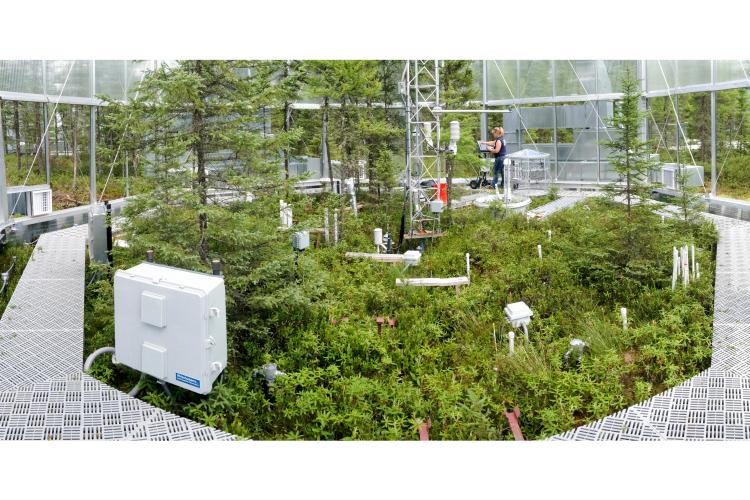
By controlling the temperature and the amount of carbon dioxide in the test chambers, scientists hope to learn how microbial communities, moss populations, various higher plant types and some insect groups respond.
Scientists are getting a glimpse of the future with a Department of Energy large-scale experiment designed to answer questions about how carbon-rich peatlands will respond to projected warming of the climate and increases in atmospheric carbon dioxide.
SPRUCE, which stands for Spruce and Peatland Responses Under Climatic and Environmental Change, was launched today at the experiment site about 25 miles north of Grand Rapids. Among those attending the ceremony were Gary Geernaert and Daniel Stover of DOE’s Office of Biological and Environmental Research; Thomas Schmidt, assistant director for research, U.S. Department of Agriculture Forest Service Northern Research Station; and Martin Keller, associate laboratory director of Energy and Environmental Sciences at DOE’s Oak Ridge National Laboratory in Tennessee.
The site consists of about seven acres of raised bog in the peatlands of the Chippewa National Forest. The natural spruce bog in northern Minnesota contains more than 10,000 years of carbon accumulated from peatlands and answers to questions related to the predicted warming of ecosystems.
Ten open-topped transparent enclosures – 12 meters in diameter by 8 meters high — are the laboratories for the experiments to assess the ecological responses. The enclosures, superimposed on a belowground corral that isolates the peatland, will host measurements of microbial communities, moss populations, various higher plant types and some insect groups.
“The SPRUCE experiment continues ORNL’s involvement in environmental change studies that are conducted in the real world at scales relevant to an ecosystems stature, biodiversity and biogeochemistry,” said Paul Hanson, who leads the project and is a member of ORNL’s Environmental Sciences Division and Climate Change Science Institute.
With the ability to control heating of the air and soil within the enclosures to a depth of two meters, scientists hope to gain an understanding of the possible effects of projected higher temperatures on vegetation and ecosystems.
While peatlands cover about 3 percent of Earth’s land surface, they contain up to 33 percent of the global soil carbon pool. Although that carbon dioxide has been trapped in the cold oxygen-poor environment for thousands of years, warming conditions threaten to see peatlands release large amounts of carbon dioxide and methane. This occurs through a combination of enhanced decomposition and aeration of surface peats.
“SPRUCE is the first experiment to test the combination of warming and elevated carbon dioxide on carbon-rich peatland ecosystems,” said Randy Kolka, team leader and research soil scientist with the Forest Service, a partner in the project.
“Peatlands contain a disproportionate amount of carbon compared to other ecosystems, and understanding their sensitivity to climate change will be critical to predict what happens to the balance between carbon stored in peatlands and the amount of carbon dioxide and methane in the atmosphere.”
The location in the peatlands of the Marcell Experiment Station, part of the Chippewa National Forest, was carefully selected by a team led by Hanson, who recalled how SPRUCE came about.
“SPRUCE represents ORNL’s response to a 2008 directive from DOE to take our group’s expertise in large-scale manipulations off of the Oak Ridge Reservation into a new ecosystem important to the global carbon cycle,” Hanson said.
Now, through SPRUCE, scientists from ORNL, the Forest Service, other DOE laboratories and universities can conduct experiments that couldn’t be done before.
UT-Battelle manages ORNL for the DOE’s Office of Science. The Office of Science is the single largest supporter of basic research in the physical sciences in the United States, and is working to address some of the most pressing challenges of our time. For more information, please visit http://science.energy.gov/.
Megacities must address climate change, Stanford Nobel laureate says
http://news.stanford.edu/news/2015/july/laureates-climate-change-072015.html

Nobel laureates, from left, standing: George Smoot, Peter Doherty, W.E. Moerner, Brian Schmidt; and seated, James Mirrlees, join memorandum team leader Penny Sackett in Hong Kong on April 25. (PIK/Asia Society)
Stanford chemist W.E. Moerner suggests that the world’s largest cities should take steps to reduce the impacts of global warming.
By Mark Shwartz
For W.E. Moerner, winning the 2014 Nobel Prize in chemistry has been a life-changing experience. Moerner, the Harry S. Mosher Professor of Chemistry at Stanford University, won the prestigious award on Oct. 8.
Since then, he has accepted numerous invitations to conferences around the world. Few have had as much impact on him as the Nobel Laureates’ Symposium on Global Sustainability held last April in Hong Kong. Moerner was among seven Nobel laureates invited to participate in the three-day symposium, which focused on how big cities – or “megacities” – particularly the booming metropolises of Asia, can address global climate change. Urban areas account for about 80 percent of all greenhouse gas emissions, according to symposium organizers.
On April 25, the laureates signed a memorandum urging megacities in China and elsewhere to take a leadership role in combating climate change. On July 3, Moerner, Stanford physicist Steven Chu and other Nobel laureates signed a separate declaration on global warming. Both documents urged support for an upcoming United Nations conference on reducing greenhouse gas emissions. In the following interview, Moerner discusses how these efforts could influence delegates at that crucial U.N. conference.
The memorandum you signed in Hong Kong calls on megacities to take the lead in curbing global climate change. That’s an intriguing approach to a problem that affects the whole planet.
Megacities can deal with problems like climate change faster than large nation-states can, in part because it’s a local problem they know they have to address. There are a lot of megacities in the world today and more are expected in the future.
Why was the symposium held in Hong Kong?
Part of the reason is that Hong Kong is one of those megacities with an amazingly dense population that depends on remote sources of water and power. One of their biggest problems is air conditioning. Imagine millions of single air conditioners in millions of apartments. A central air-conditioning system would certainly be more efficient.
Another big challenge comes from shipping, a major contributor of airborne particulates. The Hong Kong government recently decided to require that incoming ships and boats switch to more efficient green fuels that reduce pollution. That’s already required in California.
The memorandum pays particular attention to places like refugee camps and informal settlements that are becoming large, unsustainable cities.
That’s exactly right. The cities of tomorrow are forming right now. These informal settlements obviously have needs for basic services – power, water, sanitation. But little thought is given to global sustainability in terms of how power is used, how heat is generated, how sanitation is provided or how food is cooked. We are simply urging people to recognize this problem and support the sustainable development of these settlements as they grow.
You also urge support for the United Nations-led effort to reduce global greenhouse gas emissions.
Our memorandum will be presented to key stakeholders at the 2015 U.N. Conference of the Parties, COP 21, the group that’s meeting in Paris in December to try once again to see if an international agreement can be reached to limit the average global temperature rise to 2 degrees Celsius.
The memorandum says, “For our part, we will use our passion and skills to support efforts to limit and manage climate change.” What does that mean for you?
First, it means trying to make people aware of the memorandum. I’ve been invited to the World Economic Forum in Davos, Switzerland. I also give a lot of lectures. This is an important issue that I would like to address in whatever way is appropriate.
Does your own research involve energy or climate change?
Our lab has received funding from the Department of Energy to study important proteins and enzymes involved in energy storage, conversion and capture. For example, we’re looking at the behavior of photosynthetic antenna proteins in microorganisms and plants. These proteins absorb sunlight and then transfer that energy to the reaction center where photosynthesis occurs. Knowing how the proteins work at the single-molecular level could be useful information for designing artificial photosynthetic systems.
You clearly have a passion for sustainable energy, from your basic research to the global scale.
That’s one of the nice aspects about the symposium on sustainability. It allowed me to learn more about the bigger picture, how these things connect together on a much larger scale. It’s complementary to the laboratory work we do that’s very fundamental.
Does it seem like people are more willing to listen to you now that you’re a Nobel laureate?
In fact that is true, whether it’s right or wrong, good or bad. It’s one of those amazing things about the Nobel Prize: People listen to you more, so there is an opportunity to have more impact. It’s an important responsibility.
Are you optimistic that the problem of climate change can be solved?
There is so much intellectual creativity being directed toward this problem now – inventing new ways of making batteries, collecting energy and so forth.
But it’s important that people not deny the science. I don’t appreciate those who take a cafeteria-style approach to science: I’ll take a few things but I won’t take others, because I don’t like those results. About 97 percent of scientists believe that human-caused climate change is real. There are 3 percent who don’t, and some people focus on the 3 percent.
Predictions about climate change are based on probabilities. Rather than attacking this approach as a lack of knowledge, it should be understood that we’re simply trying to be careful about what we know.
We’ve already changed the world in one way by causing CO2 to increase a lot. We can change it in another way by reducing the rate of growth of CO2. I’m hoping that this will be realized in enough time for us to make significant changes and limit the effects of climate change. We prefer to be optimistic whenever possible
Scientist: Exxon Knew of Climate Change in 1981, Lied
July 9 2015
Mike Harrison
It wasn’t until 1988 when climate change entered into the public spotlight in full force, after climate scientist James Hansen told Congress that the burning of fossil fuels was causing global warming due to a buildup of greenhouse gas in the atmosphere.
“Exxon first got interested in climate change in 1981, because it was seeking to develop the Natuna gas field off Indonesia”, Bernstein wrote in an email response to an inquiry from Ohio University’s Institute for Applied and Professional Ethics. Billionaire industrialists Charles and David Koch, meanwhile, were outed by a 2010 Greenpeace report revealing they spent significantly more than ExxonMobil between 2005 and 2008 on virtually the same groups.
Exxon, however, did not push through with its development of the Natuna gas field because of the projected implications for the environment. “They may take what appears to be altruistic positions to improve their public image, but the assumption underlying those actions is that they will increase future profits”, Bernstein wrote in 2014.
But despite these warnings and other scientific evidence known at the time, Exxon publicly refused to acknowledge climate change for over 10 years and continued to provide financial support for climate denial.
When the company discovered that the reserve of natural gas was 70 percent carbon dioxide-the primary greenhouse gas and a main driver of climate change-it abandoned the project, Bernstein says. After spending almost a year reviewing a wide range of internal corporate and trade association documents pried loose by leaks, lawsuits and Freedom of Information Act (FOIA) requests, UCS researchers have compiled a broader tale of deceit. “Natural resource companies – oil, coal, minerals – have to make investments that have lifetimes of 50-100 years”. While many compare the case to the tobacco industry denying the dangers of smoking, she argues “this is an order of magnitude greater moral offense, in my opinion, because what is at stake is the fate of the planet, humanity, and the future of civilization”. It did question – legitimately, in my opinion – the validity of some of the science. “I am here to talk to you about the present”, he said. The company has since reportedly invested millions in climate change denial. “We have been factoring the likelihood of some kind of carbon tax into our business planning since 2007″.
A new report reveals that some of the top carbon polluters were fully aware of the reality of climate change but continued to spend tens of millions of dollars to promote contrarian arguments they knew to be wrong. The Guardian has reported that even efforts by members of Exxon’s founding family, the Rockefellers, failed to convince the company to move away from denial and toward clean energy in 2004.
Exxon deliberately deceived the public about the human impact on climate change for almost three decades, launching its campaign to deliberately spread misinformation years before global warming became a hot-button issue, according to a new report.
http://celebcafe.org/scientist-exxon-knew-of-climate-change-in-1981-lied/
Climate change could undermine the last 50 years of health advances
http://www.telegraph.co.uk/news/earth/environment/climatechange/11692264/Climate-change-could-undermine-the-last-50-years-of-health-advances.html
Without major reforms climate change could trigger a discontinuity in the long-term progression of humanity, academics warn in The Lancet.

Waves like these at Ilfracombe are likely to become more common Photo: Paul Grover/Telegraph
Climate change threatens to undermine the last 50 years of advances in medical health, scientists have warned as they published a major report outlining the threat of global warming.
The authors from University College London and the University of Cambridge called for major policy changes to cut pollution including phasing out coal-fired plants and investing in green cities, energy and transport.
Without major change they say climate change could be ‘sufficient to trigger a discontinuity in the long-term progression of humanity.’
In the report, published in The Lancet, the authors argue that the risk to human health posed by climate change has been widely underestimated and that flooding, droughts and heatwaves are likely to have a much greater impact.
Current predictions by the World Health Organisation suggest that 250,000 people a year could die worldwide by 2030 as a direct result of climate change but they do not take into account factors such as that the population is ageing and will be more vulnerable.
Food shortages or displacement of people is also likely to lead to civil unrest and wars.
“Climate change has the potential to reverse the health gains from economic development that have been made in recent decades – not just through the direct effects on health but through indirect means such as increased migration and reduced social mobility,” said Professor Anthony Costello, Director of the UCL Institute for Global Health.

Droughts like in California will become more widespread
Professor Hugh Montgomery of UCL’s Institute of Human Health and Performance added: “Climate change is a medical emergency. It thus demands and emergency response using technologies that are available right now.
“It’s not our grandchildren, it’s us and our children, and in this country as well as abroad.”
The report calls on governments to phase out coal-fired power plants and improve cities to promote healthy, greener lifestyles, making them better places to walk and cycle to cut pollution and obesity. They also recommend insulating more homes and buildings to cut energy use and cold-related deaths and disease.
Politicians should also bring in carbon pricing to push up the price of high carbon goods and services to make people change their behaviour, while reducing the cost of other taxes such as VAT, boosting investment or cutting the price of low-carbon technology.
This could mean the cost of flying going up, perhaps with a hike in air passenger duty for flights after the first flight a person takes in a year, pushing up the prices of the “short hop, short-term, leisure travel, stag-parties in Barcelona”.
Professor Paul Ekins, director of the Institute for Sustainable Resources, University College London, said: “That sort of thing could become quite a bit more expensive, such that people would think twice about doing that.”
People would have more money in their pockets from cuts to other taxes and if they “really valued those stag nights in Barcelona, they can still do it but they’d have to give up more in order to have it”, he suggested.

Burrowbridge on the Somerset Levels during the 2014 floods
The health sector needed to take action too on clean energy, finding ways to deliver health services to patients without them having to drive to hospitals or switching asthma sufferers over to inhalers which do not use greenhouse gases, the commission said.
An estimated one trillion US dollars (£630 billion) would be needed each year up to 2050 to tackle climate emissions from energy, on top of the 105 trillion US dollars (£66 trillion) which would be required anyway for the energy system up to mid-century.
But with people spending 6.8 trillion US dollars (£4.3 trillion) a year on health, and with the “kind of health risks coming down the line if we don’t stick to 2C, that is a very good precautionary investment”, Prof Ekins said.
Cutting air pollution as part of efforts to tackle climate change, for example by reducing transport emissions or coal-fired power stations, in the EU alone could save 38 billion euro (£27 billion) a year by 2050 due to reduced deaths, the report said.
And the experts warned climate change was not a distant problem that would happen somewhere else but an “immediate and grave threat” that, like a patient who was gravely ill, needed action straight away with the technology available.
The new Lancet report on health and climate change, which follows on from a previous commission convened on the issue in 2009, is published in the build-up to key United Nations talks in Paris in December on securing a new global climate treaty.
POPE: Take action to protect our planet and solve climate change
Friend,
The Pope has done something remarkable. Just a few hours ago, Pope Francis released his much-anticipated encyclical, commanding the faithful to take action to protect our planet and solve climate change now.
The Pope’s message calls on all of us to stop abusing the Earth’s resources and make the sacrifices necessary to combat climate change – before it’s too late. Now is the time to make the courageous, ambitious choices we need to protect our planet.
Throughout his encyclical, Pope Francis makes clear: We have to do more to safeguard our common home, like reducing our consumption, tackling pollution and greenhouse gases, and transitioning to clean energy. If we don’t, we’ll face grave consequences that put our ecosystem and human life at risk, especially for less-developed countries.
Earth Day Network is joining Pope Francis in calling on world leaders to take bold action against climate change. Stand with us and add your name today!
An encyclical is one of the most important documents a Pope can issue, reserved for only the most pressing global matters. With his encyclical on climate change, Pope Francis makes clear that addressing climate change is a matter of social justice – and that all of us must do our part to care for the world we inhabit.
I had the honor of meeting Pope Francis on Earth Day, and I was struck by how deeply he cares about protecting the poor from the devastation of climate change. But a culture of consumerism and waste is putting our planet and its most vulnerable inhabitants at risk, and we must turn the tide before it’s too late.
Stand with Pope Francis and Earth Day Network: Sign the petition to urge world leaders to take action against climate change.
Thank you,
Kathleen Rogers
President, Earth Day Network
Minimising the use of fossil fuels is key to resolving both climate change and air pollution
AcidNews June 2015
The proposed revision of the National Emission Ceilings (NEC) Directive is currently being debated in the Council and in the European Parliament. While there is wide agreement on the urgency of additional action to cut air pollution, there are differing views among member states on how much and how quickly their emissions should come down.
In its annual air quality report from November last year, the European Environment Agency (EEA) estimated that current levels of air pollution are responsible for 447,000 premature deaths in the EU every year, as well as allergies and respiratory and cardiovascular diseases which result in extra medication, hospitalisations and millions of lost working days.
Moreover, air pollution damages nature and biodiversity, with the deposition of acidifying and eutrophying pollutants and the concentrations of ground-level ozone still exceeding the tolerance limits of sensitive ecosystems over millions of hectares of land in Europe. Agricultural crops and forest productivity are also hit by air pollution, as are building materials and cultural monuments.
The health impacts alone carry enormous costs to society – estimated to amount to between €330 and €940 billion/yr.
This means that even a purely economic cost-benefit approach motivates a very significant stepping up of action to tackle air pollution, since the health benefits alone outweigh by far the additional costs for emissions control.
Because the health impacts are relatively easy to value, much of the political debate on establishing a “suitable” level of ambition for future emission reduction targets tends to focus on economics. And much too often member states focus primarily on the perceived costs, while at the same time largely ignoring the benefits.
However, clean air and water, healthy people, forests and heathlands, and a rich flora and fauna are necessary for a high quality of life, and must not be overlooked by policy makers, whether or not they are valued in monetary terms.
The gravity of the air pollution situation calls for a new NEC directive that establishes a very high level of ambition.
It is certainly not acceptable that even after 2030, air pollution will still cause a quarter of a million premature deaths, and that millions of hectares of valuable eco-systems will still be exposed to excessive pollutant levels, as would be the case under the Commission’s proposed new NEC directive.
Applying new and improved emission control techniques must be part of the solution, and that’s why EU source-sector legislation must be regularly updated and strengthened.
Minimising the use of fossil fuels is key to resolving both climate change and air pollution, as it cuts emissions of carbon dioxide as well as those of sulphur dioxide, nitrogen oxides, fine particulate matter and mercury. Better energy efficiency, increased use of less-polluting or non-polluting renewable energy sources, and behavioural change (e.g. reducing car usage and meat consumption) are examples of measures that will benefit both air quality and the climate.
The EU’s new climate and energy policy for 2030 – which was not accounted for in the Commission’s proposed new NEC directive – opens the way for more ambitious clean air targets, as was demonstrated by the Parliament’s impact assessment study.
But we all know that to avoid dangerous climate change, we need much tougher climate and energy targets, and this will help to achieve even stricter air pollution targets. At the same time, the significant short-term co-benefits for health and nature from the resulting air pollution reductions should help to motivate a much higher level of ambition for climate policy.
Christer Ågren