Clear The Air News Blog Rotating Header Image

Global

Lack of accountability stinks

Letters to the editor, January 11, 2016

As if the report by the [1] Audit Commission [2] on the Environmental Protection Department is not embarrassing enough (“Hong Kong’s waste problem: a stinking trail of missed targets, data errors and misdirected efforts [3]”, December 1), the Legislative Council’s Public Accounts Committee’s two hearings last month on food waste reduction and recycling will enshrine the department in perpetuity in the Hall of Shame in Mismanagement.

We learned that the department handled the growing problem of food waste, which accounts for 38 per cent of municipal solid waste in Hong Kong, in a piecemeal, disjointed manner. We learned that the department has no idea on how each programme quantitatively contributes to the reduction of food waste, which has increased by 13 per cent from 3,227 tonnes per day in 2004 to 3,648 tonnes in 2013. We learned that targets are either non-existent or not met if they’d been posted. We learned that officials are not accountable for their mistake, and the same consultant who partnered with the department in the mistake continues to advise the department on a bigger project.

After spending HK$150 million and HK$50 million to reduce food waste in schools and private housing estates respectively, the department cannot explain how much food waste was reduced as a result of those programmes. The same goes for the HK$18.7 million spent during 2013 and 2015 in advertising, marketing, and education programmes to promote the department’s signature Food Wise campaign.

Only 26 out of 1,027 business entities provided data on their efforts to reduce food waste on a voluntary basis. No data was provided by the 294 schools who signed onto the Green Lunch Charter on the result of their effort.

Phase one of the Organic Waste Treatment Facilities that was priced at HK$489 million in 2010, with the help of a consultant company which earned HK$8.8 million for its advice, turned out to cost HK$1.53 billion. The Audit Commission pointed out that essential components were underestimated in the initial estimate.

Despite clear evidence in the commission’s report showing mistake in professional judgment, Mr Elvis Au, assistant director of the department, insisted that rising cost and lack of reference price of the facilities were the causes of the cost overrun. Mr Au and the same consulting company have since moved on to manage one of the most expensive project in the department’s history – building an incinerator at Shek Kwu Chau.

Is there accountability in Hong Kong?

Tom Yam, Lantau

Source URL: http://www.scmp.com/comment/letters/article/1899934/letters-editor-january-11-2016
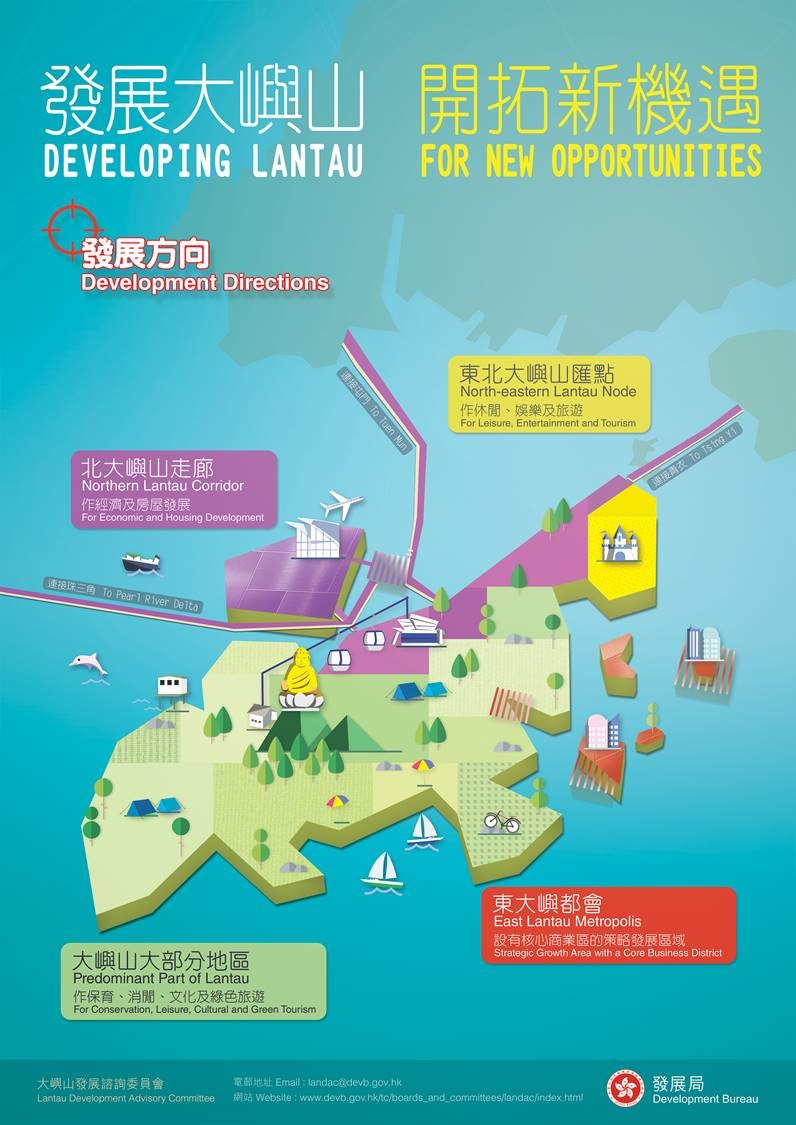
Developing Lantau For New Opportunities

Download (PDF, 769KB)

CE receives Lantau report

Chief Executive CY Leung today received the first-term work report submitted by the Lantau Development Advisory Committee.

Mr Leung said the committee has fully considered the current situations of various districts on Lantau Island, including conservation needs and development potential, and put forward its vision and its recommendation on short-term work.

Large-scale infrastructure including the Tuen Mun-Chep Lap Kok Link, Hong Kong-Zhuhai-Macau Bridge and the third airport runway will turn Lantau from an outlying island to a significant region of Hong Kong, he said.

Noting the report has been uploaded to the Government website, he called on people to continue to provide comments to develop Lantau.

Mr Leung thanked the committee and the Development Bureau for their efforts.

lantau

Hong Kong sees bigger rise in poisonous ozone pollution than industrial Guangdong

Elizabeth Cheung elizabeth.cheung@scmp.com

But environmental campaigners say pollution cannot be solely blamed on mainland sources

Hong Kong has seen a bigger rise in poisonous ozone pollution than industrial Guangdong – but pollutants from the mainland are not solely to blame, environmental campaigners say.

Environmentalists from Clean Air Network have urged the government to take tougher action on air pollutants through transport planning measures.

Campaigners looked at the data on ozone levels from the Guangdong-Hong Kong-Macau air quality monitoring database. Ozone levels recorded at the 13 monitoring stations in Guangdong province saw a 6.1 per cent increase between 2010 and 2014, compared to the 9.2 per cent increase recorded at the three Hong Kong stations, set up in Tsuen Wan, Tap Mun and Tung Chung.

When data from local general air quality monitoring stations was studied, excluding three included in a regional monitoring scheme, the rise in the level of ozone was even greater, at 17.1 per cent.
Between 2006 and 2014, local stations recorded a 27.2 per cent rise in ozone, in contrast to 19.5 per cent in the neighbouring province.

The Environmental Protection Department said more easterly prevailing winds from the mainland explained greater air pollution in eastern parts of the city, but Clean Air Network said local factors still played a role.

Kwun Tong in Kowloon East experienced a drop in the number of hours defined as having experienced serious pollution between 1992 and 2014 despite its largely northeasterly winds.

“The high level of ozone is not solely a regional issue. We can target ozone pollution both locally and regionally,” said Kwong Sum-yin, chief executive officer of the group.

Hong Kong and Guangdong have set up joint emissions reduction targets, which include four pollutants, two of which are the main sources of ozone production. But the group urged authorities to include targets on ozone.

Locally, Kwong said the rise in the number of vehicles on the roads over the past decade had contributed to the deteriorating air pollution in the city. Between 2005 and 2014, the number of trips by vehicles through the three cross-harbour tunnels daily increased from 228,000 to more than 250,000. Meanwhile, nitrogen dioxide, one of the key air pollutants measured at four roadside stations, increased steadily until 2013.

Kwong said people in Hong Kong were still exposed to significant health risks from air pollution. According to the Hedley index, an indicator developed by the University of Hong Kong’s public health school to show the public health costs and risks from pollution, as many as 2,196 people died prematurely last year due to air pollution. The cost to the public purse of such health problems amounted to HK$27 billion.

“Although there was a slight improvement in air quality, the health of people could not be guaranteed,” she said.

________________________________________
Source URL: http://www.scmp.com/news/hong-kong/politics/article/1899787/hong-kong-sees-bigger-rise-poisonous-ozone-pollution

We’re all in this together for cleaner air

While the Triple Crown is the epitome of thoroughbred racing, Causeway Bay has just been awarded an informal Triple Crown of sorts – the district has boasted one of the priciest commercial property rents in the world, one of the most tourist-congested shopping space in the world, and now the most polluted district in Hong Kong to boot. Quite an unenviable feat !

It’s fair to ask based on this fact alone, are we going the way of some first-tier Chinese cities which recently issued red pollution alerts?

Latest government statistics showed Causeway Bay’s air pollution was rated “7 (high)” or above on a scale of 1-10, with 10 being the most serious in the Environmental Protection Department’s Air Pollution Index (API). A “high” rating means people’s health isat risk. It had reached this level 103 days of last year, followed by Mong Kok, which saw 69 days of “high” air pollution level.

The level of fine particles that can penetrate the lungs and are thus hazardous to human health in Causeway Bay was way higher than the World Health Organization’s guideline in most of the days in 2015. Fortunately, it appeared not to be representative of Hong Kong as a whole as the EPD report indicated a slight improvement in our air quality last year. The concentration of nitrogen oxide, nitrogen dioxide, sulphur dioxide, ozone and respirable suspended particulate were lower than in 2014, although carbon monoxide did rise by 5%. There were 2% less ozone in the air, but its level was still high, increasing by 32% since 1999. There were fewer number of days when Air Quality Health Index was at “high” level or over, compared to 2014.

This is one issue where President John F. Kennedy’s famous exhortation: ‘’Ask not what the country can do for you. Ask what you can do for your country’’ is applicable. To effectively tackle our persistent air pollution problem, the government cannot do it all. It needs the crucial cooperation of the entire citizenry.

We’re now past blaming our northern neighbors for our air pollution and must come to grips with the reality that the main source of our current pollution are locally-generated – in particular, from motor vehicles. And we must accept that the government cannot simply disperse our population concentration to the non-existent suburbs as in America. So what do we do?

Perhaps we should start by asking: do you really need a car? The answer for the vast majority of Hongkongers is undoubtedly ‘’no’’, considering our compact size and the world-class public transportation network of many modes.
But if you must, choose a car of right capacity. A single person doesn’t need a large sized car with a large engine. Forming a car pool with your friends or neighbors will help to reduce the pollution by simply reducing the number of vehicles on the road. And don’t forget the concurrent financial savings it will afford all participants.

Fuel combustion from car engines emits nitrogen oxides and suspended particulates, which cause air pollution. These air pollutants are particularly dangerous as they tend to be trapped in the deadly jungle of skyscrapers in Hong Kong.

Beyond the immediate health benefits it will bring to us all, better air quality will no doubt enhance our economic competitiveness as we are more likely to lure more talent and investment to our shores.

Download (PDF, 763KB)

Bad Hong Kong air: Eastern districts’ increasing pollution still better than Western

Eastern parts of Hong Kong recorded more hours of poor air quality last year compared to 2014, despite a continuing improvement of general air quality in the city.

While there was a drop in several types of air pollutants, the level of ozone – one of the four major items measured by local air quality monitoring stations – remained high, according to the preliminary annual air quality data on last year released by the Environmental Protection Department.

Green groups were not happy with the drop in pollutants and said interdepartmental cooperation should be strengthened.

According to the department, Eastern District had 213 hours when the air quality health index was high, very high or serious last year, a 31 per cent increase from the previous year. A higher level indicates a greater health risk to individuals from air pollution.

Central and Western and Tai Po also experienced more hours of poor air quality, recording a 12 per cent and 7 per cent increase respectively.

“In 2015, there were days when regional air pollution was high, yet the prevailing wind from the north was more easterly. Eastern parts of Hong Kong were therefore more affected by the air pollutants,” said Mok Wai-chuen, assistant director of environmental protection.

Air pollution in the east, however, was still less severe than in the west. Tuen Mun, Tung Chung and Yuen Long topped the chart for air pollution, despite a general drop in the number of hours of poor air quality.

Overall air quality was also better than in the previous year. There was a 13 per cent reduction in the total number of hours of high or above recordings at all general stations, and a 7 per cent drop at roadside stations.

Air pollutants, including fine and respirable suspended particulates, sulphur dioxide and nitrogen dioxide, also dropped from the previous year.

However, ozone, a major air pollutant which can lead to respiratory diseases, remained at a high level of 45 micrograms per cubic metre of air.

bad-air-days

Mok said the high level was due to an increase in ozone emissions in the Pearl River Delta.

“If we want to solve the ozone problem, we need to work hand in hand with the mainland,” said Mok.

The Hong Kong and Guangdong governments set emission reduction targets for 2015 and 2020 in November 2012. Both governments are now conducting an interim review of last year ‘s emissions and the 2020 targets.

Patrick Fung Kin-wai, director of communications for Clean Air Network, an NGO focusing on air pollution, said it was hard for him to be happy with the latest air quality data.

“From 1998 [till now], the level of roadside pollution has stayed at its original point,” said Fung.

He took nitrogen dioxide, a pollutant mainly emitted by vehicles, as an example. The 1998 and 2015 levels were almost the same, close to 100 micrograms per cubic metre.

Fung urged greater cross-departmental work, such as designating more busy areas as pedestrian zones, in a bid to improve air quality.

________________________________________
Source URL: http://www.scmp.com/news/hong-kong/health-environment/article/1898228/bad-hong-kong-air-eastern-districts-increasing

Delta blamed for ozone rise

http://thestandard.com.hk/news_print.asp?art_id=164856&sid=45860273

Vehicle, factory and power plant emissions in the Pearl River Delta have pushed up the ozone level in Hong Kong, although general air quality continued to improve last year compared with 2014, the Environmental Protection Department says.

While preliminary data showed concentrations of all major pollutants, such as sulfur dioxide, nitrogen dioxide and respirable suspended particulates, dropped in 2015 compared with 2014, the level of ambient ozone dropped slightly by 2 percent but was still 32 percent higher than in 1999.

The assistant director of environmental protection, Mok Wai- chuen, said ozone pollution produced from local emissions showed a decreasing trend over the past year.

“But the increase in the regional background, mainly due to PRD-originating emissions, has led to an overall increase in ambient ozone level,” he said.

Mok stressed that collaboration with the mainland is a must when tackling the increasing level of ozone.

But he did not say what actual measures have been or would be taken.

“The two sides of the government will prepare for a mid-term review on the emission reduction results for 2015 so as to finalize the emission reduction targets for 2020 in order to further improve regional air quality,” he said.

Data showed that Tuen Mun had the worst air quality last year, with 416 hours of the Air Quality Health Index at high or above, followed by Tung Chung with 346 hours.

Principal Environmental Protection Officer Shermann Fong Che-ping said the two areas were mainly affected by ozone.

Asked if the smog in China would possibly affect the SAR air quality, Mok said: “The air quality will be worse if the wind is from mainland because it will bring the pollutants from the land and human activities.”

Mok said the government aims to phase out 82,000 pre-Euro IV diesel commercial vehicles by the end of 2019.

Three low emission zones have been set up at busy corridors in Central, Causeway Bay and Mong Kok for franchised buses whose emission performances meet Euro IV or above.

He believed that Hong Kong will reduce carbon intensity by 50 to 60 percent by 2020 compared with the 2005 level by committing to its control measures

Hong Kong, Shenzhen airports team up to provide “more options for travellers”

http://www.traveldailymedia.com/231063/hong-kong-shenzhen-airports-team-up-to-provide-more-options-for-travellers/

New agreement aimed at offering more travel options in Pearl River Delta

A new agreement has been signed that will strengthen the aviation links between Hong Kong and neighbouring Shenzhen.

Hong Kong’s Airport Authority (AA) has penned a deal with Shenzhen Airport Management Company that aims to “synergise the development” of the two cities’ airports.

The partnership was signed by Fred Lam, chief executive officer of the AA, and Wang Yang, president of the Shenzhen Airport Management Company.

“The agreement has been signed after many rounds of meetings between the two parties. The strengthened cooperation between the two airports can enhance the optimisation of airspace resources in PRD (Pearl River Delta) region,” said Lam. He added that the two airports will also support the medium- and long-term expansion plans of each other.

The agreement outlines various areas of cooperation between Hong Kong International Airport (HKIA) and Shenzhen Bao’an International Airport (SZIA). These include the establishment of a designated immigration channel at Shenzhen Bay for passengers and vehicles travelling between the two airports, and the enhancement of sea and land transport services.

The two parties will also work with airlines to develop “all-in-one” tickets that include hotel accommodation and transportation option such as flight, ferry and coach tickets.

AA said that the cooperation will provide “more options for travellers in terms of air ticket prices and flight schedules”.

At present, HKIA and SZIA operate the “Fly via Hong Kong” and “Fly via Shenzhen” services, which provide both passenger and baggage check-in services to travellers of the other airport. There are also 14 ferries and more than 80 coaches and limousines operating between the two hubs.

WHO’s Urban Ambient Air Pollution database ‐ Update 2016

Download (PDF, 674KB)

Attribution of Extreme Weather Events in the Context of Climate Change

Download (PDF, 8.48MB)