Clear The Air News Blog Rotating Header Image

China

At least five more people detained over Huizhou incinerator protest

Monday, 15 September, 2014

Huifeng He

Arrests follow weekend demonstrations involving thousands calling for project to be scrapped

At least five people were detained by police on Sunday in Huizhou in Guangdong for allegedly spreading false information over the internet to “incite” protest against a proposed trash incinerator project.

The arrests follow demonstrations during the weekend in which thousands took to the streets in Boluo county demanding the authorities scrap the project, which would process 2,600 tonnes of rubbish a day.

Since Saturday, the local public security bureau had taken away 32 people for investigation on suspicion of spreading rumours or disturbing public order and causing trouble, and 21 were still being detained.

Several local residents said they received electronic messages saying the municipal government had given approval to their taking to the streets peacefully on September 20 to voice concerns about the project. But the county’s authorities released a brief statement on Sunday night denying it had given such permission.

However, many local residents said they would again take to the street this coming Saturday, no matter the authorities approve. “We are not afraid of being detained. If we don’t stand up to fight, it will be too late to save our community,” Li Wei said

According to county authorities, the location of the incinerator had not been decided, and the party chief of the county was scheduled to meet today with representatives of the residents to hear their advice and appeals about the garbage incinerating plan.

Some internet users have called for demonstrations to spread to other cities in the Pearl River Delta. “People of Shenzhen, Dongguan and even Hong Kong should take to the street because incinerator would be so close to their water sources, Dongjiang River,” a person using the nickname Ai Yu Bu Ai said on weibo.

http://www.scmp.com/article/1593055/least-five-more-people-detained-over-huizhou-incinerator-protest
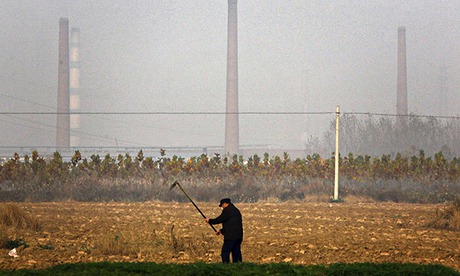
Guardian: China’s toxic air pollution resembles nuclear winter, say scientists

by Jonathan Kaiman, reporting from Beijing for the Guardian:

Chinese scientists have warned that the country’s toxic air pollution is now so bad that it resembles a nuclear winter, slowing photosynthesis in plants – and potentially wreaking havoc on the country’s food supply.

Beijing and broad swaths of six northern provinces have spent the past week blanketed in a dense pea-soup smog that is not expected to abate until Thursday. Beijing’s concentration of PM 2.5 particles – those small enough to penetrate deep into the lungs and enter the bloodstream – hit 505 micrograms per cubic metre on Tuesday night. The World Health Organisation recommends a safe level of 25.

The worsening air pollution has already exacted a significant economic toll, grounding flights, closing highways and keeping tourists at home. On Monday 11,200 people visited Beijing’s Forbidden City, about a quarter of the site’s average daily draw.

He Dongxian, an associate professor at China Agricultural University‘s College of Water Resources and Civil Engineering, said new research suggested that if the smog persists, Chinese agriculture will suffer conditions “somewhat similar to a nuclear winter”.

She has demonstrated that air pollutants adhere to greenhouse surfaces, cutting the amount of light inside by about 50% and severely impeding photosynthesis, the process by which plants convert light into life-sustaining chemical energy.

She tested the hypothesis by growing one group of chilli and tomato seeds under artificial lab light, and another under a suburban Beijing greenhouse. In the lab, the seeds sprouted in 20 days; in the greenhouse, they took more than two months. “They will be lucky to live at all,” He told the South China Morning Post newspaper.

She warned that if smoggy conditions persist, the country’s agricultural production could be seriously affected. “Now almost every farm is caught in a smog panic,” she said.

A farmer turns soil to plant crops near a state-owned lead smelter in Tianying that has made much of the land uninhabitable. (David Gray/Reuters/Corbis)

Early this month the Shanghai Academy of Social Sciences claimed in a report that Beijing’s pollution made the city almost “uninhabitable for human beings“.

(more…)

Xinhua: China’s most-polluted province faces enormous challenge

edited by Shen Qing, for Xinhua news:

Hebei, a northern region with the worst air in China, faces an enormous challenge in cleaning up its dirty air as data showed that little more than one third of all days last year met quality standards.

The air quality index (AQI) in 129 days, 35.3 percent of days in 2013, was below 100, Chen Guoying, director of the Hebei provincial bureau of environmental protection, told a local legislature on Wednesday.

The province, which surrounds the national capital Beijing, had 80 days, or 21.9 percent, of severe air pollution (AQI readings higher than 200), Chen said.

According to statistics published monthly by the Ministry of Environmental Protection, Hebei is home to up to seven of the country’s top 10 polluted cities.

“Heavy smog hit at the time of the “two sessions” in 2013 and again this year,” said Liu Ronghua, a local political advisor, at a panel discussion at the annual meeting of the provincial people’s political consultative conference.

The “two sessions” refer to the annual meetings of the local legislature and political consultative conference.

“Smog has triggered a survival crisis and people are wondering where is suitable to live. Some are fleeing big cities to avoid the toxic air,” Liu said.

Hebei’s economy is dominated by highly polluting and energy guzzling heavy industries, which contributed to up to 77 percent of all emissions into the air, according to Chen.

The three sectors of steel, petrochemicals and construction materials account for half of its industrial output. Hebei churned out 180.5 million tonnes of steel last year, the largest among all provincial-level regions, Chen said.

To tackle the severe air pollution, the provincial government has banned approvals of new steel, cement, glass and nonferrous metal plants.

Meanwhile, it has pledged to cut its annual steel and cement production capacities by 60 million tonnes respectively by 2017 and to reduce its annual coal consumption by 40 million tonnes from 2012 levels under the same time frame.

To meet the targets, authorities will encourage mergers and acquisitions and order closures or use pricing reforms to prompt outdated facilities to shut down.

Hebei has entered a period of painful economic transition and the government will focus more on environmental protection and greener growth rather than on pure gross domestic product expansion, said Zhang Qingwei, governor of Hebei.

The central government is becoming more serious in tackling pollution as the choking air has become the target of growing discontent among urban residents.

In September, the State Council, or the Cabinet, signed air pollution control initiatives with six provinces and municipalities in north China, including Beijing, Tianjin, Hebei, Shanxi, Inner Mongolia and Shandong, in a coordinated effort to tackle severe air pollution.

8 Jan 2014

Xinhua: 1 Dead in Shanghai Garbage Explosion

from CRI English:

One person was killed and five injured when a garbage incinerator blew up on Thursday afternoon in Shanghai. One person remains unaccounted for.

Police received reports at about 3:15 p.m. that a garbage incinerator on Suide Road, Jiading District, had exploded, causing a workshop to collapse and burying several people.

One person died at the scene and another is missing. Five people have been rescued from the rubble and taken to hospital.

Rescue work continues. An investigation is underway.

上海一垃圾焚烧厂爆炸1死5伤 300米外有震感

China Daily: Five injured in plant explosion (Jan 2010)

by Qin Quanlin, reporting for China Daily:

GUANGZHOU – Five people were seriously injured when a water-cooling pipeline cracked at the city’s major garbage treatment plant yesterday, local authorities said.

Those who have been protesting the building of more garbage incinerator plants said the accident gives them even stronger convictions that the facilities are not safe. Meanwhile, plant officials still maintain the incinerators are safe and eco-friendly.

A large amount of boiled water and steam leaked from the pipeline after the accident, causing the injuries, according to a statement from the Guangzhou urban planning and administrative committee.

The five were immediately sent to a nearby hospital for treatment, said Li Tinggui, the committee’s director, adding all were in stable condition.

Initial investigations indicated that the accident was caused by a sudden burst of the No 1 water-cooling pipeline at the controversial Likeng garbage incinerator, which was put into operation in 2005.

“I saw a huge stream of mushroom-shaped smoke and heard a terrific noise following the burst,” said a villager who lives near the plant.

Other facilities at the incinerator, located in Baiyun district of Guangzhou, capital of Guangdong province, ran smoothly after the accident, according to the government release.

“We will repair or replace the pipeline as soon as possible to ensure its normal operation,” Li said.

Following the accident, local authorities stopped the operation of the plant.

Francois Guyon, general manager of Veolia Environmental Services, the France-based operator of the Likeng project, said the accident had nothing to do with technology and facilities.

“This garbage incinerator has been operating very well since 2005. It was designed as an environmental-friendly project,” he said.

The general manager was not in Guangzhou yesterday, but he told China Daily in a telephone interview that the accident also had no relation to the freezing weather as the city witnessed a sharp drop in temperature.

Following the accident, netizens said the local government should more strictly supervise the garbage treatment project to ensure that it runs smoothly.

“We don’t trust the so-called state-of-the-art facilities for garbage incinerators,” said a netizen at the city’s popular online forum of dayoo.com.

“No one can ensure the incinerator’s safety in operation, let alone the great damage it poses to people’s health and the environment,” the netizen said.

At the end of last year, local authorities suspended construction of another planned large garbage incinerator in Panyu district due to a wide range of protests from local residents over fears of health and environmental damages.

In addition to Guangzhou, major Chinese cities, such as Beijing and Shanghai, are also planning to build incineration plants to tackle the huge amounts of garbage.

8 Jan 2010

China Digital Times: The Dirty Truth About China’s Incinerators

by Josh Rudolph, posted on the China Digital Times:

A heated debate burns around the topic of waste incineration, the flames of which are stoked when the practice turns mountains of trash into usable energy through a toxic transformation. An article from China Dialogue outlines the practice and politics of garbage-incineration and the use of waste-to-energy technology in China, and how it will continue through the 12th five-year-plan:

Most of China’s garbage meets with one of three fates: around half is placed in landfill, 12% is burned and a little under 10% used for fertiliser. The rest is mostly left untreated, much of it simply dumped. However, plants that burn waste – and in the process generate electricity –are on their way to playing a significant role in the disposal of Chinese refuse.

[…]China is set to increase its daily waste-processing capacity by 400,000 tonnes over that five-year period, said Shi. New investment of 140 billion yuan (US$22 billion) will be pumped into the sector, bringing total spending on waste-disposal to 260 billion yuan (US$41 billion).

[…]Evidently, China is gearing up for a Great Leap Forward in garbage incineration.

The path China has chosen will not be smooth. Local governments find themselves squeezed between mountains of rubbish piled around their cities on one side, and residents’ objections to on the other.

(more…)

RFA: Ten Detained, Two Injured in Guangdong Clashes Over Planned Waste Plant

from Luisetta Mudie, writing for Radio Free Asia:

Authorities in the southern Chinese province of Guangdong have detained at least 10 people amid clashes between riot police and protesters angry over plans to built a waste incinerator plant near their homes, residents said on Thursday.

“They detained 10 people, and some of them were injured,” a resident of Xinlian village near Guangdong’s Meizhou city said of Wednesday’s clashes.

“A lot of riot police … and special police came, maybe [350] or more,” said the resident, who gave only his surname Zhu.

“That’s when the clashes happened, and two villagers were injured, including an old lady who was taken to hospital with broken ribs,” he said. “She was in her sixties.”

Zhu said the local farming community was furious that the local government had appropriated more than 100 mu (16 acres) of rice paddy on the pretext of building a new highway, but that when construction work began, workers told the villagers they were building a waste incinerator on their doorstep.

A delegation was sent to confront the village party secretary, but was turned away without a meeting, he added.

(more…)

SCMP: Shenzhen delegates demand closure of Hong Kong landfill sites after choking smog hits city

from Chris Luo of the SCMP:

Delegates from Shenzhen Municipal People’s Congress have urged Hong Kong to shut down all of its landfill sites close to the border after smoke arising from a fire at one of the sites choked the city last week.

Dozens of city’s legislation deputies on Monday appeared at the city’s congress demanding the government to initiate a full-scale hazard assessment after polluted air hit the region, said the Southern Metropolis Daily on Tuesday.

The choking smog that filled the air came from a level-two fire on Friday night at a waste-recycling site in Fanling’s Ta Kwu Ling, just 1.5 kilometres from the Hong Kong – Shenzhen border. Fire categories in Hong Kong are classed between one and five, with five being the most serious. The Hong Kong fire department dispatched 23 fire engines and put out the fire within around two hours. No casualties were reported.

However strong odours resembling that of burned rubbish have since been reported in Luohu, Futian, and Nanshan districts in southern Shenzhen, prompting a number of people to complain on social networking websites.

The Shenzhen city government confirmed on its official microblog on Saturday that the choking smog was a result of the landfill fire. Data from the Shenzhen official meteorological bureau’s website showed a surge in levels of small inhalable particles PM2.5 that are hazardous to health shortly after the fire broke out in Hong Kong.

Yang Qin, one of the protesting delegates, told the Southern Metropolis Daily that the incident was “unprecedented in Shenzhen history” and demanded the government to publicly announce the assessment results.

“Shenzhen [government] should have clear acknowledgment and counter-measures regarding these pollution sources,” Yang was quoted as saying.

“The fire incident is an alarm for Shenzhen. [We] urge Hong Kong government to re-evaluate the future impact of landfill locations to Shenzhen and call upon [Hong Kong] to shut all of its landfill sites along the border,” Yang reportedly said on behalf of the protesting delegates.

Hong Kong’s rubbish dumps, many located close to the border with Shenzhen, have increasingly angered residents across the border.

In July, two Shenzhen residents paid a visit to Hong Kong to lodge a complaint about the Tuen Mun landfill extension plan. They said the extension plan of the site, just six kilometres from their home of Nanshan district, was “unacceptable” and would “only lead to a dead end”.

12 Nov 2013

China to reduce coal usage for power generation to battle smog and related health issues; could spell end for viable coal production

On the back of the smog that hit Northeastern China last month, the SCMP ran an editorial on serious health concerns seeping throughout China:

The prevalence of smoking in China tends to fudge the contribution of air pollution to the growing incidence of respiratory disease. A couple of examples that emerged this month are timely reminders of the cost of China’s rapid development. In one, an eight-year-old girl has become the nation’s youngest lung-cancer patient, with doctors linking her illness to environmental factors. Dr Feng Dongjie of the Jiangsu cancer hospital says the girl lived on a busy road where she inhaled dust, including superfine particles considered to be the most lethal component of smog.

The other example recalled the saying that a picture is worth a thousand words, except in this instance it was the lack of a picture. The smog that hung over many Chinese cities, including Beijing, last month was so bad in the northeastern city of Harbin , where visibility fell to below three metres, that even public security surveillance cameras could not penetrate thick layers of particles. The immediate concern for the authorities is safeguarding national security though a street surveillance network. They should also be deeply worried about the effects of smog on the public’s health as they are insidious and, if and when the air clears, will linger much longer.

The 'lack of a picture' tells a thousand words: buildings are seen through thick haze in downtown Shanghai. (SCMP/Reuters)

(more…)

SCMP: Guangzhou announces emergency measures to tackle heavy pollution

from Mimi Lau in Guangzhou, reporting for the SCMP:

Guangzhou’s government has rolled out emergency measures for days when air pollution is high.

They include taking nearly a third of government and half of private vehicles off the road and forcing factories to reduce emissions of pollutants.

Yang Liu, director of the Guangzhou Environmental Protection Bureau, said yesterday that air pollution would now be formally categorised as an emergency. A 15-department task force would co-ordinate action centrally on days when the city was hit by intense smog.

The announcement came two weeks after Beijing set out emergency measures to be taken when levels of PM2.5, the tiny airborne particles considered most harmful to health, are forecast to exceed 300 micrograms per cubic metre for three consecutive days.

Air pollution is now a top public concern in several mainland cities, many of them in the north, where energy generation relies heavily upon coal-burning plants.

In Guangzhou, the contingency measures will be activated under an orange alert. That will come into force when the air quality index is forecast to reach between 201 and 300 for 48 hours at five of 10 monitoring stations. Authorities will then take 20 per cent of the city’s 13,000 government vehicles off the road.

Under a red alert, triggered when the index exceeds 300, 30 per cent of government vehicles will be kept off the roads. Private vehicles will be usable only on alternate days based on whether their licence plate ends with an even or an odd number.

Pollutants constantly plague the air in Guangzhou. (ChinaLuxus)

(more…)