Clear The Air News Blog Rotating Header Image

Waste Management

Incinerator is important but planned for the wrong location

Oskar Joensson

I would like to add to the discussion about Hong Kong’s soaring waste problem.

As noted by many articles and comments on these pages, the government lacks a holistic perspective for tackling the issue. A charge on household waste is far from being implemented, there is a lack of recycling bins and sometimes cleaners even pour the separated waste into the same black bag anyway.

However, the plans for waste incineration plants seem to be quite advanced, judging from the Environmental Protection Department’s website.

The proposed incineration plants would be equipped with state-of-the-art technology, especially making a difference to the pollutant concentration in the exhaust air, which would no longer contain high dioxin levels as the plants previously operated in Hong Kong did. By now, the metals in the bottom ash can be recycled, yielding mostly iron but also valuable copper.

As easing the pressure on the landfills becomes increasingly important, waste incineration is able to play a vital role by reducing the volume of the landfill-destined waste to a fraction of the original and at the same time producing electrical energy for some 100,000 households. Yet, the progress on the projects of building waste incineration plants has been halted mainly due to opposition concerning the proposed sites of the plants. Especially, the site at Shek Kwu Chau is highly controversial, with critics arguing that reclaiming more land will have severe impact on the largely intact environment of the island as well as scaring off tourists in the area.

Another disadvantage that has gone largely unnoticed, is that it is also very inefficient to place the plant on a remote island. The plant should ideally be positioned where the waste is produced, which is in the city itself.

In Switzerland, waste incinerators are operated just next to city centres without plaguing residents with any foul smells. An elaborate smoke cleaning system, the same as proposed by the Environmental Protection Department, leaves the exhaust almost free of pollutants. Thus the often-mentioned and harmful dioxin emissions are way below the European Union threshold value, posing no health risk to the people living close to the plant.

Building the waste incineration plant in the city would diminish the environmental impact and increase the efficiency of the system dramatically. The high chimney would go largely unnoticed between the skyscrapers, leaving Shek Kwu Chau and neighbouring islands beautiful places to visit.

Oskar Joensson, Clear Water Bay

The Potential Contribution of Waste Management to a Low Carbon Economy

Download (PDF, 411KB)

Download (PDF, 917KB)

Download (PDF, 660KB)

Download (PDF, 138KB)

Download (PDF, 126KB)

MONITORING OF SOLID WASTE IN HONG KONG – Waste Statistics for 2014

Download (PDF, 1.25MB)

Why Hong Kong is recycling less of its rubbish as time goes on

Lifestyle

Alan Yu life@scmp.com

Even as Hong Kong landfills are rapidly running out of space, the city’s recycling levels are decreasing

For years, Christina Yang has been conscientiously sorting the plastic bottles, aluminium cans and recyclable paper from her rubbish and placing them in the appropriate bins for recycling. But last summer, a cleaning lady in her building opened her eyes to what really happened to the materials that were supposed to be recycled.

“While she was collecting from the bin, I happened to take the recycling down and I asked her how I should sort my trash. She said you don’t need to do any sorting because it all goes in the trash anyway,” Yang says. “I was very angry because I had been sorting my trash, thinking that [we] were recycling everything and now you’re telling me it’s all a sham.”

The property managers for her building couldn’t give a satisfactory answer either.

Despite the discouraging response, Yang, a career coach and environmental consultant in her 40s, continues to separate her rubbish.

“I realised that it’ll be worse if I don’t sort my trash. I believe that consumers’ voices do matter because if we don’t do it, then no one will.”

There have long been complaints about cleaners mixing trash and recyclable materials, all of which ends up in landfills: in 2013 the SCMP filmed government contract workers doing just that in Causeway Bay and Wan Chai, and residents have regularly reported similar incidents with rubbish disposal.

That is why, since last year, government contractors have been required to use clearly labelled plastic bags for recyclable materials so everyone can keep an eye on them, says Wong Hon-meng, an assistant director at the Environmental Protection Department.

But both the recycling sector and environment officials acknowledge the problem goes beyond cleaners not handling trash properly: it’s hard to make money from recycling materials and the costs of sorting and transporting recyclables can far exceed what companies earn from selling the materials.

The city just doesn’t make it worthwhile to recycle and this is creating a pressing issue – Hong Kong’s propensity for generating more trash is matched by the declining capacity of its landfills.

A 2013 report by the EPD estimates that all three landfills in the New Territories will be full by 2019. The report also shows that Hong Kong produces more rubbish each day compared to nearby cities at a similar level of development: each person in the Tokyo metropolitan area generates about 0.77kg of trash daily compared 1kg per day for a Taipei resident, while Hongkongers top them all by each producing 1.36kg per day. The EPD hopes to reduce the amount thrown out by each person to 0.8kg per day by 2022.

But even as policymakers have taken to warning in recent years how Hong Kong landfills are rapidly running out of space, the city is recycling increasingly less of its rubbish: the amount that is processed and reused has declined from 52 per cent in 2010 to 37 per cent in 2013.

This may improve as the government gears up to introduce rubbish disposal charges for households and businesses, with a series of public briefings in June.

A panel of the government-appointed Council for Sustainable Development last year proposed fees of up to 39 cents per kg under a pay-as-you-throw scheme; based on estimates that one person generates about 1.27kg of waste per day, the bill for a three-person household would come up to HK$44 each month.

In 2014 the government also committed HK$1 billion for a new fund to help upgrade technology and infrastructure in the recycling sector and an advisory panel was set up in August to guide its operation.

Because Hong Kong has few of the factories and farms that could utilise waste plastic and compost (from food waste), most of its recycled material is exported, says Wong of the EPD. This means local recyclers’ earnings are heavily dependent on the global prices of oil, plastic and other commodities. If it’s cheaper to buy new plastic, manufacturers will naturally ignore recycled material.

Wong says the new fund will help recycling companies adopt modern technologies that may bring in a more stable source of revenue, for example, by converting waste oil into biodiesel.

Jacky Lau Yiu-shing, chief director of the Hong Kong Recycle Materials and Reproduction Business General Association, believes an economic incentive should boost recycling rates.

“If the trash isn’t worth anything, then no one will sort it for you. Most cleaners don’t get paid to recycle; property management companies have to placate the Environmental Protection Department so they’ll order cleaners to recycle, but the stuff isn’t worth much money,” he says. “It’s a vicious cycle: you can’t get any money from recycling, and the people on the front lines don’t get paid.”

The thing about roadside bins is, there’s no money to be had in recycling … contractors have to go all over Hong Kong [to collect waste] so the logistics is quite expensive

Jacky Lau Yiu-shing, chief director of the Hong Kong Recycle Materials and Reproduction Business General Association

Lau, who runs recycler Lau Choi Kee Papers Co, says a lot of paper and aluminium (mostly drink cans) are recycled because there is a well-established market for those materials; but that’s not the case for plastic.

As a result, paper makes up 52 per cent of all recycled matter while plastics comprise just 12 per cent, even though both materials each account for about 19 per cent of waste generated in Hong Kong.

Moreover, Lau says government contractors are often forced to dump contents collected from roadside recycling bins with other trash because they are heavily contaminated with things such as half-eaten meals and cigarette butts.

“The thing about roadside bins is, there’s no money to be had in recycling … contractors have to go all over Hong Kong [to collect waste] so the logistics is quite expensive and they won’t really do the separation for you; all they’ll do is collect the trash and send it to another company. We [recyclers] have to pay them, so if the trash is too contaminated, then we won’t take it.”

Meanwhile, the recycling sector is going through a tough patch because the market for recycled materials isn’t very good; it’s also tiring and dirty work, Lau says, so very few young people want to enter the industry, with the youngest workers already in their 40s.

Alfred Wong perhaps presents new prospects for recycling. The 27-year-old Wong is general manager of HK Recycles, which he describes as a logistics rather than recycling business.

The company, which was set up in 2012 by two socially minded entrepreneurs, Brian Mak and Mike Shum, has been able to recycle almost 90 per cent of the trash collected from some 600 clients, including office buildings and property management companies.

Wong says the key to how it has been able to recycle so much is simple: HK Recycles runs workshops and seminars for clients on how to separate their waste before collecting recyclable materials from them. Fees are charged to cover the cost of moving the recyclable materials to companies that do the processing.

HK Recycles is able to collect clean and well-sorted recyclable materials because their collectors talk to clients and offer tips on what can and cannot be recycled (drink cartons, for example, are not suitable). And the task is made easier by issuing zippered heavy-duty plastic bags prominently labelled for glass, paper, plastic and metal.

Wong says there has been so much interest in HK Recycles services that they have had to take down the fee listing on its webpage. (Households are typically charged HK$39 for a weekly collection and offices between HK$100 and HK$200. There are also monthly corporate packages that include recycling data and workshops for between HK$500 and HK$1,000.) Even so, there are 400 to 500 potential clients on their waiting list.

“The industry complains that people don’t know how to sort and how to recycle, but from our experience, that’s actually not true,” Alfred Wong says.

Details have yet to emerge on the government’s new recycling fund but Wong wonders how effective it can be if local recycling contractors prove reluctant to modernise their operations.

Many companies conceded in a Hong Kong Productivity Council report last year that collection is inefficient and expensive because they must pay to pick up the recyclable materials from various districts. Yet none of the recycling companies that Wong spoke to expressed any interest when he outlined the HK Recycles business model and the software used to track and gather data about their operations.

“The fear that I have for this recycling fund is … if recyclers are not willing to improve their operations, then it’s kind of pointless.”

Clean up your act

Following a successful inaugural Zero Waste Week in June, environmental campaigners have added a Zero Waste corporate challenge to the programmes rolling out under the annual Hong Kong Clean-up event.

Now in its 15th year, the clean-up drive starts tomorrow and runs until November 1. Last year, 51,064 volunteers collected 3,894 tonnes of rubbish from across Hong Kong.

Volunteers can sign up for the clean-up challenge that best fits their interests and schedules.

City Clean-up: with tips from an online toolkit, families, schools and offices can find easy ways to trim back what they throw out.

Country Clean-up: nature lovers may prefer to help by collecting rubbish left along hiking trails and in country parks, which spoil our enjoyment of the natural world.

Coastal Clean-up: many groups have organised rewarding days out helping to clear up marine debris, especially plastic, which is a constant blight on the city’s beaches.

Lisa Christensen and Nissa Marion initiated the Zero Waste event three months ago to encourage Hongkongers to reduce the amount of rubbish sent to landfills by using fewer disposable items and recycling resources. And with the corporate challenge, they hope to focus business efforts by helping them set targets and come up with comprehensive solutions.

Straight to landfill? Why Hong Kong is recycling less of your rubbish

Download (PDF, 232KB)

Straight to landfill? Conspiracy theories about Hong Kong’s recycling are a load of rubbish

Christine Loh

On July 29, Hong Kong Free Press carried a story referring to a video uploaded onto Facebook: “video of workers throwing glass bottles intended for recycling into rubbish bins”.
The video shows workers emptying glass bottles from small bins into bigger ones. The assumption behind the caption was the glass bottles collected from recycling bins were being transferred to bigger bins heading for the landfill.

Screen-Shot-2015-07-29-at-4.03.24-pm

This assumption was likely made because of a belief that there is no point to separate recyclables because they all end up in landfills in Hong Kong. After all, this is a belief held by a lot of people.

But the facts were quite different in this case.

The workers filmed had unloaded the collected glass bottles into bigger bins in order to optimise the carrying capacity of the collection vehicle. In other words, they were transferring the bottles from smaller to bigger bins to make the onward transport more efficient.

We have GPS records and written receipts showing that after consolidation of the glass bottles, the collection vehicle then went to Tuen Mun to deliver over two tonnes of recyclable glass bottles to the designated recycler, who uses waste glass for remanufacturing.

How do we know this? These are government-hired contractors.

Glass recycling is one of our priorities. Over the past two years, we have consulted and got public support to implement a mandatory producer responsibility scheme (PRS) for glass bottles; and we have now presented how the scheme should work to the Legislative Council. We have put legislation to the Legislative Council on 8 July 2015 and we look forward to its passage in the next legislative year.

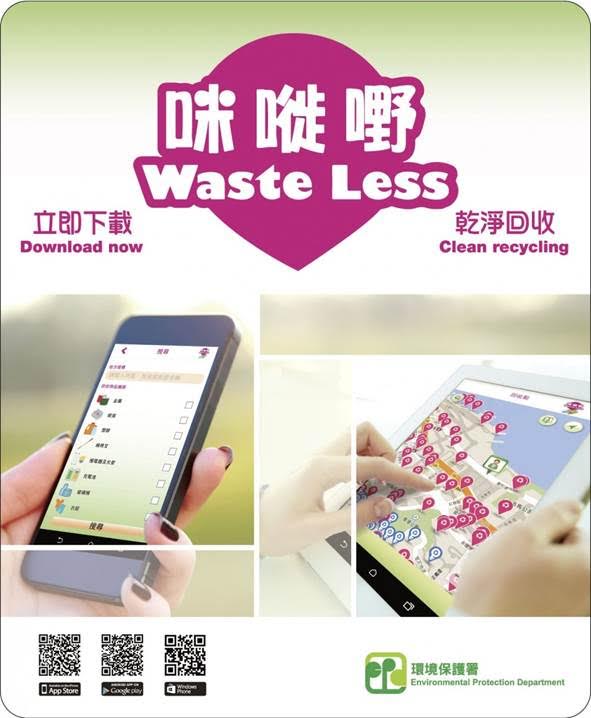
At the same time, we have expanded the glass collection network from covering 13% of the population to 70%. If you want to find recycling bins near where you are, have you tried our Waste Less app?

unnamed

We are also actively collaborating with non-governmental organisations, as well as with major mall operators with large numbers of eateries and restaurants to place recycling bins at the best locations so that more glass bottles can be collected.

While Hong Kong generates about 50,000 tonnes of waste glass beverage containers per year, we have the capacity to process most of this quantity locally into useful materials, such as eco-pavers (CTA: Tiostone, run by an incinerator promoting Professor from HK Poly U uses flyash mixed with glass in a cold process that does not kiln bake the pavers, hence they will leach into the ground) , construction materials and sand.

You may also ask what happens to other types of recyclables, such as paper and plastics, which together make up about 38% of Hong Kong’s total municipal solid waste of about 9,500 tonnes per day.

We estimate about 60% of Hong Kong waste paper are recovered for recycling (CTA: by 80 year old scavengers) , with most of the recyclable paper being exported for reprocessing. What still ends up in landfills include contaminated newsprint and tissue paper. On average, about 360 tonnes of tissue paper end up in landfills every day. It will help if everyone uses a handkerchief to wipe hands after washing instead of using paper (CTA: then carry the germs around with you all day, touch your face and shake hands with others, then take the handkerchief home for washing and use electricity to operate the machine.)

Plastic is a major problem. To reduce waste plastic ending up in landfills, Hong Kong has to organize waste plastic collection in such ways that help to increase its commercial value. Waste plastic that has been contaminated (e.g. plastic bottles still with drinks inside, plastic that has been mixed with other non-recyclable waste) will not be collected. The cost for sorting it all out once more is just too costly; hence they end up at landfills.

ob2gaDR

To enhance the quality of recyclables, we are running a new campaign to encourage clean recycling and help people to understand the importance of separating recyclables without contamination. (CTA: yes we know what we should have done a long time ago already was to mandate source separation of recyclable items, but we want to just burn everything instead) We have also just set-up a HK$1 billion Recycling Fund to help the local collection and recycling trade to improve their skills, organization and methods so that more recyclables can be collected, reused and recycled. An advisory committee has also been established to facilitate the operation of the newly set up fund.

To strengthen the effectiveness of our efforts in recycling, the Government has also revised its contracts with cleaning contractors to collect the recyclables at each recyclable collection points. The contractors are also required to sort out refuses mingled with the recyclables and deliver the recyclables to the designated recyclers on the same day. Moreover, the contractor is required to use transparent bags to facilitate public monitoring.

Everyone can help too. If you do see any questionable activities, please let us know (contact no: 2838 3111). We will check it out like we did with the video.

Hong Kong people as a whole need to change our habits if we are to transit from a wasteful society to one that is much more careful about the use of resources, as well as one that is committed to turn waste-to-resources.

https://www.hongkongfp.com/2015/08/11/straight-to-landfill-conspiracy-theories-about-hong-kongs-recycling-are-a-load-of-rubbish/

Is E-Cig Waste More Dangerous Than Traditional Cigarettes?

http://www.ciwm-journal.co.uk/archives/14657

Tons of plastics and batteries from Britain’s 2m e-cigs are ending up in landfill, according to waste management company Business Waste.

The company says that the products produce just as much “dangerous” landfill waste as the tobacco products it replaces, after finding a steep rise in vaping-related products being sent to landfill and being buried in the ground.

While waste from cigarettes still makes up the vast majority of smoking refuse, with hundreds of millions of butts and their pollutants being discarded every year, the steep rise of vaping as a so-called “cleaner” alternative is causing concern, the Business Waste company says.

“The jury is still very much out on the safety of vaping as an alternative to smoking,” says BusinessWaste.co.uk spokesperson Mark Hall, “But as far as the waste handling industry goes, it’s another challenge on top of the many challenges we already face.”

According to YouGov statistics, there are 2.1m e-cigarette users in the UK, who are either regular users, or are using the devices to help give up smoking tobacco.

The use of e-cigarettes as a means to give up smoking has now overtaken other methods such as nicotine patches. This means that waste from e-smoking has increased steadily in the last two years, with a majority of the refuse being sent to landfill.

The market for e-cigarettes was worth £90m in 2014. While this figure is growing rapidly with hundreds of shops and websites catering for customers’ needs, the UK tobacco market is still worth billions, though declining slowly.

There’s little guidance on disposing of electronic cigarette waste ethically, Business Waste says.

Hall says that although amounts of electronic cigarette waste is still relatively small in relation to the tons of cigarette waste handled every day by the waste industry, but it’s of a very different type that can be just as damaging to the environment.

“Traditional cigarette ends when dumped in landfill release poisons into the ground that can harm water tables and damage plants and animals,” he explains.”E-cigarette refuse is mainly plastics and batteries that may take centuries to break down, and heaven knows what poisons they might contain.”

He also says that chemicals used in e-cigarettes are also ending up in landfill, and they could prove just as damaging as tobacco waste.

“With careful disposal, many cigarette butts can be diverted from landfill to energy recovery, where they can be burned and contribute to electricity generation. However, users don’t know how to recycle their vaping waste, so it’s slipping through the net and ending up in general waste that’s destined for landfill, and that’s something we’re keen to avoid” Hall says.

BusinessWaste.co.uk says that spent batteries from small electrical appliances is one of the greatest challenges facing the waste industry, and the tons of waste from vaping just adds to the problem.

“While most local authorities have schemes to recycle old batteries, most people find it more convenient just to fling them in the bin,” says Hall. “It’s the same for E-cig batteries, and it’s fair to say smokers do not have the greatest of reputation when it comes to disposing of their waste, and so it goes with Britain’s millions of vapers. E-cig waste is going to landfill by the ton.”

BusinessWaste.co.uk is also finding whole vaping devices in landfill as people try e-cigarettes once and decide it’s not for them.

“There are literally thousands of nearly-new E-cigs being thrown out at the moment,” says Hall, “And that’s yet another problem for the waste industry which has to try to recycle them as appropriate.”

While the health benefits of vaping are very much up for discussion, the same cannot be said for the risks in dealing with E-cigarette waste. As more people switch their smoking habits away from tobacco to electronic devices, there needs to be stronger guidance on dealing with the very different waste that vaping produces.

“Switching from cigarettes to e-cigs switches one set of poisons for another, more subtle kind. E-smokers have to be just as careful with their vaping waste as with their cigarette butts and old lighters,” says Hall.

The story of Gipuzkoa, the fastest transition towards Zero Waste in Europe

New case study: The story of Gipuzkoa, the fastest transition towards Zero Waste in Europe

This case study proves that a fast transition to meet EU recycling targets is possible in less than 5 years

Zero Waste Europe publishes a new case study and video showing the transition of Gipuzkoa towards zero waste. This province located in the Spanish Basque Country has almost doubled recycling rates in five years and made investing in an incineration plant obsolete.

In 2011, the Province of Gipuzkoa decided to scrap the plans to build an oversized incineration plant and took steps towards Zero Waste, arguing that the plant was highly resource-consuming and it heavily endangered the circularity of resources. On top of saving € 250 million, Gipuzkoa has managed to meet EU targets 5 years earlier than expected.

Today, the province separately collects 51% of its municipal waste and plans to meet 70% by 2020. These improvements are even more significant when considering that only one fifth of Gipuzkoa’s population live in municipalities that have followed a transition, which prove that the results of these municipalities are outstanding, some of them above 80 or even 90% of separate collection.

Executive Director of ZWE, Joan-Marc Simon said “the transition we are seeing in Gipuzkoa proves that reaching the EU target of 50% recycling is completely feasible in only 5 years. Therefore, with enough political it should be possible for laggards to meet the targets for 2020 and aim at more ambitious targets for 2030.”

The drivers behind this change have been: political will, citizens mobilisation and participation, prioritisation of biowaste collection, intensive separate collection at source and not having built incineration capacity which would hijack prevention, reuse and recycling.

In less than five years, Gipuzkoa has moved from pushing for an outdated finalist treatments for waste to become Spain’s leading province in recycling, being above EU’s 2020 targets, and 12 points above Spanish average. Gipuzkoan towns have also proved that kerbside collection remains cheaper than roadside containers, while creating jobs and local economic activity.

Today, these case studies show that, in contrast with the outdated idea of burning or burying our waste, preventing, reusing and recycling it create jobs and resilience, save money, and protect the environment and public health.

You can download the case study here.

Zero Waste Week: can Hong Kong rise to the challenge?

Every day, Hong Kong disposes of 9,000 tonnes of municipal solid waste. If we carry on at that pace, experts say, by 2019 our landfills will be land-fulls.

Enter Lisa Christensen and Nissa Marion, co-founders of Hong Kong Cleanup and Ecozine, who are pioneering the city’s first Zero Waste Week campaign – a citywide challenge to reduce the amount of rubbish sent to landfills from today until June 14.

They are encouraging individuals, offices, businesses and schools to make a pledge to reduce waste.

“We aim to inspire action at the personal, business and policy level, to reduce the amount of waste we produce,” says Christensen, adding that people should try to create sustainable lifestyles by recycling discarded resources.

Participants can make a difference by not using disposable plastic bags, setting up composting heaps for food waste or simply sending nothing to the landfills for a week.

The organisers’ target is to engage more than 250,000 participants and reduce the amount of waste going to landfills by 10 per cent.

More than 30 schools and dozens of businesses have signed up.

Although the movement will only last a week, Christensen believes it will educate and inspire Hongkongers beyond that.

“After a week of consciously changing your daily habits, we anticipate a major reduction in rubbish and a continued shift in people’s waste footprint.”

On Thursday, the organisers will host the Zero Waste Global Summit, which will see global experts speak on sustainability and environmental conservation. The summit will be held at Cyberport Arcade, in Pok Fu Lam. For details, visit www.facebook.com/ ZeroWasteWeek.

Why China’s waste pickers are a better alternative to incineration

The informal recycling sector is helping tackle the country’s growing levels of rubbish, but people making a living out of sorting waste need support

 Informal recycling is widespread in Shanghai, but where the incentive of profit falls, so too do recycling rates. Photograph: Grainne Quinlan

Informal recycling is widespread in Shanghai, but where the incentive of profit falls, so too do recycling rates. Photograph: Grainne Quinlan

Zhang Jinling is picking cardboard boxes from a trash can on the side of the road in a downtown area of Shanghai. She empties the boxes, folds them and puts them on a trailer hitched to a bicycle. She also buys cardboard from residents in the houses on the same street, purchasing it for 2.5 mao (less than 3p) for a pile. When her trailer is full, she takes the load to a recycling market on the outskirts of the city where she sells each pile for a 1p profit. Markets like these sort waste into different materials and sell it to bigger markets where it ends up at big industrial recycling plants for individual materials.

Jinling is one of hundreds of thousands of waste pickers working in cities acrossChina sorting through other people’s rubbish, removing and sorting anything that can be recycled and selling it for a meagre profit. Most people working in this sector are migrant workers from the countryside who come to big cities to try to make a living.

Further down the street, Guan (who didn’t wish to give his full name) is buying cardboard from a small fruit shop. He has been doing this job for almost eight years and makes a daily profit of £10.

Guan and Jinling are collecting recyclables in one of Shanghai’s most desirable and expensive neighbourhoods but their living standards are very different from the people who live there.

Jinling lives with her husband in a 6 metre square apartment in a compound where thousands of other migrant workers live. “I would prefer not to do this work,” she says. “I would rather work for a factory or company.”

Unpredictable nature of informal recycling
The government has little or no involvement in recycling in cities, says Chen Liwen, a researcher for the environmental NGO Green Beagle. “China’s recycling is market orientated, there is no government control from the collection to the disposal of materials,” she says.

As China has developed rapidly and its citizens become more affluent, increasing amounts of rubbish are being generated. Shanghai, a city of around 24 million people, currently produces 22,000 tons of rubbish a day and the city is running out of landfill space. Liwen says that more and more waste is being generated and an increasing amount of materials that could be recycled are ending up in landfill.

Workers like Guan and Jinling ensure not all materials end up in landfill, but price fluctuations can make the informal recycling unpredictable. If it becomes less profitable for waste pickers to collect and sell a particular material, it’s unlikely to be recycled. For example, the price waste pickers get for glass bottles has recently fallen, so without an incentive of profit, glass is increasingly ending up in landfill.

Because of falling prices, the numbers of waste pickers are starting to dwindle. Guan says: “The price is going down and more people are going to work in factory and construction work.”

Government involvement

As China’s levels of rubbish grows, the government has looked to incineration. . According to local news reports, four new incineration plants are to be opened in Shanghai and city officials estimate that by 2016, 70% of the city’s household waste will be incinerated. However, incineration is becoming controversial among the public in China due to environmental concerns and there have been protests against proposed plants. In April, plans for an incinerator in Guangdong province in southern China were scrapped by the local authorities after a mass protest.

Environmental campaigners also say that incineration doesn’t deal with the root causes of China’s waste problem. “Because you are building more and more incinerators people don’t care about waste, they just throw away,” says Liwen.

The government in Shanghai and other cities have made some efforts to introduce centralised recycling systems. Last year, Shanghai set a rubbish sorting target of 95% as part of a three year initiative . But despite efforts public awareness of recycling and waste reduction remains low.

Liwen says that the informal recycling system is so widespread and efficient that instead of trying to get rid of it or replace it the government should work with it to improve recycling levels. “I don’t think they should destroy the current informal recycling system. What they need to do is to give them more space, to give them support because the current system is very good,” she said.

The circular economy hub is funded by Philips. All content is editorially independent except for pieces labelled brought to you by. Find out more here.

Join the community of sustainability professionals and experts. Become a GSB member to get more stories like this direct to your inbox.