Clear The Air News Blog Rotating Header Image

Waste Management

Vanishing rubbish bins and rotten attitudes: Hong Kong’s struggle to stay clean

Yonden Lhatoo despairs at the city’s garbage problem, suggesting that people are educated enough to be civicminded, but just have a rotten attitude

“My kingdom for a bin!” a friend of mine exclaimed in mock-Shakespearean despair, as we walked down the length of a popular street in Mong Kok, looking for a receptacle to dump a leaking coffee cup she was desperate to get rid of.

We finally found a rubbish bin after walking quite a distance, dripping java on the pavement all the way. And it presented another unnecessary dilemma, because the bin was chock-full of rubbish, and people had dumped all kinds of filth around it.

All this because the government, with the backing of environmental groups, has decided there are too many rubbish bins in Hong Kong. The logic being applied here is that if there’s no place to throw your trash, the streets will be cleaner because you’ll be forced to take it home.

Next week, the government will deploy the first batch of newly designed bins that have smaller openings for depositing waste. The idea is to dissuade people from cramming them with oversized packages. The new bins will feature bigger notices warning the public “not to discard refuse at the side or on top of litter containers and to dispose of bagged refuse properly at refuse collection points”.

What’s more, the government may further reduce the number of rubbish bins across the city, having already removed 15 per cent of them over the past 1½ years. That amounts to 3,100 bins, which is the equivalent of Taipei’s entire arsenal of bins. Singapore and Seoul also make us look like we have a bin fetish.

The bin-free drive can be linked to the impending household waste charging scheme in a way that doesn’t reflect well on Hongkongers.

The government is concerned that when it starts charging people for the rubbish they produce daily at home, many of them will start dumping bagfuls at the nearest street bin.

If the Taiwanese, Singaporeans, Koreans and Japanese (who take it to Stepford Wives extremes) can get a grip on their garbage, why not Hongkongers, right? Wrong.

Has anyone stopped to consider that people in this city are just a completely different breed when it comes to civic-mindedness? They don’t care. I watched, in horrid fascination, a woman loudly inhaling instant noodles on a minibus the other day, and thought of how the government expected her to dutifully take the container and plastic bag home to put them into a garbage bag, for which she would pay an environmental levy like a good citizen. Yeah right.

She left them on the bus, by the way.

Look at the dustbins around the city. Even when they’re not overflowing, people would rather chuck their rubbish at the bins than in them.

And you want to put smaller mouths on the bins to solve the problem?

The truth is harsh. Hong Kong is not a cesspool only because we pay an army of cleaners to do the dirty work.

Civic sense is for the birds here. And spare me the clichés about educating people.

Have you watched Hongkongers on holiday in cities that take cleanliness very seriously? We’re model tourists. Oh, we’re educated alright, and on our best behaviour. It’s only when we return home that we can’t be bothered. It just boils down to a rotten attitude.

Nothing short of severe penalties and fierce enforcement will work. And you can’t do that in a city where everything is instantly politicised with placard-waving protests about freedom.

What a mess.

I have a question for Hong Kong’s No 2 environment chief, Christine Loh Kung-wai, the silent bureaucrat who once used to be an outspoken crusader in such matters: who are you and what have you done to Christine Loh?

Yonden Lhatoo is a senior editor at the Post

New trash cans with smaller openings on the way

The Food and Environmental Hygiene Department (FEHD) will be introducing new trash cans Monday, a statement on the government’s website said.

The new design includes smaller openings for trash and bigger warning notices on the containers telling the public not to discard refuse beside or on top of the bins and to dispose of bagged refuse properly at refuse collection points, it said.

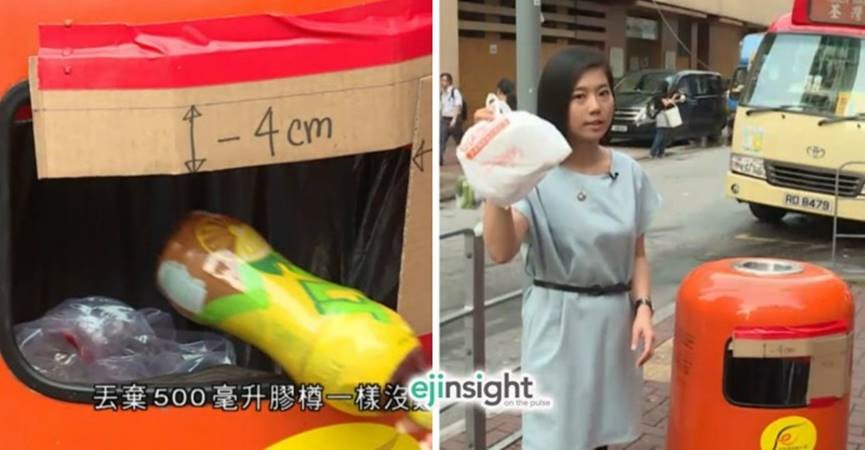
The openings have shrunk from 370 millimeters x 190mm to 230mm x 150mm, the FEHD said.

Smaller openings mean the new trash cans will accept only small pieces of garbage, but not a typical plastic grocery bag of trash. Photos: i-Cable

Smaller openings mean the new trash cans will accept only small pieces of garbage, but not a typical plastic grocery bag of trash. Photos: i-Cable

The department will also introduce, later this year, 70-litre trash cans, with openings reduced in size from 290mm x 190mm to 205mm x 130mm.

An FEHD spokesman reminded the public that it is an offense to deposit waste beside or on top of the containers.

Offenders are liable on conviction to a maximum fine of HK$25,000 (US$3,218) and imprisonment for up to six months.

They may also face a HK$1,500 fine under the Fixed Penalty (Public Cleanliness Offences) Ordinance, the spokesman said.

However, some citizens are disappointed by the change, i-Cable reported.

Far from discouraging people from indiscriminately dumping garbage, the new design will encourage them to litter, they said.

The FEHD also said it is considering further reducing the number of litter containers placed on the streets in various districts later this year, as a similar move last year had a satisfactory result.

Chloe Chow contributed to this article.

http://www.ejinsight.com/20160607-new-trash-cans-with-smaller-openings-way/

Transition from traditional waste management to Zero Waste in only 4 years

Download (PDF, 884KB)

‘Biodegradable’ Plastics Are A Big Fat Lie

A new U.N. report says the supposed greener technology is anything but.

http://www.huffingtonpost.com/entry/un-biodegradable-plastics_us_57435cb2e4b045cc9a71afa5

A prediction that the world’s oceans will contain more plastic than fish by 2050 is likely to intensify the push for sustainable, environmentally friendly alternatives.

Biodegradable plastics have long been touted as a “greener” technology, but a new report from the United Nations says these plastics do little, if anything, to actually protect the planet and marine creatures.

“Plastics marked as ‘biodegradable’ do not degrade rapidly in the ocean,” says the report, published Monday.

The 179-page report on plastic marine debris is one of several documents released in time for the United Nations Environment Assembly, which kicked off Monday in Nairobi, Kenya.

Plastics, which can cause serious ecological harm, “are now ubiquitous in the ocean, found in every ocean and on every shoreline from the Arctic through the tropics to the Antarctic,” the report states.

Biodegradable plastics — which have been used for shopping bags, water bottles and food containers — are designed to be less durable and capable of degrading quickly in the environment. But the problem, according to the U.N., is that the conditions required for such plastics to break down exist almost exclusively in industrial composters, not in the ocean.

The description is “well-intentioned but wrong,” Jacqueline McGlade, chief scientist at the U.N. Environment Program, told The Guardian.

“A lot of plastics labelled biodegradable, like shopping bags, will only break down in temperatures of [122 degrees Fahrenheit] and that is not the ocean,” McGlade told the publication. “They are also not buoyant, so they’re going to sink, so they’re not going to be exposed to UV and break down.”

The U.N. estimates that global plastic production grew 4 percent from 2013 to 2014, exceeding 311 million metric tons. At least 8 million metric tons — the equivalent of one garbage truck every minute — leak into the ocean each year, according to the World Economic Forum.

The U.N. says improving waste collection and management is the “most urgent solution” to reducing plastic litter, but social attitudes are also critical.

“There is a moral argument that we should not allow the ocean to become further polluted with plastic waste, and that marine littering should be considered a ‘common concern of humankind,’” the report says.

In other words, don’t pat yourself on the back the next time you reach for those biodegradable plastic bags. We need to do a lot more than that.

Waste Management Needs Commitment and Leadership

Letter to Hong Kong – Waste Management Needs Commitment and Leadership – Albert W. Y. Chan, April 30, 2016

http://programme.rthk.hk/channel/radio/programme.php?name=radio3/lettertohongkong&d=2016-05-01&p=535&e=&m=episode

My previous letters to Hong Kong were mainly focused on Hong Kong’s public governance and democratic development. One thing that I have mentioned quite frequently in LegCo but not in other public domains is environmental policy.

In the past twenty years, I have advocated compulsory separation of waste for Hong Kong. But unfortunately, all of these demands have fallen on deaf ears. As we all understand, political development and economic policies have to rely on the central government’s support, but for environmental policy, the Hong Kong SAR Government can determine by its own.

If you look back on the government’s environmental policies, there were very little changes in the past 18 years. The lack of initiatives in waste management indicates the government’s lack of will in governing our society and improving the livelihood of our people.

The Chief Executive, C.Y. Leung, in his election manifesto, pledged to re-examine our environmental protection policy from the perspective of sustainable development, and promised to take effective measures to provide a high quality living environment. He also indicated that he would build Hong Kong into a modern livable city. It seems that his manifesto is pure rhetoric and without much substance. If the government is sincere in improving and protecting our environment, one basic thing that they should do is to formulate a policy that will separate our waste at source.

Waste separation is an initial step in protecting the environment. If we look around the world, many cities already have established compulsory waste separation policies for decades. In most developed countries, many of them separate the waste at source. Many of them have an extremely high percentage on waste recycling, some even up to 80-90%. Hong Kong’s situation is totally undesirable. Hong Kong generated a total of 5.56 million tonnes of waste in 2012, in which only 2.16 tonnes were recyclable, and the other 3.4 million tonnes were disposed of at landfills. Our recycling rate is less than 40%.

For leadership and dedication in environment protection, we don’t have to look far for a good example. Taipei is a city, in terms of history, population, and economic development, is similar to Hong Kong, but they are far more ahead in their environmental policy.

The Taipei government started the waste separation experiment in the 90’s and formally implemented the Garbage Sorting, Recycling, and Reduction Action Plan in 2003.

The Action Plan required all residents to separate garbage into three categories: recyclable waste, kitchen waste and general household waste. After the implementation of the above policy, Taipei City’s per capita disposal rate of household garbage fell nearly 50% from 0.6 kg in 2003 to 0.39 kg in 2011. If compared to Hong Kong, Hong Kong’s per capita disposal rate of household garbage is 0.84 in 2011, which is double of Taipei.

If Taipei can be successful in solid waste management, I believe that Hong Kong people can do the same. The problem is our government.

As for the Hong Kong Government’s record, we should be ashamed of ourselves. One of the problem is the usage of plastic bags themselves. We do remember that the government encouraged people not to use plastic bags in shopping, and created a new tax for 50 cents for each plastic bag. However, the government uses plenty of plastic bags themselves. For example, the Agriculture, Fisheries and Conservation Department “AFCD”, used more than 180,000 plastic bags last year, and additional 350,000 plastic bags consumed by AFCD’s contractors in the same year. The numbers add up to over 1,400 plastic bags per day.

It should be noted that this is only one department. I believe that the Food and Environmental Hygiene Department should use much more plastic bags than AFCD. The Hong Kong SAR Government is definitely the world leader in using plastic bags.

At the time when the Hong Kong Government contaminates our environment with millions of plastic bags, the European Commissioner for Environment is advocating Zero Plastic Waste policy. Many developed cities have also established zero plastic bags policy. For example, plastic bags will be banned from all shops in Paris from 1st July 2016.

One recent development in environmental policy is “Zero Waste” policy. “Zero Waste” is a philosophy that encourages the redesign of resource life cycles so that all products are reused. If we can achieve “Zero Waste”, we don’t need any landfills and incinerators, because all the waste can be recycled and reused. By doing that, we have to change our way of life and the government have to design a system and mechanism that will collect and recycle all of our waste.

Although “Zero Waste” is a very difficult task, San Francisco has set a target for zero waste in 2020, and a target for 75% of recycling of solid waste in 2010. The difference between Hong Kong and San Francisco is leadership and commitment.

In the 2015 America Recycles Day, Obama, the President of United States said: “Communities across America must continue promoting activities that encourage people to recycle and to conserve, so we do not take for granted today the world our children will inherit tomorrow.”. He continued to say: “Let us work to fulfill our obligation to our next generation by safeguarding our resources and working with our friends, family, and neighbors to protect the world we share.” Perhaps our political leaders in Hong Kong should have the same belief and commitment, then we may have a better living environment, and a better future.

This Baltimore 20-year-old just won a huge international award for taking out a giant trash incinerator

https://www.washingtonpost.com/news/energy-environment/wp/2016/04/18/this-baltimore-20-year-old-just-won-a-huge-international-award-for-taking-out-a-giant-trash-incinerator/

Baltimore stands apart as the American big city with the most deaths caused by air pollution, and Curtis Bay is its dirtiest community. Several years ago, the air there stood to get even worse when the state approved a permit for a giant incinerator that would burn 4,000 tons of trash every day and emit up to 1,240 pounds of lead and mercury every year.

But destiny intervened. More specifically, a 17-year-old high school senior named Destiny Watford.

Outraged that her community was once again “being dumped on” and that the health of her family and neighbors was being “sacrificed for a profit,” the self-described shy girl led fellow students at Benjamin Franklin High School in a four-year campaign that mobilized Curtis Bay and halted the incinerator’s construction indefinitely.

As state environmental officials seek to revoke the permit for good, Watford is being honored with one of the world’s most prestigious environmental awards. On Monday, she was announced as a 2016 Goldman Environmental Prize winner for her community leadership.

Not only is Watford, at 20, the youngest of this year’s six recipients — who hail from Slovakia, Cambodia, Tanzania, Puerto Rico and Peru — she’s the third-youngest honoree in the history of the prize. She says she never imagined becoming an activist, let alone that her efforts would allow her to stand shoulder to shoulder with internationally recognized advocates of environmental justice. But her mother, Kimberly Kelly, isn’t surprised.

“I have five kids,” Kelly said, “and I just knew she was going to be different. She’s a debater. She wants to get her point across.”

Growing up in Curtis Bay, a community of rowhouses near Baltimore’s industrial southern tip, Watford watched her mother struggle with asthma. She knew neighbors afflicted with respiratory disease. During the campaign, when she and other students asked members of an art class at Franklin High if any of them had asthma, “almost every hand shot up,” Watford recalled last week.

A 2013 study by the Massachusetts Institute of Technology found that 113 people per 100,000 Maryland residents — higher than in any other state — die as a result of emissions from car and truck traffic, trains and ships, commercial heating systems and industrial smokestacks. Baltimore’s rate was far higher, exceeding that of New York City and smoggy Los Angeles.

Curtis Bay is Baltimore’s epicenter of pollution and bad health. Jutting into the bay where it meets the Patapsco River, it started out as a focal point for World War II-era shipping. It later gained a coal-burning power plant, a chemical-processing plant, a medical-waste incinerator and other industry.

And the air kept getting dirtier. In 2007 and 2008, Curtis Bay ranked worst in the nation for the release of toxic air pollutants, according to a report by the Environmental Integrity Project using emissions data from the federal Environmental Protection Agency. The following year, it ranked second.

Like many residents there, Watford had no idea the incinerator had been approved for her community until she saw a story about it on the Internet in 2012.

Energy Answers International was promoting the project — set to be the biggest of its kind in the nation — as an energy-producing power plant that would serve schools and other facilities. It would be located less than a mile from Franklin High and Curtis Bay Elementary, which state environmental regulations wouldn’t typically allow. But the rule became irrelevant when the Public Service Commission approved the incinerator as an energy plant.

The company said by email last week that the PSC granted the exemption because the tire rubber, vinyl, plastic, metals and other municipal waste burned at the site would be processed into a fuel elsewhere. About 1.5 million tons of landfill waste annually would be diverted, converted and marketed as renewable energy, making the facility, “by all definitions, an energy plant,” according to a company statement.

The statement noted the upper limits of lead and mercury emissions under the permit and said the company never expected the incinerator to approach those. The project would require 1,300 temporary construction workers and create 200 permanent jobs, the statement said.

Watford and her classmates were concerned more about the air. They formed an advocacy group called Free Your Voice and studied the history of industry and pollution in Curtis Bay, as well as in the nearby Brooklyn and Hawkins Point neighborhoods. They began knocking on doors, expanding their network to hundreds of residents who circulated petitions that resulted in thousands of signatures. Their rallying cry: “Clear air is a human right.”

About 100 Franklin High School students, community activists and union members march in late 2013 to the site of the highly contested incinerator as part of a campaign to stop its construction in Curtis Bay. (Kenneth K. Lam/Baltimore Sun)

Ten students were the core of Free Your Voice, but the Goldman Prize will be given to Watford, because “she’s kind of been the glue, the person who not just stuck around but deepened her involvement,” said Greg Sawtell, an organizer for the nonprofit activist group United Workers who acted as a mentor and helped nominate her for the award.

“She distinguished herself beyond the organizing with her ability to use writing and creative expression through video,” Sawtell said. “Older people said they got involved from their doors being knocked on by Destiny. She inspired a multigenerational struggle. She showed a lot of wisdom and patience.”

Watford, whose soft Afro frames a baby face, had never heard of the prize. When the Goldman Prize director called to congratulate her, she almost didn’t answer because the number showing on her cellphone was unfamiliar. Then she didn’t know what to say: “I was really confused. I didn’t know who he was or what he was talking about.”

He was talking about her work. Early on, the students thought they would win because of the incinerator’s proximity to the two schools. They persevered after that setback and discovered that the school district and city government agencies had signed an agreement to purchase energy from the incinerator, according to the Goldman Prize. Watford led students to a school board meeting at which they used artwork and video to convince members to reconsider. The board eventually took a student-organized tour of the proposed site and divested from the project.

In the end, the plant was derailed last fall on a different issue identified by Free Your Voice. According to state law, construction on an industrial project must begin during the 18 months before a permit’s air-quality provision expires. That never happened. In December, the 90-acre construction site was still only gravel and patches of grass.

The students pressed the point during a showdown at the Maryland Department of the Environment’s headquarters. With the help of United Workers, Free Your Voice brought 200 protesters to confront Environment Secretary Ben Grumbles. Only a few were allowed in for a discussion.

“We told them, ‘You guys have to take action. If not, there’s going to be a consequence,’ ” Watford recounted. The group would not accept the secretary’s explanation that his hands were tied by legal red tape, she said, and the protesters refused to leave until Grumbles declared that Energy Answers no longer met the air-quality provision. The agency officially notified the company last month of its decision.

“The permit had expired due to a lack of ‘continuous construction,’ ” Grumbles said in a statement last week. The statement acknowledged the students’ frustration over the months-long wait for his department’s final decision. It also singled out their leader.

“Destiny is a talented, resourceful and passionate young advocate,” Grumbles said, “with great potential to make a difference in the lives of those around her.”

The Goldman prize described her in similar terms, noting her “unwavering dedication and wisdom beyond her years.”

Energy Answers still holds a lease on the property and is fighting to build its plant, but at this stage of the process the company would have to get the community’s approval, which is unlikely. When Energy Answers President Patrick F. Mahoney attended a Curtis Bay meeting in March to talk about the jobs and revenue the plant would bring, he was shouted down by angry residents.

Watford, who is a junior at Towson University north of Baltimore, is now leading an effort to turn half of the proposed construction site into a community-owned solar panel farm. The project would provide energy to schools and businesses just as the incinerator would have — but without the same health risks.

The Secret to San Francisco’s Zero Waste Success

http://waste360.com/waste-reduction/secret-san-francisco-s-zero-waste-success

Is there a secret in San Francisco related to their zero waste success?

Yes, I think there is, and unfortunately it is rarely discussed.

I love San Francisco and the zero waste work they are doing. And I want to draw attention to what their “secret ingredient” is so that other cities can better understand what they don’t have but might want to pursue locally, even if in an altered form.

Last month, the New York Times wrote another admiring piece about the San Francisco zero waste program. And again, the reporter missed asking the logical question, “Why San Francisco?” What is different about Golden Gate City that makes it such a star when it comes to progressive waste management systems?

It isn’t a unique technology, as Jack Macy even admits in the article. That is an important point considering all the sketchy “new tech, one-bin” proposals we’ve been seeing lately as the way to achieve zero waste.

There is more than just one reason that San Francisco is successful. But I am going to focus on the one thing that is really special, and it’s the relationship between the San Francisco government and the private sector service provider Recology. The working relationship between these two entities is very unique and I think is the key to enabling their soaring success. So why are they such good buddies in pursuit of a common goal when elsewhere we see conflict and struggle, such as the recent Houston-Waste Management Inc. contract tussle?

I didn’t want to misspeak here, so I ran this column past a San Francisco insider to make sure I got this right. The company known today as Recology is, in fact, a very old company with deep roots in the San Francisco waste business dating to the early 1920s. They did something unique and remarkable many years ago. Two Recology predecessor haulers, Scavenger’s Protective Association and Sunset Scavenger Company, got written into the City Charter through a voter initiative ordinance as the exclusive official refuse haulers for the entire city. These exclusive refuse collection licenses could be overturned by the voters, but as long as voters were happy with the deal, it was forever. In Italy, this is called an “inside company” and is actually accepted as an option for providing public service. No surprise then that the original Recology was started by an Italian family.

This has created a sweet deal for Recology and they knew it. When the city staff approached the company in the 1990s and told them San Francisco wanted to become a zero waste city, Recology was in a good position to either fight the effort or join it. I don’t know what was said exactly. But I do remember having a personal discussion with a Recology manager back in the 90s. (When they were called Norcal.) This manager told me that the behind-the-curtain informal agreement was that the city would share the risk of this new zero waste path for long enough for Recology to learn how to transform their existing business model based upon primarily landfilling into a business plan that was based upon landfill diversion. By sharing the risk, the Recology would still be making profits during the transition. This sounded fair to me at the time, and it has proven to be a wise move.

But the remarkable part that I want to highlight here is that this sort of cooperation and planning between government and the private sector rarely happens in America. I think it must be due to Recology’s legally-protected status of being written into the City Charter that enables them to have a unique power within the relationship that can be used in partnership with the city to achieve community benefit and ensure a certain level of private sector profit.

I think this close relationship is similar to how my town “coordinates and plans the future” with our electric utility provider. This “public utility monopoly” approach for electricity exists in nearly every town in America.

So in some ways this special relationship that San Francisco and Recology have isn’t that unique. It’s just that other cities don’t use the public utility approach in the waste management industry. I think we should start doing so!

I don’t think the San Francisco City Charter approach is replicable across the entire country for many reasons. But I do think that many of the working elements that make their approach successful are replicable. At its core, the San Francisco zero waste program is run like a social enterprise, meaning that its primary purpose for being is to fulfill a mission (i.e. zero waste) and that the program is expected to make a profit while doing so. I know a lot about this approach since I created the nation’s largest nonprofit zero waste social enterprise here in Boulder, Colo., where our partnership success with the city came not from a legal protection like Recology’s, but from a civic mandate delivered to the city by a citizens army organized by Eco-Cycle.

This “double bottom-line (DBL) approach” to creating value for the community is an exciting new way of using the power of the marketplace in partnership with local government. The place to watch to see how far it can go is the U.K. right now, especially Scotland. We are watching new “legal vehicles” for the creation of DBL enterprises emerge with names such as “the CIC” (community interest company), or the “B” Corp (the for-benefit corporation), and my favorite, the “the L3C” (low-profit limited liability company LLC).

In the last few years we’ve heard the giants of industry, like Bill Gates and others, call for a more “compassionate capitalism.” The reason this topic is up for discussion is because there is a growing recognition that the current form of free market capitalism isn’t capable of addressing the serious social and environmental problems of our times. On top of that, our local, state and national government entities can’t do it either as their funding and public support is shrinking.

I say don’t mess with the existing single bottom-line capitalism—it has brought us Apple and Amazon—but that it is time for a new addition to the national economic operating system which I’ll call Capitalism 2.0, (as in two bottom lines), and that there are special needs in our world today, like clean energy and zero waste, that need a new marketplace approach that combines the leadership of government with the horsepower of business.

When more cities step forward and support the social enterprise approach, then maybe San Francisco won’t stand so alone as a national star in the race to zero waste.

Learn from Singapore’s refuse solution

Letters to the editor, April 10, 2016

The paucity of discussion about waste in Hong Kong means that our city faces a refuse crisis that requires prompt and decisive action.

Successive governments’ waste management strategies have been a failure and our landfills will reach capacity in the near future.

We should look at what Singapore has achieved. It has done an excellent job dealing with its garbage problem, which poses no threat to marine ecosystems and uses some refuse for landfills.

The Semakau Landfill is Singapore’s first and only landfill situated offshore among the southern islands of Singapore.

It covers a total area of 3.5 square kilometres. It began operating in 1999 and is expected to remain in use until 2045, and this deadline may be extended if a variety of waste minimisation and resource conservation initiatives are implemented.

It is mainly filled with ash produced by Singapore’s four incineration plants. The refuse is transported in covered barges. This prevents the ash from being blown away in the wind.

Precautions were taken before the landfill was opened to ensure that the site is not foul-smelling and unhygienic and to protect nearby coral.

There is regular water testing to make sure that all the precautionary measures implemented are still effective.

I think Hong Kong can learn from Singapore’s successful strategy, with a balanced policy that prevents the landfills reaching capacity, protects marine life and guarantees further reclamation projects are possible.

Reclamation is important for Hong Kong, with its large population. With reclamation projects, more land can be made available on which to build homes.

Tina Yeung, Ngau Tau Kok

Zero Waste in San Francisco and New York: A Tale of Two Cities

http://www.huffingtonpost.com/entry/zero-waste-in-san-francis_b_9556380.html?section=india

One of the goals of a sustainable city is to effectively manage material flows into and out of the city. Garbage, or what environmental engineers call solid waste, presents some of the most difficult challenges to urban sustainability.

San Francisco may well be on the way to achieving their goal of “zero waste,” or to divert all of its garbage away from landfills. Currently, San Francisco diverts 80% of its waste away from landfills. According to New York Times reporter Matt Richtel: “San Francisco also has a world-class reputation for its composting processes, which turns food waste into fine, coffee-like grounds that is sent to farms as fertilizer.” And he observes that San Francisco is the “Silicon Valley of recycling.”

The city and county of San Francisco’s SF Environment department has set a goal of zero waste by 2020. That formerly future-sounding date is just four years away.

According to the department, about half of the waste now placed in non-recycle bins could be recycled, which would drive the waste diversion rate to 90%. According to the department’s website:

To achieve 100 percent zero waste, SF Environment will continue to advocate for state legislation and partner with producers to develop a producer responsibility system, where producers design better products and take responsibility for the entire life-cycle of a product, including take-back and recycling.

The city’s zero waste policy includes three goals: 1. prevent waste; 2. recycle and compost; and 3. safely handle toxics. San Francisco’s unique political and social culture must be seen as a major factor contributing to this program’s success. People in that city behave as if reducing waste and recycling are important social behaviors. In contrast, New York City’s waste diversion rate is 16%. The goal is to get to zero waste by 2030. It’s a little difficult to see how that goal will be achieved. The city’s target for FY 2016 is 19%, but according to the NYC Mayor’s Management report, the actual diversion rate is anywhere from 1.2- 2.9% below target.

Any casual look at New York City’s public recycling bins will provide a sense of the difficult road New York must travel to reach anything approaching zero waste. Paper bins are filled with bottles and the bottle bins are filled with a wide variety of unsorted waste. Northern Californians may be thoughtful about waste disposal, but New Yorkers can’t be bothered. It is not clear that New York is capable of a cultural shift deep enough to achieve the diversion rates already reached in San Francisco.

Each city is different, and New York’s pace, diversity, and size make comparisons to San Francisco difficult. Still, large-scale behavior changes can be achieved with leadership, strategy and creativity. New York City has eliminated indoor smoking in public places. New Yorkers have learned how to comply with alternate side of the street parking rules and some are even learning how to stop jaywalking. So it is possible that waste disposal behaviors could change. But it will take leadership and the sustained attention of the mayor and the media. It’s unlikely to happen because garbage has little appeal as a political issue. Climate change holds conferences in Paris and attracts attention at Davos.
Garbage gets a little less glamor.

In any case, behavior change alone is not sufficient. The recycled waste must actually be reused—a problem with the weak market for some recycled substances. The technology of waste sorting and the energy efficiency and cost-effectiveness of recycling also need improvement. A city’s system of recycling and waste management is as important as an individual’s waste disposal behavior. The technology and market will come to New York City, but probably not by 2030.

Zero waste is an element of the concept of a circular economy. In a circular economy, all waste from consumption becomes an input into new production. Inevitably there is some leakage in the tightest circular production process. But the goal is to move from a linear model of production-consumption-waste to one more closely resembling a circular model. I don’t think of zero waste as an achievable operational goal, but rather as a model and an aspiration. It is a way to think about resource use and waste management, rather than an absolute target.

It requires a paradigm shift or a new way of thinking about consumption and garbage. Instead of mindlessly tossing something you have consumed into a waste bin, you sort it or consider how it might be re-used. In the case of production processes, it includes the concept of producer responsibility. The producer includes in the price of a good an incentive to bring the good back to the place of purchase or to the manufacturer. The manufacturer, in turn, designs the good to be mined for resources or to be reconfigured for additional use. Of course moving the good or material through the production process requires energy and so the closed system works best when it is powered by renewable energy.

These ideas of closed systems of production and consumption are central to the concept of the sustainable city. As the mechanization of agriculture reduces rural employment and as the Internet communicates the appeal and seductiveness of urban lifestyles, more and more of the world’s population is moving to cities. This creates opportunities for more efficient production, distribution and consumption of goods and services and leads to the possibility of systems that approach the goal of zero waste.

While New York City may aspire to zero waste by 2030, at the same time the city was announcing that goal in 2015, it was also proposing a long-term deal with an upstate New York landfill to take the city’s garbage for the next several decades. According to Cole Rosengren of City Limits:

A new plan to send Brooklyn’s garbage upstate would solidify the city’s waste export strategy for decades, but also shows how impractical the system has become. Under a newly proposed 20-year contract with IESI—a major industry player owned by Canadian company Progressive Waste Solutions—much of Brooklyn’s residential garbage would be shipped to the company’s Seneca Meadows landfill at a projected cost of $3.3 billion…New York has struggled to deal with its garbage in a sustainable way since the Fresh Kills landfill closed on Staten Island in 2001. According to Department of Sanitation (DSNY) data, it cost $99 to dispose of a ton of garbage in 2000 versus $145 in 2014 when adjusted for inflation.

It is clear to most experts that a system of recycling facilities, waste-to-energy plants and changed public behavior would be a more cost effective and environmentally beneficial waste management system for New York City.

Unfortunately, New York can barely site marine waste transfer facilities and has been unable to build waste-to-energy plants or other elements of a more advanced waste management system. New Yorkers simply won’t accept construction of those facilities in their neighborhoods. In any case, as New York’s land prices rise, it becomes increasingly uneconomical to locate those facilities within the city.

The gap between San Francisco’s accomplishment of 80% landfill diversion and New York’s 16% is huge. New York was ahead of its time in building its water and mass transit system, but is far behind the times in dealing with its garbage.

When compared to San Francisco, the two waste management systems are truly a tale of two very different cities.

How Can Product Designers Help Solve The World’s Massive E-Waste Problem?

Every gadget you casually toss helps destroy the planet—and lives. It’s time we think about the lasting effects of what we’re building and buying.

http://www.fastcoexist.com/3057506/how-can-product-designers-help-solve-the-worlds-massive-e-waste-problem

In February, a new smartphone launched in India that cost the equivalent of $3.60. The quickly dropping price of electronics, along with rising incomes around the world, means that there will soon be many more gadgets in the market. And when a newer, cheaper one comes along in a year, many more of them will end up as electronic waste.

That’s one of the points made in a new exhibition on e-waste at the New School’s Parsons School of Design, which shows the changing landscape of electronic production, consumption, and disposal, and asks how designers can start to help address the problem.

“I think when you live in the U.S. or Europe, you’re not so exposed to this—you don’t see the social and environmental consequences,” says Shaun Fynn, CEO and creative director of StudioFynn, a design firm that collaborated on the exhibition. While living in India for a commercial design research project, Fynn started photographing waste pickers sorting through e-waste in unregulated dumps, and researching the full lifecycle of products such as phones and tablets.

For a waste picker, a cell phone—filled with copper, silver, and a little gold—is a valuable source of income. But shredding and burning a gadget to get out those valuable components can also expose someone to lead poisoning or toxic dust that can lead to respiratory disease.

In the past, most e-waste might have been sent to the developing world from places like the U.S. Today, almost as much is now generated domestically. Over the last seven years, domestic e-waste in India and China grew about eight times larger. By 2014, China generated over 6 million metric tons of e-waste. By 2018, the world will be throwing out 50 million metric tons of gadgets. By 2019, 5 billion people will own a mobile phone, with 1.4 billion connections in China and 1 billion in India.

Designers can help by designing phones and other electronics for easy disassembly and recycling at the end of the product’s life. But they can also try to pressure brands to rethink their responsibility for a gadget when a consumer no longer wants it.

“I’d be interested to see how designers can influence the thinking of their clients to look to how we can have services to take things back,” says Fynn. “I think designers are in a position now with clients and corporations where people listen to them a little bit more. I think they should have a little bit more of a voice to encourage that responsibility.”

Brands usually ignore the end of a product’s life, but that doesn’t really make sense. “Once products reach the end of their lifecycle, the brand promise of the advertising message is no longer true,” he says. “It’s no longer there, yet the product still exists in the environment. People are working with it; it’s affecting people’s lives. It’s affecting their health.”

Though a few state-of-the-art e-waste recycling centers exist, most processing still happens in the informal economy. “E-waste workers are really doing work that no one else wants to do, or no one else has collectively come together to do,” Fynn says. “So really they’re forming a front line. Without them in the environment, nothing would be reprocessed. They’re filling a part of the system that we haven’t yet really evolved our own methods and services to understand.”

It’s something that brands could easily take on. “I think we’re very good at understanding production, understanding consumers, but we’re not very good at understanding the world of the receiver—the people that work with the waste,” he says. “I think that’s what strikes me most from running a design agency. I know how sophisticated production methods are. I know how sophisticated clients are to bring things to market, but once we get to this end of market, it’s a different world.”

It’s an issue that design schools like Parsons are also trying to tackle. “We are interested in the myriad generative ways diverse fields—including industrial design, psychology, and urban policy—can begin to model a more sustainable future,” says Rama Chorpash, director of the industrial design MFA at Parsons, who helped organize the exhibit as part of student work exploring design for disassembly.

The project will bring together experts to talk about the problem of e-waste on March 11.