Clear The Air News Blog Rotating Header Image

Waste Management

Jersey’s toxic waste problem a warning

Thursday, 28 August, 2014

I refer to the letter by Chan Fung-chun (“Superficial platitudes on waste [1]”, August 26) berating Elvis W. K. Au, assistant director of environmental protection, on the limited landfill space in Hong Kong.

Having just returned from my home in Jersey, in the Channel Islands, for a summer holiday, I was perplexed and interested in the similar situation there regarding a recently constructed energy-from-waste incinerator. The disposal of the waste ash does not seem to have been properly addressed.

A report in the Jersey Evening Post [in 2012] said the island may require an additional reclamation site “if a solution is not found to deal with the island’s toxic ash”.

This ash came from burning waste in the incinerator. It was buried in lined pits that were close to capacity.

The paper said that “the move has sparked strong criticism from environmental campaign groups, who fear that the toxic substance could eventually leak into the sea”.

This is becoming a major problem for the tiny island of Jersey, and I have been following the for-and-against arguments for our own incinerator here in Hong Kong with the proposed siting in Shek Kwu Chau.

For Jersey, it may well be that there will be two islands soon, one for the inhabitants and one, getting increasingly large every year, for the toxic waste.

Peter Keeping, Causeway Bay

http://www.scmp.com/comment/letters/article/1581270/letters-editor-august-28-2014

dynamco Aug 28th 2014
6:33am

Jersey
www.gov.je/News/2013/pages/IncineratorAshExport.aspx

In September TTS started the tender process for the export of air pollution control residue (APCr), this is now well underway. Jersey will be exporting both IBA and APCr, thereby reducing the harmful elements stored in the ground. The Transport & Technical Services Minister, Deputy Kevin Lewis, said “When I became Minister I said I did not want to leave this material at La Collette as a legacy for future generations.” (HINT!)
www.bbc.com/news/world-europe-guernsey-17117050

“Plans to invest in increasing recycling/pursuing the option of exporting Guernsey’s waste have been approved”
HKG ENB officials were impressed with NIMBY incineration method in Sweden- which imports trash to burn to keep its incinerators operational, then it ships the toxic ash back to the trash origin.
In HKG’s case, we are repeatedly told our landfills are almost full. Yet we have no source separation of waste legislation, we have no Govt organised collection of voluntarily separated recyclables o/s housing estates, our alleged recycling figures are ‘cooked’ as revealed when Operation Green Fence stranded imported transit trash ‘recycling stats’ intended for China,here.
So our Govt will have to beg for the building of HKG’s own ‘Pulau Semakau’ island in the sea as the new ash lagoons. Unlike Singapore, HKG is in a typhoon area & no doubt the future super typhoons will wash everything into the sea.
Great thinking – NOT.

Approval for Invergordon waste incinerator quashed

Mohamed Al Fayed Mohamed Al Fayed opposed the incinerator

A decision to approve plans for a controversial £43m waste incinerator in Invergordon has been quashed following a legal challenge.

Combined Power and Heat (Highlands) was given the go-ahead in November 2012 following a public inquiry.

Highland Council and former Harrods boss Mohamed Al Fayed’s Ross Estates challenged the decision.

Judges have now ruled that the inquiry must be re-opened, but only deal with the issue of what waste is handled.

Mr Al Fayed has spoken out in the past against the incinerator.

Lawyers for both the local authority and the businessman’s Ross Estates had argued that the entire case should be heard again by a public inquiry.

But the Lord President, Lord Gill, who heard the appeal at the Court of Session in Edinburgh with Lord Menzies and Lord Clarke, took the view that was “unnecessary”.

The judges ruled that a condition allowing the plant to accept a maximum of 100,000 tonnes of non-hazardous waste from within the Highland Council area, but also some from outside the region, should be examined by a public inquiry.

The condition was one of 16 attached to planning consent granted by a Scottish government planning reporter two years ago.

Combined Power and Heat (Highlands) has offered to place a restriction on the waste, but judges said opponents to the scheme should be given a fair chance to make submissions.

Highland Council has welcomed the ruling.

Councillor Maxine Smith said: “I am delighted that we have the opportunity to go back to inquiry to argue that planning permission should be refused.

“This incinerator is not wanted in Invergordon by the majority of people living here.”

Councillor Martin Rattray added: “I think this is a positive outcome and I am sure the community will welcome this as they have worked so hard and fought with such enthusiasm.”

28 August 2014

http://www.bbc.com/news/uk-scotland-highlands-islands-28967395

State approves tax incentives for $193 million Pike County project to turn natural gas into synthetic fuel

Would create 30 full-time jobs paying average hourly wages of $34.16

FRANKFORT, Ky. (Aug. 28, 2014) — Pike County could soon be the location of a $193 million synthetic oil production facility with estimated production of 1,700 barrels a day. Kentucky economic development assistance program  officials in Frankfort today game preliminary approval for $18 million in tax incentives to RCC Big Shoal LLC.

RCC BigShoal is a newly formed company that has developed technology to convert natural gas to synthetic diesel fuel, synthetic base oils and lubricant oils, and synthetic naphtha, according to information presented this morning at the Kentucky Economic Development Finance Authority’s monthly meeting.

The KEDFA board must approve tax incentive packages that private sector companies negotiate with the state Cabinet for Economic Development under its portfolio of programs. Companies lower their future tax bills for state and local taxes if they fulfill commitments to invest in Kentucky and/or hire state residents.

The project would create 30 full-time jobs paying average hourly wages of $34.16, which does not include benefits. Pike County’s most recent unemployment rate was 12.2 percent, much higher than the state average of 7.5 percent. Information presented at today’s KEDFA board meeting did not list a possible start date for the Pike County project.

RCL Chemical Conversion LLC is listed as owning at least 20 percent of RCC Big Shoal, which could receive state tax breaks through the cabinet’s Incentives for Energy Independence Act program, which the General Assembly enacted in 2007. IEIA incents companies that make or sell non-fossil fuel and alternative energy products, including transportation fuel; products created from coal or biomass; and alternative power generation.

David L. Farmer, president and CEO of RCL Chemical, is the principal of RCC Big Shoal, which filed Kentucky papers in mid-February, according to Bizapedia.com. Farmer previously led construction, startup and operation of the world’s largest commercial scale chemical plasma gasification plant at Dow Corning’s Midland, Mich., facility.

According to the website of RCL Chemical Conversion, which is incorporated in Delaware, its gas-to-liquids technology is the “commercial solution for marketing remote U.S. natural gas reserves and the oversupply of ethane.”

It is pursuing modular GTL opportunities for remote and smaller gas fields where scale has been a limiting factor. Estimates are that less than 10 percent of the world’s gas fields are capable of sustaining a 10,000 barrels per day facility, according to RCL Chemical Conversion’s website.

“However, scaling down to a 2,000 bpd production range is estimated to open 70 percent of the world’s gas fields to economic viability,” it states. “Hence, approximately 30 years of energy independence immediately derived from the U.S.A’s newfound and now procurable natural gas reserves.

Eastern Kentucky’s shale gas reserves could fit that scaled-down model.

Kentucky shale gas activity that rose with the development of hydraulic fracturing techniques has fallen off the past few years in favor more easily worked and more productive plays in the Marcellus Shale formation under Pennsylvania, West Virginia and eastern Ohio. In addition to its Devonian Shale assets, Kentucky is on multiple major gas transmission pipeline routes running between the nation’s main energy processing cluster on the Gulf Coast and the prime consumption markets in the Northeast corridor.

The proposed Pike County project meets IEIA statue conditions, according to the state’s Department of Energy Development and Independence, and the University of Kentucky Center for Applied Energy Research. Kentucky’s Department of Revenue reported to KEDFA that RCC Big Shoal is in good standing.

http://www.lanereport.com/37857/2014/08/state-approves-tax-incentives-for-193-million-pike-county-project-to-turn-natural-gas-into-synthetic-fuel/

Zero Waste Week: a challenge to send nothing to landfill

Rachelle Strauss

Wednesday 27 August 2014

“Pass to all emergency services. This is a major incident. I repeat; this is a major incident. We require all standby aircraft available, and all available land-based emergency crews as we are in danger of losing Boscastle and all the people in it.”

That was the message to RAF Kinloss Aeronautical Rescue Coordination Centre (ARCC) from Capt Pete McLelland (Royal Marines) flying above Boscastle, on 16 August 2004. On that day one of Britain’s worst rainstorms was unleashed on the hills above Boscastle, and I was standing in the village holding my three-year-old daughter in my arms. It’s a strange thing when you wonder whether you’ll ever see your husband alive again. Weird thoughts go through your head. My thoughts seemed quite logical – I believed, rightly or wrongly, that everything I’d read about climate change was happening. Not in 50 years’ time, but now. And in that moment, I decided to be part of the solution – for my daughter’s sake.

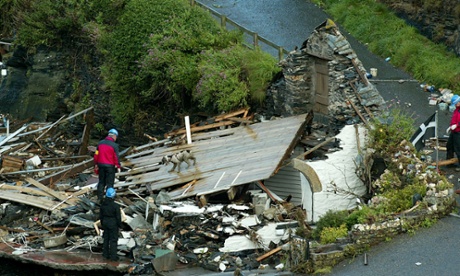
Boscastle floods

Emergency workers search a house in Boscastle, two days after the flood caused devastation, sweeping away cars and buildings. Photograph: John D McHugh/AP

According to The Story of Stuff, only 1% of the items we buy are still in use six months after they are bought. All the latest gadgets we can’t live without, the tools that promise to make our lives easier, the so-called must-have thing that guarantees us to be more popular/sexy/healthy – the majority of them end up in landfill in under a year.

We generate around 177m tons of waste every year in England alone. This poor use of resources costs businesses and households money and causes environmental damage.

And while it can be a depressing picture if we dwell there too long; I’m all about being part of the solution. A few years after the Boscastle floods, I decided to reduce the amount of waste I send to landfill. I’d seen people’s livelihoods washed out to sea and it made me realise that I wanted to make better use of the resources I had. I started a blog about reducing my waste to keep myself accountable. But every day, people from across the world tuned in to see what I’d found in the back of my fridge or hiding in the attic. And most importantly – what I was going to do about it.

A few months after I started blogging, a fellow waste geek, Karen Cannard from the Rubbish Diet, challenged me to have my own zero waste week. I asked my readers to join in to keep me company and 100 people signed up. At the end of the week I was inundated with emails telling me what fun people had, and now that it was over they intended to keep new habits in place – and so the annual Zero Waste Week campaign was born.

Rachelle Strauss' zero waste week

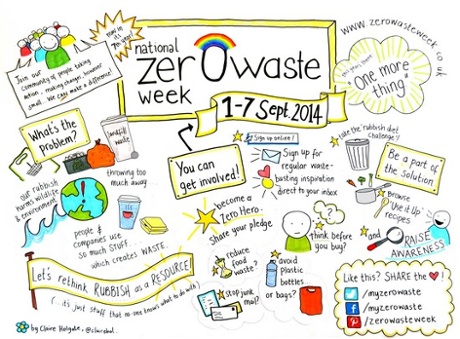
This year’s Zero Waste Week asks you what ‘one more thing’ can you do to reduce your household waste. Photograph: Claire Holgate

The growth of the campaign over the past seven years has been beyond amazing. What started off as a few individual householders has now grown into several thousand, with small and large businesses signing up, local authorities and large corporations all pledging to make a difference.

Zero Waste Week (1-7 September 2014) is predominantly a social media campaign. People sign up to the mailing list with their email address and pledge. Every year has a theme and this year’s is “One More Thing” in answer to the question: “What one more thing could you do to reduce landfill waste?” If you’re new to this, perhaps you’ll say no to disposable carrier bags and start using a reusable one. If you’ve been reducing waste for a while maybe it’s time to swap a disposable product for a reusable one. And if you’re a bit of a rubbish geek already, you could have your very own zero waste week with the aim of sending nothing at all to landfill. It’s an intense week. I like to think of it as a boot camp for bins – where size zero is acceptable.

I spent a year showing that you could send almost nothing to landfill – we filled just one old fashioned dustbin in 2009 – and now I just do my best, working in more of an advisory role and encouraging others to grab the zero waste baton. After all, it has much more impact if every household and business reduces their waste by a tenth than one household who go to the nth degree. Zero Waste Week applies to me the same way as to others – it gives me the opportunity to stop and think about my choices over the past year and make a commitment to get good habits back in place.

http://www.theguardian.com/lifeandstyle/2014/aug/27/zero-waste-week-challenge-send-nothing-to-landfill

Recycling figures: plain rubbish

ENVIRONMENT PANEL Chairman CHAN HAK KAN

2012 – reasons for Panel EA rejection of ENB landfill / incinerator package

www.legco.gov.hk/yr12-13/english/panels/ea/papers/ea0527cb1-1079-2-e.pdf
“13. Details of the funding proposals for the three landfill extension projects are set out in LC Paper No. CB(1)1369/11-12(01) which is hyperlinked in the Appendix. According to the Government, IWMF would require some seven years for reclamation, construction and commission, while landfill extension would need a few years for site preparation works
15. The Panel held another special meeting on 20 April 2012 to continue discussion on the funding proposals. Noting that many measures pertaining to the Policy Framework had yet to be implemented , members were opposed to the reliance on landfills for waste disposal in view of the associated environmental nuisances, as well as the long lead time and cost incurred from restoration of landfills. They stressed the need for an holistic package of waste management measures (including waste reduction, separation and recycling) with waste incineration as a last resort and better communication between the two terms of Government on environmental policies, in particular on the need for incineration. They also urged the Administration to identify other suitable outlying islands for IWMF and promote the local recycling industry. In view of the foregoing, members did not support the submission of the funding proposals to the Public Works Subcommittee for consideration.”
Q: WHAT POLICY AND DIRECTION HAS CHANGED AT ENB SINCE THE LAST LEGCO PANEL ENV AFFAIRS REJECTION ?   A: NOTHING !

actually gone backwards as the ‘new’ figures show– the China ‘Operation Green Fence’ blocking of transhipped dirty plastic from overseas to China via HKG exposed this sham of using the plastic trash transhipment figures as ‘local recycling’. ENB/EPD were caught out cheating by ‘Operation Green Fence’. The ENB denied the container loads of blocked plastics were locally landfilled – so what happened to it ?

http://www.theguardian.com/sustainable-business/china-green-fence-global-recycling-innovation

SCMP Recycling figures: plain rubbish

CTA says: this only came to light due to China’s ‘Operation Green Fence’
ENB has been using data of containers of trash transhipped through here to China in their local recycling figures
When China blocked the transhipment of unwashed plastic imports the shxt hit the fan + the divisive ‘local recycling’ practice came to light
Still waiting to find out which local landfill they buried the dirty plastic waste in

Recycling figures: plain rubbish?

Wednesday, 29 January, 2014

Cheung Chi-fai

Overhaul of system is promised as officials admit estimates of the amount of waste the city recycles have been drastically overstated

Officials have admitted that estimates of the amount of Hong Kong waste being recycled – once put at over 50 per cent – have been drastically overstated. They said yesterday that the figures were distorted by “external factors” beyond their control and the system for calculating them would be overhauled. The admission came as the Environmental Protection Department reported a slashed recycling rate of 39 per cent in 2012, down from 48 the previous year and a peak of 52 in 2010.

The department blamed fluctuations in the waste trade and irregularities in export declarations for the distortions. In an effort to improve its data collection, it will introduce extra measures, as recommended by a consultant commissioned to look into the problem. But the officials said they did not believe the distortion would affect policy-making or the achievement of targets set out in the waste-management blueprint released last year.

World Green Organisation chief executive William Yu Yuen-ping said he was concerned about the “inflation of the recycling rate” and urged the department to set up an expert group to review the system. Friends of the Earth said the public would be confused by the figures. According to the 2012 solid waste monitoring report released by the department yesterday, Hong Kong recycled just 2.16 million tonnes of waste, 860,000 tonnes less than 2011. About 60 per cent of the shortfall was due to a sharp drop in the trade in plastic waste. Last year, a reported 320,000 tonnes of plastic waste was recycled, down from 840,000 tonnes in 2011 and 1.58 million tonnes in 2010. But the amount dumped in landfills largely remained steady at 600,000 to 700,000 tonnes during the same period. Since then, officials have used the disposal rate per person, rather than the recycling rate, as the key indicator to measure policy effectiveness.

In 2012, the former rate rose 3 per cent to 1.27kg. The department said the recycling rate had been calculated from waste export figures compiled by census and customs officers, and the booming trade in recent years might have inflated the figure. It also admitted that the formula could not accurately reflect local recycling efforts since it also included waste imported and then exported after processing. “We believe the 2012 figure is closer to the reality of how the city fared in recycling after a slump in the trade,” said an official, speaking anonymously.

Officials refused to be drawn on whether the admission showed that the recycling rate, used by former environment chiefs to highlight the city’s progress in dealing with its waste problem, had little value. “The public still have expectations for this figure and we will try to give the best estimate,” said an official, adding that the formula was widely adopted elsewhere in the world. Greeners’ Action executive director Angus Ho Hon-wai said the government should set up a registration system for recyclers in order to get first-hand recycling data. Lau Yiu-shing, a local waste recycler, admitted some operators might have wrongly reported export figures to suit their needs. But the scope of doing so had shrunk as mainland customs stepped up checks in recent years.

http://www.scmp.com/news/hong-kong/article/1415979/recycling-figures-plain-rubbish

Incinerator figures don’t add up

Elvis Au (“Incinerator will adopt proven, cost-effective technology on island [1]”, August 5) continues to weave his tangled web of half-truths.

He revealed that of the HK$18.2 billion requested for the project, HK$12.7 billion is to build the incinerator and HK$5.5 billion (30 per cent of the total cost) to build infrastructure on Shek Kwu Chau.

So we will pay an extra HK$5.5 billion because vested interests do not want the incinerator built near the Tuen Mun landfill, which is the logical site.

The “balanced distribution of waste facilities” Au cites as the reason for selecting Shek Kwu Chau was never raised by the Environmental Protection Department from 2004 to 2010.

It surfaced only in 2011 after Lau Wong-fat, chairman of Tuen Mun District Council, objected to putting the incinerator in Tuen Mun.

The department then created the “balanced distribution” criterion to justify Shek Kwu Chau.

Getting approval for another site takes no more time than obtaining it for Shek Kwu Chau, that is, one year from April 2011 to April 2012.

On the capital cost, Au provides selective data.

A survey of all incinerators constructed shows that economies of scale lead to lower per-tonne capital cost the larger the capacity. Au chose Denmark’s lower-capacity 1,100 tonnes per day incinerator costing HK$4.27 million per tonne to compare to his proposed high-capacity 3,000 tonnes per day incinerator costing HK$4.25 million per tonne.

This is like comparing the per passenger cost of a bus to a Rolls Royce.

An honest comparison is with the per-tonne cost of high-capacity incinerators.

These include – the 2,300 tonnes per day facility in Runcorn, Cheshire, UK, at HK$2 million per tonne; the Afval Energie Bedrijf Waste Fired Power Plant in Holland with 3,800 tonnes per day capacity at HK$1.1 million per tonne; the 3,000 tonnes per day facility in Beijing at HK$1 million per tonne; the 1,600 tonnes per day facility in Riverside, Kent, UK, at HK$2.6 million per tonne.

Nor did Au mention the 1,000 tonnes per day incinerators in Finland, China, England, South Korea and Azerbaijan costing less than HK$3 million per tonne.

The 1,000 tonnes per day plasma gasification plant in Teesside, England, cost HK$3.1 million per tonne, paid by the operator.

If approved by the Legislative Council’s Finance Committee in October, Au’s Rolls Royce incinerator will cost between 100 per cent and 300 per cent more than similar capacity incinerators in the world.

Dr Tom Yam, Lantau

http://www.scmp.com/comment/letters/article/1574518/letters-editor-august-16-2014

dynamco Aug 16th 2014
8:10am

If Tom Yam is quoting $ numbers then at least he should get them right, upfront.
The Govt and AU especially well know what they asked for:
www.legco.gov.hk/yr11-12/english/panels/ea/papers/ea0326cb1-1369-1-e.pdf

CB(1)1369/11-12(01) 1.1.b) sets out the Administration’s request @money-of-the-day prices in March 2012
5177DR: IWMF Phase 1 14.96bn – MOD – now 17bn
5163DR: NENT landfill ext 6.632bn MOD -now 8bn
5164DR: SENT landfill ext 1.76bn MOD -now over 2bn
5165DR: WENT landfill ext 33.4mn – now 36mn
The ‘package’ is at least 27bn!
The building of an incinerator is dependent on the capacity of the landfills being increased to handle the 30% by weight ash produced, so they are a ‘package’
Then need to ADD a Pulau Semakau island as the new ash lagoons (10 bn?)
So even at today’s money of day prices Shek Kwu Chau package is $9m per tonne
but by the time it would be finished (like the fast rail to nowhere) it will be far higher
Then, we have all the peer reviewed evidence showing increase in deaths, cancers, birth defects, orofacial clefts in spatial proximity to incinerators
Only with a Rubber Stamp person I/C EIA approvals could this be allowed to happen & she wears two hats & has never knocked back a Govt EIA to date!

The correct numbers sought in Legco by ENB included ALL the infrastructure as shown here:

5177DR – LEGCO REQUEST FOR FUNDING 2012

IWMF PHASE 1 FUNDING REQUEST 14.96 BN INCLUDES THE ISLAND COST AND MUCH MORE AS SHOWN BELOW

www.legco.gov.hk/yr11-12/english/panels/ea/papers/ea0326cb1-1369-1-e.pdf

4.1.1.4 Scope of work

4.1.1.4.1 A plan showing the location of the IWMF Phase 1 at the SKC site is at Annex B1. The IWMF will be built on an artificial island

formed by reclamation to the south-western coast of SKC. The reclaimed island will measure about 11.8 ha including a berth area and storage area

for waste containers. Due to occasionally rough sea condition in the vicinity, the project will include constructing a breakwater of about 4.1 ha

to ensure that loading/ unloading activities can be safely carried out in the berth, and that the safety of facilities can be guaranteed.

4.1.1.4.2 The scope of 5177DR comprises –

(a) design and construction of reclamation to form an artificial island near SKC;

(b) design and construction of an MSW incineration plant of a design capacity of 3 000 tpd employing advanced moving grate waste-to-energy technologies. The incineration plant will comprise the following main components –

(i) waste reception, storage and feeding system;

(ii) moving grate incinerators;

(iii) waste heat recovery, turbine generator and cooling

(iv) boiler feedwater treatment system;

(v) flue gas treatment and discharge system;

(vi) fly ash, bottom ash and residues storage, treatment and handling system;

(vii) bulky waste storage and handling system, reagent

reception and storage system; and

(viii) process control and monitoring system;

(c) design and construction of a mechanical sorting and recycling plant of a design capacity of 200 tpd. The mechanical treatment plant will comprise the installation of the following main components –

(i) waste reception system;

(ii) mechanical sorting and shredding system; and;

(iii) process control and monitoring system;

(d) provision of ancillary and supporting facilities including submarine power cables and electrical system connecting the artificial land to Cheung Sha of Lantau Island, a desalination plant providing water supply to the facility, a wastewater treatment plant, an environmental education centre, community facilities1 and minor supporting facilities for a marine park2; and

(e) environmental monitoring and auditing during the

construction stage.

A layout plan showing the proposed works is at Annex B2. Subject to funding approval of the FC, we plan to commence the design and

construction works in September 2013 and commission the IWMF in 2018/19.

The Govt and AU especially well know what they asked for:
www.legco.gov.hk/yr11-12/english/panels/ea/papers/ea0326cb1-1369-1-e.pdf

CB(1)1369/11-12(01) 1.1.b) sets out the Administration’s request @money-of-the-day prices in March 2012
5177DR: IWMF Phase 1 14.96bn – MOD – now 17bn
5163DR: NENT landfill ext 6.632bn MOD -now 8bn
5164DR: SENT landfill ext 1.76bn MOD -now over 2bn
5165DR: WENT landfill ext 33.4mn – now 36mn
The ‘package’ is at least 27bn!

NY Food-Waste-to-Energy Pilot Expands

New York City will expand a pilot food-waste-to-energy program this fall.

The program, which launched last summer, diverts food from the waste stream and converts it into natural gas, Capital New York reports. The city expects the program to avoid about 90,000 metric tons of CO2.

Waste Management separates the uneaten food from the rest of the trash it collects.

During the pilot program, the city has processed between 1.5 tons and 2 tons of food waste daily. This will increase to 50 tons a day under the expanded program. The city hopes to eventually process 250 tons daily.

The Newtown Creek Wastewater Treatment Plant in Greenpoint, which processes the waste, could process up to 500 tons or 15 percent of the city’s residential organic waste, the newspaper reports.

In New York City’s other food-waste reduction efforts, its restaurants diverted more than 2,500 tons of food waste from landfills between May 2013 and November 2013. The food from 100 restaurants participating in the city’s voluntary Food Waste Challenge was used as compost or donated to food banks.

August 15, 2014

http://www.environmentalleader.com/2014/08/15/ny-food-waste-to-energy-pilot-expands/

Detroit residents sue incinerator owner over ‘noxious odors and contaminants’

on Mon, Jul 28, 2014

A class-action lawsuit has been filed against the owner of Detroit’s municipal solid waste incinerator Monday, accusing the company of nuisance and gross negligence violations

According to the complaint filed by Detroit-based Liddle & Dubin P.C., “On occasions too numerous to list, Plaintiffs’ property including Plaintiffs’ neighborhood, residences and yards were physically invaded by noxious odors and contaminants

As a direct and proximate result of the Defendant’s’ negligence in operating and/or maintaining the facility, Plaintiffs’ property has been invaded by noxious odors.”

The eight-page complaint charges that local property values have dropped due to the incinerator’s presence, “and has interfered with Plaintiffs’ use and enjoyment of their property.” The lawsuit, filed in Wayne County Circuit Court, seeks a financial award in excess of $25,000 and all costs and attorney fees related to the case.

In an email, a spokesperson for the company says, “Detroit Renewable Power is reviewing the complaint filed today,” but declined further comment.

The suit comes weeks after a Metro Times’ cover story earlier this month found a growing number of odor complaints from nearby residents since Detroit Renewable Power LLC (DRP) took control of the facility in 2010. The investigation found a spike in citations from the Michigan Department of Environmental Quality (MDEQ) for noncompliance related to odor issues, and showed how the incinerator’s odor is the predominant issue for a local enforcement agency. Since last fall, MDEQ ramped up its enforcement and began to craft a consent judgement with DRP that would likely stipulate fines, and lay out a timeline for the company to follow to resolve the alleged odor, officials said.

Attorney Nick Coulson, one of the plaintiffs’ lawyers in the case, cited the recent Metro Times cover story as a factor that led to the suit.

“It appears the odors have worsened substantially in the past few years,” Coulson says in an email. “The recent Metro Times article brought to light increased odor complaints and violations. We believe those reflect not only worsening odor emissions, but also increased community concern.

“People are upset, and they want this problem to stop.”

The incinerator was constructed in 1986 by the city of Detroit, which issued $440 million in bonds to finance construction of the facility. Since its inception, the trash-burning machine has been a source of complaints. Soon after, then-Mayor Coleman Young sold it for $54 million to private investors, including tobacco giant Philip Morris.

By 2009, Detroit had spent north of $1.2 billion to retire the incinerator bonds. Vocal opponents called for the city to dump the plan, but the following year, the Greater Detroit Resource Recovery Authority — the quasi-public agency created in 1986 that’s responsible for overseeing disposal of the city’s municipal waste — passed a resolution obligating the city to continue sending trash to the incinerator until 2021. That’s when DRP stepped in.

The facility process as much as 3,300 tons of trash per week at temperatures higher than 2,300 degrees. Its furnaces create steam that’s purchased by DRP’s sister company Detroit Thermal to heat and cool more than 140 buildings between downtown and New Center. The company is permitted to receive as much as 20,000 tons of municipal solid waste per week, according to the state.

http://www.metrotimes.com/Blogs/archives/2014/07/28/detroit-residents-sue-incinerator-owner-over-noxious-odors-and-contaminants

Consultant ‘has taken sides’ on waste charging

Thursday, 31 July, 2014

News›Hong Kong

ENVIRONMENT

Cheung Chi-fai chifai.cheung@scmp.com

The Council for Sustainable Development and its consultant have been accused by green activists of jumping to a conclusion on the best means of charging for household waste disposal.

Activists said the council and a consultant appointed to gauge public views were favouring the easy option of charging per building instead of a fairer method of charging each household for what they actually dumped. But council chairman Bernard Chan rejected the claim, saying no decision could be made before interim results of a pilot scheme were released in September.

The row follows a meeting of council members and a group of advisers late last month.

A digest of the meeting released by the council secretariat said participants felt household and weight-based charging could not be achieved “in a single step” and building-based charging should be used.

Conservancy Association deputy chief executive Rico Wong Tze-kang, one of the advisers, said he was surprised by the summary as it ran contrary to the consultation findings. “It seems the consultant has taken sides already,” he said.

The council must find the most suitable charging method to be introduced by 2016 at the earliest. It is due to report later this year.

The household approach is supported by a majority of respondents to questionnaires in the consultation that ended earlier this year, according to the consultant’s analysis.

Green activists are strongly in favour of that approach as it offers direct incentives for each household to cut waste.

They also acknowledge it would be harder to enforce. But they say the building-based method – with charges shared equally – would not offer the same incentives.

Chan said his view was that residents and property management firms should decide what methods to adopt in each building. “There is no single plan that fits all,” he said, adding that there was a need to secure political support as lawmakers must approve the plan.

The council would meet on Monday to determine the level of the charge, Chan added. He believed it should not be too high, due to the risk of fly-tipping.

The Environmental Protection Department said the meeting digest summarised members’ views and did not reflect any conclusion.


http://www.scmp.com/news/hong-kong/article/1562946/consultant-has-taken-sides-waste-charging

SCMP: Follow best practice on waste incineration, and think local

Friday, 15 August, 2014

Comment›Letters

As project designer of a conservation group on Lantau, I wish to respond to the letter by Elvis W. K. Au, assistant director of environmental protection, regarding the Shek Kwu Chau incinerator (“Incinerator will adopt proven, cost-effective technology on island [1]”, August 5).

I visited the plasma arc gasification plant in Teesside, in northeast England, on June 18, joining its annual open day. Many delegates and big name companies from around the world attended. I was the plant’s first “Hong Kong delegate”.

The day included presentations and a visit to the plant, which was impressive. It is the largest plant in the world and will come into commission by next year.

The most striking part of the visit was the large number of delegates from China, gathering information on plasma. Two out of the three presentations given were by Chinese companies, which have set up plasma gasification plants; it felt as if China was teaching the rest of the world.

I also talked with the British team that met seven Hong Kong government representatives when they visited Britain. They had met in a hotel room in London for an hour: the Hong Kong representatives had said they did not have enough time to visit the Teesside plant. They then visited a small-scale plasma gasification site, in Avonmouth, in southern England, Afval, a company generating electricity from waste in the Netherlands, and then went on to Denmark.

The reaction of the British officials had been the same as mine: surely, if you go on a fact-finding mission, you should go to the best example of whatever that subject is.

Someone senior in the government told me we needed the proposed super incinerator, because, firstly, Hong Kong people were never going to be able to reduce, reuse and recycle their waste in time; and, secondly, plasma would not work.

After my visit to the Teesside plant, my response is to ask: why will plasma arc facilities not work? If the rest of the world is doing it, and it needs to be done, then Hong Kong can do it.

Let’s catch up. Hong Kong always wants everything super-sized, but is that the way of the future?

The workable future is smaller scale and localised. A plasma plant can be constructed quickly, and does not pollute or need landfills, as there is no residue ash waste.

We can set up cluster recycling centres for composting, recycling, plasma arc facilities and education centres where they are needed all over Hong Kong.

The government has already signed contracts so it is reluctant to change tack. But what is really best for Hong Kong?

Jenny Quinton, Ark Eden Foundation, Lantau

More on this:

Incinerator will adopt proven, cost-effective technology on island [1]


Source URL (retrieved on Aug 15th 2014, 5:55am): http://www.scmp.com/comment/letters/article/1573735/follow-best-practice-waste-incineration-and-think-local

Links:
[1] http://www.scmp.com/comment/letters/article/1566561/incinerator-will-adopt-proven-cost-effective-technology-island