Clear The Air News Blog Rotating Header Image

Incineration – Solid Waste Disposal

Largest American landfill shuts down while HK plans to expand existing landfills

The largest American landfill, located at Puente Hills in Southern California, has been closed down.

While its closure has been an admistrative certainty – a decision made in 2003 – what made it possible is the recycling efforts that goes into sorting trash. In addition to residential efforts, privately-operated waste disposal companies operate their own recycling facilities, which ensures that the maximum amount of recyclables is extracted and exported for re-use in manufacturing. The landfill thus saw its input drastically reduced from 13,200 tons a day in 2003, to 7,500 tons a day in 2013 – a number that can be handled by alternative facilities, avoiding a ‘trash’ crisis when the landfill closed.

Meanwhile, in Hong Kong, officials are pushing to expand its existing landfills, paying lip service to the concerns voiced by nearby residents about the impact on their living environment. To make matters worse, their insistence in building an incinerator as the future go-to facility for trash disposal not only threatens to render recycling efforts redundant (since incinerators will need to take the recyclables and additional fuel to combust waste), it will continue to feed the necessity for landfilling, in order to dispose of the highly toxic ash produced at the end of incineration – an even more harmful substance to be landfilled than normal trash.

Click here to read the coverage:

SCMP Letters: Officials stick with outdated technology

Frank Lee, Mid-Levels

Mary Melville is spot on with her comments on food waste and her invitation to the secretary for the environment (“Environment-friendly fix makes molehill of food waste mountain [1]”, October 12).

Besides the possibility of using special bacteria to convert biosolids sludge into agricultural fertiliser, there is a similar biological system (operational in California) that converts such waste into bio- plastics. It is reported that these biodegradable materials offer a realistic alternative to plastics derived from oil – seemingly a double whammy for environmentalists.

Many lucid letters have questioned the Environmental Protection Department’s plan for a massive incinerator at Shek Kwu Chau and its brusque brush-off of Green Island Cement’s efforts to use municipal solid waste (MSW) in an Eco-co-combustion facility proposed at its Tap Shek Kok cement plant.

Elvis W. K. Au, assistant director of environmental protection, poured cold water on this proposal because “this technology has not been used for MSW treatment anywhere in the world for large tonnages” (“Cement plan not yet viable refuse solution”, August 16).

I was therefore astounded to read the report (“Saving a packet”, October 2) about a firm that has been highly successful in using this technology on a large scale in Switzerland for some time and will incorporate the technology into its Asian cement kilns in India and Vietnam.

It seems that our Environmental Protection Department is getting well behind the curve. Cement kilns operate at 1,450 degrees Celsius and gasification plants burn at over 1,500 degrees, whereas the outdated incinerator planned for Shek Kwu Chau will only reach 850 degrees.

This has a large bearing on emissions and residue.

I also cannot understand why we are not planning to use already proven plasma gasification technology to generate electricity from MSW, in conjunction with Hongkong Electric and CLP Power. This would render the Shek Kwu Chau plans superfluous.

It appears our civil servants are bureaucratically locked into a plan that will not give Hong Kong the most effective, efficient, or environmentally sound outcome, and therefore the Legislative Council was correct to block the department’s funding request. By Mr Au’s own admission, the department has blocked Green Island Cement’s use of MSW since 2000, while all this time our landfills inexorably extend.

Perhaps when environment secretary Wong Kam-sing replies to Mary Melville, he can also clarify the confusion surrounding the Shek Kwu Chau project.

24 Oct 2013

Proposed incinerator on Shek Kwu Chau to take backwards step in waste disposal

The proposed incinerator on Shek Kwu Chau would need a guaranteed consistent supply of Municipal Solid Waste (MSW) feedstocks. This would not only defeat the purpose of recycling; the incinerator would also produce hazards that cause cancer, birth defects and deaths with proximity to burner.

Here is a collection of reports on the inefficiencies, health and environmental hazards of incinerators around the world.

Holcim Turns Toxic Dolls Into Cement as Waste Boosts Profit


http://www.businessweek.com/news/2013-09-22/holcim-turns-toxic-baby-dolls-into-cement-as-waste-boosts-profit

Bloomberg News

Holcim Turns Toxic Dolls Into Cement as Waste Boosts Profit

By Patrick Winters September 23, 2013


Holcim Ltd. Chief Executive Officer Bernard Fontana is turning waste into profit at the world’s largest maker of cement by burning toxic baby dolls, contraband cigarettes and old sunglasses.

Fontana, who last year became the first outsider to run Jona, Switzerland-based Holcim in its 101-year history, is ramping up the use of waste materials, instead of coal, to heat cement kilns from India to Vietnam and cut costs. The expansion into waste management is generating revenues as companies such as cigarette makers pay to burn copycat and expired goods, said Aidan Lynam, an area manager for Holcim in South Asia.

“They watch to make sure every last cigarette goes into our kiln,” he said, referring to manufacturers in Vietnam that pay to cremate contraband at Holcim plants. “It disappears like a grain of sand in the Sahara,” he said, adding that at extreme temperatures, cigarettes become part of the cement.

Following more than $10 billion of acquisitions in the decade through 2011, Fontana began a cost-cutting program last year to boost operating profit by 1.5 billion Swiss francs ($1.6 billion) and adjust for declining demand amid the European debt crisis. Burning waste may make some cement plants in Asia as energy efficient as in Europe, helping Holcim to free up cash and compete with rivals Lafarge SA and Cemex SAB.

‘Massive Saving’

“Short term, it’s a massive saving; over time it will slow down,” said Ian Osburn, an analyst at Cantor Fitzgerald in London, adding that energy is about one third of the cost of making cement. “Holcim clearly have been leaders for this and early thinkers, but all the cement manufacturers move quickly to copy each other.”

Alternative fuels contribute about 20 percent of energy used at European cements plants, said Philippe Fonta of the WBCSD cement sustainability initiative, consisting of manufacturers representing about 30 percent of world production. Alternative fuels represent less than 1 percent in markets such as India, he said.

“There’s huge potential, particularly with the use of municipal solid waste in fast-growing emerging countries,” he said. Countries such as India could boost the use of alternative fuels to 25 percent over the next decades, he said.

Cement makers worldwide are seeking to reduce energy costs as they’re cutting expenditures after a slump in demand following the debt crisis and expensive acquisitions.

Industry Woes

Cemex (CX:US), the biggest cement maker in the Americas, has posted net losses for 15 consecutive quarters as the U.S. construction market slumped after its $14.2 billion acquisition in 2007 of Rinker Group Ltd. In September 2012, Cemex agreed a debt restructuring with creditors to extend the maturity of bank loans by three years.

France’s Lafarge, which acquired Orascom Cement for 10.2 billion euros ($13.6 billion) in 2008, is seeking to reduce borrowings to below 10 billion euros this year to regain an investment grade rating. It has announced 1.7 billion euros of asset sales since the start of 2012.

Holcim, which paid $4.1 billion for Aggregate Industries in 2005, avoided a drop to junk status. Before today, Holcim has dropped 38 percent in the last six years in Zurich, valuing the company at 22 billion francs, while Lafarge declined 45 percent in Paris and Cemex slumped 48 percent in Mexico City. Today, Holcim gained 0.4 percent.

BSE Cattle

Holcim’s Untervaz plant in a Swiss valley above the river Rhine is an model for what the cement maker wants to achieve at its emerging market operations. The plant, founded in 1957 by Max Schmidheiny, whose descendant Thomas Schmidheiny is Holcim’s largest shareholder, already uses up to 40 percent alternative fuels to fire up the kilns.

At one point fuel included diseased cattle during the height of the European bovine spongiform encephalopathy (BSE) crisis. Now the plant burns mainly tyre chips and plastics as substitutes for coal or petcoke, said site manager Markus Hepberger, while proudly displaying his latest-model caterpillar truck for transporting rock and a 15 million-franc waste heat recovery system installed by ABB Ltd.

Holcim’s Wadi plant in India can produce six times as much cement as the average Swiss plant in a year, and has a correspondingly large energy bill, Lynam said. Holcim wants to bring Asian plants, especially in India, up to the same level of efficiency as those in Europe, as many factories, acquired through acquisitions, still have uneven levels of knowledge, he said.

No Escape

Fontana “laid down the gauntlet” to plant managers, adding urgency to cost-saving efforts in energy, the biggest cost in cement operations, Lynam said. Asian energy savings, which contribute “extremely strongly” to the expected 300 million franc total energy savings from the so-called Leadership Journey program, may exceed targets, he said.

Holcim’s thermal substitution rate, or the percentage of alternative fuels used instead of traditional fuels like coal and petcoke, increased to 12.8 percent last year, up from 12.5 percent in 2011. The substitution rate increased by 2 percentage points in the six months through June compared with a year ealier, Fontana said on a call Aug. 15.

Plants make cement by feeding a mix of limestone and clay into a kiln where temperatures can reach as high as 2,000-degrees (3,600 Fahrenheit), turning it into clinker. Clinker is then cooled, ground and mixed with gypsum to yield cement.

Burning conditions inside the kiln will break down waste like expired drugs and pesticides without leaving residues, unlike incinerators which burn at lower temperatures. That makes Holcim’s furnaces perfect for the so-called co-processing of unwanted stock such as defect baby dolls, which were burned because of lead contamination, Lynam said.

To be sure, there are some things Lynam won’t burn, such as Agent Orange, a herbicide used by the U.S. army as a chemical weapon in Vietnam.

“We just don’t want to go there,” he said.

To contact the reporter on this story: Patrick Winters in Zurich at pwinters3@bloomberg.net

To contact the editor responsible for this story: Simon Thiel at sthiel1@bloomberg.net

The “WTE” Incinerator Wastes More Energy than it Generates

http://www.envisionfrederickcounty.org/wte-incinerator-wastes-energy-generates/

The “WTE” Incinerator Wastes More Energy than it Generates

By Ellis BurrussSeptember 19, 2013

The proposed and approved regional incinerator planned for Frederick County is also referred to as a “Waste to Energy” facility. These incinerators are not just another kind of electricity-producing power plants, burning municipal waste instead of natural gas or coal. They would never be built for that purpose, since, as generators of electricity, they cost as much as dozens of times more than natural gas, and a lot more than solar or wind power, or even nuclear power.

These large mass burn incinerators are built, at great cost to taxpayers, to reduce a highly mixed stream of municipal waste to ash. In modern incinerators, the incineration of these materials produces electricity is a byproduct that is sold to help offset a portion of the cost of operating the facilities.

The industry’s sales pitch emphasizes the energy production, even attempting to portray it as “green” or “renewable” energy, and, more often lately, as part of a “zero waste to landfill” strategy.

But the evidence reveals that, rather than producing what might be considered bonus energy, converting the typical municipal waste stream to ash and energy is actually a waste OF energy.

That may sound counter-intuitive, but the amount of energy produced by a so-called Waste to Energy incinerator is considerably less than the amount saved by recycling the recyclable materials that would be burned.

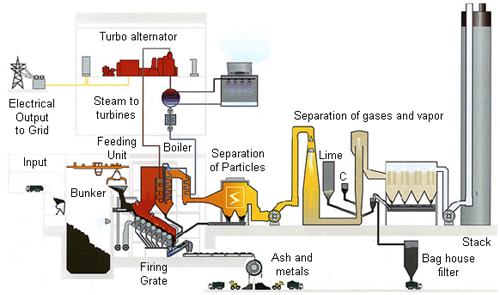
wteschematic

Consider the following examples:

1) Paper:

Manufacturing a ton of news paper from trees takes 11,699 kilowatt hours (kwh)(1). If that ton of paper is burned, it can produce 1,875 kwh(2) of electricity to sell. That’s a loss of 9,824 kwh.

Incinerating paper wastes 9,824 kwh per ton!

If that ton of paper is recycled, a new ton of paper can be made using only 6,442 kwh. That’s a saving of 5,257 kwh

2) Plastics:

Even plastics such as PET (soda bottles) that have a high heat content as fuel (10,250 btu/pound) produce only 2,403 kwh per ton when burned yet require 9,619 kwh/ton to make. That’s another loss of 7,216 kwh/ton.

Incinerating soda bottles wastes 7,216 kwh per ton!

If that ton of plastic is recycled, a new ton of plastic can be made using only 1,222 kwh. That’s a saving of 8,397 kwh.

3) Aluminum:

It takes 62,512 kwh of power to manufacture a ton of aluminum. Most incinerators do not attempt to recover aluminum from the ash. Beverage cans and other thin aluminum with high surface-to-volume ratios are oxidized to ash. All of the energy invested in making the aluminum is wasted.

Incinerating aluminum cans wastes 62,512 kwh per ton!

If that ton of aluminum is recycled, a new ton can be made using only 4,865 kwh. That’s a saving of 57,647 kwh.

4) Food Scraps:

To work efficiently a “WTE” incinerator must have fuel with an average heat content of 5000 to 5500 btu/pound. Food scraps have a heat content of only 2600 btu/pound. They actually dilute the fuel of an incinerator.

Food scraps are another resource wasted by incineration!

Food scraps, which make up 13% of our waste, can be composted to make a valuable soil amendment, replacing fertilizers made from fossil fuels.

All the manufactured products that are used as fuel for an incinerator take a lot of energy to make. If they are recycled instead of burned, they save much, much more energy than is produced by an incinerator.

Burning usable resources to produce a meager amount of electricity is like burning your furniture to heat your house and then bragging about all the heating oil saved.


NOTES:

1) Figures for process energy for manufacture are from the EPA Solid Waste Management and Greenhouse Gases — A Life-cycle Assessment of Emissions and Sinks; 3rd Edition, September 2006; Exhibit 2-4 pg 27 and Exhibit 2-6 pg. 29

2) Values for heat content are from The Energy Information Administration (DOE) Methodology for Allocating Municipal Solid Waste to Biogenic and Non-Biogenic Energy; May 2007; pg 10.

Electricity produced from stated heat content assumes a 40% thermal efficiency for a steam-cycle generating plant.

Martin Williams <martin@drmartinwilliams.com>
21 Sep (3 days ago)

to James, me, cyd4hk, info

Good one

Notions that it is “better” for global warming also misleading: these compare with landfill waste giving off methane; not with recycling scenario in which carbon emissions are far lower.
Heard yesterday of Kaohsiung: special vehicle coming round for waste collection, people working together beforehand on separation
– govt here puts minimal effort into reduction of waste in first place
Very old fashioned!!!!

Dr Martin Williams. Writing. Photography. Multimedia.
Recognised as an Outstanding Earth Champion by the Earth Champions Foundation
Cheung Chau, Hong Kong; tel 96201824

www.drmartinwilliams.com
www.hkoutdoors.com

On 21 Sep, 2013, at 6:46 AM, “James Middleton” <dynamco@netvigator.com> wrote:

The “WTE” Incinerator Wastes More Energy than it Generates

By Ellis BurrussSeptember 19, 2013

The proposed and approved regional incinerator planned for Frederick County is also referred to as a “Waste to Energy” facility. These incinerators are not just another kind of electricity-producing power plants, burning municipal waste instead of natural gas or coal. They would never be built for that purpose, since, as generators of electricity, they cost as much as dozens of times more than natural gas, and a lot more than solar or wind power, or even nuclear power.

These large mass burn incinerators are built, at great cost to taxpayers, to reduce a highly mixed stream of municipal waste to ash. In modern incinerators, the incineration of these materials produces electricity is a byproduct that is sold to help offset a portion of the cost of operating the facilities.

The industry’s sales pitch emphasizes the energy production, even attempting to portray it as “green” or “renewable” energy, and, more often lately, as part of a “zero waste to landfill” strategy.

But the evidence reveals that, rather than producing what might be considered bonus energy, converting the typical municipal waste stream to ash and energy is actually a waste OF energy.

That may sound counter-intuitive, but the amount of energy produced by a so-called Waste to Energy incinerator is considerably less than the amount saved by recycling the recyclable materials that would be burned.

<image001.jpg>

Incinerating trash a waste of resources

Incineration is expensive, inefficient and environmentally unfriendly

September 11, 2013

http://www.troymedia.com/2013/09/11/incinerating-trash-a-waste-of-resources/

VANCOUVER, BC, Sep 11, 2013/ Troy Media/ – Many urban areas have built or are considering building waste-incineration facilities to generate energy. At first glance, it seems like a win-win. You get rid of “garbage” and acquire a new energy source with fuel that’s almost free. But it’s a problematic solution, and a complicated issue.

Metro Vancouver has a facility in Burnaby and is planning to build another, and Toronto is also looking at the technology, which is already being used elsewhere in the region, with a plant in Burlington and another under construction in Clarington. The practice is especially popular in the European Union, where countries including Sweden and Germany now have to import waste to fuel their generators.

The term “waste” is correct; there’s really no such thing as garbage. And that’s one problem with burning it for fuel. Even those who promote the technology would probably agree that the best ways to deal with waste are to reduce, reuse and recycle it. It’s astounding how much unnecessary trash we create, through excessive packaging, planned obsolescence, hyper-consumerism and lack of awareness. This is one area where individuals can make a difference, by refusing to buy over-packaged goods and encouraging companies to reduce packaging, and by curbing our desire to always have newer and shinier stuff.

We toss out lots of items that can be reused, repaired or altered for other purposes. As for recycling, we’ve made great strides, but we still send close to three quarters of our household waste to the landfill. Considering each Canadian produces close to 1,000 kilograms of waste a year, that’s a lot of trash! Much of the material that ends up in landfills is usable, compostable or recyclable, including tonnes of plastics.

Turning unsorted and usable trash into a valuable fuel commodity means communities are less likely to choose to reduce, reuse and recycle it. Burning waste can seem easier and less expensive than sorting, diverting and recycling it. But once it’s burned, it can never be used for anything else – it’s gone!

Incinerating waste also comes with environmental problems. Although modern technologies reduce many air pollutants once associated with the process, burning plastics and other materials still creates emissions that can contain toxins such as mercury, dioxins and furans. As with burning fossil fuels, burning waste – much of which is plastics derived from fossil fuels – also produces carbon dioxide and nitrous oxide emissions that contribute to climate change.

Burning waste doesn’t make it disappear, either. Beyond the fly ash and pollutants released into the atmosphere, a great deal of toxic “bottom ash” is left over. Metro Vancouver says bottom ash from its Burnaby incinerator is about 17 per cent the weight of the waste burned. That ash must be disposed of, usually in landfills. Metro testing has found high levels of the carcinogenic heavy metal cadmium in bottom ash, sometimes twice the limit allowed for landfills. High lead levels have also been reported.

Incineration is also expensive and inefficient. Once we start the practice, we come to rely on waste as a fuel commodity, and it’s tough to go back to more environmentally sound methods of dealing with it. As has been seen in Sweden and Germany, improving efforts to reduce, re-use and recycle can actually result in shortages of waste “fuel”!

It’s a complicated issue. We need to find ways to manage waste and to generate energy without relying on diminishing and increasingly expensive supplies of polluting fossil fuels. Sending trash to landfills is clearly not the best solution. But we have better options than landfills and incineration, starting with reducing the amount of waste we produce. Through education and regulation, we can reduce obvious sources and divert more compostable, recyclable and reusable materials away from the dump. It’s simply wasteful to incinerate it.

It would be far better to sort trash into organics, recyclables and products that require careful disposal. We could then divert these different streams to minimize our waste impacts and produce new commodities. Organics used in biomass energy systems could help offset fossil fuel use while creating valuable supplies of fertilizers. Diversion and recycling lessen the need to extract new resources and disrupt the environment while creating more value and jobs. That’s a win all around!

Dr. David Suzuki is a scientist, broadcaster, author, and co-founder of the David Suzuki Foundation.

HK activist’ arrested over village incinerator protest

· china_incinerator_protest_xay801_12603619.jpg

Guangdong police have arrested three activists, one of them a Hong Kong resident, for organising protests over a planned incinerator in Huizhou. Photo: AP

South China Morning Post

Published on South China Morning Post (http://www.scmp.com)

Home > ‘HK activist’ arrested over village incinerator protest


‘HK activist’ arrested over village incinerator protest

Friday, 06 September, 2013, 12:00am

NewsChina

ENVIRONMENT

Police take hard line against trio accused of organising demonstration in Huizhou

Guangdong police have arrested three activists, one of them a Hong Kong resident, for organising protests over a planned incinerator in Huizhou.

The Huiyang district police bureau said in an online statement yesterday that the three detainees were suspected of “disrupting social order by attempting to mobilise several thousand villagers to demonstrate in front of local government buildings”.

A Beijing-based environmentalist who has studied mainland incinerator projects, and who wished to remain anonymous, said that Pan Yu, a Hong Kong resident, was arrested on August 30 during a trip to Shenzhen.

“Villagers and other property owners, mostly from Shenzhen, oppose the incinerator so they soon joined the protests against the project,” the environmentalist said. “But police accused Pan and two others of leading local villagers in the protests.”

Pan and the two other suspects own property near the planned incinerator location.

A spokesman for Hong Kong’s Immigration Department said last night it had not received any request for assistance.

The arrests are the latest in a series of detentions as mainland authorities take a harder line on protests against construction seen by local residents as undesirable for their neighbourhoods.

The incineration plant, planned for Shatian town with a daily burning capacity of 1,200 tonnes, is strongly opposed by residents of Lanzilong village and a nearby property development.

Local environmental authorities have tried to reassure residents that the incinerator would be safe, saying it uses the most advanced technology and similar environmental standards to those in the European Union.

But many villagers remain unconvinced. Residents have protested three times this year, according to media reports, with the biggest turnout estimated at several hundred. Protesters and police clashed at one rally in May, attended by 60 demonstrators, of whom 10 were detained briefly.

The police statement said the incinerator had won majority support from local residents.

Incinerator projects have become a popular cause for environmental protests on the mainland in recent years, with some residents fearing that the emissions cause cancer. Earlier this year, about 10 protesters against an sewage pipeline in Jiangsu received criminal charges.

Additional reporting by Danny Mok


Source URL (retrieved on Sep 6th 2013, 5:43am): http://www.scmp.com/news/china/article/1304292/hk-activist-arrested-over-village-incinerator-protest

Council To Make Environment Agency Correspondence Available To Public

http://www.scillytoday.com/2013/09/02/council-to-make-environment-agency-correspondence-available-to-public/

Council To Make Environment Agency Correspondence Available To Public

Added by Andy Hargreaves on September 2, 2013.

Islanders will be able to view the correspondence between the Environment Agency and the Council’s Chief Technical Officer, which outline the agency’s concerns over the Moorwell incinerator.

Using a Freedom of Information request, Radio Scilly received around 400 pages of e-mails and letters documenting regular breaches in the safe limits of dioxins and other pollutants from the site, between June 2010 and earlier this year.

During the sample periods, levels of dioxins, which are classified by the World Health Organisation as one of the most toxic chemicals on earth, reached up to 65 times the permitted amounts.

The Environment Agency forced the Council to take action and since consultants SLR have managed the incinerator, levels have returned safe limits.

They found the incinerator was being overfilled and too much plastic was being burnt from un-sorted off-island waste.

Chairman of the General Purposes Committee, Cllr Steve Sims, says the correspondence will be available to view in the Council’s One-Stop Shop. But you won’t be allowed to make any copies.


http://www.abc.net.au/news/2012-11-06/east-arm-quarantine-incinerator-shut-down/4356552

East Arm quarantine incinerator shut down

Posted Tue 6 Nov 2012, 5:02pm AEDT Australia

The Northern Territory Government has shut down its quarantine incineration facility at East Arm Wharf in Darwin because of pollution concerns.

The Environmental Protection Authority (EPA) says there has been an ongoing problem with the incinerator for the past six years.

Transport Minister Adam Giles says the Government decided to shut the facility because it fails to meet new environmental standards.

The incinerator was set up in 2006 to treat waste from commercial shipping and international flights.

EPA chairman Dr Bill Freeland says the incinerator was found to be emitting dioxins into the surrounding soil.

He says alternative arrangements for the waste are being established.

“There will be waste coming in every day and currently it is being stored, and arrangements are being put in place … to actually get that all sealed up and trucked to a proper facility to South Australia,” he said.

Mr Giles says the Territory receives about one shipping container of bio-hazard waste from international aircraft and ships every day.

“I want to make sure that people see Darwin Port as a clean port,” he said.

Is incineration holding back recycling?

http://www.theguardian.com/environment/2013/aug/29/incineration-recycling-europe-debate-trash

Is incineration holding back recycling?

Increasingly common in Europe, municipal ‘waste-to-energy’ incinerators are being touted as a green trash-disposal alternative

Newhaven incinerator in East Sussex , waste incinerator

After 10 years of debate, Newhaven incinerator opened last year. Photograph: Peter Cripps/Alamy

For communities short on landfill space, “waste-to-energy” incineration sounds like a bulletproof solution: Recycle all you can, and turn the rest into heat or electricity. That’s how it’s been regarded in much of Europe, where nearly a quarter of all municipal solid waste is burned in 450 incinerators, and increasingly in the United States, where dozens of cities and towns are considering new, cutting-edge plants.

But leaders of the international zero-waste movement, which seeks to reuse all products and send nothing to landfills or incinerators, say incineration falls short on the energy front and actually encourages waste. Many “zero wasters” — including groups such as Zero Waste Europe and the Global Alliance for Incinerator Alternatives, or GAIA — have become ardent opponents of the technology, contending that proponents have co-opted the carefully crafted zero-waste label by suggesting that burning to produce energy isn’t actually wasting. In Europe, where incineration capacity continues to grow despite already exceeding the trash supply in some countries, the showdown goes beyond semantics to the heart of the meaning of sustainability.

While the world certainly has no shortage of it, trash is not renewable — not in the way that sunlight, wind, and geothermal heat are. Producing goods from virgin, finite resources requires energy — lots of it. Once the goods become trash, zero-waste advocates say, burning them in an incinerator destroys those resources for good.

Incinerators can provide heat for municipal heating systems or steam for electricity, recovering some of the energy used to produce their fuel. But even given the environmental costs of recycling, which include transporting and processing the material, zero wasters contend that it makes far more sense to recycle than to incinerate.

The precise energy savings for any given waste stream depends on its composition, according to Jeffrey Morris, an economist and environmental consultant with Sound Resource Management Group Inc. in Olympia, Washington. “But it would be a surprising situation to find a waste stream that it would be more beneficial to burn rather than to source-separate and recycle,” says Morris, who did a study in 1995 — still widely cited by recycling advocates — which found that recycling most materials from municipal solid waste saves on average three to five times more energy than does burning them for electricity.

These days, the waste-to-energy debate is particularly active in Europe, where government incentives and subsidies have encouraged the construction of incinerators. Waste-to-energy supporters contend that the recycle-versus-incinerate comparison represents a false choice — that the two can coexist. “We see waste-to-energy continuing to have a role to play in an integrated approach to waste management, providing hygienic treatment of the remaining waste that is not suitable for sustainable recycling, and at the same time generating energy from it, rather than it being sent to a landfill,” Ella Stengler, managing director of the Confederation of European Waste-to-Energy Plants, wrote in an email. “Recycling and waste-to-energy are complementary to achieve lower landfill rates.”

As it turns out, countries with the highest rates of garbage incineration — Denmark, Norway, and Sweden, for example, all incinerate at least 50 percent of their waste — also tend to have high rates of recycling and composting of organic materials and food waste. But zero-wasters argue that were it not for large-scale incineration, these environmentally conscious countries would have even higher rates of recycling. Germany, for example, incinerates 37 percent of its waste and recycles 45 percent — a considerably better recycling rate than the 30-plus percent of Scandinavian countries.

There’s no doubt that dumping untreated municipal solid waste in the landfills common in eastern and southern Europe, where incineration rates lag far behind those of northern Europe, poses significant environmental problems. These include the leaching of toxic chemicals into groundwater, an increasingly urgent shortage of space, and the release of methane — a potent greenhouse gas — into the atmosphere. (In the United States, more than half of all waste is dumped in landfills, and about 12 percent burned, of which only a portion is used to produce energy.) According to the U.S. Environmental Protection Agency, landfills are the third-largest source of methane in the United States, behind industry and agriculture. Such environmental impacts are the reason why many European countries have instituted landfill bans in recent decades, contributing to the rapid expansion of incineration and waste-to-energy technology.

Zero-wasters say that a major problem with incineration is the long-term contracts that waste-to-energy plants sign with the cities that supply them with trash. Incinerators are extremely expensive to build — large, modern facilities in Europe cost $150 million to $230 million — and to make a profit and repay investors, incinerator operators need a guaranteed stream of waste. The operators sign contracts with municipalities to provide a certain volume of waste over a long period of time, often 20 or 30 years, effectively committing municipalities to generating a certain amount of waste. Zero-waste advocates say this reduces the incentive to recycle more and waste less, which exists with landfills, where tipping fees can be high.

With incineration, said Dominic Hogg, chairman of UK-based waste-management consulting firm Eunomia, “the financial logic for engaging in further recycling is lost.”

Hege Rooth Olbergsveen, a senior adviser in Norway’s Waste Recovery and Hazardous Waste department and a proponent of waste-to-energy, acknowledges that the economics of incineration can impair recycling efforts.

“It is in many cases more expensive to collect and sort out waste for material recycling than just to collect it as residual waste and send it to energy recovery,” she wrote in an email. “Some municipalities introduce only cost-effective waste solutions, while other municipalities have strong political will to introduce environmental measures and collect more waste for recycling.”

German zero-waste advocate Hartmut Hoffmann, head of Friends of the Earth Germany’s waste working group, said he’s seen such an effect in Bavaria. In and around the towns of Schwandorf, Coburg, and Burgkirchen, each of which contains an incinerator, some waste authorities have openly refused to separate organic waste for composting, he said, instead incinerating the material at a lower cost. “For us, this refusal is good proof that the existence of incineration plants can hinder recycling,” Hoffmann said.

In Flanders, Belgium, an effort to keep a lid on incinerator contracts has led nearer to zero waste, said Joan Marc Simon, executive director of Zero Waste Europe and European regional coordinator for GAIA. Since the early 1990s, when recycling rates were relatively low, the local waste authority in Flanders has decided not to increase incineration beyond roughly 25 percent, Simon said. As a result, combined recycling and composting rates now exceed 75 percent, GAIA says. “They stabilized and even reduced waste generation when they capped incineration,” Simon said.

Without incineration, he believes, most European countries could improve current recycling rates of 20 or 30 percent to 80 percent within six months. Hogg agreed, saying that rates of 70 percent should be “easy” to attain. The U.S. Environmental Protection Agency, which calculates recycling and composting together, puts the current U.S. rate at 35 percent, compared to a combined European Union figure of 40 percent. Many of the newer members of the EU, mainly from Eastern Europe, have few if any waste-to-energy incinerators, recycle very little, and landfill 75 percent or more of their trash.

Except for pockets like Flanders, Simon believes that the major mistake Europe’s leading incinerator countries have made is committing too much trash to incineration too soon by instituting landfill bans. “Back then nobody knew or expected it would be possible to achieve the current recycling rates,” he said. “As they rolled out recycling they also planned incineration capacity. This trend hit the wall when recycling started competing with incineration for the available waste. In this situation some countries decided to give way to incineration and either import waste to burn or burn recyclables.”

Plastics are particularly attractive for burning, as they’re made with petroleum and generate more energy when incinerated than almost any other material. “Plastic is a good fuel, ” said Pål Mårtensson, a zero-waste advocate in Gothenburg, Sweden. “So they don’t bother that much to sort it out [for recycling].”

Burning plastic is also known to release harmful dioxins into the air. Waste-to-energy proponents say state-of-the-art plants filter out such toxic air pollution, but opponents say even the best plants do not filter out all toxics. This week, the Scottish Environmental Protection Agency revoked the operating license of a waste-to-energy incinerator in Dumfries after a large fire, saying the operator had failed to recover energy efficiently and had not met the requirements of its operating permit.

Despite EU directives calling for member states to both end the burning of all recyclable materials and achieve recycling rates of 50 percent (the current average is 25 percent) by 2020, public subsidies support the expansion of incineration capacity in many European countries.

Waste importers Sweden (with 31 plants as of 2011), Germany (72 plants), the Netherlands (12), and Denmark (29) continue to approve, finance, and build new waste-to-energy plants even though capacity exceeds domestic waste volumes. The United Kingdom (24 plants) is expected to reach capacity by 2018, according to a June report by Eunomia. Still, incineration remains profitable for facilities accepting waste that is shipped hundreds of miles from eastern and southern Europe.

Malcolm Williams, a director of the UK Zero Waste Alliance, is concerned that increased incineration capacity may lead Europe to miss what he deems are already modest waste-reduction targets for 2020. Even 90 percent recycling should be attainable, he contends. “It’s just a myth that recycling is a difficult thing to do,” said Williams. “So why on earth is anybody planning anything that is going to burn or bury more than 10 percent of the waste we’re producing?”

Incineration Versus Recycling: In Europe, A Debate Over Trash

28 AUG 2013: REPORT

Incineration Versus Recycling:
In Europe, A Debate Over Trash

Increasingly common in Europe, municipal “waste-to-energy” incinerators are being touted as a green trash-disposal alternative. But critics contend that these large-scale incinerators tend to discourage recycling and lead to greater waste.

by nate seltenrich

For communities short on landfill space, “waste-to-energy” incineration sounds like a bulletproof solution: Recycle all you can, and turn the rest into heat or electricity. That’s how it’s been regarded in much of Europe, where nearly a quarter of all municipal solid waste is burned in 450 incinerators, and increasingly in the United States, where dozens of cities and towns are considering new, cutting-edge plants.

But leaders of the international zero-waste movement, which seeks to reuse all products and send nothing to landfills or incinerators, say incineration falls short on the energy front and actually encourages waste. Many “zero

Waste incinerator in Germany

Norbert Nagel/Wikimedia Commons

A waste-to-energy incinerator in Hesse, Germany.

wasters” — including groups such asZero Waste Europe and the Global Alliance for Incinerator Alternatives, or GAIA — have become ardent opponents of the technology, contending that proponents have co-opted the carefully crafted zero-waste label by suggesting that burning to produce energy isn’t actually wasting. In Europe, where incineration capacity continues to grow despite already exceeding the trash supply in some countries, the showdown goes beyond semantics to the heart of the meaning of sustainability.

While the world certainly has no shortage of it, trash is not renewable — not in the way that sunlight, wind, and geothermal heat are. Producing goods from virgin, finite resources requires energy — lots of it. Once the goods become trash, zero-waste advocates say, burning them in an incinerator destroys those resources for good.

Incinerators can provide heat for municipal heating systems or steam for electricity, recovering some of the energy used to produce their fuel. But even given the environmental costs of recycling, which include

Waste-to-energy advocates say the recycle vs. incinerate comparison is a false choice – that the two can coexist.

transporting and processing the material, zero wasters contend that it makes far more sense to recycle than to incinerate.

The precise energy savings for any given waste stream depends on its composition, according to Jeffrey Morris, an economist and environmental consultant with Sound Resource Management Group Inc. in Olympia, Washington. “But it would be a surprising situation to find a waste stream that it would be more beneficial to burn rather than to source-separate and recycle,” says Morris, who did a study in 1995 — still widely cited by recycling advocates — which found that recycling most materials from municipal solid waste saves on average three to five times more energy than does burning them for electricity.

These days, the waste-to-energy debate is particularly active in Europe, where government incentives and subsidies have encouraged the construction of incinerators. Waste-to-energy supporters contend that the recycle-versus-incinerate comparison represents a false choice — that the two can coexist. “We see waste-to-energy continuing to have a role to play in an integrated approach to waste management, providing hygienic treatment of the remaining waste that is not suitable for sustainable recycling, and at the same time generating energy from it, rather than it being sent to a landfill,” Ella Stengler, managing director of theConfederation of European Waste-to-Energy Plants, wrote in an email. “Recycling and waste-to-energy are complementary to achieve lower landfill rates.”

As it turns out, countries with the highest rates of garbage incineration — Denmark, Norway, and Sweden, for example, all incinerate at least 50 percent of their waste — also tend to have high rates of recycling and composting of organic materials and food waste. But zero-wasters argue that were it not for large-scale incineration, these environmentally

Zero-waste advocates say a major problem is the long-term contracts that waste-to-energy plants are locked into.

conscious countries would have even higher rates of recycling. Germany, for example, incinerates 37 percent of its waste and recycles 45 percent — a considerably better recycling rate than the 30-plus percent of Scandinavian countries.

There’s no doubt that dumping untreated municipal solid waste in the landfills common in eastern and southern Europe, where incineration rates lag far behind those of northern Europe, poses significant environmental problems. These include the leaching of toxic chemicals into groundwater, an increasingly urgent shortage of space, and the release of methane — a potent greenhouse gas — into the atmosphere. (In the United States, more than half of all waste is dumped in landfills, and about 12 percent burned, of which only a portion is used to produce energy.) According to the U.S. Environmental Protection Agency, landfills are the third-largest source of methane in the United States, behind industry and agriculture. Such environmental impacts are the reason why many European countries have instituted landfill bans in recent decades, contributing to the rapid expansion of incineration and waste-to-energy technology.

Zero-wasters say that a major problem with incineration is the long-term contracts that waste-to-energy plants sign with the cities that supply them with trash. Incinerators are extremely expensive to build — large, modern facilities in Europe cost $150 million to $230 million — and to make a profit and repay investors, incinerator operators need a guaranteed stream of waste. The operators sign contracts with municipalities to provide a certain volume of waste over a long period of time, often 20 or 30 years, effectively committing municipalities to generating a certain amount of waste. Zero-waste advocates say this reduces the incentive to recycle more and waste less, which exists with landfills, where tipping fees can be high.

With incineration, said Dominic Hogg, chairman of UK-based waste-management consulting firm Eunomia, “the financial logic for engaging in further recycling is lost.”

Hege Rooth Olbergsveen, a senior adviser in Norway’s Waste Recovery and Hazardous Waste department and a proponent of waste-to-energy, acknowledges that the economics of incineration can impair recycling efforts.

“It is in many cases more expensive to collect and sort out waste for material recycling than just to collect it as residual waste and send it to energy recovery,” she wrote in an email. “Some municipalities introduce

In many European countries, public subsidies support the expansion of incineration capacity.

only cost-effective waste solutions, while other municipalities have strong political will to introduce environmental measures and collect more waste for recycling.”

German zero-waste advocate Hartmut Hoffmann, head ofFriends of the Earth Germany’s waste working group, said he’s seen such an effect in Bavaria. In and around the towns of Schwandorf, Coburg, and Burgkirchen, each of which contains an incinerator, some waste authorities have openly refused to separate organic waste for composting, he said, instead incinerating the material at a lower cost. “For us, this refusal is good proof that the existence of incineration plants can hinder recycling,” Hoffmann said.

In Flanders, Belgium, an effort to keep a lid on incinerator contracts has led nearer to zero waste, said Joan Marc Simon, executive director of Zero Waste Europe and European regional coordinator for GAIA. Since the early 1990s, when recycling rates were relatively low, the local waste authority in Flanders has decided not to increase incineration beyond roughly 25 percent, Simon said. As a result, combined recycling and composting rates now exceed 75 percent, GAIA says. “They stabilized and even reduced waste generation when they capped incineration,” Simon said.

Without incineration, he believes, most European countries could improve current recycling rates of 20 or 30 percent to 80 percent within six months. Hogg agreed, saying that rates of 70 percent should be “easy” to attain. The U.S. Environmental Protection Agency, which calculates recycling and composting together, puts the current U.S. rate at 35 percent, compared to a combined European Union figure of 40 percent. Many of the newer

Russian incinerator protesters

OXANA ONIPKO/AFP/Getty Images

Russian youths protest plans for building a Moscow incinerator in 2009.

members of the EU, mainly from Eastern Europe, have few if any waste-to-energy incinerators, recycle very little, and landfill 75 percent or more of their trash.

Except for pockets like Flanders, Simon believes that the major mistake Europe’s leading incinerator countries have made is committing too much trash to incineration too soon by instituting landfill bans. “Back then nobody knew or expected it would be possible to achieve the current recycling rates,” he said. “As they rolled out recycling they also planned incineration capacity. This trend hit the wall when recycling started competing with incineration for the available waste. In this situation some countries decided to give way to incineration and either import waste to burn or burn recyclables.”

Plastics are particularly attractive for burning, as they’re made with petroleum and generate more energy when incinerated than almost any other material. “Plastic is a good fuel, ” said Pål Mårtensson, a zero-waste advocate in Gothenburg, Sweden. “So they don’t bother that much to sort it out [for recycling].”

Burning plastic is also known to release harmful dioxins into the air. Waste-to-energy proponents say state-of-the-art plants filter out such toxic air pollution, but opponents say even the best plants do not filter out all toxics. This week, the Scottish Environmental Protection Agency revoked

Incineration remains profitable for facilities accepting waste shipped from eastern and southern Europe.

the operating license of a waste-to-energy incinerator in Dumfries after a large fire, saying the operator had failed to recover energy efficiently and had not met the requirements of its operating permit.

Despite EU directives calling for member states to both end the burning of all recyclable materials and achieve recycling rates of 50 percent (the current average is 25 percent) by 2020, public subsidies support the expansion of incineration capacity in many European countries.

Waste importers Sweden (with 31 plants as of 2011), Germany (72 plants), the Netherlands (12), and Denmark (29) continue to approve, finance, and build new waste-to-energy plants even though capacity exceeds domestic waste volumes. The United Kingdom (24 plants) is expected to reach capacity by 2018, according to a June report by Eunomia. Still, incineration remains profitable for facilities accepting waste that is shipped hundreds of miles from eastern and southern Europe.

Malcolm Williams, a director of the UK Zero Waste Alliance, is concerned that increased incineration capacity may lead Europe to miss what he deems are already modest waste-reduction targets for 2020. Even 90 percent recycling should be attainable, he contends. “It’s just a myth that recycling is a difficult thing to do,” said Williams. “So why on earth is anybody planning anything that is going to burn or bury more than 10 percent of the waste we’re producing?