Clear The Air News Blog Rotating Header Image

Incineration – Solid Waste Disposal

Outdated plant will blow poisonous cocktail over Hong Kong residents

SCMP – 22 Jan 2012

I refer to the excellent editorial (“Developing Lantau a delicate task”, January 15) saying how ill-conceived the Environmental Protection Department’s plan is to build a super-incinerator on Shek Kwu Chau off Lantau.

The department should be trying to reduce pollution, not increase it. Its reply that it won’t increase it by very much, is just not what we expect of the so-called world-class government of “Asia’s world city”.

The obsolescent technology which the department proposes to use will spew dioxins and heavy metals and damaging particulates into the atmosphere. The department claims the winds will only blow this back over Hong Kong 8 per cent of the time (“Neighbours mull legal bid to stop incinerator”, January 13). In fact the Hong Kong Observatory’s figures show winds will blow this poisonous cocktail over Hong Kong for 25 per cent of the time, not 8 per cent. And even for the rest of the time, where will this toxic brew go? It will of course land in the sea, and affect marine life.

Modern proven technology exists which will not generate pollutants, but the department will not admit that it is making a mistake by choosing an outdated system. It prefers poisoning the population to losing face. The department has been stalling on updating Hong Kong’s air quality objectives – if it did update them, this very project could not pass. So, it is cheating us.

Also, the reclamation at Shek Kwu Chau will cause the project to cost the taxpayer some HK$10 billion more than using alternative sites, and involve much higher ongoing running costs. So why has the department selected Shek Kwu Chau?

We taxpayers deserve better.

R. E. J. Bunker, Lantau


Waste Planning

Download PDF : APP-Waste-Planning-Journal-Article-Oct2011 (1)

Waste plan must include recycling

South China Morning Post – 20 Jan 2012

I have been very disappointed to learn about the government’s proposal to charge for solid waste.

This is not because I do not support efforts to reduce the volumes of waste generated in Hong Kong. However, the government is once again proposing a short-sighted solution to what is a pressing problem.

Most countries which have introduced this kind of waste-charge system have made it part of an integrated package, with a good recycling system and facilities which enable the public to distinguish between different kinds of waste. Also, regular and convenient collection methods are provided.

This is not the case in Hong Kong. I still cannot find a place to leave empty glass bottles for recycling. I have no choice but to throw them in the rubbish bin.

How can the government simply introduce a waste charge for the public without ensuring there is a comprehensive recycling network?

It is acting with indecent haste and I wonder if it has considered the possible consequences of its actions.

Some Hong Kong citizens, in order to avoid paying the waste charges, might just leave rubbish on the streets. Imagine the manpower and other resources that would be required to clean up this mess. And what sort of impression would this give to our visitors?

Some households might even accumulate rubbish at home rather than pay the charge.

If that happens, I dread to think what conditions will be like in some of the tiny flats we have in Hong Kong. It could also lead to domestic problems.

It is important to promote the need for us to have simpler lifestyles and recycle, not to reduce waste by charging.

I wish to stress again that without a good recycling system, this charging policy is bound to fail.

It will leave the public feeling discontented with the new policy and only cause grievances.

I hope the administration will shift its focus and come up with policies that have long-term benefits for society.

C. C. Chan, Hung Hom

Right choice

South China Morning Post – 20 Jan 2012

Edwin Lau says officials must rally Hong Kong to accept the best option for waste charging, and not cave in to the objections of vested interests

Why is Secretary for the Environment Edward Yau Tang-wah taking so long to roll out a legislative proposal on waste charging? After all, he’s been the secretary for five years, charged with the priority task of tackling Hong Kong’s mounting waste problems.

Some are sceptical about Yau’s timing for the recently announced public consultation that will end in April. By the time the government releases the consultation findings, this hot potato will probably have been passed to someone else.

The consultation document lists successful overseas examples, along with the pros and cons of four waste-charging options. One of them is a quantity-based charging option, which we believe to be the most effective of the four as it uses financial incentives to encourage the public to produce less waste, under the polluter-pays principle. Yet, officials hesitate to lead the public towards this option.

The first question raised by the media when this document was released was about the range of charges for the quantity-based option. How can the public give sensible feedback without knowing how much they would need to pay?

The public expects the Environment Bureau, with its professional knowledge and insight, to lead them towards the right approach, not to throw us “equal” options to choose from. Moreover, neither the fixed-charge nor the proxy-system option – which offers no financial incentives – can drive behavioural change.

Every proposal that either brings inconvenience or hits a person’s pocket is bound to encounter opposition from vested interests. The plastic-bag levy and anti-smoking law are examples of the fight the business sector can put up. Business interests can also be good at projecting worst-case scenarios to scare the public. Yet, despite these scare tactics, we now enjoy more smoke-free places and have established a “bring your own bag” habit on shopping trips to reduce the use of plastic bags.

Friends of the Earth (HK) has, over the past two years, carried out surveys of domestic waste from residential estates. In the 200 bags we looked at, 20 per cent of the waste was recyclable and almost 50 per cent was food waste. We should enhance the current waste separation and recycling systems to facilitate the collection of food and other waste. Then, through waste charging, recyclers will see business opportunities in food waste, glass bottles and other low-value recyclables, and they won’t have to be buried in our bulging landfills.

South Korea and Taipei city implemented waste charging in 1995 and 2000, respectively. As a result, their amount of disposed waste per person has dropped by up to 60 per cent, which has saved their governments money and reduced the pressure on expanding landfills and building incinerators. At the same time, the recycling industry has been developed to provide more green jobs in the community.

We have seen that as little as 50 cents can change behaviour in the use of shopping bags, so we do not require high charges to get Hongkongers to reduce, reuse and recycle. Yau should educate the public and legislators to get them to support the right choice, even when faced with opposition from stakeholders.

What is missing is not the technology to “treat” our waste; it is the political will of officials.

Edwin Lau Che-feng is director, general affairs, at Friends of the Earth (HK)

China Daily

http://www.cdeclips.com/files/web-image/2012/01/14/20120114095824721_M.jpg

Li Feng/China Daily

http://www.cdeclips.com/en/hongkong/Poor_waste_management_deteriorates_quality_of_life/fullstory_71549.html

Waste management is a very important issue facing Hong Kong, so perhaps the candidates for the post of Chief Executive should take note. The implications of poorly developed waste management policy will have an enormous impact on the environment and further deteriorate the quality of life for many in the SAR.

A recent example is the plan to construct a controversial super-incinerator on the unspoilt island of Shek Kwu Chau, located off lower Cheung Sha beach on Lantau Island’s picturesque south side. The plans have attracted a very well organized lobby of opponents. Residents are receiving robust support from the Living Islands Movement, a community-based organization whose aims are to promote sustainable development on Hong Kong’s outlying islands.

This most recent plan for the destruction of an area of outstanding natural beauty in the outlying islands is being described as “the most expensive bonfire in the world”. The Living Islands Movement previously thwarted an ill-conceived plan by the government to build a super prison between Sunshine Island and Hei Ling Chau on 114 hectares of land reclaimed from the sea.

After a public review with which many people were dissatisfied due to issues of transparency, the Environmental Impact Assessment sub-committee recently gave its approval for the proposed super-incinerator to proceed. The Environmental Protection Department’s appointed advisers ruled that pristine Shek Kwu Chau and the already spoiled Ash Lagoons near Tsuen Mun were both acceptable locations.

Having opted for the more expensive and most environmentally destructive of the two, the approval enables the Environmental Protection Department to finalize its plans and seek funding from the Legislative Council for the project to proceed.

This action has outraged opponents who are now considering a judicial review. They dismiss the sub-committee’s conclusions that there will not be a significant environmental impact. Opponents are questioning the decision that has been made. The project, estimated to cost an estimated HK$8 billion to HK$13 billion, is designed to process some 3,000 metric tons of municipal rubbish a day, utilizing outmoded technology that will cause extensive damage and increase pollution in the surrounding area.

Interestingly the government’s stated planning intention for the area is conservation and recreation. This does raise questions regarding the decision by the Environmental Protection Department to proceed in a direction that contradicts existing plans, particularly as their name suggests that their overall remit seems pretty clear.

In addition, informed opinion also suggests that this expensive super project fails to adequately address Hong Kong’s solid waste management problems. So what happens next? There is no question that the issue of waste management needs to be addressed and that the existing land-fill sites are having a serious impact on the environment. With capacity over stretched they do not meet Hong Kong’s on-going requirements.

So let’s consider for a moment the root of the problem. It’s probably fair to say that we lag way behind other developed economies in our overall approach to solid waste management and in particular to recycling. Waste is treated as simply that and no regard is given to the long-term consequences or cost of poor waste management. Surely this is a case where policy makers should be leading the way and giving clear directives to all parties concerned.

There appears to be a carelessness that pervades in the territory in relation to our individual responsibilities. For example there are no clear directives regarding recycling at the municipal level. More importantly adequate facilities or incentives do not exist to promote best practice at the household level. As a result Hong Kong is a very difficult place to be environmentally friendly on a daily basis. There is a definite need for an educational process at grassroots level. Government should be addressing these issues as a matter of urgency.

If policy makers look at how waste management is dealt with in countries like Ireland or Singapore for example, they will be aware that there is a mindset that exists within these societies that considers the importance of efficient waste management as an absolute necessity, and of the utmost significance from an environmental standpoint and a fundamental pillar of a developed economy.

The Hong Kong government has just released a public consultation document on applying charges for municipal solid waste, so we can assume that they understand many of the issues and the need for action. But surely they should be taking the responsibility and the lead on this issue and not avoiding taking positive action as many believe to be the case. If it transpires that waste management charges need to be levied, then so be it.

As for Shek Kwu Chau, the Town Planning Board will shortly meet to discuss and possibly approve the necessary re-zoning. Following that, the Legislative Council Finance Committee has to approve the requested budget for the incinerator. It is to be hoped, on this occasion, common sense will prevail and the efforts of those lobbying the government will not be wasted. It would be heartening for all in the city if policy makers can begin the New Year by taking sensible decisions that are vital to our long-term well-being, as the economy continues to battle well in the very turbulent global environment.

Effective waste management affects many aspects of daily life, from overall quality to environmental, healthcare and a range of other issues that reflect Hong Kong’s ability to achieve the coveted aspiration of becoming Asia’s world city. These should not be opportunities lost.

The author is chairman of the Multitude Foundation and director of the Irish Chamber of Commerce.

Providing adequate recycling facilities far more effective than waste charges

South China Morning Post – 18 Jan 2012

With all the news about such issues as incinerators, landfills and excessive wastage, I am glad to see that someone is trying to move in the right direction [with proposed waste charges]. But the government appears to want to take more money from people without providing other means of handling waste.

Before the administration starts charging for handling refuse, it should be certain that it has ensured all possible means of recycling waste are available to people. And they must be adequate. The existing options are almost non-existent. In fact, at my place of work, we are only able to recycle plastic and cardboard, and organising the former proved difficult.

At my home, I have repeatedly asked if we can get recycling bins emptied more frequently or larger ones put in place as the paper one, in particular, is always full. My requests have been ignored.

Recycling of glass is almost impossible in Hong Kong. We generate tonnes of glass every month at my workplace.

I have tried to get a recycling scheme launched, but no one wants it. Even the organisation which has a recycling service in Wan Chai, while being supportive, has said there is just too much glass for recycling.

In some countries, people take glass to large containers outside supermarkets and it is sent back to the manufacturer for reuse. If that was done here, it would ease the pressure on our landfills.

While a waste charge will pay for part of the cost of dealing with refuse, it will not encourage citizens to recycle, as we have too few recycling facilities in Hong Kong.

Marco Veringa, Tung Chung


SCMP letter

SCMP Letter to Editor , 3 Jun 2005

We refer to the letter dated May 14 regarding waste treatment and the article ‘Ambitious scheme for waste treatment plant’, (City, May 14).

We share many of the concerns of Friends of the Earth regarding the planned use of large-scale incineration as the main method of destroying municipal solid waste.

But there is an alternative renewable energy technology that should be given consideration. It is a proper disposal system that:

1. does not pollute the air

2. does not create landfill

3. creates clean-burning gas for electric power generation

4. may produce potable water

5. allows the harvest of useful raw materials from waste

6. does not draw electricity from the grid after initial start-up

7. generates significant electric power to sell to the grid

8. has the ability to handle significant volumes

9. is competitive in price to set up

10. is relatively quick to install

11. could be set up as distributed plants to meet district requirements

This off-the-shelf technology has been in use for more than 60 years and is often known by such names as ‘electric pyrolysis’ or ‘plasma gasification’.

Its electric power generation uses traditional steam boiler or low heat output gas generators. We propose that the authorities in Hong Kong should visit such facilities in Taiwan, Japan, Hawaii and Europe.

The same waste-to-energy plants are being built in the US and the UK. It is a wonder that such an off-the-shelf technology has not been examined as a suitable solution for Hong Kong.

Wes Loran and Fraser Simpson, Pokfulam

Who’s talking rubbish about waste incinerator plan?

South China Morning Post – 17 Jan 2012

Alexander Luedi has a second letter in today’s paper in which he takes us to task for disagreeing with him over the choice of technology for the government’s proposed integrated waste management facility on Shek Wu Chau, off Lantau.

We suggested plasma arc technology should be considered, since it produces very low emissions compared with the conventional moving-grate incinerator the government is proposing to use.

Luedi refers to plasma arc technology as “something we consider about as expensive and, given the good track record of moving-grate incinerators, as unnecessary as sending the garbage to the sun”. He has called for “facts” to support our view, which is something his own lofty observations could benefit from.

The government is proposing a moving-grate incinerator to burn 3,000 tonnes of municipal solid waste per day, making it the biggest plant of its kind in the world.

Incinerators produce bottom ash and fly ash amounting to 30 to 50 per cent by volume of the original waste, which will have to be stabilised, loaded on to barges and dumped. Fly ash is toxic and has to be treated as a hazardous waste. According to the British Society for Ecological Medicine, it is one of the most toxic materials on the planet.

“Abatement equipment in modern incinerators merely transfers the toxic load, notably that of dioxins and heavy metals, from airborne emissions to the fly ash,” it said. “This fly ash is light, readily windborne and mostly of low particle size. It represents a considerable and poorly understood health hazard.”

Plasma arc technology, by contrast, produces virtually no emissions, no toxic ash or solid waste effluent. It produces small quantities of vitrified slag, which can be used in making concrete, road fill, bricks and other manufacturing uses.

The synthesis gas, or syngas, that is captured in the process can be variously used for producing electricity, or converted into jet fuel, or bio-diesel, depending on the technology employed, which in turn offsets the capital costs and waste disposal fees. Nor does it require a 130-metre stack.

As for the “good track record” of moving-grate incinerators that Luedi talks of, we see that a team from Imperial College London has been commissioned to carry out a survey after fears emerged about the health risks posed by incinerators, particularly for young children. This came after alarming discoveries of a higher incidence of infant deaths among those living downwind of a number of incinerators in Britain.

The good people of Detroit, home to the world’s largest incinerator, are three times as likely to be hospitalised for asthma compared with Michigan as a whole, and asthma death rates in the city are two times that for the state. There are plenty of other examples of incinerators being fined or closed down for exceeding emission caps.

Luedi says plasma arc is expensive compared with traditional moving-grate incinerators. An incinerator in Harrisburg, Pennsylvania, for example, has become so expensive to run it has bankrupted the town.

Meanwhile, a study in the US shows that a plasma arc gasification facility is near break-even at a capacity of about 180 to 270 tonnes of waste per day and generated net revenue using higher levels of waste. Traditional mass burn incineration produced negative net annual returns.

The study is by Dr Gary Young, an expert in industrial processes and the author of the recently published Municipal Solid Waste To Energy Conversion Processes; Economic, Technical and Renewable Comparisons.

He concludes “plasma arc gasification is an economically viable technology for managing municipal solid waste”, adding that the process is a “technologically advanced and environmentally friendly method of disposing of waste, converting it into commercially usable by-products”.

This is why we feel it should be considered for Hong Kong. The scheme favoured by Luedi is on the verge of obsolescence.

The plant will burn 3,000 tonnes of municipal solid waste a day.

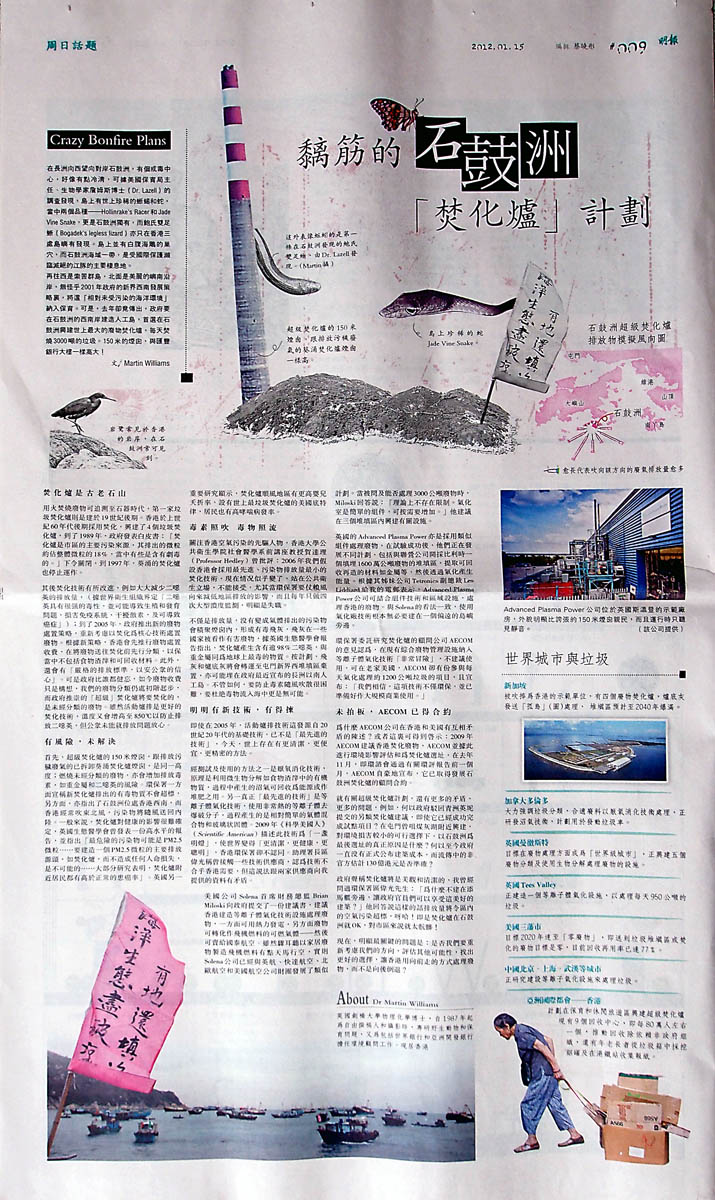
Crazy Shek Kwu Chau “Bonfire” Plans

Ming Pao – 15 Jan 2012

Crazy Shek Kwu Chau “Bonfire” Plans

If you’re on Cheung Chau, look west across the harbour, and you’ll see a small island: Shek Kwu Chau. It appears deserted, but hosts a drug rehabilitation centre.

Wildlife surveys led by US biologist Dr James Lazell, director of the Conservation Agency, have discovered reptiles including two snakes – Hollinrake’s Racer and a sub-species of Jade Vine Snake – that are unique to the island, along with Bogadek’s legless lizard, which is known from only three Hong Kong islands. This is one of perhaps eight nesting sites for white-bellied sea-eagle in Hong Kong. Waters along the west coast are key haunts of Hong Kong’s small population of Indo-Pacific finless porpoise, which the International Union for the Conservation of Nature classes as Vulnerable to global extinction.

With the Soko Islands further west, and the beautiful south coast of Lantau to the north, it’s not surprising that in 2001 a government development strategy for the southwest New Territories included a plan to “protect and conserve the relatively unspoilt marine environment while providing recreational and educational opportunities to the public in these areas”.

Yet there was a surprise last year, when the government determined that Shek Kwu Chau was the preferred location for building one of the world’s largest waste incinerators, burning 3000 tonnes of waste per day. Plans call for this to be on an artificial island, constructed just off the southwest coast of Shek Kwu Cha, in prime porpoise habitat. It will be an industrial site with a 150-metre chimney – almost as tall as the HSBC Bank Building.

The incinerator plans have met widespread opposition for a host of reasons, including the damage to wildlife and fisheries, severe impact on scenery in a beautiful area, and massive financial cost. Seventeen groups including Friends of the Earth, Greenpeace Hong Kong, Green Sense and the Living Islands Movement have signed a joint statement outlining their concerns. Plus, incinerator technology is dated, likely threatening public health – and there are cheaper, cleaner, more sophisticated ways to deal with Hong Kong’s waste than simply setting fire to it.

Incineration Dates from the Stone Age

Incineration – using fire as a means of waste disposal – dates back to the Stone Age. The first waste incinerators were built in the late 19th century.

From the late 1960s, Hong Kong turned to incineration to reduce the volume of waste sent to landfills. Four waste incineration plants were built, but in 1989 a government white paper on pollution noted, “Incinerators are a major source of pollution in the urban areas. They account for approximately 18% of all respirable particulates emitted into the atmosphere of the territory and can be a source also of trace quantities of highly toxic substances.” The incinerators were phased out, with the last of them – at Kwai Chung – ceasing operation in 1997.

Incinerator technologies have since improved, such as through greatly reducing emissions of dioxins which, according to the World Health Organization, “are highly toxic and can cause reproductive and developmental problems, damage the immune system, interfere with hormones and also cause cancer”. In 2005, the Hong Kong government published a strategy for dealing with waste, with plans including use of “state-of-the-art technology to treat unavoidable waste in a cost-effective, yet environmentally sustainable, manner”. Conveniently forgetting the 1989 white paper, this announced the core technology would be incineration.

According to the strategy, Hong Kong would first introduce charging for waste disposal; and before waste was sent to the incinerator it would be sorted, so would not include food waste or recyclable materials. Plus, there would be “stringent emission standards that command public confidence”.

It seems the government has since proven even more forgetful. Waste charging remains just an idea, we have little waste separation, and the incinerator will burn predominantly unsorted waste.  Though the government makes much of the incinerator using a moving grate for better burning, plus temperatures of around 850C to safeguard against dioxins, there is strong public concern instead of confidence concerning the likely emissions.

Potential Health Hazard

Even the incinerator’s planned design seems cause for concern – as it’s 150 metre chimney will be the same height as the chimney of the dirty and demolished Kwai Chung Incinerator Plant. Burning unsorted waste will increase the risks of emissions including toxins such as heavy metals and dioxins. Though the Environmental Protection Department claims there will be low levels of toxins, it also highlights the fact that Shek Kwu Chau is in southwest Hong Kong, so prevailing northeasterly winds will often blow away from the territory.

As so often with air pollution, it can be hard to be certain about health impacts of waste incinerators. The British Society for Ecological Medicine has produced one of the best reports on the issue, outlining a host of potential and likely problems, and noting, “probably the most dangerous pollutant of all is the PM2.5 particulate … it is not possible to build a major source of PM2.5 particulates, such as an incinerator, without lives being lost… The majority of studies around incinerators have shown excesses of cancers.”

In the UK, a major study will soon begin assessing evidence suggesting there are significantly higher rates of infant mortalities in areas downwind of incinerators. Other apparent health effects include high rates of asthma around the world’s largest waste incinerator, in Detroit, US.

“In 2006 we assumed that any incineration technology adopted in Hong Kong would be state-of-the-art and ensure that pollutant emissions were minimized to the greatest possible extent,” comments one of Hong Kong’s staunchest campaigners for cleaner air, Professor Anthony Hedley, former Chair Professor of Community Medicine at the University of Hong Kong. “This now appears not to be the case and is unacceptable from a public health viewpoint.  This is especially so, given that the EPD is apparently defaulting to depending on air movement to mitigate the impact of emissions locally and will only monitor mass concentrations four times a year.”

It is not only the emissions that are cause for concern. Pollutants that don’t escape as gases will be trapped in the chimney, forming fly ash so toxic that in many jurisdictions it is treated as hazardous waste. According to the British Society for Ecological Medicine, fly ash contains over 98% of dioxins produced by an incinerator together with heavy metals, “making it some of the most toxic material on the planet”.

Plans call for the fly ash plus ash from below the flames to be dumped in the West New Territories Landfill, north of Tuen Mun. Yet there are suspicions that the government’s recently announced plan for a possible artificial island south of Cheung Chau is at least partly to create a more suitable site for dumping the ash. No matter where the ash is headed for, it will be hard to prevent it being blown by the wind, and surely impossible to prevent the toxins escaping into coastal waters over time.

Alternative Technologies: Tried and Tested, and World-changing

Even in 2005, moving grate incineration was far from “state-of-the-art technology”; it was based on techniques first developed in the 1920s. Today, it seems even more primitive – and there are cleaner, cheaper, more sophisticated ways of treating waste.

One way that’s tried and tested is called anaerobic digestion. This involves using micro-organisms to break down organic matter such as food waste – creating methane that can be burnt to produce energy, along with compost. But partly as Hong Kong has little need for compost, its development is rudimentary here.

Another way is truly “state-of-the-art”, and is based on using extremely hot plasma to blast molecules apart, resulting in relatively simple gas mixtures and glassy solids. In 2009, Scientific American described plasma gasification as “lighting in a bottle”, and featured it among “20 Ways to Build a Cleaner, Healthier, Smarter World”.

The Environmental Protection Department seems determined that plasma gasification will not build a cleaner Hong Kong. Deputy director Elvis Au says they have contacted a few technology suppliers, which indicated they cannot meet Hong Kong’s needs.

This assertion conflicts with information from two suppliers. Brian Miloski, Chief Financial Officer of US company Solena, has submitted a proposal to build plasma arc facilities that would treat all Hong Kong waste, using heat to generate electricity, and combining components of the resulting gas to create jet fuel – which could be bought by Cathay Pacific. Though creation of jet fuel from domestic waste seems futuristic, Solena is already working on plans for similar plans together with British Airways, Qantas, SAS, and a consortium of American Airlines. Asked if the process can treat 3000 tonnes of waste per day, Miloski replied, “There is no theoretical limit. The gasification chambers are simple modular and you add on as many as you need.” He advises building the facilities at the three landfills.

UK based Advanced Plasma Power adopts a similarly modular approach to waste treatment. After successful trials with a demonstration plant, they are developing projects including a joint venture to mine over 16 million tonnes of waste from a Belgian landfill, extracting recyclable material such as metal and using gasification to create energy. According to an email to me from Les Liddiard, vice president of sister company Tetronics, Advanced Plasma Power can treat Hong Kong waste, using a combination of modular approach and regional facilities. Just as with Solena, there’s no need to build the gasification plants beside a remote island

The EPD’s consultant for the incinerator project, Aecom, considers that, “scaling up the plasma gasification technology for adoption in the present IWMF [Integrated Waste Management Facility] project would be very risky and hence not advisable.” And yet … in the US, Aecom is involved in a project to gasify about 1200 tons of waste per day, and announced, “We believe that this technology is not only environmentally friendly but ready for large-scale commercialization.”

Contradictions, Questions and Politics

Why such contradictory statements by Aecom in Hong Kong and the US? Well, you might want to consider this: in 2009, Aecom advised that Hong Kong should use incineration; Aecom then conducted the environmental impact assessment to select the site for the incinerator; and in November last year – a month before the environmental impact assessment process was complete – Aecom proudly announced it had been awarded a consultancy contract for developing the incinerator.

There are more contradictions, more questions, regarding the mega incinerator plans. For instance, why has the government dismissed an alternative incineration proposal by Green Island Cement, even though it has conducted a successful pilot project? What are the real reasons Shek Kwu Chau is considered a suitable site for a mega incinerator, especially as the alternative – at Tsang Tsui, near Tuen Mun, is lagoons with power plant ash, of minimal environmental value? Why has no official construction cost been given, and are unofficial estimates of HK$13 billion accurate?

The government claims the incinerator will be attractive, and clean. I once asked Elvis Au: “So why not build it beside Tamar, so government officials can enjoy looking at it?” He replied that the emissions would make the area’s air quality worse than permitted by the Air Quality Objectives. Aha, so this means the incinerator is ok for Shek Kwu Chau, but too dirty for the city.

Now, the key question to ask is surely: Is this time to reconsider our direction, assess possibilities, and find better options, so Hong Kong shows the way forward for waste treatment, not the way backward?

World Cities and Waste

Singapore

Touted as a role model for Hong Kong, with four waste incinerators, and ash sent to a landfill “island” that will be full by 2040.

Toronto, Canada

Strong emphasis on separation of waste, with suitable materials processed by anaerobic digestion. Producing biogas, and aims to use this to power waste trucks.

Manchester, UK

Aiming to become a “world-class city” in terms of waste treatment, building five centres for separation and biological treatment of waste.

Tees Valley, UK

About to build a plasma gasification facility to treat 950 tonnes of waste per day.

San Francisco, US

Adopting a “zero waste” strategy, in which nothing would go to landfills or be incinerated. Currently recovers 77 percent of the materials it discards, with goal of zero waste by 2020.

Hong Kong, Asia’s World City

Plans to build mega-incinerator in beautiful area earmarked for conservation and leisure tourism. Nine recycling centres – around one per 800,000 people, with waste separation and recycling partly reliant on non-governmental organizations, and elderly ladies digging cans from waste bins and collecting newspapers at subway stations.

Dr Martin Williams

I have a PhD in Physical Chemistry from Cambridge University, UK; obtained this through conducting experiments in which used a strong electrical discharge to blast apart water molecules, and followed reactions with a laser. Lived in Hong Kong since 1987, working mainly as freelance writer and photographer specialising in wildlife and conservation issues, as well as environmental consultant, including for World Bank and the Asian Development Bank.

Neighbours mull legal bid to stop incinerator

South China Morning Post – Jan 13, 2012

Group warns of ‘last resort’ action as proposed rubbish plant off Lantau Island nears approval

A group of Cheung Chau residents are threatening a legal challenge against a government plan to erect a rubbish incinerator off Lantau Island, as the project nears one of its last remaining hurdles next week.

Tom Hope, a retired lawyer who lives in Cheung Chau, said a judicial review would be a “last resort”, and that the residents still had other action planned to stop the project. The proposal was endorsed by the Advisory Council on the Environment last month and is slated for discussion by the Executive Council and the Town Planning Board next Tuesday.

“We want the government to stop and reconsider other options because there is still time to look at the technology, which seems to be a solution,” Hope said. “The government cannot be doing something wholly unreasonable.

“The primary reason for the incinerator is to alleviate landfills,” he said. “But the incinerator they are proposing will dispose hundreds of tonnes of ash while burning 3,000 tonnes of rubbish a day. There is alternative technology available.”

The technology favoured by the group, plasma arc gasification, has been tried in Canada, Britain and elsewhere. But Hope said one supplier told him the government does not want to explore it.

The Environmental Protection Department said in a statement it had considered other technologies, like plasma gasification, but they were “not suitable because of drawbacks” including an inability to handle a variety of rubbish.

The residents also criticised officials for failing to implement a waste-management plan laid down in 2005, which emphasised waste reduction and recycling over incineration.

The government proposes reclaiming 16 hectares of sea just south of Lantau near Shek Kwu Chau to serve as a site for the incinerator. It would be able to incinerate 3,000 tonnes of rubbish a day and will have a small mechanical sorting facility.

The reclamation would require the loss of 31 hectares of marine habitat, but the government promises to create a 700-hectare marine park between Shek Kwu Chau and the Soko Islands to make up for the damage.

The residents question the environmental impact assessment’s claims that plant emissions would have little effect on Lantau communities because southwesterly winds prevail only 8 per cent of the year. The group says Observatory data shows such winds prevailed 16 per cent of the time over the past two years.

joyce.ng@scmp.com

The incinerator would be built on Shek Kwu Chau.