Clear The Air News Blog Rotating Header Image

Incineration – Solid Waste Disposal

Islanders’ bid to halt Shek Kwu Chau incinerator fails

Friday, 26 July, 2013, 8:38pm

NewsHong Kong

ENVIRONMENT

Austin Chiu and Ada Lee

Court throws out all arguments of challenge to plan to build a HK$15b waste incinerator on Shek Kwu Chau near dolphin habitat

A Cheung Chau resident yesterday lost his legal battle to stop the government building a massive offshore waste incinerator on an island south of Lantau.

Leung Hon-wai objected to the proposed HK$15 billion incinerator on Shek Kwu Chau, which is near an important marine habitat for finless porpoises. He claimed the environmental impact assessment conducted for the project was flawed.

He saw all eight challenges he mounted dismissed by the Court of First Instance and vowed to take the challenge further.

“We will definitely file an appeal. It’s not surprising that we lost,” said Leung, 66, who took the case to court on behalf of Cheung Chau residents. “Our grounds are reasonable. We ought to fight for justice.”

Leung said he opposed the construction of the incinerator because the government had not done enough to mitigate potential respiratory problems arising from the operations of the giant burner.

Secretary for the Environment Wong Kam-sing said the court’s decision reaffirmed the objectiveness and transparency of the impact report, which was filed by the Environmental Protection Department.

The government would retable the project in the Legislative Council “at a suitable time”, Wong said.

The proposal was presented to Legco in April last year, but the environmental affairs panel decided, amid public opposition, not to endorse it.

Wong declined to give an estimate on how much the projected costs had risen since then, but appealed for public support as an incinerator could take as long as eight years to build.

“Any further delay will not benefit Hong Kong’s long-term development,” he said.

Friends of the Earth advised against retabling the incinerator plan too soon. Instead, the government should seek to build public trust with its efforts to reduce and recycle waste, the environmental group said.

Leung’s lawyers argued that the impact report failed to meet the requirements of a technical memorandum and a study brief from the government.

In part because of that, the department should not have granted the project an environmental permit, nor should the Town Planning Board have submitted a draft plan on the zoning of Shek Kwu Chau to the Chief Executive in Council, Leung said.

Dismissing the arguments, Mr Justice Thomas Au Hing-cheung said off-site mitigation measures proposed in the impact report met requirements.

The judge pointed to the government’s proposal to designate 700 hectares for a marine park – where no further developments would be allowed without prior approval – that would meet the requirement to offset a permanent loss of 31 hectares of marine habitat due to the project.

On Leung’s challenge that the impact report failed to take into account a certain amount of persistent organic pollution and very fine particles, the judge said it was up to the “professional judgment” of the department to decide what to include in the report since there were no specific requirements.

Au also threw out Leung’s position that it was wrong for the director of environmental protection to compile the impact report, approve it and grant the permit. The judge said the different tasks had in fact been done by the director’s subordinates, who were properly separated.

The judge ordered Leung, who brought the case using legal aid, to pay costs.


Source URL (retrieved on Jul 27th 2013, 8:14am): http://www.scmp.com/news/hong-kong/article/1291486/bid-halt-shek-kwu-chau-incinerator-fails

Toxic Snowfall engulfs Delh’s Okhla Residents, untested, unapproved Chinese incinerator technology takes its toll | ToxicsWatch Alliance

http://www.toxicswatch.org/2012/12/toxic-snowfall-engulfs-delhs-okhla_720.html

Posted by Krishna at 4:27 AM 0 comments

Press Release

Toxic Snowfall engulfs Delh’s Okhla Residents, untested, unapproved
Chinese incinerator technology takes its toll

High Court delay and ecological lawlessness unfolding in national
capital with impunity.

December 27, 2012, New Delhi: Residents of Okhla neighbourhoods were
delighted to see what they thought was the  season’s first snowfall descending on their
homes and frosting their cars. But delight turned to anger when they
realised that it was toxic ash from a large waste-to-energy plant
operated by the Jindal in their neighbourhood.  Children were quickly
ordered indoors and windows and doors tightly shut.

A group of residents led by the resident’s welfare association (RWA) office
bearers then drove up to the plant and demanded immediate stoppage of the
plant, which has been functioning  since March without proper clearances
from the Central Pollution Control Board (CPCB).

Plant representatives R. K, Tomar and Som Vir Singh were compelled by the
RWAs of Pocket A and Pocket B, Sukhdev Vihar, to visit the colony and take
away samples of the thick grey-brown ash for analysis.  They assured the
RWAs that this was the result of excess silt in the household refuse which
is being burned in the plant and that steps were being taken to reduce ash.
Vimal Monga, President of the RWA of Pocket A told the Jindal plant
managers that the air over the colony had become fouled by thick smoke ever
since it began operating with many residents now suffering from respiratory
and other ailments.  The situation was particular bad in foggy conditions
with the smoke and ash from plant failing to disperse and settling on the
residential colonies of Sukhdev Vihar, New friends Colony, Maharani Bagh,
Haji Colony and Ghaffar Manzil.

Adjacent to the plant are major institutions such as the Institute of
Genomics and Integrative Biology (IGIB), Central Road Research Institute
(CRRI),  Apollo Hospital, Fortis Escorts Heart Institute and the Holy
Family Hospital, besides several schools such as the Dev Samaj Public
School.

The plant faces bitter opposition from residents, waste pickers and
environmental groups. There is a a Writ Petition (Civil) NO. 9901/2009 in the
Delhi High Court against the power plant by Delhi’s Timarpur-Okhla Waste
Management Co Pvt Ltd (TOWMCL) of M/s Jindal Urban Infrastructure
Limited (JUIL), a company of M/s Jindal Saw Group Limited.

The 31 page report of the Union Environment & Forests Ministry
constituted Technical Experts Evaluation Committee of Central
Pollution Control Board (CPCB) on the Timarpur-Okhla Waste to Energy
Incinerator Plant has condemned the Timarpur-Okhla Waste to Energy
Incinerator Plant by JITF Urban Infrastructure Limited (Jindal
Ecopolis) has violated every rule in the rule book including
environmental clearance conditions. It revealed to the Experts
Committee in September 2011 that it is using untested and unapproved
Chinese incinerator technology in complete violation all laws and
environmental clearance of 2007 including its own project design
document and environment impact assessment report. Chinese technology
provider is from Hangzhou New Century Company Ltd of Hangzhou Boiler
Group. The critique of the report is attached.

In the report, Dr A B Akolkar, Director, CPCB emphasized that as per
Municipal Solid Waste (Management & Handling) Rules odegrdable
wastes to be treated using biological method rather than deriving RDF
or by incineration as is being done by Jindal Ecopolis. This clearly
demonstrates that the Timarpur-Okhla Waste to Energy Incinerator Plant
violates the Municipal Solid Waste (Management & Handling) Rules
framed under Environment Protection Act, 1986.

In the Writ Petition (Civil) No. 9901 of 2009 in Delhi High Court,
legal officials like Mr A S Chandiok Additional Solicitor General and
Standing Counsel for the Delhi Government and for the Delhi Pollution
Control Committee, Najmi Waziri has been misleading and
misrepresenting facts about waste to energy plants in Andhra Pradesh
by saying that Refuse Derived Fuel incineration technology was
already in use at Hyderabad and Vijayawada. The fact is that there is
no plant in Hyderabad. The plant that became functional as per legal
officials now stands defunct is in Shadnagar, Mahboobnagar district of
Andhra Pradesh. On 18th July, 2011, Delhi High Court asked CPCB and
the Delhi Pollution Control Committee (DPCC) to conduct a joint
inquiry about India’s first waste-to-energy plant and file a report on
the allegations that it posed health risks to citizens. “A joint
report be submitted by the DPCC and the CPCB after an inquiry of the
site of the energy plant about the alleged risks posed to citizens,”
ordered a bench of Chief Justice Dipak Misra and Justice Sanjiv
Khanna, Delhi High Court. This has not been done so far. A bizarre
situation has emerged because the arguments for fuse Derived Fuel
incineration technologyhat was advanced by the law officers is no
more relevant because the plant is using an experimental Chinese
technology which was never ever mentioned at the time of submitting
the project proposal.

There have been incessant demonstrations and protest rallies against
this project. There is an ongoing campaign against it. The plant that
has been built despite protest is 150 m from the residential areas.
The area has a bird sanctuary, a university and three hospitals within
a radius of 10 kilometres. All will be adversely affected by toxic
fumes of the plant. The idea of waste to energy plants which is based
on a tried, tested and failed incineration technology in Okhla.

MCD, Delhi government and central government has shown unpardonable
callousness towards hazardous emissions from municipal incinerators
that cause serious environmental and health problems both to people
living near them and thousands of kilometres from the source. These
projects are destroying the livelihood of about 3.5 lakh waste
recycling workers and valuable resource material for compost that is
required to be treated by composting/anaerobic digestion/vermin
composting/other biological processing for stabilization as per
Municipal Solid Waste (Management & Handling) Rules.

Representatives of GTZ (German Technical Cooperation) led by Dr.
Juergen Porst, Senior Advisor have stressed the need for a Disaster
Management Plan in the very first meeting of the CPCB’sTechnical Expert
Committee, which is annexed to the CPCB’sreport. But this does not find
mention in the recommendations of the report. This finds reference in
the minutes of the meeting annexed with the report. It underlines the
possibility of disaster from the Timarpur-Okhla Waste to Energy
Incinerator Plant, which is situated in a residential area. It is
noteworthy that a hazardous plant in Bhopal’ds residential area that led
to world worst industrial disaster in 1984 also did not have any
disaster management plan.

The Review of Technical Evaluation by Anant Trivedi, Member, Technical
Evaluation Committee, CPCB reads: “The Okhla plant has a capacity of
2050 tpd of domestic waste input. However the plant design allows upto
10,000 tpd of input for incineration. Toxic bottom ash quantity
produced will be 20-30% of input. This amounts to at least 410 tpd
rising to a maximum of 3,000 tpd. Additionally there will be toxic
flyash of about 10% of the bottom ash.None of the landfill sites have
the capacity to take in so much toxic waste and mulba has been dumped
every where including all public spaces.” He asks, “so what is
proposed to safeguard public health from this toxic substance?

The report apprehended that the information that is submitted to the
experts committee of CPCB might be used in the on-going case in the
Delhi High Court. It makes a shocking revelation that although High
Court has been hearing the case since 2009, the project proponent did
not inform the court about gross deviations from the project design
plan envisaged in the EIA report. As per the minutes of the second
meeting of the technical experts committee, non-cooperative approach
of the senior officials of Timarpur-Okhla Waste to Energy Incinerator
Plant was condemned on August 11, 2011. Representatives of GTZ
underlined that there was lack of transparency with regard to
environmental and health impact on the neighborhood residents. It was
also noted that the fugitive emissions and the expected emission of
Dioxins and Furans has not been quantified. The characteristic of ash
and required standards was not mentioned. Prof. T R Sreekrishnan,
Department of Biochemical Engineering and Biotechnology stated that
disposal option for incineration instead of bio-methanation proposed
for green waste is in violation of what was mentioned in the EIA
report.

A site visit by social and environmental researchers and activists has
revealed the close proximity of the residential colonies to the
hazardous plant which is belching out a cocktail of toxic smoke in the
households. The testimonies from the residents who are suffering from
the adverse impact of industrial smoke in the houses.

For Details: Gopal Krishna, Convener, ToxicsWatch Alliance (TWA), Mb:
9818089660, Email: krishna1715@gmail.com, Web:
toxicswatch.blogspot.com
Vimal Monga, President, 9711408421 Sukhdev Vihar RWA
Asha Arora, Okhla Anti-incinerator Committee –  9810499277
Okhla Anti-incinerator Committee, http://www.facebook.com/home.php#!/ghoslaokhla
Jindal plant representative.  R.K Tomar 999978044
Jindal  plant representati (environment and health) Som V

Guiyang residents plan protest against waste incinerator

Published on South China Morning Post (http://www.scmp.com)

Home > Guiyang residents plan protest against waste incinerator


Guiyang residents plan protest against waste incinerator

Saturday, 06 July, 2013, 12:00am

NewsChina

SOCIAL UNREST

Olivia Rosenman olivia.rosenman@scmp.com

Guiyang residents angry about plans to build waste incinerator near a built-up area; authorities cancel consultation meeting

Guiyang residents plan to march on a local government headquarters today to protest against a planned incinerator to be built near residential areas in the Guizhou capital.

Organisers expect 300 people to turn out to voice their opposition to the plant, which they say will emit toxic air pollution and contaminate their water supply.

One organiser said the group wanted the government to move the site at least 10 kilometres from residential areas.

The current location for the incinerator is just 3 kilometres from a community of around 50,000 people, including schools and a hospital, on the northern side of the city.

A public hearing on the environmental impact assessment for the incinerator had been planned for Monday, but has been postponed indefinitely.

A spokesman for the local ecological construction bureau said by phone yesterday that the agency had been overwhelmed with registrations and was trying to find a larger venue for the hearing. A Guiyang resident who signed up for the hearing, said she received a text message telling her the hearing had been postponed because “more preparations” are needed.

“I’m worried about the negative impact,” said the woman, who lives about 6 kilometres from the proposed site. “But I feel I don’t know enough about it, which is why I wanted to attend the hearing.”

Garbage incineration is often associated with high emissions of dioxin gases, which are highly toxic and can cause reproductive and developmental problems, damage the immune system, interfere with hormones and cause cancer, according to the World Health Organisation.

“People can be exposed to these pollutants via inhalation or by touching the soil or eating the food grown locally”, said Mao Da, a researcher with Nature University, a Beijing-based environmental group.

Mao said high concentrations of pollutants usually persist up to 3 kilometres from an incinerator. Although concentrations fall beyond that radius, they are still not necessarily safe.

“There is some evidence that Chinese incinerators emit very high levels of dioxins and mercury,” Mao said.

“So if we evaluate the distance based on the Chinese reality, it will be very different from standards in other countries like Japan, Germany and Denmark.”

The frequency of environmental protests is increasing on the mainland.

In May, thousands of Kunming residents in mobilised against a petrochemical plant. The same weekend, a similar protest planned in Chengdu , Sichuan , was quashed by thousands of police who took to the streets to deter would-be protesters.


China’s waste incineration plants refuse data request

http://www.chinadialogue.net/blog/5947-China-s-waste-incineration-plants-refuse-data-request/en

China’s waste incineration plants refuse data request

Zhang Chun

26.04.2013

Readinch

The majority of China’s waste incineration plants are refusing to disclose information, according to the NGOs Friends of Nature and Wuhu Ecology Centre

article image

Protest against a waste-buring plant in Guangzhou Fanyu, south China (Image copyright: Chongqing Dagong Website)

The majority of China’s more than 100 waste incineration plants have failed to respond to pollution data requests by environmental NGOs.

Green campaign groups Wuhu Ecology Centre and Friends of Nature submitted requests to 122 trash-burning plants throughout China, asking for information on pollution discharge. Only 42 responded.

Friends of Nature’s director Liang Xiaoyan said the plants that did respond only did so after multiple requests. “If you just make a normal application, you might not receive any information at all,” he said.

Along with China’s rapid urbanisation, waste has become a major environmental problem.

By 2015, China is expected to have more than 300 waste incineration plants. But China’s pollution control standards for burning household waste lag behind those of the EU, with 10 times the dioxin concentration limits. As a result, waste incineration has been linked to environmental pollution and public health problems and continues to trigger public protests.

The environmental NGOs say that even the information they did obtain was incomplete. Of the 112 operational incinerator plants, only two provided monitoring data for fly ash, three for slag and eight for carbon monoxide and mercury.

Lai Weijie, chairman of Taiwan’s Green Citizen’s Action Alliance and previously a project consultant for Friends of Nature, said there was no need for companies to withhold the data. The more information is made available and the more transparency there is, he said, the more chance of finding the pollution source and person responsible when a problem arises.

“The reason the government doesn’t disclose is because there is no separation between state and business. The government acts as both referee and sportsman,” said Mao Da, of Nature University’s Institute of Waste.

He cited the recent example of Guangzhou’s Li Hang incineration plant as a case in point. Nature University took the plant to court at the end of October 2012 for not responding to its application for information disclosure.

Li Hang used to be state-run, but was later restructured and its operations transferred to a company (in which the government was a stakeholder).

At first the incineration plant agreed to a request to disclose information. However, a public notification later stated that the information Xie Yong had applied for involved trade secrets and that the company would therefore need to seek the approval of their affiliated company before responding.

A later court ruling dismissed Xie Yong’s appeal of the decision. He is now in the process of referring this ruling to the State Council, the highest administrative body in China.

Violent clashes over plan for incinerator in Guangzhou

Published on South China Morning Post (http://www.scmp.com)

Home > Violent clashes over plan for incinerator in Guangzhou


Violent clashes over plan for incinerator in Guangzhou

Saturday, 20 July, 2013, 12:00am

NewsChina

· 14666f5435456738cc318cb16adafc5c.jpg

Protesters outside the government headquarters. Photo: Mimi Lau

CIVIL UNREST

Suspected protest leaders rounded up after four injured in running battles with police as thousands take to the streets of Guangzhou

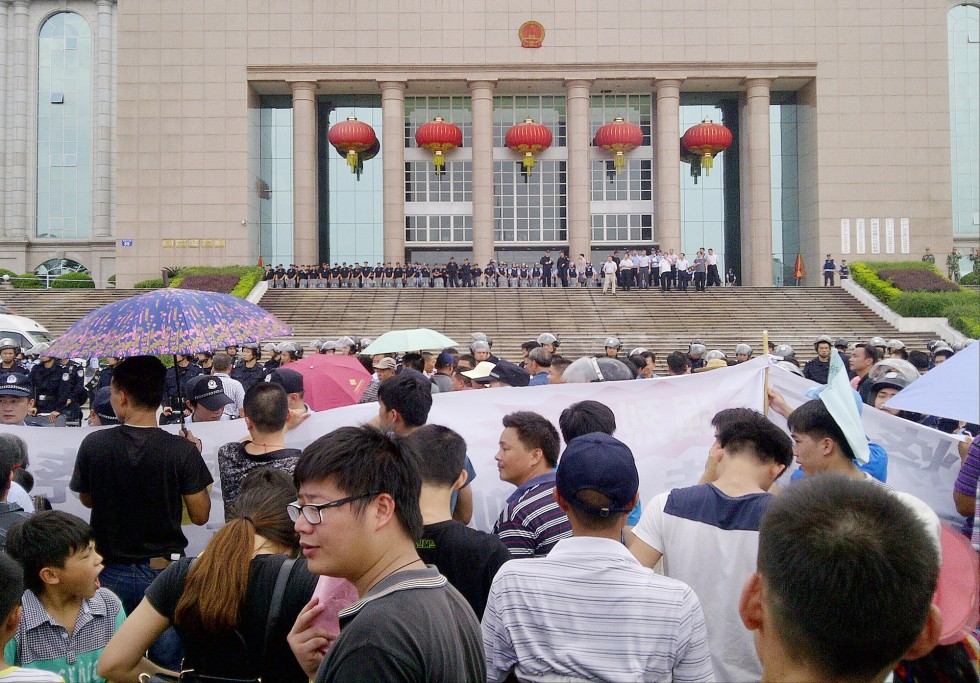
Riot police rounded up about a dozen people late last night in a raid on Qianjin village, Guangzhou, the site of a planned incinerator, after violent clashes earlier in the day.

Officers moved in hours after police used force to disperse thousands of protesters in Huadu district following a series of running battles. At least four protesters were injured during protests involving as many as 10,000 people at times.

It was the third large-scale rally in two weeks to fight the proposed refuse incinerator in Shiling township, a national hub for leather-goods manufacturing.

Villagers said the riot police who took part in last night’s raid were armed with helmets and shields and that they took away suspected leaders of the protest.

Despite a heavy police presence, protesters broke through police barricades at about 11am to enter Huadu Plaza, an open area outside the district government headquarters. They then marched along some of Huadu’s busiest roads, bringing traffic to a halt in many areas.

Chanting slogans and waving banners, demonstrators claimed the incinerator would “damage their health” and turn Shiling into a “death zone”.

Things got violent after the crowd returned to the Huadu district government headquarters at about 2.30pm and called on district officials to respond to their demands. Some protesters pushed on police lines while others threw water bottles and hit police with sticks.

Police injured at least four men with batons and arrested another man. Two of the injured men appeared to be unconscious and required medical attention.

Protesters lowered the national flag to half-staff outside the government headquarters.

At 5.30pm, police began to use force to disperse the some 2,000 protesters left in the plaza, chasing them with batons. It was cleared by 6pm.

Protesters said the city should learn a lesson from Likeng village in the city’s Baiyun district. Residents there complain that the air, ground and water supply have been severely polluted by two incinerators there.

“If we don’t keep on fighting, there will be no home to go back to,” said a 30-year-old Shiling bag maker. “We don’t want to be the next Likeng, move the incinerator elsewhere and work on other ways to reduce garbage.”

Such environmental protests have been on the rise across the mainland. The Huadu clashes come just days after large protests in the Guangdong city of Jiangmen forced local officials to cancel plans for a uranium processing plant.

Some of yesterday’s protesters said they had been warned not to take part.

Huadu officials announced plans to locate the incinerator in Qianjin village earlier this month. The project is expected to be finalised on August 30, with an environmental assessment ready in February, and construction to start in June next year.


Source URL (retrieved on Jul 20th 2013, 6:13am): http://www.scmp.com/news/china/article/1286568/violent-clashes-over-plan-incinerator-guangzhou

http://www.youtube.com/watch?v=fzeeSMRR_9k

CTA Letter

Download PDF : CTAletterPanelEAJul172013

10,000 join protest against Guangzhou refuse incinerator

Tuesday, 16 July, 2013, 12:00am

NewsChina

· bb7c18f01b0bff80bc3d7c8f8fe9edd2.jpg

Some of the thousands of residents who protested against the plan for a refuse incinerator in Huadu district. Photo: SCMP

Kitt

ENVIRONMENT

Mimi Lau in Guangzhou mimi.lau@scmp.com

Demonstrators march to township government offices to voice concern that plan will worsen pollution in leather-goods manufacturing centre

About 10,000 people gathered yesterday in a township under Huadu district, Guangzhou, to demonstrate against plans to build a refuse incinerator in the national hub for leather-goods manufacturing.

The demonstration, approved by Shiling township officials, began at around 3pm at the Qianjin village committee office, with about 3,000 participants.

More people joined as protesters marched along main roads in Shiling to the local government offices. Some witnesses put the total number of protesters at between 8,000 and 20,000, while the organiser said at least 10,000 people showed up.

Nearly 1,000 armed police officers were seen clearing the way for demonstrators, many of whom carried colourful flags and large banners criticising the incinerator plan. The sea of people appeared to stretch about a kilometre along the roads.

We are all very upset. The incinerator is only 500 metres from my home. I have two children and I don’t want them to develop health problems in a few years

“We are all very upset. The incinerator is only 500 metres from my home. I have two children and I don’t want them to develop health problems in a few years,” said a 33-year-old father of two who grew up in Qianjin, which he said has about 500 residents. “Over half of the world’s handbags are made here – Shiling is polluted enough and can’t handle an incinerator.”

This was the second related protest in Shiling, following one on Saturday that drew only about 100 people. Shiling has about 300,000 residents.

Last week, Huadu officials announced a timetable for the incinerator, after saying late last month that it would be located in Qianjin. The project is expected to be finalised on August 30, with an environmental assessment ready in February, and construction to start in June next year.

“Police didn’t hurt anyone today – they were protecting women and the elderly, and keeping things in order,” said a 26-year-old Shiling resident.

At least 5,000 flags were passed out for the protest, which peacefully dispersed after reaching the township government offices at around 6pm.

The protest organiser, a 45-year-old Qianjin villager who declined to be named, said the demonstration was discussed with Shiling officials last week. “We will give Shiling officials a few days to address our concerns, but if there is no reply, we will head to Huadu district authorities and eventually the Guangzhou city government,” he said.

Last summer, hundreds of residents of Qingyuan and Guangzhou took to the streets to protest against the project even before site details were announced. It was one of the largest protests against government plans to build incinerators in Guangzhou.

By 2015, Guangzhou plans to build five new garbage incinerators, in addition to the existing one in Likeng in Baiyun district.

The Likeng incinerator handles 1,000 tonnes of refuse a day. Most of the rest of the 18,000 tonnes of waste the city produces each day ends up in landfills which, according to the Southern Metropolis Daily, already contained 40 million tonnes last year.


Source URL (retrieved on Jul 16th 2013, 7:32am): http://www.scmp.com/news/china/article/1283465/10000-join-protest-against-incineration-guangzhou

HK needs not one but three incinerators

dynamco Jul 13th 2013 10:10am

Mr Paine should acquaint himself w/ differences between incineration, gasification & plasma gasification for the treatment of MSW. Incineration 750-850 deg C is thermal conversion of MSW to ash in the presence of oxygen, the resultant 30% ash by weight is toxic, needs treatment & landfilling.

Gasification of MSW at 1300-1500 deg C in the presence of controlled oxygen creates a syngas used to generate electricity or biofuels. Ash residues are converted to usable vitrified slag by the heat.
Plasma gasification in excess of 4000 deg C without oxygen molecularises MSW into a component syngas & vitrified slag as above. The slag can be used as aggregate. There are No ash residues.
HKG has the wettest worldwide putrescible waste w/ 90% moisture levels from wet markets & avg 70+% domestic vs 56% Korea,50% Japan,30% Europe. Anaerobic digestate is an appropriate treatment for wet food waste(WFW).
To sustain combustion a calorific value(CV) of 6MJ/kg is needed whereas HKG WFW has CV of <4MJ/kg & WFW is 43% (4000tpd) of HKG’s daily domestic MSW; how do you burn water ? Incineration means adding higher CV materials into the combustion mix eg paper & plastics, which dents all hopes of increased recycling efforts. Incineration is the totally wrong choice for HKG’s waste treatment, & incinerators’ cancerous emissions.

www.ncbi.nlm.nih.gov/pubmed/15242064

‘Risk of adverse reproductive outcomes associated w/proximity to MSW incinerators w/ high dioxin emission levels in Japan’

South China Morning Post

Published on South China Morning Post (http://www.scmp.com)

Home > Letters to the Editor, July 13, 2013


Letters to the Editor, July 13, 2013

Saturday, 13 July, 2013, 12:00am

CommentLetters

HK needs not one but three incinerators

I would like to add to Alex Woo’s excellent letter (“Incineration a key part of a responsible waste disposal system [2]“, June 29) and your editorial (“The rubbish of a waste policy [3]“, June 25).

To add to your correspondent’s Nimby comments, in metropolitan Tokyo there is an incinerator in each of its wards, covering a population of 13 million.

Choosing a single site for one incinerator is a poor policy.

Legislators should accept that we will need at least three, for Hong Kong Island and west and east Kowloon.

I do not understand why industrial solid waste and glass are being dumped in landfills, when there is so much water surrounding Hong Kong. Why isn’t it being used for reclamation or just dumped in designated areas at sea? This would extend the life of the existing landfills.

Finally, why are Friends of the Earth or the green groups not putting forward these ideas to legislators and executive councillors? It would appear they are poorly informed or just not interested in this important issue.

J. R. Paine, Tai Hang

Links:
[1] http://www.scmp.com/news/hong-kong/article/1268769/departure-norm
[2] http://www.scmp.com/comment/letters/article/1271395/incineration-key-managing-waste
[3] http://www.scmp.com/comment/insight-opinion/article/1268244/wading-through-hong-kongs-rubbish-waste-policy
[4] http://programme.rthk.org.hk/rthk/tv/programme.php?name=tv/city_forum&amp;d=2013-06-30&amp;p=899&amp;e=223412&amp;m=episode
[5] http://www.scmp.com/news/hong-kong/article/1263062/lingnan-university-students-threaten-boycott-over-new-pro-government

Guangzhou protest planned over Huadu district incinerator plan

Published on South China Morning Post (http://www.scmp.com)

Home > Guangzhou protest planned over Huadu district incinerator plan


Guangzhou protest planned over Huadu district incinerator plan

Thursday, 11 July, 2013, 12:00am

NewsChina

ENVIRONMENT

Mimi Lau in Guangzhou mimi.lau@scmp.com

People living in the Huadu district of Guangzhou are planning a protest this weekend against the local government’s recent decision to build a refuse incinerator in the area.

A call urging district residents to gather at the Lotus supermarket by Huadu Plaza at 10am on Saturday was circulated via social media yesterday. “Please pass this around and act upon protecting a green home for us,” the message said.

It was unclear who was organising the gathering, but the effort comes just two weeks after the Guangzhou government announced a proposed site in the Qianjin area of Shiling township, a national centre for leather-goods manufacturing.

A Qianjin resident, who refused to be named, told the South China Morning Post they are against the incinerator project for fear of unforeseen damage.

“The government never consulted us and told the media the project is backed by many villagers instead,” the resident said. “I am not afraid of being cracked down on. If we can’t even fight for our interests, what is the point of living?”

The government never consulted us and told the media the project is backed by many villagers instead … If we can’t even fight for our interests, what is the point of living?

Qianjin resident

Located in northwestern Huadu district, the planned incinerator would be three kilometres from the Fenshui landfill. But it would also be 2.5 kilometres from the Qingyuan city limits and three kilometres from the Hongbenggang reservoir.

Last summer, hundreds of Guangzhou and Qingyuan residents took to the streets to protest against the project before a site was even announced. It was one of the largest protests Guangzhou had seen against one of its five incinerators.

The Nanfang Daily reported on its official microblog yesterday that the proposal to build the Huadu incinerator was expected to be finalised by August 30th. An environmental assessment would be ready in February, with construction to begin in June.


Source URL (retrieved on Jul 15th 2013, 10:27pm): http://www.scmp.com/news/china/article/1279933/guangzhou-protest-planned-over-huadu-district-incinerator-plan

Toronto Disco Road Anaerobic Digestate facility

Download : AECOMconflicts

case-study-disco-final-WEB