Clear The Air News Blog Rotating Header Image

Roadside

RTHK Backchat: Idling Engines

Last updated: April 19, 2010

Source: RTHK

On today’s Backchat we talk about idling engines. The government is proposing a 3 minute rule for drivers before they have to switch off their engine; failing to turn it off will mean a fine of HK$320. There will be exemptions for the first 5 taxis at a stand, first 2 green minibuses at their terminus & hybrids to name a few. Will this proposal turn up the heat even more?

You can listen to the show here.

A STUDY ON SAVING FUEL BY IDLING STOPS WHILE DRIVING VEHICLES

Read the study by Motoda Yoshitaka here.

They do it in Singapore, why don’t they do it here?

Regarding Stationary motor vehicles
21. —(1) Subject to paragraph (2), the driver of every motor vehicle shall, when the vehicle is stationary for reasons other than traffic conditions, stop the engine of or other machinery attached to or forming part of the vehicle.

Download the ENVIRONMENTAL PROTECTION AND MANAGEMENT (VEHICULAR EMISSIONS) REGULATIONS PDF here

Only heavy goods vehicles need to idle after startup or they cannot move until the air brake reservoirs are full

180px-leyland_t45_roadtrain_tractor_unit_1988Normally the time allowed for idling is for startup of diesel heavy goods vehicles after the engine has been switched off then restarted. They cannot move until the airbrakes have sufficient pressure to release the handbrake. Small goods vehicles and cars do not have such a necessity. Also overseas legislation has to contend with sub zero temperatures which does not apply
in Hong Kong.

Read the PDF here.

Engine Idling: Just the Facts

engine-idlingIt’s a toxic health hazard, it’s hard on your engine, and it wastes expensive gasoline.
Idling gets you nowhere.

Download the leaflet from the City of Portland Office of Transportation

Clear the Air Letter to Editor SCMP

yes_prime_minister_1Roadside pollution comes mostly from local vehicles here. The Government has finally proposed a further exemption to the Motor Vehicle Idling (FP) Bill by allowing a 3 minute ‘still legal to pollute’ grace period for stationary drivers to run their engines which issue the most microfine pollutants at idling speed.

The Government chooses to cherry pick that several Toronto municipalities (but not elsewhere in Canada) have a three minute vehicle and boat idling period. It conveniently omits that Toronto allows car and boat engines to continue idling when the temperature inside the vehicle is above 27 Deg C or below 5 deg C, that the fixed penalty for the offence is between C$100 – C$ 380 (two to 8 times more than here) and can be up to C$ 5,000 if contested in court. It does not mention that the vehicle emissions’ standards in Canada are far stricter than Hong Kong http://www.dieselnet.com/standards/ca/#hdv

nor that Toronto has an average of 15 cms of snow and at 630 sq kilometers with a 7,200 sq kilometer green belt surrounding it, is far more spread out as a city and does not have the same curtain wall urban canyon effect that traps roadside microfine pollutants here.

Here is yet another example of Hong Kong’s obdurate Government trying to issue a loopholed piece of legislation to pander to big Business  and is worthy of a sketch from ‘Yes Prime Minister’. The law as proposed , is unenforceable – should the enforcers stand next to the vehicles  for an hour and count a total of 3 engine idling minutes to wait to issue a ticket ? The Government should learn from its deliberately flawed anti smoking laws that allowing such exemptions resulted in  legal tobacco sales’ increase in 2008 after the flawed ban with exemptions came into place, so must we expect the same increase in engine idling with this potholed legislation ?  They should re-name the Engine Idling legislation the ‘Amazing Grace’ Ordinance. It seems the Government yet again puts vested interests ahead of the health of the local public to which it has a duty of care.

James Middleton

Chairman Energy Committee

www.cleartheair.org.hk

Tel 26930136

Delta air cleaner, roadside air worse: Region breathes easier, but not Causeway Bay

air-pollution-causeway-bayLast updated: April 30, 2010

Source: South China Morning Post

Environment officials have been told not to rejoice over remarkable improvements in regional air quality last year, since roadside air pollution continues to worsen and remains at health-threatening levels.

Hong Kong and Guangdong yesterday jointly released monitoring results that showed sulphur dioxide and nitrogen dioxide levels fell 26 and 7 per cent respectively last year, some of the biggest reductions recorded in four years.

But roadside figures quietly published on the government website two days ago showed annual average concentrations of nitrogen dioxide at the roadside in Causeway Bay, Central and Mong Kok all rose by up to 13 per cent.

The figures, the worst in at least five years, show concentrations of the key pollutant exceeded 100 micrograms per cubic metre of air – more than double the World Health Organisation guideline of 40.

The Clean Air Network, an independent group that encourages public comment about air pollution, said officials would be “grossly disingenuous and misleading” if they were to call the regional improvement a victory, as many people were still being exposed to excessive local pollution.

“Roadside pollutant concentrations are critical when assessing harm to human health,” network chief executive Joanne Ooi said. “What matters is the level of pollution to which people are actually exposed to at street level.” She noted that all the regional monitoring stations were well above that level.

Environment officials pledged to continue tackling roadside air pollution from vehicles.

The encouraging regional readings come from a network of 16 air quality monitoring stations in various cities in the Pearl River Delta including Hong Kong. They measure four key air pollutants. The results have been published since late 2005.

The report says the number of days with better air quality rose to 75 per cent last year, compared to 68 per cent in 2006 – in line with local improvement in ambient air quality last year.

Environment officials dismissed suggestions that the good result was attributatble to a drop in industrial production caused by the 2008 credit crunch. They said power consumption in Guangdong rose only modestly last year despite strong economic growth in the province.

They put the improvements down to emission control programmes in Guangdong, such as power plant desulphurisation, and to the use of cleaner vehicle fuel. These, they said, had led to cumulative reductions in the sulphur dioxide level of 38 per cent and of 9 per cent in nitrogen dioxide.

Both pollutants mainly come from combustion in power generation, industrial boilers and the millions of vehicles in the region.

There was similar progress on respirable suspended particles, with the concentration falling 7 per cent since 2006 and remaining roughly the same last year as in 2008. The officials admit, however, that regional ozone pollution has shot up, rising 10 per cent over 2008 and 17 per cent over 2006 – reflecting a similar deterioration in Hong Kong.

Ozone is a secondary pollutant formed through chemical reaction mainly between two pollutants – nitrogen dioxide and volatile organic compounds, such as solvents used in industrial production – under strong sunlight.

The officials blamed stronger solar radiation last year. “There has been fluctuation of the radiation level over the years, and we need more time to observe that,” one said. The official said increased cloud cover earlier this year had led to a decrease of 20 per cent in solar radiation, and the ozone concentration had fallen by roughly the same extent.

Officials also warned that there were signs that ambient ozone pollution had influenced the formation of nitrogen dioxide at the roadside.

They said ozone could react with nitrogen oxides emitted from vehicles and turn the latter into nitrogen dioxide – which has been found to have increased by up to 16 per cent between 2005 and 2009 at the three roadside monitoring stations.

Professor Alexis Lau Kai-hon, an atmospheric scientist from the Hong Kong University of Science and Technology, said while officials’ theory on ozone and nitrogen dioxide was correct, it did not suggest vehicle emissions should not be blamed.

He said it would take a long time to address the complicated ozone pollution and no matter how much the ozone could be suppressed, the presence of nitrogen oxide emissions from vehicles would still contribute to more roadside pollution.

“After all, vehicle emissions remain excessive and dirty enough to threaten our health. There is no excuse not to clean them up,” Lau said.

Lau said the government should take roadside air pollution seriously and implement more transport management measures on top of controlling exhaust emissions.

Professor Wang Tao, a scientist specialising in air pollution research at the Polytechnic University, said ozone pollution was a worldwide issue and the most difficult to deal with. He said his research suggested that volatile organic compounds, such as solvents found in paints and protective coatings, were the main driver of ozone pollution.

“Unlike controlling sulphur dioxide and particulate matter, for which one can target a relatively smaller number of power plants, the volatile organic compounds are being emitted from thousands of factories in the region, many of which are small and medium-sized,” he said.

Wang said improvement in regional air quality did not guarantee better roadside air, and it was advisable for the government to tackle vehicle pollution at the same time.

Ooi of the Clean Air Network said roadside pollution had a greater direct health impact than regional pollution. “The lowest pollution monitor included in the sampling network was five metres above the ground, far above pedestrian height, with all other monitoring stations at nine metres or higher,” she said.

She also noted that while levels of roadside respirable suspended particles fell last year, concentrations were still several times higher than WHO guidelines.

Read the full reports on Hong Kong and Pearl River Delta air pollution.

http://www.epd-asg.gov.hk/english/report/files/AAQS09e.pdf

http://www.gdepb.gov.cn/gsgg/200710/P020100429536280667936.pdf

Written by Cheung Chi-fai

Pall of filth casts shadow over marathon

logoLast updated: March 25, 2010

Source: The Standard

The organizer of the Standard Chartered Marathon is worried about the record high air pollution in the city, which he fears could hit next year’s event.

The organizer of the Standard Chartered Marathon is worried about the record high air pollution in the city, which he fears could hit next year’s event.

The air pollution index hit a choking 500 on Monday – the highest reading since 1989 when the government launched the index.

Worsening air pollution has also played a part in preventing Hong Kong’s elevation in the latest Location Rating report published yesterday by ECA International.

The report ranks countries according to the living standards they can offer expatriates.

Regional director Lee Quane said that air pollution continues to be the dominant factor that makes Hong Kong a harder location for foreigners to adapt to living in.

Hong Kong Amateur Athletic Association chairman Kwan Kee said he is worried about air pollution endangering runners in the annual Standard Marathon.

“A lot of education is needed to teach runners about how to cope with different weather conditions and how to take care of themselves,” said Kwan. “We will do our best to provide runners with updated information about the temperature, humidity and the air index.”

However, he said that because of the unpredictable weather, even a change in the date of the run might not help.

He is looking at areas of improvement suggested by the runners of this year’s marathon, held on February 28.

“The route, date and the opening hours for the roads will all affect the organization of the coming marathon, and we are in discussions with various government departments to work on this,” Kwan said.

The champion of the women’s full marathon, Mok Chi-ling, hopes the date of the race can be changed to some time in January, when the weather should not be as bad.

Even though she had trained hard for the event, she was unable to run as well as she had hoped to. Humidity was the main problem, not the air temperature, she said.

“The high humidity causes more energy to be exerted because of dehydration, and you need to drink a lot of water to replace this,” she said.

“I have become more worried because of the worsening air pollution. A marathon requires a lot of physical exertion especially after the 30-kilometer mark, and breathing will be very difficult if the pollution is bad.”

Mok added that she copes with the pollution by training in the mornings, when the weather is better and there are fewer cars around to contribute to the worsening air pollution.

Written by Kaylene Hong

Air quality index may grade risks to health

canadian-scaleLast updated: March 24, 2010

Source: South China Morning Post

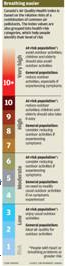
Canadian pollution alert model considered

The government is studying a Canadian air pollution alert system as an alternative to the existing outdated system, which does not indicate the direct health impact of various pollutants.

This emerged as the choking sandstorm that had blanketed the city since Sunday night – pushing the air pollution index off the top of a 500-point scale and forcing some pilots to use autopilot to land at the airport because of poor visibility – slowly dispersed in the face of a southeasterly wind.

A person familiar with the situation said a group of health scientists commissioned by the Environmental Protection Department to study improvements to the alert system submitted a framework for a new system last year. But the proposal has been put on hold pending the results of a review of air quality objectives enacted 23 years ago.

The recommended system is modelled on the Canadian Air Quality Health Index, which has a scale of 1 to 10 and shows four categories of health risks from low to very high. It is still not clear, however, whether this is the only proposal being considered or whether the government will incorporate contingency plans to discourage polluting activities on days of high health risks.

The city’s 15-year-old air pollution index (API) is calculated based on the readings of the maximum level of any one of five selected air pollutantssulphur dioxide, nitrogen dioxide, ozone, respirable suspended particles and carbon monoxide.

Whenever that maximum reading exceeds the level of the air quality objectives, the API will rise to a level of over 100, categorised as “very high”. Different levels also carry different health advisories.

“What is flawed in this system is that the index only informs people about the excessive levels of a particular pollutant. It also implies there is a safety level and does not tell people the actual health impacts,” a person familiar with the study said.

The main feature of the proposed system is that the health impact for each of the chosen air pollutants would be quantified based on past studies, such as the extra number of hospital admissions when the a particular pollutant is above a certain level. The aggregated impact of all pollutants would then be converted into indexes, which could be grouped into different health risk categories.

Dr Wong Chit-ming, a biostatistician at the University of Hong Kong, said under the Canadian system any index value above zero was a clear indication that people were suffering from the impact of air pollution.

Wong said such a system was better because it took into account the total impact of multiple pollutants rather than just one and could avoid overexaggerating the index when a single pollutant skyrocketed in unusual circumstances.

“Had this been adopted, the pollution reading of the sandstorm might have not been so high.”

At the peak of the sandstorm, 10 of the 14 monitoring stations went off the top of the 500-point scale. Several stations were still above 400 at 8am and above 300 at 2pm, but all but one, Eastern District, had dropped below 200 by 8pm.

Written by Cheung Chi-fai

Letter to the South China Morning Post

bus-pollutionLast week the Legco Panel on Environmental Affairs received submissions on the Euro 1 and pre Euro diesel vehicle retirement scheme. We are led to believe the proposed increased road licence fee on these vehicles will not be enough to get them off the road. The replacement of these vehicles is a health measure to reduce major roadside pollution.

We suggest what will  make a difference is to require a full roadworthiness  test twice a year for vehicles up to 15 years old and three times a year for 15-20 year diesel bangers, in addition to a levy on imported replacement spare parts.  The ‘hassle’ value and the cost of repeated maintenance and  testing may be enough to get the owners to voluntarily scrap the vehicles for which there should be no charge at surrender areas.

We suggest members of the public write  letters  directly to LegCo members on the Environmental Panel to influence them into positive action.

Meanwhile a firmer line must be taken with the bus companies to use hybrid and  or Euro 5 vehicles on the major thoroughfares like Nathan Road; considering these companies obtain their diesel without excise duty and are not required to pay first registration tax on their vehicles ,their licence to print money needs mandatory early retirement of their existing polluting fleet. KMB has 1240 Pre and Euro 1 buses out of a fleet of 3880; Citibus has 350 pre and Euro 1 buses out of a fleet of 920 and New World First Bus has 110 out of 700. There are only 145 Euro 4 buses in Hong Kong out of a total fleet of 5,760.

James Middleton

Chairman Energy Committee

Clear the Air

www.cleartheair.org.hk

Tel 26930136