Clear The Air News Blog Rotating Header Image

Recycling

Democrats hope for $5b recycling fund

January 15, 2014

Qi Luo

The Democratic Party is hoping that today’s policy address will include the setting up of a HK$5 billion fund to help promote recycling.

Democratic lawmaker Wu Chi-wai said 60 percent of respondents in a poll conducted by the party recently supported such a move.

“We want competition in the recycling industry, not monopoly,” he added. “The number of recycling agents should not be limited.”

Wu said that sections of the Public Cleansing and Prevention of Nuisances Regulation needed to be amended along with arrangements covering contractors for the Food and Environmental Hygiene Department to allow cleaners to collect materials that can be recycled.

The survey also showed that 61 percent of 859 respondents supported waste charges being levied according to volume.

“We believe this is the best way to push residents to change their habits,” Wu said.

He went on to urge officials to look at charging individual flats for garbage rather than a building.

Backing that plea, Wu said 58 percent of respondents said charging for waste would make them more active in recycling. And nearly 60 percent said a reward for recycling would help.

Another survey by the party showed 53 percent of public housing residents back charges for waste.

http://www.thestandard.com.hk/news_detail.asp?we_cat=4&art_id=141502&sid=41324105&con_type=1&d_str=20140115&fc=4

Preventing Waste: recycling isn’t enough for a circular economy

https://www.foeeurope.org/preventing-waste-090315

The many social, environmental and economic benefits that would result from robust resource policies have been recognised by both the European Union and the governments of its member states. For example, by boosting re-use and repair of products, jobs are created while the impacts from mineral and metal extraction, incineration and landfill are avoided. But ambitions for encouraging re-use and repair, and the broader vision of a more resource-efficient and lowerconsuming Europe, appear to be at risk of being abandoned by policy-makers.

This briefing documents a series of community-led projects that are helping Europe to reduce its resource use and waste, and makes policy recommendations that would enable these best-practices to become the norm. The case studies show that it is often local, under-resourced communities, guided by principles of sustainability, that are at the forefront of improving resource use and waste prevention.

Without adequate political and financial support however, these activities will remain a scattered minority, and often risk fizzling out due to a lack of resources or infrastructure. The EU and its member states have strong policy options at their disposal to encourage such projects, boosting economies in a way that has clear social and environmental co-benefits. The policy recommendations in this briefing are designed to bridge the gap between Europe’s unfulfilled policy goals and the lower-consuming and resource-efficient Europe that the EU can – and must – become.

New offer proposes zero waste, zero pollution and zero to landfill

04 December, 2014

Howard Winn

Given the controversy surrounding the proposed Shek Kwu Chau incinerator and extensions to the landfills, you would think a proposal that involved zero waste, zero pollution and zero waste to landfill would be of interest to the government and the public at large.

Zero Waste Smart City Resources Association says it can do this by the end of 2018 and is today sending copies of the proposal it sent to the government to the district councils and legislative councillors. Furthermore, Zero Waste chief executive Peter Reid says his company’s proposals would obviate the need to extend the landfills since there would be no waste left to send.

At the same time there would be no waste for the mega incinerator, organic waste treatment plants, hazardous waste incinerator, or even the sewage sludge incinerator.

The approach views “waste” as a resource, much of which can be recycled on a commercial basis. The government’s approach assumes waste is useless and is proposing to incinerate it, a process which produces up to a third by weight in toxic waste which has to be sent to landfill.

The zero-waste scheme envisages that the waste will be sorted within Hong Kong’s 18 districts using advanced proven digital waste separation technologies and waste applications at no charge to households. The food and green waste would also be dealt with at district level using anaerobic digestion plants, which would produce fertiliser and fish food. Recyclables would also be extracted at this stage. The remaining waste after this would be sent to a plasma vapourisation closed-cycle combined power and heat plant to be built at the Tai Po Industrial estate or the Science and Technology Park.

This would produce syngas to be used in the production of electricity or fed into the gas network. Reid believes his proposal can achieve a 12.5 per cent net return on investment. This stands in stark contrast to the government proposals which will cost about HK$60 billion to build and operate.

http://www.scmp.com/business/article/1654994/new-offer-proposes-zero-waste-zero-pollution-and-zero-landfill

Sweden Runs Out Of Garbage: Only 1% Ends Up In Landfills

http://www.collective-evolution.com/2014/11/26/sweden-runs-out-of-garbage-only-1-ends-up-in-landfills/

Something incredible has been taking place in Sweden over the past several years, somewhat of a “recycling revolution,” if you will.

Something incredible has been taking place in Sweden over the past several years, somewhat of a “recycling revolution,” if you will. Currently less than one percent of the garbage produced in Swedish homes ends up in the landfill today, with the other ninety-nine percent being recycled or composted.

Sweden has been known for years now for the amazing and resourceful waste management system that they have had in place for some time. They have 32 waste-to-energy (WTE) plants and this burned waste powers 20 percent of Sweden’s district heating as well as electricity for about 250,000 Swedish homes.

In fact, Sweden has become so good at recycling their waste; the country now has to import 800,000 tons of trash each year from the U.K., Italy, Ireland and Norway to keep their WTE plants up and running.

According to Swedish Waste Management communications director Anna-Carin Gripwell, “Waste today is a commodity in a different way than it has been. It’s not only waste, it’s a business.”

This is pretty impressive especially when compared to Americans who recycled just thirty-four percent of their waste in 2010 and according to the Environmental Protection Agency more than fifty percent of the average U.S. household waste ended up in landfills, this is about 136 million tons of garbage in total. According to the New York Times there are some trash burning facilities in the United States, but only a small portion of the waste is burned, and most of that burned waste ends up in landfills anyways.

What About The Environmental Effects?
Of course there is some controversy over this method of waste management and energy production. There are fumes that are produced that are toxic, but many argue that this is still a much better alternative to the typical landfills that we see more often in America. On average, more than forty percent of the world’s trash is burned and mostly in open air, this is much different from the regulated, low-emission process that has been adopted by Sweden. This makes Sweden’s method a lot more eco-friendly.

It is unfortunate that at this time the options are to either pollute the air, or pollute the Earth because we are producing so much garbage and it doesn’t just simply disappear without leaving its mark. It doesn’t look like manufacturers are going to stop making products that can’t be recycled anytime soon, so it is up to us to be more conscious with what we are consuming. We need to stop the problem at the source.

How Can We All Be A Bit More Like The Swedish?
Sweden is an excellent example of a nation of citizens that care for their environment and their ecological footprint. If the Swedish are able to recycle 99% of their waste, why can’t we? Well we certainly can, however it does take a bit more effort. I believe that it is truly worth the effort, soon it will become so natural to us that it won’t even feel effortful, we just have to start taking that step!

There are many people now that are striving to produce zero or at least very minimal waste. You can read one of those stories here, check out the supermarket in Germany that produces zero waste here and read about the American restaurant that managed to not produce any waste in two years and counting here to get inspired on how you to can begin to implement a minimal waste, minimal footprint lifestyle.

Sweden Runs Out Of Garbage: Only 1% Ends Up In Landfills

Something incredible has been taking place in Sweden over the past several years, somewhat of a “recycling revolution,” if you will. Currently less than one percent of the garbage produced in Swedish homes ends up in the landfill today, with the other ninety-nine percent being recycled or composted.

Sweden has been known for years now for the amazing and resourceful waste management system that they have had in place for some time. They have 32 waste-to-energy (WTE) plants and this burned waste powers 20 percent of Sweden’s district heating as well as electricity for about 250,000 Swedish homes.

In fact, Sweden has become so good at recycling their waste; the country now has to import 800,000 tons of trash each year from the U.K., Italy, Ireland and Norway to keep their WTE plants up and running.

According to Swedish Waste Management communications director Anna-Carin Gripwell, “Waste today is a commodity in a different way than it has been. It’s not only waste, it’s a business.”

This is pretty impressive especially when compared to Americans who recycled just thirty-four percent of their waste in 2010 and according to the Environmental Protection Agency more than fifty percent of the average U.S. household waste ended up in landfills, this is about 136 million tons of garbage in total. According to the New York Times there are some trash burning facilities in the United States, but only a small portion of the waste is burned, and most of that burned waste ends up in landfills anyways.

What About The Environmental Effects?

Of course there is some controversy over this method of waste management and energy production. There are fumes that are produced that are toxic, but many argue that this is still a much better alternative to the typical landfills that we see more often in America. On average, more than forty percent of the world’s trash is burned and mostly in open air, this is much different from the regulated, low-emission process that has been adopted by Sweden. This makes Sweden’s method a lot more eco-friendly.

It is unfortunate that at this time the options are to either pollute the air, or pollute the Earth because we are producing so much garbage and it doesn’t just simply disappear without leaving its mark. It doesn’t look like manufacturers are going to stop making products that can’t be recycled anytime soon, so it is up to us to be more conscious with what we are consuming. We need to stop the problem at the source.

How Can We All Be A Bit More Like The Swedish?

Sweden is an excellent example of a nation of citizens that care for their environment and their ecological footprint. If the Swedish are able to recycle 99% of their waste, why can’t we? Well we certainly can, however it does take a bit more effort. I believe that it is truly worth the effort, soon it will become so natural to us that it won’t even feel effortful, we just have to start taking that step!

There are many people now that are striving to produce zero or at least very minimal waste. You can read one of those stories here, check out the supermarket in Germany that produces zero waste here and read about the American restaurant that managed to not produce any waste in two years and counting here to get inspired on how you to can begin to implement a minimal waste, minimal footprint lifestyle.

8 ways to rethink resources: nappies to benches and food waste to biogas

3 November 2014

Conscious consumers know not to use disposable plastic bottles, or single-use plastic bags, and try to use as little packaging as possible in order to save the planet. A growing number of companies are also developing innovative ways to give waste a second lease of life.

1. Nappies to roof tiles and railway sleepers

Every parent knows that disposable nappies generate enormous amounts of waste. And with the average baby using the equivalent of 150kg of wood, nappies waste a lot of resources, too.

To remedy this, two years ago Scotland – with a total of 450,000 used nappies per day – pioneered a nappies-to-roof tiles scheme. Nappies are collected in recycling bins and sent to treatment plants, where they’re sterilised and the human waste removed. The plastics and celluloid contained in the nappies are then converted to everyday products such as park benches, railway sleepers and road signage.

In Mexico, consumer product giant P&G now turns rejected Charmin nappies into roof tiles, while scraps from its American Pampers nappies are reused as upholstery filling. Fifty P&G plants now produce zero manufacturing waste, and it claims that repurposing the waste has created an additional value of $1bn for the company. Elsewhere, a growing number of parents are turning to GNappies. The British company makes nappies in two parts: covers that can be reused, and inserts that can be composted or even flushed down the toilet with human waste.

2. Paper to reduce food waste

Rarely does one blank piece of paper make a big difference. But FreshPaper, an organic and biodegradable sheet added to fruit and vegetables, keeps the produce fresh for two-four days longer, thereby eliminating countless tonnes of wasted food. As world demand for food keeps rising, eliminating food waste will become even more important. Today FreshPaper, first sold at farmer’s markets in America, is available in shops in several dozen countries.

3. Sustainable construction materials

San Diego-based Ecor takes cellulose fibres, a material found in wood, cardboard and even forest and agricultural waste, and turns it into new construction material. The process is surprisingly simple: the waste is mixed with water, heated, pressurised and made into sturdy panels that can be used in a variety of functions: as wall panels, tables, bowls, building walls, even glasses frames. Best of all, the products contain no toxic additives and can themselves be recycled at the end of their life-span.

4. Clothes from old water bottles

If you really need to buy soft drinks or even bottled water, make sure to recycle the bottles; they can be used for yarn. Bionic Yarn turns used PET bottles into fibres that can be used in clothes. This is how it works: the bottles are cut into chips, which are in turn shred into fibres. The fibres are mixed with polyester and spun into yarn. The end product, reports Bionic Yarn, contains 40% recycled plastic bottles, including ones from the large colonies of plastic bottles floating on the world’s oceans.

5. Agri-waste into plastic bottles

Bio-on provides an excellent reason to choose your plastics carefully. The Bologna-based company has developed a pioneering process that allows it to turn agricultural waste into biodegradable plastics. Using a fermentation process involving sugar beet, Bio-on manufactures plastics that can be used for anything from food packaging to electronics. Better yet, the process requires no chemical additives, and the end products are biodegradable, dissolving upon prolonged contact with bacteria.

6. Worms as fertiliser

Repurposing waste can be as simple as it is ingenious. In Guatelamala, Byoearth uses red worms to transform food and other biodegradable waste into organic fertiliser. Doing so, of course, reduces waste but also results in higher-quality soil.

7. Food waste to biogas

Got food waste, need energy? BioTrans Nordic has got just the thing for you, especially if you work in a restaurant, canteen or other large kitchen. The Danish company’s BioTrans tank stores food waste, where it turns into biomass. The biomass is collected by a truck for delivery to biogas plants and delivery to local customers.

8. Recycling polyester

Japanese firm Teijin didn’t set out to repurpose clothe; it’s a chemical company. But, almost as a by-product of its R&D, Teijin discovered a way of recreating polyester from itself. Because reusing clothes’ fibres has long been considered near-to impossible, Teijin’s discovery was a considered a breakthrough. It has already saved tonnes of clothes from landfill, and earlier this year, Swedish firm Re:newcell unveiled a similar process for cotton. For several years now, retailer Patagonia has sold clothes made from Teijin-recycled fabric.

Today you can wear new clothes made from old clothes and old plastic bottles, while eating food enhanced by old food – and stored in plastic containers made from agricultural waste – in a restaurant powered by food-waste energy and decorated by agricultural-waste wood panels with nappy-based roof tiles. Not too shabby.

http://www.theguardian.com/sustainable-business/2014/nov/03/8-ways-rethink-resources-nappies-benches-food-waste-biogas

Ljubljana; first EU capital to adopt a Zero Waste strategy

The Slovenian capital and three other municipalities, Vrhnika, Borovnica and Log Dragomer join the European network of Zero Waste municipalities

September 8, 2014

The mayor of Ljubljana, Mr. Zoran Janković announced today the commitment of his city to move towards Zero Waste.

In a press conference which took place in the Town Hall of the Slovenian capital the mayor of Ljubljana together with the mayor of Vrhnika, Stojan Jakin, the president of Zero Waste Europe, Rossano Ercolini and the chair of the Scientific Committee of ZWE, Enzo Favoino, confirmed the adhesion of Ljubljana and three other municipalities to the European network of Zero Waste communities. With this move Ljubljana becomes the first capital in the EU to adopt the Zero Waste goal.

Currently, Ljubljana is already the EU capital with best performance regarding waste separation and waste avoidance; it separately collects 60 % of municipal waste and generates less than 150kg of residual waste –what is not recycled or composted- per person yearly. Until 2025 they commit to increase separate collection to 78 % and decrease the amount of residual waste to 60 kg per person per year. With this commitment for zero waste, Ljubljana officially rules out building any incinerator in order to have the flexibility to continue reducing the non-recyclable waste and push for prevention and recycling.

Mr Janković, Mayor of Ljubljana said “In August residents of Ljubljana separately collected over 60% of their waste. They adopted responsible waste management as their own project. I am therefore specially proud that today Ljubljana became the first European Zero Waste capital.”

The other Slovenian towns to join the network of Zero Waste municipalities are Vrhnika, Borovnica and Log Dragomer. Today they collect and recycle over 76 % of its waste and on the average each resident creates 80 kg of residuals per year. By 2020, those municipalities will increase separate collection to 80 % and decrease residuals to 70 kg per person per year. To read the case study of Vhrnika click here.

Erika Oblak, coordinator of Zero Waste Slovenia said “No reuse or recycling system will be successful without the participation of the residents. Today we celebrate with all who separately collect our waste and those who support sharing our resources with future generations”.

On September 9, a conference will take place in the National Council of Slovenia –low chamber of the national parliament- to present the best practices from Zero Waste Europe and discuss the plans for zero waste implementation in Slovenia.

http://www.zerowasteeurope.eu/2014/09/ljubljana-first-eu-capital-to-adopt-a-zero-waste-strategy/

Demands of oversized incinerator will stifle the efforts to recycle more waste

Jul 30, 2014

EARLIER this month, the European Commission published a range of new recycling targets for waste which, if accepted by the European Parliament, will be embedded in a revised Waste Framework Directive.

It would mean that local councils would be expected to recycle 70 per cent of household waste by 2030, while the target for packaging waste would be 80 per cent. The Commission is also looking to prohibit the sending of recyclable waste to landfill by 2025.

The proposal has been broadly welcomed by environmental groups, who are working towards a more sustainable approach to waste management and are keen to maximise what we recycle and compost.

I certainly agree that it is ridiculous that thousands and thousands of tonnes of recyclable and biodegradable material is dumped in landfill or incinerated, when much better use could be made of such resources.

The response from the Government, however, has been quite frosty. It has indicated that its representatives will oppose the targets when they are debated, citing the “potential costs to business, householders and local authorities”.

Such a view is in stark contrast to the Wealth From Waste report from the Local Government Association, published a few years ago.

This stated: “The simple fact is that taxpayers would be better off, the economy will benefit, and more people will have jobs if we grow the domestic market for collecting, sorting and reprocessing recycling … recycling actually brings in cash for the taxpayer and we owe it to today’s hard-pressed taxpayers to get as much of their money back as possible.”

The commission’s new targets would certainly need to trigger a step-change in how the United Kingdom deals with waste. According to figures from DEFRA (the Department for Environment, Food and Rural Affairs), English local authorities recycle, on average, 43.2 per cent of residents’ waste, though in Wales the figure is over 50 per cent.

But here in Cornwall, the unitary authority is tied into a multimillion-pound “integrated waste management contract” for the controversial incinerator – with an annual capacity of 240,000 tonnes – being built near St Dennis. It will principally deal with Cornwall’s domestic waste.

We have a recycling rate of less than 40 per cent and are generating 180,000 tonnes of residual waste annually – significantly less than the capacity of the incinerator – and I do fear that efforts to almost double recycling efforts in our area will be stifled by the need to fill the over-sized incinerator in Mid-Cornwall.
http://www.cornishguardian.co.uk/Demands-oversized-incinerator-stifle-efforts/story-22016426-detail/story.html#YXxdzyDF8laltgOt.99

Zero Waste Week: a challenge to send nothing to landfill

Rachelle Strauss

Wednesday 27 August 2014

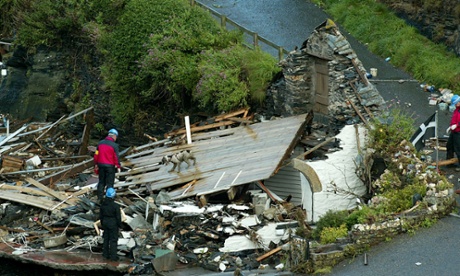
“Pass to all emergency services. This is a major incident. I repeat; this is a major incident. We require all standby aircraft available, and all available land-based emergency crews as we are in danger of losing Boscastle and all the people in it.”

That was the message to RAF Kinloss Aeronautical Rescue Coordination Centre (ARCC) from Capt Pete McLelland (Royal Marines) flying above Boscastle, on 16 August 2004. On that day one of Britain’s worst rainstorms was unleashed on the hills above Boscastle, and I was standing in the village holding my three-year-old daughter in my arms. It’s a strange thing when you wonder whether you’ll ever see your husband alive again. Weird thoughts go through your head. My thoughts seemed quite logical – I believed, rightly or wrongly, that everything I’d read about climate change was happening. Not in 50 years’ time, but now. And in that moment, I decided to be part of the solution – for my daughter’s sake.

Boscastle floods

Emergency workers search a house in Boscastle, two days after the flood caused devastation, sweeping away cars and buildings. Photograph: John D McHugh/AP

According to The Story of Stuff, only 1% of the items we buy are still in use six months after they are bought. All the latest gadgets we can’t live without, the tools that promise to make our lives easier, the so-called must-have thing that guarantees us to be more popular/sexy/healthy – the majority of them end up in landfill in under a year.

We generate around 177m tons of waste every year in England alone. This poor use of resources costs businesses and households money and causes environmental damage.

And while it can be a depressing picture if we dwell there too long; I’m all about being part of the solution. A few years after the Boscastle floods, I decided to reduce the amount of waste I send to landfill. I’d seen people’s livelihoods washed out to sea and it made me realise that I wanted to make better use of the resources I had. I started a blog about reducing my waste to keep myself accountable. But every day, people from across the world tuned in to see what I’d found in the back of my fridge or hiding in the attic. And most importantly – what I was going to do about it.

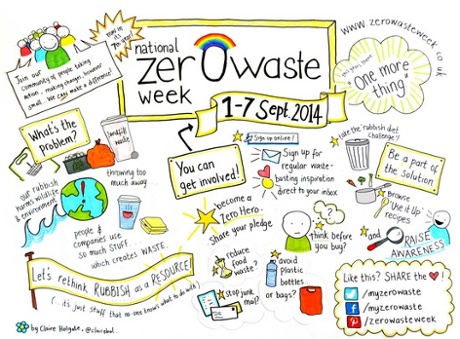
A few months after I started blogging, a fellow waste geek, Karen Cannard from the Rubbish Diet, challenged me to have my own zero waste week. I asked my readers to join in to keep me company and 100 people signed up. At the end of the week I was inundated with emails telling me what fun people had, and now that it was over they intended to keep new habits in place – and so the annual Zero Waste Week campaign was born.

Rachelle Strauss' zero waste week

This year’s Zero Waste Week asks you what ‘one more thing’ can you do to reduce your household waste. Photograph: Claire Holgate

The growth of the campaign over the past seven years has been beyond amazing. What started off as a few individual householders has now grown into several thousand, with small and large businesses signing up, local authorities and large corporations all pledging to make a difference.

Zero Waste Week (1-7 September 2014) is predominantly a social media campaign. People sign up to the mailing list with their email address and pledge. Every year has a theme and this year’s is “One More Thing” in answer to the question: “What one more thing could you do to reduce landfill waste?” If you’re new to this, perhaps you’ll say no to disposable carrier bags and start using a reusable one. If you’ve been reducing waste for a while maybe it’s time to swap a disposable product for a reusable one. And if you’re a bit of a rubbish geek already, you could have your very own zero waste week with the aim of sending nothing at all to landfill. It’s an intense week. I like to think of it as a boot camp for bins – where size zero is acceptable.

I spent a year showing that you could send almost nothing to landfill – we filled just one old fashioned dustbin in 2009 – and now I just do my best, working in more of an advisory role and encouraging others to grab the zero waste baton. After all, it has much more impact if every household and business reduces their waste by a tenth than one household who go to the nth degree. Zero Waste Week applies to me the same way as to others – it gives me the opportunity to stop and think about my choices over the past year and make a commitment to get good habits back in place.

http://www.theguardian.com/lifeandstyle/2014/aug/27/zero-waste-week-challenge-send-nothing-to-landfill

Two thirds of residual municipal waste in Germany incinerated in 2012

Germany’s local authorities managed two thirds of their residual municipal waste by sending it to incineration plants in 2012. The 66.6 per cent share is slightly lower than in the previous year, when incineration accounted for 67.7 per cent of residual municipal waste, according to an annual overview published by the German statistical office (Destatis) at the end of July.

Overall, waste management plants in Germany treated nearly 18 million tonnes of mixed residual municipal waste in 2012. This is around 0.4 million tonnes less than in the year 2011. The total does not include source-separated waste fractions such as paper and board, packaging waste and organic waste collected from households and similar sources.

8 Aug 2014