Clear The Air News Blog Rotating Header Image

Recycling

Hong Kong recyclers ‘need more manpower, not machines’ from government’s HK$1b Recycling Fund, industry insiders say

Ernest Kao ernest.kao@scmp.com

Government fund that will subsidise equipment would be better spent on improving collecting and sorting among workers, insiders say

A provision in the government’s new HK$1 billion Recycling Fund that allows recyclers to receive subsidies for new equipment should be reworked to help street collectors find and sort materials instead, industry insiders say.

Falling oil prices and a slump in the regional economy have seen the prices fetched for waste plastic fall to virtually nothing, and street recyclers have stopped collecting it in the past few months.

“We have the capacity to process 40 tonnes per day, but now, we only receive just two or three tonnes,” said Jacky Lau Yiu-shing, director of the Recycled Materials and Reproduction Business General Association, whose organisation buys materials from recyclers for export.

Lau said because there was no money to be made, more plastic was destined for landfills.

Allowing recyclers to set targets on how much plastic to collect and offering funds to increase manpower would be more helpful, he said, since sorting recyclables is the most costly part of the whole operation.

“We welcome the fund … but the government may be trying to do a good thing only to produce a bad outcome,” Lau said. “You don’t need to help buy machinery that they already have.

“It would be better if the fund could subsidise frontline recyclers in collection and sorting.”

From a high of HK$6,500 per tonne, export prices for waste plastic have fallen by half to HK$3,200.

Processing costs, rent, wages and transport expenses continue to rise, and labour in the industry is drying up, recyclers say.

“Waste plastic would be priced at about HK$1 per kg, but now it’s dropped to zero,” said frontline recycler Leung Hing-fai, who owns a collection shop in Wan Chai.

Leung said he expected many recyclers to close in the near future as costs rise and margins for everything from waste paper to scrap metal get thinner.

“On a good month, I’m only making a profit of about HK$400 or HK$500,” he said. “I know a recycler who’s recently just quit and found a job as a minibus driver.”

Melonie Chau Yuet-cheung of Friends of the Earth said the situation on Hong Kong Island was worse due to the distance from processing plants in the New Territories.

“The government has not been addressing these problems,” she said.

Hong Kong’s recycling rate declined from 52 per cent in 2010 to 37 per cent in 2013. The amount of plastic recovered for recycling fell from 1,577 tonnes to 242 tonnes in the same period.

The Environmental Protection Department said purpose of the Recycling Fund was to help the industry improve their operational capability and efficiency. Recyclers will be allowed to apply for grants up to HK$5 million, while grants for non-profit organisations will be capped at HK$15 million.

To make it easier for small and medium sized businesses to embark on smaller-scale projects, a special “matching fund” with a ceiling of HK$150,000 will be provided.

“The industry can use a more convenient process to apply for assistance for standard projects like employee training, industry accreditation schemes and improving standards of occupational safety,” a spokesman said.

“The EPD will continue to monitor the latest market situation and maintain close contact with the industry to understand their needs.”

Why Hong Kong is recycling less of its rubbish as time goes on

Lifestyle

Alan Yu life@scmp.com

Even as Hong Kong landfills are rapidly running out of space, the city’s recycling levels are decreasing

For years, Christina Yang has been conscientiously sorting the plastic bottles, aluminium cans and recyclable paper from her rubbish and placing them in the appropriate bins for recycling. But last summer, a cleaning lady in her building opened her eyes to what really happened to the materials that were supposed to be recycled.

“While she was collecting from the bin, I happened to take the recycling down and I asked her how I should sort my trash. She said you don’t need to do any sorting because it all goes in the trash anyway,” Yang says. “I was very angry because I had been sorting my trash, thinking that [we] were recycling everything and now you’re telling me it’s all a sham.”

The property managers for her building couldn’t give a satisfactory answer either.

Despite the discouraging response, Yang, a career coach and environmental consultant in her 40s, continues to separate her rubbish.

“I realised that it’ll be worse if I don’t sort my trash. I believe that consumers’ voices do matter because if we don’t do it, then no one will.”

There have long been complaints about cleaners mixing trash and recyclable materials, all of which ends up in landfills: in 2013 the SCMP filmed government contract workers doing just that in Causeway Bay and Wan Chai, and residents have regularly reported similar incidents with rubbish disposal.

That is why, since last year, government contractors have been required to use clearly labelled plastic bags for recyclable materials so everyone can keep an eye on them, says Wong Hon-meng, an assistant director at the Environmental Protection Department.

But both the recycling sector and environment officials acknowledge the problem goes beyond cleaners not handling trash properly: it’s hard to make money from recycling materials and the costs of sorting and transporting recyclables can far exceed what companies earn from selling the materials.

The city just doesn’t make it worthwhile to recycle and this is creating a pressing issue – Hong Kong’s propensity for generating more trash is matched by the declining capacity of its landfills.

A 2013 report by the EPD estimates that all three landfills in the New Territories will be full by 2019. The report also shows that Hong Kong produces more rubbish each day compared to nearby cities at a similar level of development: each person in the Tokyo metropolitan area generates about 0.77kg of trash daily compared 1kg per day for a Taipei resident, while Hongkongers top them all by each producing 1.36kg per day. The EPD hopes to reduce the amount thrown out by each person to 0.8kg per day by 2022.

But even as policymakers have taken to warning in recent years how Hong Kong landfills are rapidly running out of space, the city is recycling increasingly less of its rubbish: the amount that is processed and reused has declined from 52 per cent in 2010 to 37 per cent in 2013.

This may improve as the government gears up to introduce rubbish disposal charges for households and businesses, with a series of public briefings in June.

A panel of the government-appointed Council for Sustainable Development last year proposed fees of up to 39 cents per kg under a pay-as-you-throw scheme; based on estimates that one person generates about 1.27kg of waste per day, the bill for a three-person household would come up to HK$44 each month.

In 2014 the government also committed HK$1 billion for a new fund to help upgrade technology and infrastructure in the recycling sector and an advisory panel was set up in August to guide its operation.

Because Hong Kong has few of the factories and farms that could utilise waste plastic and compost (from food waste), most of its recycled material is exported, says Wong of the EPD. This means local recyclers’ earnings are heavily dependent on the global prices of oil, plastic and other commodities. If it’s cheaper to buy new plastic, manufacturers will naturally ignore recycled material.

Wong says the new fund will help recycling companies adopt modern technologies that may bring in a more stable source of revenue, for example, by converting waste oil into biodiesel.

Jacky Lau Yiu-shing, chief director of the Hong Kong Recycle Materials and Reproduction Business General Association, believes an economic incentive should boost recycling rates.

“If the trash isn’t worth anything, then no one will sort it for you. Most cleaners don’t get paid to recycle; property management companies have to placate the Environmental Protection Department so they’ll order cleaners to recycle, but the stuff isn’t worth much money,” he says. “It’s a vicious cycle: you can’t get any money from recycling, and the people on the front lines don’t get paid.”

The thing about roadside bins is, there’s no money to be had in recycling … contractors have to go all over Hong Kong [to collect waste] so the logistics is quite expensive

Jacky Lau Yiu-shing, chief director of the Hong Kong Recycle Materials and Reproduction Business General Association

Lau, who runs recycler Lau Choi Kee Papers Co, says a lot of paper and aluminium (mostly drink cans) are recycled because there is a well-established market for those materials; but that’s not the case for plastic.

As a result, paper makes up 52 per cent of all recycled matter while plastics comprise just 12 per cent, even though both materials each account for about 19 per cent of waste generated in Hong Kong.

Moreover, Lau says government contractors are often forced to dump contents collected from roadside recycling bins with other trash because they are heavily contaminated with things such as half-eaten meals and cigarette butts.

“The thing about roadside bins is, there’s no money to be had in recycling … contractors have to go all over Hong Kong [to collect waste] so the logistics is quite expensive and they won’t really do the separation for you; all they’ll do is collect the trash and send it to another company. We [recyclers] have to pay them, so if the trash is too contaminated, then we won’t take it.”

Meanwhile, the recycling sector is going through a tough patch because the market for recycled materials isn’t very good; it’s also tiring and dirty work, Lau says, so very few young people want to enter the industry, with the youngest workers already in their 40s.

Alfred Wong perhaps presents new prospects for recycling. The 27-year-old Wong is general manager of HK Recycles, which he describes as a logistics rather than recycling business.

The company, which was set up in 2012 by two socially minded entrepreneurs, Brian Mak and Mike Shum, has been able to recycle almost 90 per cent of the trash collected from some 600 clients, including office buildings and property management companies.

Wong says the key to how it has been able to recycle so much is simple: HK Recycles runs workshops and seminars for clients on how to separate their waste before collecting recyclable materials from them. Fees are charged to cover the cost of moving the recyclable materials to companies that do the processing.

HK Recycles is able to collect clean and well-sorted recyclable materials because their collectors talk to clients and offer tips on what can and cannot be recycled (drink cartons, for example, are not suitable). And the task is made easier by issuing zippered heavy-duty plastic bags prominently labelled for glass, paper, plastic and metal.

Wong says there has been so much interest in HK Recycles services that they have had to take down the fee listing on its webpage. (Households are typically charged HK$39 for a weekly collection and offices between HK$100 and HK$200. There are also monthly corporate packages that include recycling data and workshops for between HK$500 and HK$1,000.) Even so, there are 400 to 500 potential clients on their waiting list.

“The industry complains that people don’t know how to sort and how to recycle, but from our experience, that’s actually not true,” Alfred Wong says.

Details have yet to emerge on the government’s new recycling fund but Wong wonders how effective it can be if local recycling contractors prove reluctant to modernise their operations.

Many companies conceded in a Hong Kong Productivity Council report last year that collection is inefficient and expensive because they must pay to pick up the recyclable materials from various districts. Yet none of the recycling companies that Wong spoke to expressed any interest when he outlined the HK Recycles business model and the software used to track and gather data about their operations.

“The fear that I have for this recycling fund is … if recyclers are not willing to improve their operations, then it’s kind of pointless.”

Clean up your act

Following a successful inaugural Zero Waste Week in June, environmental campaigners have added a Zero Waste corporate challenge to the programmes rolling out under the annual Hong Kong Clean-up event.

Now in its 15th year, the clean-up drive starts tomorrow and runs until November 1. Last year, 51,064 volunteers collected 3,894 tonnes of rubbish from across Hong Kong.

Volunteers can sign up for the clean-up challenge that best fits their interests and schedules.

City Clean-up: with tips from an online toolkit, families, schools and offices can find easy ways to trim back what they throw out.

Country Clean-up: nature lovers may prefer to help by collecting rubbish left along hiking trails and in country parks, which spoil our enjoyment of the natural world.

Coastal Clean-up: many groups have organised rewarding days out helping to clear up marine debris, especially plastic, which is a constant blight on the city’s beaches.

Lisa Christensen and Nissa Marion initiated the Zero Waste event three months ago to encourage Hongkongers to reduce the amount of rubbish sent to landfills by using fewer disposable items and recycling resources. And with the corporate challenge, they hope to focus business efforts by helping them set targets and come up with comprehensive solutions.

Hong Kong’s $1bn recycling fund to be overseen by new committee

http://www.waste-management-world.com/articles/2015/08/hong-kong-s-1bn-recycling-fund-to-be-overseen-by-new-committee.html?cmpid=EnlWMW_WeeklyAugust212015&eid=294835160&bid=1158155

An Advisory Committee has been selected by the Hong Kong government to oversee the $1 billion Recycling Fund established last year to promote the recycling and recovery of waste.

Set up by the Environment Bureau, the committee will advise and make recommendations to the Government on matters relating to the overall administration and operation of the Recycling Fund.

The committee comprises experts, academics and people with experience in business management and community service, as well as representatives from various business and industry associations.

Committee members will remain for a term of three years from August 1, 2015. The Hong Kong Productivity Council will be serving as the secretariat.

Secretary for the environment, Wong Kam-sing, said, “In view of the imminent waste challenge, we aim to promote the effective operation and sustainable development of the recycling industry to enhance waste recycling and reduce disposal at landfills, which is vital to the overall waste management policy in Hong Kong.”

Straight to landfill? Conspiracy theories about Hong Kong’s recycling are a load of rubbish

Christine Loh

On July 29, Hong Kong Free Press carried a story referring to a video uploaded onto Facebook: “video of workers throwing glass bottles intended for recycling into rubbish bins”.
The video shows workers emptying glass bottles from small bins into bigger ones. The assumption behind the caption was the glass bottles collected from recycling bins were being transferred to bigger bins heading for the landfill.

Screen-Shot-2015-07-29-at-4.03.24-pm

This assumption was likely made because of a belief that there is no point to separate recyclables because they all end up in landfills in Hong Kong. After all, this is a belief held by a lot of people.

But the facts were quite different in this case.

The workers filmed had unloaded the collected glass bottles into bigger bins in order to optimise the carrying capacity of the collection vehicle. In other words, they were transferring the bottles from smaller to bigger bins to make the onward transport more efficient.

We have GPS records and written receipts showing that after consolidation of the glass bottles, the collection vehicle then went to Tuen Mun to deliver over two tonnes of recyclable glass bottles to the designated recycler, who uses waste glass for remanufacturing.

How do we know this? These are government-hired contractors.

Glass recycling is one of our priorities. Over the past two years, we have consulted and got public support to implement a mandatory producer responsibility scheme (PRS) for glass bottles; and we have now presented how the scheme should work to the Legislative Council. We have put legislation to the Legislative Council on 8 July 2015 and we look forward to its passage in the next legislative year.

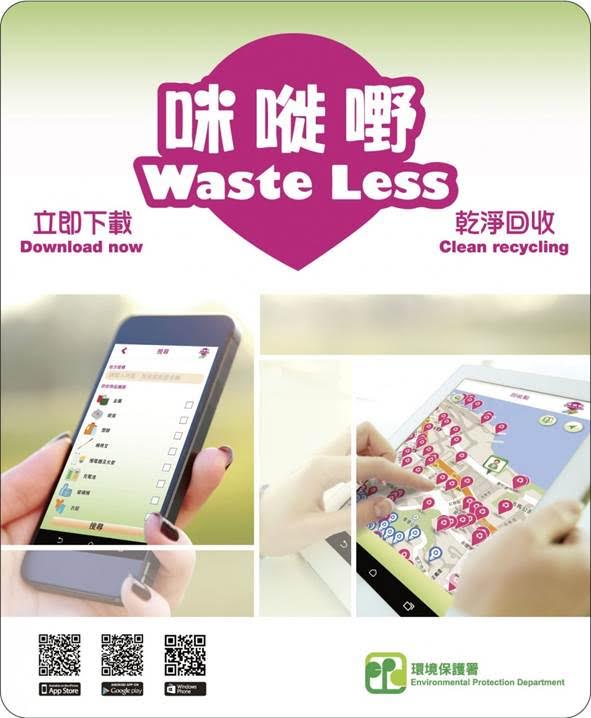
At the same time, we have expanded the glass collection network from covering 13% of the population to 70%. If you want to find recycling bins near where you are, have you tried our Waste Less app?

unnamed

We are also actively collaborating with non-governmental organisations, as well as with major mall operators with large numbers of eateries and restaurants to place recycling bins at the best locations so that more glass bottles can be collected.

While Hong Kong generates about 50,000 tonnes of waste glass beverage containers per year, we have the capacity to process most of this quantity locally into useful materials, such as eco-pavers (CTA: Tiostone, run by an incinerator promoting Professor from HK Poly U uses flyash mixed with glass in a cold process that does not kiln bake the pavers, hence they will leach into the ground) , construction materials and sand.

You may also ask what happens to other types of recyclables, such as paper and plastics, which together make up about 38% of Hong Kong’s total municipal solid waste of about 9,500 tonnes per day.

We estimate about 60% of Hong Kong waste paper are recovered for recycling (CTA: by 80 year old scavengers) , with most of the recyclable paper being exported for reprocessing. What still ends up in landfills include contaminated newsprint and tissue paper. On average, about 360 tonnes of tissue paper end up in landfills every day. It will help if everyone uses a handkerchief to wipe hands after washing instead of using paper (CTA: then carry the germs around with you all day, touch your face and shake hands with others, then take the handkerchief home for washing and use electricity to operate the machine.)

Plastic is a major problem. To reduce waste plastic ending up in landfills, Hong Kong has to organize waste plastic collection in such ways that help to increase its commercial value. Waste plastic that has been contaminated (e.g. plastic bottles still with drinks inside, plastic that has been mixed with other non-recyclable waste) will not be collected. The cost for sorting it all out once more is just too costly; hence they end up at landfills.

ob2gaDR

To enhance the quality of recyclables, we are running a new campaign to encourage clean recycling and help people to understand the importance of separating recyclables without contamination. (CTA: yes we know what we should have done a long time ago already was to mandate source separation of recyclable items, but we want to just burn everything instead) We have also just set-up a HK$1 billion Recycling Fund to help the local collection and recycling trade to improve their skills, organization and methods so that more recyclables can be collected, reused and recycled. An advisory committee has also been established to facilitate the operation of the newly set up fund.

To strengthen the effectiveness of our efforts in recycling, the Government has also revised its contracts with cleaning contractors to collect the recyclables at each recyclable collection points. The contractors are also required to sort out refuses mingled with the recyclables and deliver the recyclables to the designated recyclers on the same day. Moreover, the contractor is required to use transparent bags to facilitate public monitoring.

Everyone can help too. If you do see any questionable activities, please let us know (contact no: 2838 3111). We will check it out like we did with the video.

Hong Kong people as a whole need to change our habits if we are to transit from a wasteful society to one that is much more careful about the use of resources, as well as one that is committed to turn waste-to-resources.

https://www.hongkongfp.com/2015/08/11/straight-to-landfill-conspiracy-theories-about-hong-kongs-recycling-are-a-load-of-rubbish/

Europe plans to cut energy use, wastes and CO2 emissions by more stringent recycling

http://www.eenews.net/stories/1060022033

BERLIN — Visit a state-of-the-art recycling plant on the outskirts of this historic city, and one cannot help but marvel at the ambition of the facility owner, the Alba Group, one of the 10 largest companies for recycling services and raw material supply worldwide. At its Hellersdorf operation, more than 100,000 tons of packaging waste is processed annually, with the centerpiece a fully automated and very busy system of conveyor belts that distribute and sort assorted refuse by means of infrared sensors, overbelt magnets, sieves and air-blown separators.

The plant represents the best of German engineering and technological prowess. It was born out of a licensing fee system that has since 1990 turned the Germans into a nation of rubbish sorters, but the system, impressive as it may look, still has loopholes you can drive a garbage truck through.

While glass and paper are recycled at rates approaching 100 percent waste retention, plastics, by contrast, barely top 50 percent. Moreover, what’s counted as “recycled” often means the plastics were incinerated. Experts say Germany doesn’t track materials that are rerouted somewhere else, as the French system does.

As a result, German incineration plants’ appetites are huge. They import one-sixth of the required 16 million tons of garbage from the United Kingdom, where a high landfill tax drives waste out of the country. The country has 68 household waste incineration plants, which use district heating systems to pipe enough warmth for 3 million people. In addition, the facilities generate more than 6 billion kilowatt-hours of electricity flow from the facilities — enough for 2 million people.

Every year, roughly 45 million tons of waste winds up in a category called “thermal recycling,” which has nearly doubled since 2004. Some blame that on misguided laws qualifying energy-efficient incinerators as part of the nation’s much-touted Energiewende, or energy revolution.

As a consequence, both Alba and Remondis — the market leader for packaging waste recycling in Germany — have had to scale back operations, as reported by the Handelsblattnewspaper earlier this month. Of Remondis’ original 17 sorting facilities for plastics, it now runs only three in full-time service.
The road to a ‘circular economy’

Looking ahead, environmental campaigners in Europe say a better approach should not only be a focus on increased processing — as is the German model. Rather, it should include a shift toward waste prevention that sees closed-loop approaches emphasizing everything from longer-lasting product design to remanufacturing and reuse systems.

“Resource politics in Germany tend to focus on ‘waste,’ and what we want to do is look at resources in the first place,” said Falko Leukhardt of the Council for Sustainable Development, a quasi-governmental organization that advises the German government and reports directly to the chancellor’s office.

The discussion about achieving what is called a “circular economy” is slowly coming about in Germany, Leukhardt added, but in a piecemeal manner that lacks a unifying vision.

Draft legislation being moved through the Environmental Ministry does, for example, extend producer responsibility laws to nonpackaging items like flower pots made of plastic, kitchen utensils and children’s toys. There is also a proposed system of licensing fees that will be graded according to environmental criteria. For example, it would reward easily recyclable mono plastics with a lower charge compared with heavier, composite plastics that are typically very expensive or even technologically impossible to separate.

These measures will likely shift the market toward greater use of recycled plastics, though to what extent remains unclear. Much of the demand for recycled material has dropped due to a fall in the price of oil, a basic feedstock used to make plastics, according to the BDE Federation, a trade association representing Germany’s waste management industry. Meanwhile, gaps in German recycling laws have enabled waste haulers to take their plastics to be burned in highly inefficient and unregulated cement kilns.

Germany’s road to this mess was paved with good intentions in a 2005 law that banned landfilling, explained Piotr Barczak, a waste policy officer at the European Environmental Bureau, a Brussels-based coalition of grass-roots environmental organizations from across the continent. While garbage incineration plants can be operated at relatively high levels of energy efficiency, they are, in effect, using energy to destroy resources. For every ton of waste burned in an incinerator, EEB estimates 20 percent of it will wind up as a hazardous ash that must be stored in a costly landfill.

“They are in a trap,” Barczak said of the Germans. “They have an overcapacity of incineration, creating a competition for resources that puts incinerators in direct conflict with recyclers.”

Extending the ‘useful life’ of products

As the European Union ponders a landfill ban, environmentalists argue there should also be simultaneous restrictions on incineration. That position has now been adopted by the European Parliament, the body that, along with the European Commission, has joint responsibility for crafting legislation. Viewed as the more environmentally active of the European Union’s institutions, on July 9 it passed a far-reaching set of measures that, among other things, establishes binding 2030 targets that substantially increases recycling rates for municipal (70 percent) and packaging (80 percent) waste.

The goal of the circular economy, then, is that products and materials should be kept at their highest utility and value at all times. Thus, plastic should remain plastic, and that incineration of nonrecyclable waste should be stopped after 2020. Incineration subsidies will also be cut alongside a pledge to gradually limit the landfilling of certain hazardous and residual waste streams.

Across the European Union’s 28 member countries, only 40 percent of materials in the municipal solid waste system is currently recycled. Roughly 25 percent is recycled with energy recovery, and the rest goes to landfills.

“This needs to change,” Frans Timmermans recently wrote in a blog post he co-authored with three colleagues from the European Commission, of which he is a first vice president. Led by Timmermans, the commission has opened a public consultation to collect views on a circular economy package that is said to be a more ambitious approach than one that was scrapped in late 2014.

“Products should be designed to be durable, shared, re-used, repaired and recycled,” wrote Timmermans, citing a report by the Ellen MacArthur Foundation, a British group that gives startling numbers on so-called planned obsolescence — the practice of designing products with a purposefully limited life span so that they need to be replaced sooner.

The “useful” life of physical products averages out to only four years, say the report authors, after which only 40 percent of all materials is reused or recycled, at only 3 percent of its original value.

“Even materials such as plastic bottles, steel, paper, deemed to be recycling success stories, experience as much as 75 percent loss of their value from the first time they are used,” Timmermans added.

“We need new material standards, secondary material markets and an upgraded recycling system.”

Use it here, burn it there is wasteful

What might a circular economy look like in practice?

Already the European Union has an eco-design directive that requires products to be more durable, repairable and recyclable. So far it only addresses energy-related white goods like washing machines and refrigerators. Advocates want to extend the provisions to provide product passports so that consumers have information on recyclable materials and repairability.

If the initiative succeeds, perhaps it might resemble a French law enacted in March that legislates against planned obsolescence. Moving forward, all French appliance manufacturers are required to inform vendors how long spare parts for a given product will be produced. Vendors are then required to inform buyers in writing, and failure to do so can result in up to €15,000 ($16,800) in fines.

France reportedly has plans to enact an additional measure next year that will require manufacturers to replace or repair faulty appliances free of charge for the first two years after they’ve been purchased — basically a mandatory warranty.

As for incineration, the discussion playing out in the Netherlands has already seen major generators like the Amsterdam Waste-to-Energy Co. begin to phase out the two oldest of its three incinerators in the medium term. It’s starting to invest in open networks — essentially smart grids for heat — to which other energy sources such as geothermal energy, biomass or generator-produced heat can also be connected, noted Nicole van Buren, project leader at the Council for the Environment and Infrastructure, an advisory board for the Dutch government on matters of sustainability.

“The investments in the heat network can turn into lock-ins when these networks can only be used for the energy from incineration plants,” said van Buren. “This lock-in would be a barrier for the realization of a circular economy.”

In the short term, a more immediate solution resides in simply viewing waste as a resource to be traded across borders, just like any other commodity. One could thereby help E.U. member states close down their landfills and simultaneously build up a recycling structure, said Leukhardt.

In the United Kingdom, for example, a high landfill tax now drives much of the waste out to countries like Germany and the Netherlands. That policy decision — to move toward higher recycling targets — was made by British leaders and is now being facilitated, in part, by waste incineration capacity in mainland Europe.

A similar arrangement could be established in Eastern European countries like Poland and the Czech Republic, where anti-incineration campaigners are pushing for more progressive recycling policy.

“The point is not just to carry truckloads of waste to Germany to burn it and enable the owners to make a whole lot of money,” Leukhardt added. “You would need to find a mechanism where money earned from burning waste here could be used to finance or invest in recycling structures in those other countries.”

Why China’s waste pickers are a better alternative to incineration

The informal recycling sector is helping tackle the country’s growing levels of rubbish, but people making a living out of sorting waste need support

 Informal recycling is widespread in Shanghai, but where the incentive of profit falls, so too do recycling rates. Photograph: Grainne Quinlan

Informal recycling is widespread in Shanghai, but where the incentive of profit falls, so too do recycling rates. Photograph: Grainne Quinlan

Zhang Jinling is picking cardboard boxes from a trash can on the side of the road in a downtown area of Shanghai. She empties the boxes, folds them and puts them on a trailer hitched to a bicycle. She also buys cardboard from residents in the houses on the same street, purchasing it for 2.5 mao (less than 3p) for a pile. When her trailer is full, she takes the load to a recycling market on the outskirts of the city where she sells each pile for a 1p profit. Markets like these sort waste into different materials and sell it to bigger markets where it ends up at big industrial recycling plants for individual materials.

Jinling is one of hundreds of thousands of waste pickers working in cities acrossChina sorting through other people’s rubbish, removing and sorting anything that can be recycled and selling it for a meagre profit. Most people working in this sector are migrant workers from the countryside who come to big cities to try to make a living.

Further down the street, Guan (who didn’t wish to give his full name) is buying cardboard from a small fruit shop. He has been doing this job for almost eight years and makes a daily profit of £10.

Guan and Jinling are collecting recyclables in one of Shanghai’s most desirable and expensive neighbourhoods but their living standards are very different from the people who live there.

Jinling lives with her husband in a 6 metre square apartment in a compound where thousands of other migrant workers live. “I would prefer not to do this work,” she says. “I would rather work for a factory or company.”

Unpredictable nature of informal recycling
The government has little or no involvement in recycling in cities, says Chen Liwen, a researcher for the environmental NGO Green Beagle. “China’s recycling is market orientated, there is no government control from the collection to the disposal of materials,” she says.

As China has developed rapidly and its citizens become more affluent, increasing amounts of rubbish are being generated. Shanghai, a city of around 24 million people, currently produces 22,000 tons of rubbish a day and the city is running out of landfill space. Liwen says that more and more waste is being generated and an increasing amount of materials that could be recycled are ending up in landfill.

Workers like Guan and Jinling ensure not all materials end up in landfill, but price fluctuations can make the informal recycling unpredictable. If it becomes less profitable for waste pickers to collect and sell a particular material, it’s unlikely to be recycled. For example, the price waste pickers get for glass bottles has recently fallen, so without an incentive of profit, glass is increasingly ending up in landfill.

Because of falling prices, the numbers of waste pickers are starting to dwindle. Guan says: “The price is going down and more people are going to work in factory and construction work.”

Government involvement

As China’s levels of rubbish grows, the government has looked to incineration. . According to local news reports, four new incineration plants are to be opened in Shanghai and city officials estimate that by 2016, 70% of the city’s household waste will be incinerated. However, incineration is becoming controversial among the public in China due to environmental concerns and there have been protests against proposed plants. In April, plans for an incinerator in Guangdong province in southern China were scrapped by the local authorities after a mass protest.

Environmental campaigners also say that incineration doesn’t deal with the root causes of China’s waste problem. “Because you are building more and more incinerators people don’t care about waste, they just throw away,” says Liwen.

The government in Shanghai and other cities have made some efforts to introduce centralised recycling systems. Last year, Shanghai set a rubbish sorting target of 95% as part of a three year initiative . But despite efforts public awareness of recycling and waste reduction remains low.

Liwen says that the informal recycling system is so widespread and efficient that instead of trying to get rid of it or replace it the government should work with it to improve recycling levels. “I don’t think they should destroy the current informal recycling system. What they need to do is to give them more space, to give them support because the current system is very good,” she said.

The circular economy hub is funded by Philips. All content is editorially independent except for pieces labelled brought to you by. Find out more here.

Join the community of sustainability professionals and experts. Become a GSB member to get more stories like this direct to your inbox.

The state of recycling in America

With summer approaching, the resort town of Ocean City, Maryland, will soon see an influx of tourists, their coolers filled with water bottles and soda cans. Vacationers here can also take a break from recycling and toss all their trash — every last bit of paper, aluminum and plastic — in the garbage can, guilt-free. The city ditched its recycling program five years ago, saying that it had become too costly.

“It was something that needed to be done,” said solid-waste manager Steven Brown, who says Ocean City has saved about a million dollars by contracting to incinerate all its trash.

But don’t call it burning the trash — that’s old school. Here, as in Palm Beach County, Florida, it’s the cleaner-sounding “waste-to-energy” program. And with the cost of recycling climbing each time the price of oil drops, it’s looking better every day, especially as some worry that America has achieved peak recycling with a rate stubbornly hovering around 34 percent.

It’s probably coincidence, but recycling levels began to plateau about the time John Tierney wrote a now infamous piece for The New York Times Magazine, titled “Recycling is Garbage.” In it, Tierney said recycling may be America’s “most wasteful activity” and railed against government-mandated programs that created “a glut of paper, glass and plastic that no one wanted to buy.” This was in 1996, 16 years after Woodbury, N.J., was the first American municipality to implement mandatory recycling, with other cities eagerly following.

Recycling rates climbed steadily in the 1980s and 1990s. There has been scant growth in the past decade, however, despite cities’ enthusiastic attempts to engage their citizens. (Residents of Mt. Pleasant, S.C., qualified for random cash prizes last fall if they put stickers on their trash cans that indicated the kinds of recyclables accepted.)

In a 2012 report, the Environmental Protection Agency estimated that for every 4.38 pounds of trash they produce, Americans recycle about 1.51 pounds. When broken down by types of material, the rate can drop even lower. The recycling rate for plastics is about 23 percent, despite the billion water bottles sold every year.

One man’s trash

An anemic recycling rate is not unique to America. In the United Kingdom, they call it “green fatigue” — an initial burst of enthusiasm at the prospect of saving the planet, worn down by years completing tedious tasks like rinsing out peanut butter jars or prying off labels with no discernible difference to the environment. The Great Pacific Garbage Patch still floats between California and Japan, a sickening amalgamation of fishing nets, particles of plastic and random ocean-faring detritus. A plastic bottle will wear down — after 450 years.

The major problem with recycling for municipalities, however, is not the stagnant participation rates, but the cost.

In Ocean City, where year-round residents number just 7,000, the city reached a point where it could no longer afford to recycle, said Brown, the solid-waste manager. Instead, they rewrote the old adage about trash and treasure, changing it to “One man’s trash is another man’s fuel source.”

The city loads its trash into tractor-trailers that truck the waste to a commercial incinerator in Fairfax, Virginia; the heat and steam turn turbines that produce electricity. For every ton of trash that is burned, 670 kilowatts of electricity are created, Brown said. After incineration, any remaining metals are recycled.

Some Ocean City residents didn’t like the idea at first, “but most understood that it was a cost-saving venture for us,” Brown said. Those who wish to recycle still have the option of taking recyclables to county facilities, and Ocean City still recycles the more profitable white metals, and offers bulky item pickup for its residents.

Fired up

Recycling costs cities and towns in dual collection and sorting. Sometimes there is a payoff in the sale of recyclables, but that small profit shrinks further as oil prices diminish. When oil prices are low, it’s cheaper to make new plastic than recycle, leading one New York recycler to complain to a reporter for Crain’s, “Prices for recycled plastic are so low now, it’s not worth stealing anymore.” New plastic now costs 67 cents per pound, compared to 72 percent for recycled, Crain’s Plastics News says.

Of course, there’s another way that cities can profit from recycling: Charge for it. The town of Worcester, Massachusetts, grappling with how to pay for its recycling program, recently proposed monthly fees for it. While the goal, ironically, is to keep more recyclables out of landfills, one councilman told the Worcester Telegram, “It bothers me that the people who will hurt the most are the ones who faithfully and conscientiously recycle.” The matter is scheduled for a vote on May 20, but many Worcester residents are lobbying against it.

It’s unlikely the nation will ever enter a post-recycling age, but with many towns considering incineration, one Florida county is emerging as a model with its three-pronged approach to solid waste. Palm Beach County made headlines when it proposed opening a massive incinerator that would also accept waste from outside the county. It is part of an integrated program that also includes landfills and recycling, said Willie Puz, director of public relations and recycling for the Solid Waste Authority of Palm Beach County.

The county chose to build the $670 million incinerator when the local residents rejected its alternative: a new and larger landfill near the Everglades. When it fires up in June, it is expected to burn a million tons of garbage each year and add 30 years to the life of the existing landfill.

In addition, the county operates seven household hazardous waste drop-off sites and a biosolids processing facility that convers wastewater sludge to fertilizer, leaving the landfill as a “last resort” for waste.

As for the nation’s seemingly lackluster rates, Puz offers a sliver of hope: that reduced tonnage could reflect, however, small, a society-wide reduction in consumption. For example, with more people reading online, fewer print newspapers are published, and many of those that are have smaller dimensions. As manufacturers look to find ways to shrink packaging, even plastic bottles and aluminum cans take up less space. Ten years ago, Puz said, 31 bottles made a pound of glass; now 49 do.

Jennifer Graham is an East Coast journalist and author. On Twitter, she’s @grahamtoday.

Read more at http://national.deseretnews.com/article/4492/The-state-of-recycling-in-America.html#57TT1m6HcCtEtbYD.99

$550m e-waste recycling facility set for Hong Kong EcoPark

http://waste-management-world.com/a/550m-e-waste-recycling-facility-set-for-hong-kong-ecopark

Following a Bill being reviewed in Hong Kong to help recover electrical goods, the government has awarded a DBO contract for a e-waste recycling plant in the Tuen Mun EcoPark…

The Hong Kong Environmental Protection Department (EPD) has awarded a design, build and operate (DBO) contract for a 30,000 tonnes per annum (tpa) waste electrical and electronic equipment (WEEE) treatment and recycling facility.

To be built at the EcoPark in Tuen Mun, the contract was awarded to ALBA Integrated Waste Solutions Hong Kong Limited (ALBA-IWS) following an open tender.

The Government has earmarked HKD$550 million (US$71m) for the building of the project and its operating cost.

ALBA-IWS is a joint venture comprising ALBA Asia, German recycling technology firm Erdwich Vertriebs GmbH and a local collection firm, IWS Environmental Technologies.

An EPD spokesperson said that commissioning could start by 2017.

In March, a new bill was introduced to Hong Kong’s Legislative Council to encourage WEEE recycling.

Called the Promotion of Recycling and Proper Disposal (Electrical Equipment and Electronic Equipment) (Amendment) Bill 2015, it includes refrigerators, washing machines, TVs, among others.

Manufacturers and importers of regulated electrical equipment will be required to register as registered suppliers and pay a recycling fee for regulated electrical equipment that is distributed in Hong Kong.

Recycling the unrecyclable

2014-05-09

Ming Yeung

As Hong Kong is lagging behind its neighbors in ridding its mounting waste, a Recycling Fund established to thwart an imminent waste crisis, stakeholders say, wouldn’t serve its purpose unless it’s put to good use. Ming Yeung writes.

The Hong Kong government has long realized that the city’s waste will soon have no final resting place, forcing it to kick start a Recycling Fund with a planned HK$1 billion injection to make it tick.

The government’s prolonged bid to expand the three existing landfills — at Tseung Kwan O, Ta Kwu Ling and Tuen Mun — and to build an incinerator at Shek Kwu Chau, north of Lantau Island at whatever costs has become snarled though, running into acrimonious public protests and debate.

The Environmental Protection Department (EPD) said the SAR recycled only 2.16 million tonnes of waste in 2012 — 860,000 tonnes less than the year before.

Of the total recycled figure, about 60 percent of the decline was said to be the result of a drastic drop in the trading of plastic waste, of which 320,000 tonnes were recycled in 2012, compared to 840,000 tonnes in 2011 and 1.58 million tonnes in 2010.

(more…)

Hong Kong recycling rate ‘drastically overstated’

February 10, 2014

China′s Environmental Protection Department (MEP) reported a significantly lower recycling rate of 39% for 2012, well down on the 48% of the previous year and a far cry from the claimed 52% for 2010.

Hong Kong recycled ′just 2.16 million tonnes of waste in 2012′, which is 860 000 tonnes less than 2011, according to MEP. About 60% of the decline was the result of a severe drop in the trade of plastic waste, of which reportedly 320 000 tonnes was recycled last year compared to 840 000 tonnes in 2011 and 1.58 million tonnes in 2010.

Recycling figures for Hong Kong were ′distorted by external factors′ beyond their control, MEP officials note. They cite fluctuations in the waste trade and irregularities in export declarations as the main issues in establishing an accurate recycling rate.

The system for calculating Hong Kong’s recycling performance will be overhauled, with data collection to be improved by the implementation of measures recommended by a yet-to-be-commissioned consultant. But according to MEP, it is unlikely that the ‘distortion’ will influence policy-making or the achievement of targets as detailed in the last year’s waste management blueprint.

Some industry parties such as the World Green Organisation are wary of the ‘inflation of the recycling rate’. Its chief executive William Yu Yuen-ping argues that MEP should convene an ‘expert group’ to review the system. The government would also benefit from setting up a registration system for recyclers in order to get first-hand recycling data, it has been suggested.

http://www.recyclinginternational.com/recycling-news/7674/research-and-legislation/china/hong-kong-recycling-rate-039-drastically-overstated-039