Clear The Air News Blog Rotating Header Image

Local

Area with lowest pollution readings deteriorating rapidly

Cheung Chi-fai – SCMP

If you are looking for the place in Hong Kong where you can breathe most easily, Tai Po has the cleanest air – on the face of it.

It had the fewest hours of unhealthy air in the first half of the year – 1,188 hours, equivalent to 50 days.

But take a closer look and you will see a different picture.

A South China Morning Post (SEHK: 0583, announcements, news) analysis of Environmental Protection Department data from the 11 general air-quality monitoring stations citywide shows Tai Po was one of only three to record an increase in unhealthy air between the first half of 2005 and the first half of this year.

The increase in “high” and “very high” pollution readings in Tai Po between 2000 and 2008 was also the third-biggest across the city.

Sha Tin – like Tai Po, a New Territories new town – and Eastern district are the next cleanest, both recording fewer than 1,300 hours of unhealthy air in the first six months of the year.

Sham Shui Po and Kwun Tong were the most polluted built-up areas, with more than 1,500 hours of high or very high pollution in the first half of the year. These areas all experience heavy traffic on their roads.

Under the city’s 22-year-old air quality guidelines – which critics say are outdated – an air pollution index reading of 51 to 100 is classified as high and a reading above 100 as very high.

The government says persistent exposure to high levels of air pollution may have long-term effects and that when pollution is very high, people with heart or respiratory illnesses should reduce outdoor activity.

The general monitoring stations measure concentrations of sulphur dioxide, nitrogen dioxide, ozone and respirable suspended particles.

The number of hours of high and very high air-pollution readings in Tai Po in a full year rose by 48 per cent, from 2,309 in 2000 to 3,422 in 2008. Only remote Tap Mun Island, with a 110 per cent increase, and the Sha Tin and Eastern districts, where the hours of unhealthy air rose 50 per cent, did worse.

The figures came as a big surprise to Yau Wing-kwong, a green activist and Tai Po district councillor.

“I have all along believed Tai Po is the greenest part of the city. I had no idea the air quality had worsened at such a pace,” he said.

“It is clearly very alarming and the district council should follow this up immediately. We should get involved with experts from universities to look into the problem.”

Mr Yau suspects a wave of property development, and reclamation of Tolo Harbour – the sea inlet on which Tai Po new towns sits – have played a role in changing the district’s microclimate.

Chan Chak-keung, a chemical engineering professor at the University of Science and Technology, said ozone pollution – caused by the reactions between volatile organic compounds and nitrogen oxides under strong sunlight – could be a big factor in Tai Po’s air pollution.

While the district had one of the lowest annual average concentrations of three of the four major pollutants last year, it had the second-highest average ozone pollution.

Only Tap Mun in Mirs Bay, into which Tolo Harbour runs, had worse ozone pollution. Government officials see the high levels there as a indicative of regional pollution levels, given the island’s proximity to the border.

Professor Chan said ozone pollution involved a complex process and its impacts in urban areas and the countryside were different. Ozone pollution tended to be less acute in urban areas since the gases could be “consumed” by nitrogen oxides emitted by motor vehicles, he said. But this offsetting process might be weaker in Tai Po.

“The district is relatively open and large, making dispersion of pollutants easier, while emissions from transport sources in the district are lower than in the urban areas.”

Frank Lee Shun-cheng of Polytechnic University said prevailing winds were a key factor in variation in air quality between districts.

No quick fixes for the problem of air quality

Cheung Chi-fai – SCMP

The environment minister has admitted that roadside air pollution has not significantly improved over the years but says addressing it in isolation without tackling other sources will never deliver satisfactory air quality.

Edward Yau Tang-wah said air pollution had to be tackled on all fronts, and he called for community support when a review of air quality objectives was released for public consultation.

Mr Yau was responding to a report in the South China Morning Post yesterday which showed that the hours of worst roadside pollution had increased sixfold in five years while the quality of the air at higher levels had been steadily improving.

In an interview with the Post, the minister said a “multi-pronged approach” addressing both energy and transport at both regional and local levels was needed to deal with multiple sources of pollution.

“It is neither realistic to blame pollution from the mainland nor sufficient to work on local roadside pollution alone, as we are facing different sources of pollutants,” he said.

“It is never our stance that we can do nothing because of pollution from across the border. But we also don’t want a public perception that there is nothing more the mainland can do either,” he said.

The levels of the major background pollutants have fallen by between seven and 20 per cent since 2004. But Mr Yau admitted there had been little or no changes in overall roadside pollution levels, except for a 14 per cent reduction in suspended particles.

Mr Yau challenged the use of air pollution index figures to monitor air quality trends, which he said could be distorted by weather fluctuations. He said it was equally important to address power plant emissions.

Mr Yau said that in the upcoming review, the public would be confronted with questions over what carrots or sticks should be used in tackling pollution and to what extent people were prepared to pay for the changes.

Roadside air pollution up sixfold in 4 years – HK traffic not Guangdong factories to blame: scientists

Cheung Chi-fai – SCMP

image011

Air pollution at street level has soared in the past four years while improving at the city’s rooftops, calling into question assertions that Hong Kong’s chronic air-quality problems have a regional more than local source.

Roadside monitoring stations recorded more than six times as many periods of health-threatening pollution levels in the first half of this year than in the same period in 2005.

The stations, in Central, Causeway Bay and Mong Kok, registered 1,066 hours – the equivalent of more than 44 days – during which the air pollution index rose above the “very high” 100 level. (A 100 level prompts a health warning to those with heart and respiratory conditions.)

But above street level, the number of such hours recorded by general monitoring stations – which track sulphur dioxide, nitrogen dioxide, ozone and respirable suspended particles – fell by more than half, to 56, according to an analysis of Environmental Protection Department data by the South China Morning Post (SEHK: 0583, announcements, news) .

There are 13 general monitoring stations across the city, located on building rooftops 11 to 25 metres above ground.

Scientists consulted by the Post say the improvement in air quality high above ground is due largely to Guangdong’s efforts to install sulphur scrubbers in power plants and the closure of many factories because of the recession.

The worsening street-level air is likely the product of cars and trucks on the city’s congested streets, the experts say.

“It is undeniably a local pollution problem at street level. All we need is a lot more and urgent measures to address vehicular pollution to protect public health,” said Alexis Lau Kai-hon, an atmospheric scientist from the University of Science and Technology.

But the Environmental Protection Department blamed regional air pollution for deteriorating street-level air quality. It said three key pollutants emitted by motor vehicles had in fact fallen, while regionally generated ozone was combining with other pollutants to form nitrogen dioxide by the road, pushing up the figures.

The department said changes in pollutant concentration readings were more reliable than the index in reflecting air quality trends.

It credited emission-control measures introduced in the past decade for bringing down levels of sulphur dioxide, suspended particles and nitrogen oxides by about 20 per cent between 1999 and last year.

But another roadside pollutant, nitrogen dioxide, rose 9 per cent in the first six months of this year and has remained at 1999 levels.

“The increase is mainly due to the rise in ambient background ozone concentration, which has aggravated the conversion of nitrogen oxides from motor vehicles to nitrogen dioxide,” a spokesman said.

Levels of ozone – the major component of smog – have risen 18 per cent in the first six months of the year and in recent years have been at higher levels than in 1999. Ozone can react with nitrogen oxides to form nitrogen dioxide.

But the government’s explanation was not accepted unquestionably by scientists.

“Without a high level of roadside nitrogen oxides from vehicles, the ozone would not have caused more serious secondary pollution of nitrogen dioxide,” Professor Lau said.

Chan Chak-keung, a professor in chemical and biomolecular engineering at HKUST, said controlling ozone-inducing volatile organic compounds coming from a wide spectrum of sources such as vehicles, factories and products like paints was never an easy task. There are nearly 636,000 cars, buses and trucks on the road in Hong Kong, up 5.7 per cent from the end of 2005.

Roadside pollution is also linked to poor dispersion of pollutants, caused by an urban design that favours high-rise towers even in congested streets.

Clean-air ideas abound but hard choices rare, green groups charge

Joyce Ng – SCMP

Green groups blame the city’s high roadside air pollution on the inadequacy of steps to curb bus and truck emissions and the failure to implement other long-discussed ideas.

Despite a series of attempts to tackle the problem over the past decade, high pollution levels have persisted.

The groups also pointed to reluctance among operators to join a voluntary subsidy scheme to get rid of old, polluting trucks and buses, and say it should be made compulsory.

Friends of the Earth environmental affairs manager Hahn Chu Hon-keung said: “The government is never short of proposals to improve air quality; lots of ideas have been thrown at it in the past decade. It’s just a question of determination.”

Efforts to tackle traffic pollution include the 2000 introduction of taxis burning liquefied petroleum gas instead of dirtier diesel.

More recent measures include tax concessions for those buying environment-friendly petrol cars in 2007, and the introduction of electric cars this year. By May, about 7,500 tax-reduction applications had been approved, about 11 per cent of all newly registered motor vehicles.

But Green Power chief executive Man Chi-sum said old diesel trucks, buses and minibuses were the types of vehicle that contributed most to dirty roadside air, and the most urgent task was to deal with them.

About a third of the franchised bus fleet on Hong Kong’s roads still does not meet Euro IV emission standards, the second-highest of five sets of standards that have been introduced progressively in Europe since 1992 and adopted internationally.

The last of the 1,800 pre-Euro and Euro I buses – which are more than twice as polluting as the newer models – will only be taken off the roads in 2015. Bus companies have said that replacing them immediately would be costly and require a fare rise.

“Whenever these buses start their engines, black smoke pours out,” Dr Man said. “It is time the government took bold action [such as] setting up a fund to subsidise bus companies in speeding up the process.”

A HK$3.2 billion subsidy scheme introduced in 2007 to replace the pre-Euro and Euro I diesel vehicles is regarded as a failure, with owners of fewer than a quarter of them applying for the subsidy by the end of last year. Dr Man and Greenpeace campaign officer Prentice Koo Wai-muk said the government should increase grants, make the scheme mandatory and set a deadline for replacement.

In November, the government proposed raising licence fees for more than 30,000 older commercial vehicles, but nothing further was done after truck drivers’ groups expressed opposition.

New measures such as electronic road pricing, further bus-route rationalisation and pilot low-emission zones have been proposed by concern groups for many years. They are now included in a consultation paper on the air-quality-objective review to be released this summer. But no timetable has been laid out for their introduction.

image009

Tough action needed now on air pollution

Jul 15, 2009

The government has long blamed high pollution levels in Hong Kong largely on emissions from factories and power plants in Guangdong province. Clear skies of late have been put down to effective policies on both sides of the border. This newspaper’s study of data from the Environmental Protection Department’s monitoring stations certainly shows an improvement in air quality at the rooftop level over the past four years. Alarmingly, though, what we breathe on our streets has become dangerously unhealthy.

We found that during the first half of this year, the air pollution level at roadside stations in Central, Causeway Bay and Mong Kok was above the “very high” 100 mark for 1,066 hours, or the equivalent of more than 44 days. The figure was more than six times worse than in 2005. Predictably, authorities have responded by pointing to Guangdong. They say regionally produced ozone is mixing with pollutants which descend to street level, causing the high readings.

The explanation is at odds with what scientists we have spoken to contend. They say that purely and simply, the problem is homegrown. Vehicle exhaust fumes are mostly at fault.

Scientific study of pollution is not exact. A multitude of often complex factors can cause poor air quality. Findings are open to interpretation. But there can be no quibbling with the data; in this case, it shows that we are increasingly exposed to unhealthy air when we take to our busiest streets.

It is wrong for officials to shrug their shoulders and say there is little they can do because the source of the problem is out of their reach. Their lack of urgency in tackling pollution from vehicles reveals an ignorance of data that their own environmental department has collected. Policies have been implemented, but they are clearly not sufficient. Options long available to the government, ranging from action on idling vehicle engines to electronic road pricing remain untried. The approach belies the seriousness of the problem.

The government is not ignoring the problem. Taxis and many buses now run on clean fuel. Tax breaks are on offer for buyers of environmentally friendly cars. Nonetheless, the poor air quality readings show that a tougher stand is necessary.

A sound start would be to adopt higher World Health Organisation standards than those proposed by a review of our air quality objectives, and to put in place a timetable for their implementation. The government has suggested that the least-stringent control level be adopted for the key pollutants sulphur dioxide, ozone and fine air particles. Legislation banning idling vehicles with running engines has to be promptly put before lawmakers. Next, concerted effort must be made to rid our roads of the tens of thousands of old buses and trucks with polluting diesel engines. Road pricing and pedestrian streets must be among measures given serious consideration.

The health risks of high pollution levels are well proven. Hong Kong cannot afford to take the least intrusive steps. The problem is a collective one, but the government has to take the lead. Tough action is needed and it has to be taken quickly.

Blog: Is Hong Kong eco-trendy or eco-serious?

Source: http://edition.cnn.com/2009/WORLD/asiapcf/07/07/hong.kong.plastic.environment/

Miranda Leitsinger, CNN

HONG KONG, China (CNN) — A plastic bag levy, a total indoor smoking ban and skyscrapers shutting the lights off? There has been a flurry of environmentally-friendly activity in Hong Kong over the past few weeks.

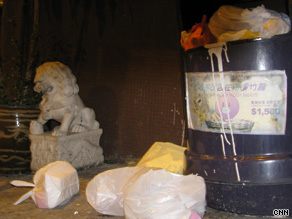
Piles of plastic bags are a common sight on street corners in Hong Kong.

Tuesday marked the beginning of the environmental levy on plastic bags. For every plastic bag a customer takes at certain retail outlets, they will be charged 50 Hong Kong cents (US$0.06). Green signs have sprouted up at these outlets to inform shoppers of the new fee.

The previous week, a full ban on indoor smoking in public places came into effect. Bars, nightclubs, massage businesses and mahjong-tin kau (Chinese dominoes) premises that had earlier received an extended deferment of the ban are now forced to implement it.

Piles of plastic bags are a common sight on street corners in Hong Kong.

And in late June, more than 3,500 buildings and groups in the southern Chinese enclave turned out the lights on a skyline known around the world for its nighttime illumination.

What is going on here? Is Hong Kong, a city that is often shrouded in smog, getting eco-serious or eco-trendy? What do you think? Sound Off below

In a city where piles of plastic bags on street corners are not uncommon — even being accosted by them while frolicking in the sea here is not unusual — and smoking goes hand in hand with a beer or Cosmopolitan martini, I was pleasantly surprised by the moves.

Secretary for Food and Health Dr. Yok Chow said earlier this year that tobacco “remains the major attributable factor to the top five leading causes of death in Hong Kong” and claims some 6,900 lives here yearly.

A stroll on Monday through one of the city’s popular nighttime and commercial neighborhoods not only revealed the usual plastic bag mess, but also smokers puffing away in bars.

At some bars, management set up ashtrays the size of kitchen garbage cans on the sidewalks for their customers to smoke one step outside the venue.

When I spoke with staff at three different places, one said she was unsure about the requirements of the new law, another said smoking just outside the venue was fine (as long as it didn’t bother anyone else) and a third told me I could actually smoke inside the bar by open windows.

I spoke with the head of the Tobacco Control Office, which has 85 officers on the team who perform unannounced inspections and look into complaints. He told me that venues were not fined for violations — but violators could be hit with fines of up to $5,000 HK dollars ($645).

“The venue managers themselves do not have any accountability or punishment that will be imposed on them, even if they do not enforce the law. In a way, it’s a bit different from overseas legislation,” Lam said. “What we are working on is a kind of a collaboration — on one hand we try to engage the venue managers to support us, on the other hand we want to emphasize the role of education and publicity.”

The efforts are promising, but I fear old habits die hard and wonder about Hong Kong’s commitment to improving the environment for its residents.

As for me, I will carry a cloth bag for groceries and the Tobacco Control hotline number in my mobile phone to do my part to help make this city eco-serious.

Government snubbing efforts by company to utilise solid waste

SCMP

In the article (“Nurturing growth”, June 22), Chief Executive Donald Tsang Yam-kuen talked about “changing the relationship between government, business and the market”. This certainly seems to be the time to adjust the balance between these relationships.

Given that finances are tight, the government should encourage more private enterprises to participate in the development of Hong Kong.

From my recent experience with the Environmental Protection Department, the message I received is that private sector involvement in public services, such as waste management, is not encouraged even if it can demonstrate substantial savings and environmental benefits.

Green Island’s eco-co-combustion system is an environmentally friendly and cost-efficient waste management solution. Sludge and municipal solid waste would be used as a refuse-derived fuel at our cement plant. The system boasts a number of benefits. For the treatment of sludge and solid waste, it presents a significant upfront cost saving of more than HK$6 billion compared to the department’s proposal. With sludge and solid waste being used to replace at least 40 per cent of coal used in the cement plant, there will be a net improvement in total emissions. In addition, there will be no residue ash as it would be used as clinker in cement manufacturing.

Our proposal for sludge treatment has already been denied, while for the treatment of the sold waste, we understand the department’s upcoming tenders have restricted its proposed integrated waste management facility to either Tsang Tsui or Shek Kwu Chau, so our proposal cannot be considered.

The eco-co-combustion model represents a good example of how the private sector can participate in Hong Kong’s environmental development. Instead, we are being prevented from competing. We hope the department will take heed of Mr Tsang’s words and consider private participation and not just stick to the conventional government-owned design-build-operate model.

Don Johnston, executive director, Green Island Cement (Holdings)

Environmental Levy Scheme on Plastic Shopping Bags

http://www.epd.gov.hk/epd/psb/en/register.html

http://www.epd.gov.hk/epd/psb/en/index.html

Socioeconomic disparities in air pollution-associated mortality

Elsevier Inc. – 26 November 2007

Abstract

This study aimed to determine whether individuals with lower socioeconomic status (SES) were more susceptible to the acute effects of ambient air pollution than those with higher SES. We included 24,357 Hong Kong Chinese aged 30 or above who died of natural causes in 1998. Information on individual socioeconomic characteristics was obtained by interviewing proxy informants with a standardized questionnaire in all four death registries. Individual SES was indicated by three measures: type of housing, occupational group and education attainment. Poisson regression was performed to assess the short-term effects of ambient air pollution measured by PM10, NO2, SO2 and O3 on mortality for each SES group. The differences in the effects between SES groups were estimated by the interaction between air pollution and SES. We found that PM10 and NO2 were associated with greater risk of mortality on people living in public rental housing than in private housing. The effects of all four pollutants were significantly greater in blue-collar workers than the never-employed and white-collar groups (p<0.05). However, we found no compelling evidence of effect modification by education attainment. Our results provide new evidence on the role of individual’s SES as effect modifiers of the short-term effects of air pollution on mortality. The reduction of risks associated with air pollution for socially disadvantaged populations should be a high priority in public health and environmental policies.

More information on: http://www.sciencedirect.com/science?_ob=ArticleURL&_udi=B6WDS-4S7HSDP-1&_user=10&_rdoc=1&_fmt=&_orig=search&_sort=d&_docanchor=&view=c&_searchStrId=942173795&_rerunOrigin=google&_acct=C000050221&_version=1&_urlVersion=0&_userid=10&md5=a4db5b5a6fb74c4ffb2a8b12af10a3c9

A Clear Vision

SCMP – Jun 25, 2009


Hong Kong has better visibility during the summer because prevailing winds blow pollution away. Unfortunately, the thick smog will return later and much of the Pearl River Delta will be enveloped by the ugly yellow-brown haze once more.


With Hong Kong investment, the delta became one of the world’s busiest industrial hubs, so it should come as no surprise that air pollution has risen substantially over the past two decades. The task now is to clean it up quickly to protect the health of some 50 million people.


The loss of blue sky in the region has much to do with two pollutants – particulates and ozone. Particulates are derived from the burning of fossil fuels by vehicles, and in industrial processes and power generation; ozone is formed when other pollutants react in the presence of sunlight.


Complex chemical reactions are involved, which makes these two pollutants among the hardest to control.


We are not alone in facing this problem. Many cities and regions around the world are struggling to find solutions, too. It is therefore important to understand the specific regional conditions for us to devise directly relevant solutions. Moreover, the types and mix of pollutants change constantly as the industrial profile of the region alters.


For example, the change in the region’s fuel mix and quality will have an impact, as will the increasein the number of vehicles.


While Hong Kong has already done solid research on the nature of local emissions, and there have been publicly and privately funded studies on cross-border emissions, we are not yet carrying out the kind of inquiries that others do as a matter of course. Despite Hong Kong’s status as a developed city, the science necessary for policymaking remains patchy.


This is easy to correct but our environmental officials need to give priority to setting up the right structure and ensure continued funding. The government as a whole needs to focus on upgrading its ability to regulate.


For example, the United States set up “supersites” monitoring programmes more than a decade ago to conduct detailed and wide-ranging air pollution and health-related studies in various locations. This was done to inform policymakers about the cost and methods to control particulates. Supersites take into account more than just regular monitoring of air pollution, and include factors such as human exposure to pollution. The sites include areas with unique climate, emissions or population characteristics, for example. This way, regional aspects of pollution problems can be better understood and dealt with.


Between 2002 and 2005, Taiwan set up four supersites to gain a better understanding of the characteristics and amount of particulates in both the north and south of the island.


In the Pearl River Delta, there have been several supersite studies between 2004 and last year, and the results are being used for planning similar programmes in the rest of Guangdong province. This is all the more reason why Hong Kong needs to set up its own data-gathering programme as a way to collaborate with our regional neighbours.


As the mainland builds it regulatory system, Hong Kong must push ahead even faster to improve its ability to gather and evaluate data and consider strategies to control the problem.


Such research is cost effective: a few million dollars a year goes a long way, and authorities can call on universities to help. The results are critical to policymaking based on evidence. If there is no data, there is no science.


The expensive part is the measures to control the problem that are eventually rolled out by the government; the research is relatively cheap.

A quick look at what others are doing should help the Hong Kong government chart a course. With resources and talent on the ground, there is no reason not to push ahead.


Christine Loh Kung-wai is chief executive of the think-tank Civic Exchange. cloh@civic-exchange.org