Clear The Air News Blog Rotating Header Image

Health

BMJ Editorial: Air pollution as a carcinogen

written by Krishnan Bhaskaran, Ben Armstrong, Paul Wilkinson, and Andy Haines, published in the British Medical Journal:

The possibility that air pollution might increase the risk of cancer is not a new idea. Richard Doll and Austin Bradford Hill initially believed that general atmospheric pollution from car exhaust fumes, surface dust of tarred roads, gas works, industrial plants, and coal fires might be responsible for the increased incidence of lung cancer in the first half of the 20th century. However, their landmark 1950 paper implicated tobacco smoking and set the direction for decades of research that firmly established smoking as a leading cause of lung cancer. By contrast, research into other possible causes was relatively neglected, and further evidence on the effects of air pollution was slow to accumulate.

However, more than 60 years later, the International Agency for Research on Cancer has released a monograph concluding that there is sufficient evidence to establish outdoor air pollution as carcinogenic to humans. This conclusion is based on consistent associations between pollution levels and the risk of lung cancer in animals and humans, as well as strong mechanistic evidence.

(more…)

SCMP: Average hours of unhealthy air in Hong Kong up on last year

from Ernest Kao of the SCMP:

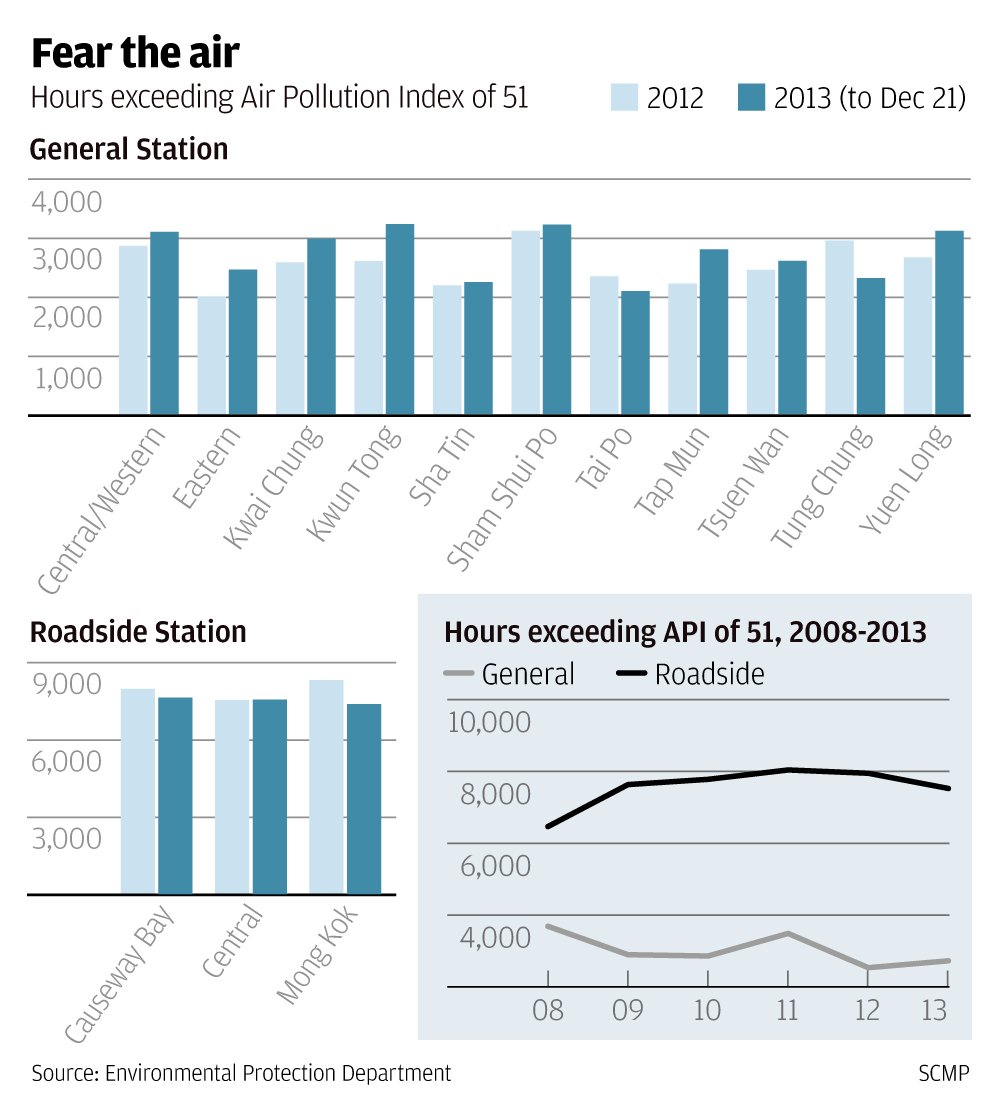
Hong Kongers endured an average of 2,727 hours of unhealthy air this year, surpassing last year’s figure with a week to spare.

The Post examined hourly air pollution index (API) data from the Environmental Protection Department’s 11 general air quality monitoring stations and three roadside stations.

From January 1 to December 21, the average number of hours of high, very high or severe air pollution recorded by each general monitoring station rose 7.6 per cent from last year’s 2,534.

The API measures concentrations of major air pollutants such as carbon monoxide and respirable suspended particulates in a range of 0 to 500. Readings above 51 are "high" - acceptable in the short term but beyond long-term health standards. "Very high" is above 100, indicating air that is unhealthy in both the short term and the long term. "Severe" readings are above 200. (SCMP)

(more…)

SCMP Letters: Citizens support waste-cutting, opposed to incineration

Incinerator will pose risk to residents

from Massimo Massarola, Lantau

Studies have shown higher rates of adult and childhood cancer and also birth defects around municipal waste incinerators. The results are consistent with the associations being causal.

Incinerator emissions are a major source of fine particulate, of toxic metals and of more than 200 organic chemicals, including known carcinogens, mutagens and hormone disrupters. Emissions also contain other unidentified compounds whose potential for harm is as yet unknown, as was once the case with dioxins.

Since the nature of waste is continually changing, so is the chemical nature of the incinerator emissions and therefore the potential for adverse health effects. Incinerators produce bottom and fly ash, which amounts to 30 to 50 per cent by volume of the original waste (if compacted), and require transporting to landfill sites.

Abatement equipment in modern incinerators merely transfers the toxic load, notably that of dioxins and heavy metals, from airborne emissions to the fly ash.

This fly ash is light, readily windborne and mostly of low particle size. It represents a considerable and poorly understood health hazard. Two large cohort studies in America have shown that fine (PM2.5) particulate air pollution causes increases in all-cause mortality, cardiovascular mortality and mortality from lung cancer, after adjustment for other factors.

A more recent, well-designed study of morbidity and mortality in postmeno-pausal women has confirmed this, showing a 76 per cent increase in cardiovascular and 83 per cent increase in cerebrovascular mortality in women exposed to higher levels of fine particulate.

The fine particles are primarily produced by combustion processes and are emitted in large quantities by incinerators.

We need to support zero-waste alternatives such as waste reduction, product reuse, recycling and composting, and oppose the planned waste incinerator in Hong Kong.

Cut waste with far better recycling

from Chan Wing-ki, Ngau Tau Kok

There has been strong opposition to the government’s proposal to expand our landfills, which are nearing capacity.

Residents living near the landfills are concerned because of the odour caused by the waste. Other people are against the expansion proposals because they will encroach on country parks.

Another proposal is to build an incinerator. If this option is chosen, I hope the government will give careful consideration to the site and have a thorough public consultation.

The most effective way to deal with this problem is to reduce the volume of municipal solid waste generated. The administration should be putting more resources into the recycling industry.

11 Dec 2013

FT: Hong Kong’s air quality blighted by fumes from road and sea

by Demetri Sevastopulo, for the Financial Times:

When Beijing residents visit Hong Kong, they sometimes quip that the territory is like a breath of fresh air, especially in winter when the Chinese capital can be bathed in extremely hazardous smog for days on end.

While most Hong Kongers can understand that feeling – having seen countless images of mainland cities wrapped in smog – they are far from happy with their own air quality.

According to the Hedley Environmental Index, compiled by the University of Hong Kong, the territory had 69 clear days – when the levels of five pollutants complied with World Health Organisation guidelines – last year. The pollution cost the economy an estimated HKD40bn ($5bn) in healthcare costs and lost productivity.

Hong Kong had all of 69 clear days last year. (AFP)

(more…)

Science Daily: Air Pollution Puts the Health of School Children at Risk

from Science Daily:

A recently completed study by The Hong Kong Polytechnic University (PolyU) on 310 children in 12 schools across the territory found the air pollution level along the traveling routes from home to schools and particulate levels outside school both at a very high level, and most of the school children have lung function weaker than the predicted levels.

The study was done by Dr Hung Wing-tat, Professor Frank Lee Shun-cheng and Ms Lee Sin-hang of the University’s Department of Civil and Environmental Engineering. They found that children in only two out of twelve surveyed schools have lung function better than predicted levels, whilst children in the remaining ten schools have lung function weaker than the predicted levels.

The study also found that carbon dioxide levels inside five of the twelve school classrooms are found to be higher than the stipulated good class level of HK Indoor Air Quality (HKIAQ), probably due to the presence of full class of students within the monitoring period.

PolyU researchers also collected information about the traveling patterns of these 310 school children and then monitored the air pollution level along the traveling routes of the subjects. About 48% of school children go to school on foot, the second most popular choice is the school bus (24%). They found that both PM10 and PM2.5 levels in various transportation modes are high.

It is worth noting that PM2.5 levels far exceed the stipulated health levels of WHO safety level of 75 µg/m3 (24 hours average) and the situation in school buses is worst. The total volatile organic compound (TVOC) levels in all transportation modes far exceed the good class level of HKIAQ and the situation in school buses is worst.

The study also found that allergic rhinitis is very common among local school children (ranging from 13% to 59.3% in schools). Allergic rhinitis is found to be related to tobacco smoking household, incense burning at home and molds at home. However, molds and mildews are common (25.9% to 62.5%) in household because of the humid weather.

Children in tobacco smoking households also have significantly poorer lung function. The study found high percentages of smokers in the households, ranging from 25.0% to 69.6%. One of the key findings is that Lung function of school children, FVC and FEV1 are found to be negatively co-related with PM10 levels in classrooms at 0.05 significant levels. It is critical to suppress the level of PM10 in classroom to protect the health of school children.

Pulmonary function tests were conducted on surveyed school pupils to assess their lung function, which was measured by a spirometer in this study.

The above story is based on materials provided by The Hong Kong Polytechnic University.

19 Nov 2013

Howard Winn/SCMP: Air pollution continues to plague streets of HK; health costs pile up

Howard Winn, in his column for the SCMP, has tirelessly written articles for consecutive weeks to promote awareness over the continued poor state of air quality on the streets of Hong Kong; its slow but deadly and very costly effects on the health of Hong Kong’s citizens, especially children; and the lack of action and evidence of aptitude from the Hong Kong government in dealing with this matter:

How much longer for action on roadside pollution?

The Environmental Protection Department issued a statement yesterday morning pointing out that its air pollution indices at roadside air quality monitoring stations reached a “very high” level. However, turning to the Hedley Environmental Index (HEI), we see that it described air pollution over Hong Kong more graphically as being “very dangerous”.

The HEI is linked to World Health Organisation (WHO) guidelines which indicate the levels beyond which air pollution begins to affect health.

In Causeway Bay, the hourly concentration of nitrogen dioxide at 5pm was 259ìg/m3 (micrograms per cubic metre), compared with the WHO guideline average level for a 24-hour period of 140ìg/m3 – i.e. 85 per cent over the WHO limit. At the roadside in Central, the nitrogen dioxide level was 338ìg/m3. The PM10 respirable particles were 99ìg/m3 and 105ìg/m3 at Causeway Bay and Central respectively, compared with the WHO short-term guide of 50ìg/m3.

Levels of the much more dangerous PM2.5 particles, which can enter the lungs, were also dangerously high at 65ìg/m3 and 61ìg/m3 in Causeway Bay and Central, compared with the WHO guideline of 25ìg/m3. These figures are way above WHO guideline levels.

(more…)

Air pollution recognized as carcinogenic, also linked to prenatal development problems

The World Health Organization (WHO) has finally reported that air pollution causes cancer: vehicle, industrial and other forms of emissions fill the air with a toxic cocktail of chemicals and particulate matter. Meanwhile, the Guardian also reports that air pollution, combined with an environment of heavy traffic, increases the likelihood of babies being born with low birthweight, which leads to other health problems. With Hong Kong suffering from both problems, the government will need to put its foot down to improve the situation if it is serious about improving its citizens’ health.

When pollution strikes hard: Air quality in March 2010 (left), compared to better days. (WSJ)


Click here for more coverage:

3,000 TONNES PER DAY INCINERATED ASH & HIGHLY TOXIC FLYASH TO LANDFILL

cartoon0812.jpg

Download PDF : ENBFLAWEDWASTEPLAN

Indoor Air Pollution Kills More Than AIDS, Malaria Combined

http://www.weather.com/health/indoor-air-pollution-twice-deadly-air-pollution-20130806

Indoor Air Pollution Kills More Than AIDS, Malaria Combined

Jeffrey Kopman Published: Aug 6, 2013, 3:09 PM EDT weather.com

http://s.imwx.com/dru/2013/08/70b6d261-845a-499c-9774-44f7d3074d13_650x366.jpg

(Thinkstock/Jupiterimages)

Outdoor air pollution might get more attention because of global warming, agricultural problems and the deadly diseases it causes, but indoor air pollution is actually more dangerous — killing approximately four million people worldwide each year, according to research from the World Health Organization.

Outdoor ozone and particulate air pollution contributes to about two million deaths a year, according a study recently published in the journal Environmental Research Letters. As climate change warms the planet, some researchers believe this figure will increase.

Indoor air pollution is largely caused by burning biomass fuels from sources such as wood, agricultural waste or coal. More developed countries have shifted away from these fuels in favor of petroleum products and electricity, but 13 percent of global energy was still derived from biomass fuels as recently as 2000. There is evidence that use is increasing among families in poverty, according to a study from the University of Michigan — potentially raising health risks.

Smoke from cook stoves is believed to be the largest contributor of indoor air pollution, which can cause childhood respiratory infections, COPD, asthma, cancer and infant mortality. People in developing countries, where alternative fuel sources are not readily available, spend between 3 and 7 hours a day exposed to high levels of indoor pollution, meaning indoor air pollution affects about 50 percent of the world’s population.

“The most important [health problems] appear to be childhood acute lower respiratory infections, which remain the single most important cause of death for children aged under 5 years in developing countries,” the study authors said.

(MORE: Air Pollution Linked to Millions of Deaths)

WHO officials compared the effects of indoor air pollution to the global burden caused by tobacco and unsafe sex. The four million deaths per year is more than AIDS-related deaths, malaria and tuberculosis combined, according to WHO data.

Future research should look at the benefits of reducing indoor air pollution exposure, and evaluate how poor households can cut their exposure, the study authors said. Installing clean cook stoves that use chimneys could be one way to solve many of the problems linked to indoor air pollution.

Because poverty creates a need to rely on cheaper, more dangerous fuels, researchers also called for socioeconomic development to combat the worldwide problem of unhealthy household environments

Systematic review of epidemiological studies on health effects associated with management of solid waste

Download PDF : 1476-069X-8-60