Clear The Air News Blog Rotating Header Image

Health

UK Health Research

http://ukhr.eu/incineration/selchp.htm

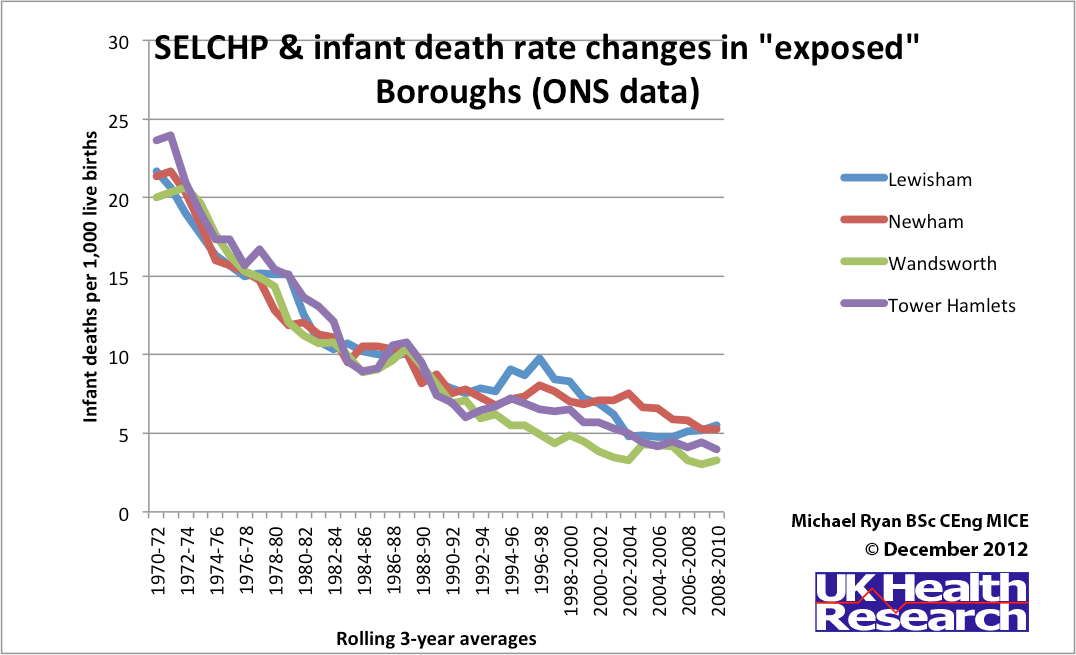
SELCHP & Infant Death Rate Changes Graph

Border image

This graph illustrates the changes in Infant Death Rates in three Boroughs exposed to emissions from the SELCHP incinerator located in South Bermondsey, London. Note that Wandsworth is mainly “upwind” of SELCHP and therefore relatively free from emissions.

See Japanese study of infant deaths around 63 incinerators which concluded:

“Our study shows a peak-decline in risk with distance from the municipal solid waste incinerators for infant deaths and infant deaths with all congenital malformations combined.”
(J Epidemiol. 2004 May;14(3):83-93.)

SELCHP graph

Click the graph to see it at a larger size.

James Middleton
07:27 (14 hours ago)

to me, Eastern

http://ukhr.eu/incineration/

Incineration

In this section we explain what is meant by the term PM2.5s and discuss the effects of incinerators on public health.


Click here to see a map showing pattern of infant deaths in wards around Edmonton Incinerator


Click here to see a map showing Infant Mortality Rates in electoral wards upwind & downwind of Coventry incinerator


Click here to read Shropshire Star letters on the health effects of breathing in PM2.5 emissions.


Click here to see Dr Woodward’s ‘scientific’ report about Ironbridge Power Station. Note that her report has no ‘control’ in an area free from PM2.5 emissions from the power station or any other source and lacks any data or journal references.

Border image

SELCHP & Infant Death Rate Changes Graph

Border image

This graph illustrates the changes in Infant Death Rates in three Boroughs exposed to emissions from the SELCHP incinerator located in South Bermondsey, London. Note that Wandsworth is mainly “upwind” of SELCHP and therefore relatively free from emissions.

Border image

Border image

Border image

Border image

Edmonton Map of Infant Mortality rates

Border image

The Greater London Authority’s map [click here, page 8] shows wards with infant death rates of 9.0 per 1,000 live births and above for period 2002-2008 and this map shows how emissions from Edmonton incinerator cannot be excluded as a causal factor. Click here to learn more

Border image

Border image

Border image

Border image

Kirklees Map of Infant Mortality rates

Border image

Cllr Ann Raistrick, who is concerned about high infant death rates in parts of Kirklees, will find this map useful – as will the Social Services Departments in Kirklees and elsewhere.

Border image

Border image

Border image

Border image

Open Letter to Daniel Kawczynski MP 21.07.2009

Border image

Daniel Kawczynski was a member of the EFRA committee which examined the performance of the Environment Agency in 2006 and should by now realise that the Environment Agency is ignoring the health effects of incinerators, aided and abetted by the Health Protection Agency and others. (Click here to read Michael Ryan’s statement to the House of Commons which has been ignored so far by MPs and the Environment Agency).

Border image

Border image

Border image

Border image

Objection letter to Harlescott Incinerator, Shrewsbury

Border image

Sheila Healy used to be Chief Executive at Cornwall County Council, where the councillors turned down the proposed St Dennis incinerator in March 2009. The Shropshire Star haven’t bothered to report this fact despite SITA wanting to build a similar incinerator at Granville, Telford. Note that Capel Parish Council had another SITA incinerator proposal quashed in the High Court in January 2009. The Shropshire Star ignored this as well.

Border image

Border image

Border image

Border image

HPA admit no health studies around incinerators

Border image

The Health Protection Agency give ‘expert’ advice to Primary Care Trusts about the health effects of incineration and yet they haven’t bothered to examine the rates of illness and premature deaths at electoral ward level around any incinerators. The PCTs accept the Health Protection Agency’s worthless advice and make no objections to incinerator proposals on health grounds.

Border image

Border image

Border image

Border image

Infant deaths 4 x higher downwind of Ironbridge Power Station

Border image

Click here to read how Office for National Statistics (ONS) data at electoral ward level shows a four-fold increase in rates of infant mortality downwind of Ironbridge Power Station compared with upwind for the five year period 2003 – 2007.

Border image

Border image

Border image

Border image

High Infant Mortality rates in Sheffield, Rotherham & Doncaster

Border image

Click here to view the map detailing the high rates of infant mortality in electoral wards around incinerators in the area of Sheffield, Rotherham and Doncaster.

Border image

Border image

Border image

Border image

REPORT regarding NEWHAVEN proposed incinerator site

Border image

Read the report by Dr Dick van Steenis on the varied health effects of incineration, together with the wider social and economic impact.

Border image

Border image

Border image

Border image

London boroughs with highest & lowest infant mortality rates

Border image

Read which London boroughs have the highest infant mortality rates, and which ones have the lowest (based on 2006 London infant mortality data).

Border image

Border image

Border image

Border image

Norwich Lecture

Border image

Should past failures to get justice over health damage from industrial
PM2.5 emissions from incinerators etc. discourage further efforts?

Border image

Border image

Border image

Border image

Infant death rate 3 times higher downwind of Power Station

Border image

Examination of ONS data for years 1998 – 2005 has shown that electoral wards that are downwind of the Ironbridge Power Station had an average infant mortality rate three times that of the upwind wards.

Border image

Border image

Border image

Border image

Incinerators: A Few Home Truths

Border image

The Shropshire Star Letters page has revealed that the UK’s incineration policy is based on fraud and has no consideration for the provable adverse health effects of PM2.5 emissions including the significant reduction in life expectancy.

Jonathan Davies, of Enviros Consulting Ltd is a co-author of DEFRA’s report about waste disposal and he has been exposed by the Shropshire Star’s letters page. Click here to read letters which are a key part of Incinerators: A Few Home Truths.

Some opponents of waste incineration opt for processes that result in pelletized waste that is then burnt in incinerators or cement kilns resulting in high levels of toxic PM2.5 emissions.

Border image

Border image

Border image

Border image

Something disturbing in the air

Border image

The Chartered Institute of Environmental Health is the professional body of Environmental Health officers in local authorities who have a duty to monitor air quality. They seem unaware of the fact that the PM10s that they monitor are too large to get into the lungs and cause health damage. They should all have had ample opportunity to read this important article during the last 12 months.

Border image

Border image

Border image

border image

Ironbridge Power Station Emissions Cover-up

border image

Telford and Wrekin Primary Care Trust (PCT) have failed to examine the pattern of illness and premature deaths downwind of Ironbridge power station, but have invited Michael Ryan to prepare a scientific report. The preliminary outline of that report was part of a statement of evidence to the EFRA Committee investigation into the performance of the Environment Agency who fail to monitor industrial PM2.5 emissions. Click here and see pages Ev 202 – 206 of the report published 11 May 2006.

Co-incineration of coal and waste oils has resulted in a reduction in average particle size from PM5 to about PM2.2, which has meant that the majority of emissions have become small enough to enter the lungs. There has been a significant deterioration in health and life expectancy among those downwind of the power station compared with those living upwind.

border image

border image

border image

border image

PM2.5s and life expectancy

border image

PM2.5s are particles that are small enough to enter the lungs. Particles that are larger than 3 microns in diameter (PM3s) are too large to get into the lungs.

Harvard School of Public Health found that for every reduction of one microgram per cubic metre of industrial PM2.5 emissions in average levels of industrial PM2.5 emissions, there were 3% fewer deaths. The largest drops in mortality rates were in cities with the greatest reduction in fine particulate air pollution, ie PM2.5s. Click here for the Harvard press release 15 March, 2006.

Unlike the USA and many other countries, the UK do not measure PM2.5s, preferring to measure PM10s, ie particles that are between 11 microns and 4 microns in diameter that are too large to get into the lungs and cause a range of illnesses and premature deaths of all ages.

The huge increase in PM2.5 emissions in the UK during the last decade has reversed the previous upward trend in life expectancy. If life expectancy were increasing, the age of the oldest resident would also be increasing. That is not happening as the oldest recorded resident was 115 years old in 2000. Infant mortality rates are highest where industrial PM2.5 exposure is greatest. Anyone living in an electoral ward with a high infant mortality rate can expect their lifespan to be curtailed with their health.

Incinerator fumes link to infant deaths

http://www.express.co.uk/news/uk/5688/Incinerator-fumes-link-to-infant-deaths

Incinerator fumes link to infant deaths

HUNDREDS of baby deaths a year are being linked to ­pollution emitted by public waste incinerators.

By: Lucy Johnston and Martyn Halle

Published: Sun, April 29, 2007

0Comments

The-Edmonton-incinerator-highlighted-in-the-reportThe Edmonton incinerator highlighted in the report

Researchers have established a significantly higher death rate among children up to one year old when they live under smoke from an incinerator chimney.

There is a lower death rate for children who live out of the path of incinerator emissions.

The report comes after a detailed analysis of death rates across the country.

Dr Dick van Steenis, a retired GP who helped head the study, said: “The incinerators are burning all sorts of material from domestic waste to hazardous chemical and radioactive waste.

“The danger comes from the particles released into the atmosphere. They are of a size that can be easily inhaled into the lung where they lodge and cause damage to the body.”

The most damaging particle, known as PM 2.5, is particularly harmful to youngsters he said. “Newborn babies are more likely to succumb to damage from chemical pollutants in these inhaled particles.” He added: “Around every single incinerator, infant mortality rates, asthma rates and autism rates are sky-high.

“That’s if you live under the smoke stream from the chimney. In areas nearby which don’t get the smoke, the death rate is either at the national average or lower.”

The data has been collected from the latest official statistics covering the years 2003 to 2005.

Enfield in north London has the UK’s largest incinerator at Edmonton. The death rate for babies up one year old in west of the ­borough is virtually nil.

But in eastern Enfield, which sits downwind of the incinerator and is exposed to smoke from the chimney, the death rate is between 10 and 12 per thousand of population. The national average death rate for babies up to a year is 5.2 per thousand.

Dr van Steenis said that he had accounted for other factors that could increase the death rate such as social deprivation. He pointed out, for example, that “leafy middle-class areas” of west London were affected by emissions from a big incinerator at Colnbrook near Slough. In some parts around this plant infant mortality rates are treble the national average.

“We compared those areas with nearby well-to-do wards that didn’t get emissions and they were significantly lower than the national average.”

Professor Vyvyan Howard, an expert on environmental pollution from the University of Ulster, said dioxins released in the burning of rubbish had been shown to be cancer causing.

He said that while incinerator filters take out 99 per cent of particles, it is the ultra fine one per cent – the PM 2.5s – that can have chronic effects on health.

London Waste, which owns the Edmonton incinerator, said it had not seen the van Steenis report. A spokesman said: “We use a proven technology with a track record of safe operation and it is recognised throughout Europe as a safe and efficient method of energy generation.

“There is no consistent ­evidence that our facilities cause adverse health effects.

“We continually monitor ­particulates such as PM 2.5s and the levels released are lower than the maximum permitted.”

Emissions from a mass-burn incinerator at Capel become a major concern for those living within 16 miles due north, north-east and east of the site

Download PDF : CAG_infant_deaths_report

Tobacco and roadside pollution more dangerous than bird flu

Friday, 12 April, 2013, 12:00am

Business

LAI SEE

Howard Winn

Given the rising concern over bird flu, it is worth recalling that there are other bigger killers in Hong Kong. In the past two weeks in which nine deaths have been recorded, Hong Kong’s dirty air has led to 123 avoidable deaths. This is using the Hedley Environmental Index, which calculates there were an average 3,200 avoidable deaths a year in the past five years on account of roadside emissions.

Smoking is an even bigger killer. The University of Hong Kong estimates 7,000 people a year die due to smoking, or an average of 269 every two weeks.

These two sources alone do far more damage than bird flu yet seem to raise far less alarm in the minds of legislators and government. This is why it is particularly galling that there was no increase in the tax on tobacco in this year’s budget. A packet of Marlboro Light costs HK$50 in Hong Kong, HK$76 in Singapore and HK$139 in Brisbane. Increasing tax is considered to be one of the biggest deterrents to smoking among young people, even by the tobacco industry.

.

Have you got any stories that Lai See should know about? E-mail them to howard.winn@scmp.com [2]


Source URL (retrieved on Apr 12th 2013, 6:21am): http://www.scmp.com/business/article/1212517/tobacco-and-roadside-pollution-more-dangerous-bird-flu

Links:
[1] http://Knowyourmeme.com
[2] mailto:howard.winn@scmp.com

https://e02.optimix.asia/trackingdata?imgtag=1&opxUid=0&opxEventID=2022&opxClientID=87&opxcounter=1

Toll of cancer misery rises in Shandong’s petrochemical villages

Thursday, 04 April, 2013, 5:04am

News›China

CANCER

Li Jing in Zibo, Shandong province jing.li@scmp.com

Shandong villagers convinced pollution from petrochemical plants that ring their homes is behind surge in tumours, but feel powerless to fight it

It was a cold, gloomy early spring day in Jinnan village, Shandong province – fitting weather for a ceremony commemorating the death of a local man who had recently died of lung cancer.

A young couple, who wished only to be known by their surnames Ma and Sha, dressed in white mourning robes to conduct the event last Thursday.

“My father-in-law was only 65,” said Sha, 33. “He did not smoke much, but when he was diagnosed with lung cancer in December, it was already in the terminal stage.”

She said her father-in-law was strong enough to work in the fields until September, when his health began to fail. “He was not able to eat much after that,” she said.

Both Sha and Ma, her husband, say pollution from the petrochemical plants that surround their village may be a factor in the rising prevalence of cancer in recent years. Sha’s father died of stomach cancer a few years ago.

“Too many villagers here develop cancer,” said Ma. “Almost every family has a cancer patient.”

Jinnan is one of nine villages under the jurisdiction of Jinling Hui ethnic township in Zibo, a prefecture-level city in the centre of Shandong. Jinling Hui town is entirely located within the 22-square-kilometre Qilu Chemical Industrial Zone, according to the township government.

Since 2002 the area has been co-developed by the provincial government and the giant China Petrochemical Corporation, or Sinopec. But the history of the  industry in the area dates back to 1966, when Qilu Petrochemical   moved into Zibo.

The industrial zone is an important source of revenue for the province. In 2010 its output reached 71.5 billion yuan (HK$88.6 billion). A billboard lists details of 26 companies in the area, each with annual revenue of more than 20 million yuan, which produce all manner of essential chemicals  for plastics, coatings, pharmaceuticals, pesticides, ceramics and other goods.

But the development has encroached on local villages, which are now separated only by a road from a large stretch of chemical plants. Tanks laden with hazardous or flammable chemicals line the road. Various unpleasant odours fill the air as you drive by the different factories.

On the other side of the road, Jinling’s villages are quiet. The streets and small alleys are almost empty, with the iron gates on most homes securely locked.
“Many have left Jinling because of the pollution,” Ma said. He and his wife now live and work in central Zibo,  but their mothers remain in Jinling. It is a common pattern across rural China, where young people work in the city, leaving behind the children and elderly.

The couple’s stable income was a blessing for Ma’s father, who was able to get treatment from a renowned hospital in the provincial capital, Jinan.

Yang Hongtao, 64 and Bi Qingshui, 55, in Jinling Wucun (or Jinling No 5 village) are not as lucky. Both were diagnosed with terminal lung cancer in early February. Oxygen and painkillers are the only therapy the two men can afford.

Yang, lying half naked in bed, can barely talk and is exhausted after only a few words. His ribs are visible on his emaciated frame as he gasps for air. The cancer has spread to his liver and bones. His daughter Yang Lijie says there is not much that can be done, except to give him oxygen when he has difficulty breathing.

Bi is in an even worse situation. Curled up on a grimy bed, he has already lost the strength to talk and is permanently on oxygen.

Bi’s 29-year-old son begged a barefoot doctor – a fellow villager who runs a small traditional Chinese medicine clinic – to give his father an injection of atropine sulfate, convinced it could help reduce the inflammation and relieve pain.

The son said the family was too poor to get a doctor’s prescription for the drug, which he was forced to obtain through underground channels. He had to quit work to look after his dying father, leaving the family in even more financial difficulty.

“[The cancer] progressed really fast. He could still sit outside and enjoy sunshine before the Spring Festival,” the son said. “In a few days I will be the last one left in this family.” His mother died a few years ago.

It is only a matter of time before  Yang and Bi join the growing list of cancer victims being compiled by the villagers.

In Jinling Wucun alone, villagers told the South China Morning Post that at least 20 people, aged between 46 and 80, had died of cancer in recent years. Lung cancer was the most prevalent, followed by cancers of the stomach, liver and oesophagus.

Almost all cancer patients in the village suffered a similar fate: the tumours already measured between 6cm or 7cm when they were diagnosed – too late for an operation – and they grew so fast that the patients died in about a year.

The wife of one such patient, Zhang Jixin, who died of lung cancer at the age of 67 last year, said: “Cancer is becoming so common, just like catching flu. Even the doctors at the Jinan hospitals were surprised and asked, ‘What on earth is happening in Jinling?’.”

Villagers are increasingly convinced that pollution from the nearby  petrochemical plants is behind the growing cancer rate. They say the factories release foul-smelling “toxic gas” every night after 10pm.

The smell  is sometimes so pungent it is impossible to open the windows, even on the hottest summer days. The villagers are also fear that factory waste is contaminating groundwater.

Not far from the Jinling villages, a stone tablet erected  by Zibo’s water conservation bureau marks a 149-square-kilometre protection zone for the town’s drinking water. It stipulates that no new industrial projects should be built within the zone and all existing factories should meet emission standards.

However, part of the Qilu Chemical Industrial Zone is located right in the protection zone, while official documents show new projects are still planned before 2015.

A research paper published in the bimonthly journal Ground Water by two researchers from the Zibo hydrology bureau in 2010 said tests showed groundwater in the area had “relatively high concentrations of petroleum and benzene”.

But apart from making private complaints, the Jinling villagers say they are helpless. They have begun to accept this state of affairs as their fate, as they know there is no way the government will relocate the factories or the entire township.

“The factories have been here for more than 30 years … people say the pollution causes cancer, but who knows? What else can we do?” said Yang Lijie.
The Jinling villagers’ plight is but one  small example of the price in public health that mainlanders are paying for rapid industrialisation. Last month alone, mainland media ran reports on other cancer villages in Henan, Hunan and Jiangsu provinces.

In a document released in February, the Ministry of Environmental Protection made a rare acknowledgement of the existence of cancer villages due to chemical pollution. But officials are still reluctant to admit the link between rising cancer rates and rampant pollution. An official from the Shenqiu county environmental protection bureau in Henan province dismissed media reports of a local cancer village as “merely hype”.

Professor Yang Gonghuan, deputy director of the Chinese Centre for Disease Control,  said confirming the relationship between cancer and pollution would require complicated scientific proof of cause and effect.

“Usually, a high occurrence of cancer will take place about a decade after a sudden increase in pollution, and there needs to be a geographical overlap of pollution and outbreak of cancers before scientists can decide if there is a causal relationship,” said Yang.

The scientist conducted a five-year study along the Huai river in central China in 2005, and confirmed that the high occurrence of cancer in villages in the river basin was linked to water pollution.

For scientists like Yang, finding the link between cancer and pollution might demand lengthy and rigorous research, but for Jinling villagers who have lost loves ones or caring for those in their final days, there is little doubt.

In the neighbouring village of Liuhang, Wang, a local farmer ploughs a tiny parcel of land, despite the sour smell emanating from the chemical plants less than 100 metres away.

“You can see for yourself that we’re literally surrounded by chemical plants on three sides, but what can we do?” he said. “I still need to grow maize to make congee.”

Topics:

Cancer

Jinling

Carcinogens

Petrochemical

Pollution in China

WHO will help set Hong Kong’s air quality goals

SCMP

Thursday, 28 March, 2013, 12:00am

News›Hong Kong

HEALTH

Cheung Chi-fai chifai.cheung@scmp.com

Government is believed to be calling in global experts as it sets out a seven-year road map

World Health Organisation experts will help set Hong Kong’s air quality objectives, according to a schedule to be released by the Environment Bureau today, a source close to the government says.

The 40-page road map for Clean Air for Hong Kong will outline the targets and timetables for improving air quality.

The document, to be launched by Secretary for the Environment Wong Kam-sing, will cover at least the next seven years and is expected to be the most comprehensive air quality blueprint for Hong Kong yet.

The plan will include government measures to curb emissions at local sources, from roads to marine transport and power generation. It will also highlight the need for co-operation with Guangdong in addressing regional smog caused by ground-level ozone pollution.

The source said it would also focus on the link between public health and air pollution, and the need for long-term local health studies, as well as possible funding sources for this research.

But room for new local measures seemed limited, as the bureau had recently already rolled out or announced a number of measures. These included phasing out old, polluting trucks by 2019, with the help of HK$10 billion earmarked by Chief Executive Leung Chun-ying.

It is understood that the bureau has been shortlisting experts to review its objectives and advise on studies through the WHO’s director general Margaret Chan Fung Fu-chun.

“It is hoped the experts can help determine how far Hong Kong can go in setting the air quality targets,” the source said. “[The road map] will also give ammunition to environment officials [trying to] improve air quality in future.”

It is hoped the experts can help determine how far Hong Kong can go in setting the air quality targets

To highlight co-operation between different bureaus and departments, Wong will be joined in the announcement by Secretary for Transport and Housing Professor Anthony Cheung Bing-leung, undersecretary for food and health Professor Sophia Chan Siu-chee, and permanent secretary for development Wai Chi-sing.

“The Environment Bureau wanted to get Dr Ko Wing-man, the secretary for health and food, involved to highlight the importance of the issue. It is far more convincing for Ko to tell the public what is bad for their health than Wong,” the source said.

But a spokesman for Ko said the health minister had to show up at another event that would clash with the press conference.

“Dr Ko will attend a doctors’ event about Sars at Nethersole Hospital. He had promised to attend the event before the [press] conference was finalised,” the spokesman said.

Early last year, environment officials announced new air quality targets to be introduced next year, but the Audit Commission said the targets were not sufficient to protect public health.

The officials also listed at least 19 measures to reach the targets, some of which are already in use.

Topics:

World Health Organisation

Clean Air for Hong Kong

Air quality


Source URL (retrieved on Mar 28th 2013, 8:25am): http://www.scmp.com/news/hong-kong/article/1201374/who-will-help-set-hong-kongs-air-quality-goals

Acute changes in lung function associated with proximity to a steel plant: A randomized study

http://www.sciencedirect.com/science/article/pii/S0160412013000342

Cancer Council report slams fast food outlets

Junk Food Pollution …………………..

Report uncovers alarming statistics about our eating habits

22 February, 2013 Brea Carter http://www.hospitalitymagazine.com.au/food/news/report-uncovers-alarming-statistics-about-our-eati

Report uncovers alarming statistics about our eating habits

The NSW Cancer Council’s Fast Food: Exposing the Truth report highlights the need for fast food chains to provide customers with food nutrition information. Image: fastfoodfact.net

A report released by the Cancer Council has found that Australians spend nearly one third of their weekly household food budget on fast food and eating out.

This figure highlights that Australian’s spend 50 percent more on fast food and eating than they did six years ago.

The report, entitled Fast Food: Exposing the Truth highlights the need for Australians to rethink their eating habits and food choices, and features a range of recommendations that the may adopt to do so.

It uncovered that the food nutrition information fast food chains display in store varies between states and some brands display such information while others do not.

The report also highlights just how important it is that fast food chains look at reducing the saturated fat, salt and sugar content of their menu items.

Clare Hughes, nutrition program manager at Cancer Council NSW said it is integral that the Federal Government and Australia’s fast food industry work together to improve the health of Australians. She said this can be achieved by introducing mandatory reformulation targets, making food nutrition information labelling consistent across all states and brands, and to tighten up already existing initiatives.

“Mandatory kilojoule labelling has already been introduced in NSW, and this is a step in the right direction. But it needs to be introduced across Australia, with more detailed information also available in store. “Our survey of fast food chains found that customers who wanted to make informed choices were getting different levels of nutrition information depending on where they dined,” she said. She said we are coming to rely on fast food more and more because many of us a time-poor and do not have time to prepare home cooked meals on a regular basis.

“New measures need to be introduced to make it easier to choose healthier foods when we are eating out, and to gradually reduce the levels of kilojoules, fats and salt in fast food.”

She advises that fast food chains display nutrition information just as supermarket products do.

“For years nutrition information panels on packaged foods have helped us to identify healthier choices in the supermarket. We should also have the right to be informed when we’re eating out, with easy access to information to assist consumers in choosing healthier meal options and snacks.”

Even though a number of fast food chains have introduced healthier meal options, the report found customers do not typically opt for these menu items.

Subsequently, she said “we’d like to see firm commitment from both industry and government to reduce the amount of kilojoules, fats, sugars and salt, to make standard menu items healthier.

“We know that obesity and the problems associated with it, such as certain cancers, diabetes and heart disease will continue to spiral out of control if the government doesn’t take action now,” said Hughes.

http://au.lifestyle.yahoo.com/womens-health/article/-/16205783/cancer-council-report-slams-fast-food-outlets/

Cancer Council report slams fast food outlets

February 22, 2013, 8:57 amYahoo!7

Cancer Council NSW calls on the Federal Government and the fast food industry to step up and implement initiatives that make it easier for customers to make healthier fast food choices.

http://l.yimg.com/ea/img/-/130222/hamburger_18id62s-18id631.jpg

Getty Images

Christine Richmond

Cancer Council NSW calls for mandatory nutritional labelling at fast food outlets

Our nation’s Macca’s habit is growing, according to a new report. Australians are spending 50 per cent more on fast food and eating out than we were just six years ago – we’re now forking over about 28 percent of our household food budget on the stuff, according to the Cancer Council NSW’s new 25-page report “Fast Food: Exposing the Truth.”

Why does the Cancer Council care about fast food? The report comes at a time when more than half of Australian adults and nearly one in four children are overweight or obese.

And carrying extra weight ups your risk of cancers of the bowel, kidney, pancreas, oesophagus, endometrium and breast.

The report argues that nutrition labeling should be mandatory and consistent nationwide, and that menu items should be reformulated to be lower in salt, fat, sugar and kilojoules.

(Gross but true: The average fast food meal provides 47 percent of your daily kilojoule needs.)

The Cancer Council wants to see the Federal Government get involved to make sure these changes are implemented.

Here’s what else the report uncovered:

Looking for nutrition information? Good luck. A Cancer Council survey of 222 fast food stores (including McDonald’s, KFC, Hungry Jack’s, Red Rooster and Subway) found that 34 per cent had no nutrition information available to customers. And only one store had info for every item on the menu.

The highest energy children’s meal had nearly six times more energy than the lowest energy children’s meal.

When healthier options like salads are available, we’re not buying ‘em. The Cancer Council tracked fast food purchases at McDonald’s and found that only 1 per cent came from the healthy menu.

What’s more, research has shown that having healthier menu options can actually boost sales of unhealthy foods. (One explanation: We reward ourselves for eating the salad by ordering dessert.) This is why reformulating menu items so they’re lower in fat, sugar, salt and energy is so important, says the Cancer Council.

Recommendations from Cancer Council NSW

1. The Federal Government should introduce mandatory menu labelling in-store in fast food chains, nationwide.

2. In the absence of nationwide mandatory menu labelling, the fast food industry should ensure that complete nutrition information is always available in-store.

3. Fast food chains should ensure that staff receive training on the provision of nutrition information to customers.

4. The fast food industry should reformulate their menu items to reduce the amount of energy, saturated fat, sugar and sodium.

5. The QSRI Initiative’s nutrient criteria should be revised to ensure that children’s fast food meals do not exceed 30% of children’s daily needs.

6. The Food and Health Dialogue should set targets for voluntary reformulation of fast foods, and move towards mandatory reductions.

7. The fast food industry should promote their healthier menu items in preference to their unhealthy menu items.

Published on South China Morning Post (http://www.scmp.com)

Home > Study links fast food linked to childhood asthma


Study links fast food linked to childhood asthma

Submitted by virginia.addison on Jan 15th 2013, 5:04pm

Lifestyle›Health

HEALTH

Agence France-Presse in Paris

Children who frequently eat fast food are far likelier to have severe asthma compared to counterparts who tuck into fruit, a large international study published on Monday said.

Researchers asked nearly half a million teenagers aged 13 to 14 years old and children aged six and seven about their eating habits and whether in the previous year they had experienced wheezing, eczema or an itchy, blocked nose when they did not have a cold or flu. The questionnaires – completed by a parent or guardian for the younger children – were distributed in scores of countries. The study marks the latest phase in a long-running collaborative programme, the International Study of Asthma and Allergies in Childhood (ISAAC), which was launched in 1991.

The investigators filtered out factors that could skew results, such as maternal smoking during pregnancy, sedentary lifestyle and body-mass index, in order to focus purely on diet. They found that fast food was the only food type that could be clearly linked to asthma severity. Three or more weekly servings of fast food were associated with a 39 per cent increase in the risk of severe asthma among teens and a 27 per cent increase among younger children. It also added to the risk of eczema and severe rhinitis.

In contrast, eating three or more weekly portions of fruit led to a reduction in symptom severity of between 11 per cent and 14 per cent, respectively. The study, which appears in the British Medical Association journal Thorax, notes that to prove an association is not to prove a cause – but argues that a further inquiry is clearly needed. “If the associations [are] causal, then the findings have major public health significance, owing to the rising consumption of fast foods globally,” the authors said. Previous research had found that the saturated and “trans” fatty acids trigger an inflammatory response from the immune system, the paper noted.

Topics:  Fast Food


Source URL (retrieved on Feb 22nd 2013, 7:26am): http://www.scmp.com/lifestyle/health/article/1128638/study-links-fast-food-linked-childhood-asthma

SCMP Sunday Morning Post

Sunday, February 19, 2006

Hong Kong’s Big Macs fattest in the world
McDonald’s burgers in ‘Asia’s world city’ are cholesterol-crammed, alarming nutritionists

RAYMOND MA
Big Macs served in Hong Kong contain more fat and cholesterol than anywhere else in the world, the Sunday Morning Post can reveal.

The average burger can also lay claim to having the joint highest number of calories – along with those served in the United States,
according to comparisons based on nutritional information posted on McDonald’s website. McChicken burgers and Chicken McNuggets had
similarly high amounts of fat, cholesterol and calories. The findings have drawn concern from nutritionists who point to the close association between a diet high in fat and cholesterol, and heart disease. Some also point to the risk of high blood pressure, and kidney problems because of the high salt content in local Big Macs.

McDonald’s Hong Kong attributed the higher levels to the use of different ingredients suppliers in various parts of the world.

A spokeswoman for the company in Hong Kong said: “The ingredients of McDonald’s food items worldwide are basically the same. The nutritional
composition of items … may vary from country to country as the ingredients are provided from suppliers in different areas.”

According to information posted on McDonald’s website, Hong Kong Big Macs contain 560 calories each – 80 calories more than those eaten by
Australians and 50 calories more than those in the Middle East. They also have 85mg of cholesterol – the highest of any country for which
information is available.

Total fat content of 31 grams means that local burgers have 35 per cent more fat than Big Macs in Britain.

Mandy Sea Man-mei, manager of the Centre for Nutritional Studies at Chinese University’s school of public health, expressed concern over
the amount of salt.

There is 1.07 grams of sodium in each local burger. This is half the amount in burgers eaten by Swedes and the British, but still
constitutes nearly 45 per cent of the daily recommended intake (RDI).

Based on a sodium RDI of 2,400mg and a three-meal day, a person should aim to limit salt intake to 800mg per meal, she said.

“It’s more unhealthy than Big Macs overseas because of the higher fat and sodium levels,” Dr Sea said. She also cautioned that the degree to
which Big Macs in Hong Kong were less healthy than overseas burgers would depend on the amount of saturated fat present, since diets high
in the fats correlated with increased incidence of coronary heart disease and the blocking of arteries.

McDonald’s declined to disclose the amount of saturated fat in its foods in Hong Kong, or provide any other nutritional information on its
menu.

However, Georgia Guldan, a nutritionist and associate professor at Chinese University’s biochemistry department, said that an extra 50
calories per day could add 4kg to a person’s weight a year.

She added that the differences between local burgers and those served elsewhere were not large in terms of daily intakes.

Morgan Spurlock’s academy-award-winning documentary Super Size Me drew global attention to health issues associated with McDonald’s food,
particularly to a diet based solely on the outlet’s menu.

Download PDF : Fast-Food-Exposing-the-Truth-22-February-2013

Beijing unveils blueprint to control health risks of toxic chemicals

Submitted by admin on Feb 22nd 2013, 12:00am

News›China

ENVIRONMENT

Li Jing jing.li@scmp.com

For first time, policy blueprint links pollution to rising health threats in industrial areas

The central government has unveiled its first blueprint to control the environmental and health risks of toxic chemicals, and for the first time officially acknowledged the existence of “cancer clusters” due to such pollution.

The blueprint, covering the period from 2011 to 2015 and posted on the website of the Ministry of Environmental Protection, admits that excessive levels of chemical pollutants are already found in the country’s major rivers and lakes, and even in animal and human bodies.

“In recent years, toxic and hazardous chemical pollution has caused many environmental disasters, cutting off drinking water supplies, and even leading to severe health and social problems such as ‘cancer villages’,” the blueprint said.

In recent years, toxic and hazardous chemical pollution has caused many environmental disasters, cutting off drinking water supplies, and even leading to severe health and social problems such as ‘cancer villages

Between 2008 and 2011, more than a half of the 568 environmental emergencies dealt with by the ministry were related to chemicals, official statistics show.

Calling the blueprint “a significant first step”, Liu Jianguo , an associate professor at Peking University, said chemical pollution on the mainland had become “the most severe problem” and one that government could no longer ignore.

Mainland officials were previously reluctant to link pollution levels with rising cancer rates in industrial areas.

Some chemical pollutants can travel long distances and accumulate in the environment and human bodies, disturbing endocrine and immune systems and even causing cancer.

However, the production and use of such chemicals on the mainland has become so widespread due to rapid and chaotic industrial expansion over the past three decades that the government has yet to come to terms with the risks.

A 2010 survey of more than 40,000 plants in the petrochemical, chemical and pharmaceutical industries, conducted by the ministry, found 40 per cent posed a severe threat to public health, the blueprint said.

For instance, 23 per cent of the plants were located five kilometres or less upstream of drinking water sources or agricultural land. About 15,000 were near residential areas.

But such information is not yet available for other industrial sectors, with the blueprint admitting that no official statistics were available on the number and location of chemical emission sources, or their impact on human health.

The blueprint aims to establish a sound information system on chemical production and use by 2015 and start to register all enterprises involved in producing, using, transporting and discharging hazardous chemical pollutants, following international practice.

It also lists 58 types of chemicals that will be under specific control, including those that could damage human health or cause environmental accidents.

Wu Yixiu , a Beijing-based Greenpeace campaigner, said it was the first time the authorities had proposed monitoring the environmental impact of chemicals.

However, experts are not optimistic about the impact of the blueprint because the production of some chemicals that were banned or restricted in developed countries was still rising on the mainland, with manufacturing having moved to China. Wu said the blueprint still failed to set out a timetable to phase out some highly toxic chemicals, and that would send a stronger signal to producers and users than merely putting them on a watch list.

Topics:

Water Pollution

Chemical Pollution

China

Environment

More on this:

China’s water still unfit to drink after multibillion-yuan clean-up [1]

Mainland editorial declares war on water pollution [2]


Source URL (retrieved on Feb 22nd 2013, 6:05am): http://www.scmp.com/news/china/article/1155782/beijing-unveils-blueprint-control-health-risks-toxic-chemicals

Links:
[1] http://www.scmp.com/news/china/article/1155372/chinas-water-still-unfit-drink-after-multibillion-yuan-clean
[2] http://www.scmp.com/news/china/article/1150179/mainland-editorial-declares-war-water-pollution

Day’s worth of fat in child fast-food meal

http://www.canberratimes.com.au/national/health/days-worth-of-fat-in-child-fastfood-meal-20130221-2euad.html

Day’s worth of fat in child fast-food meal

Date

February 22, 2013

  • (0)
  • Read later

Amy Corderoy

Health Editor, Sydney Morning Herald

Child eating burger.

Super-size … a report from the Cancer Council NSW found 90 per cent of children’s meals exceeded recommended limits of salt and sugar.

CHILDREN’S fast food meals vastly exceed the amount of energy, salt, sugar and saturated fat children should eat in one meal, according to a damning report from the Cancer Council NSW.

The Fast Food: Exposing the Truth report showed an urgent need to reduce the amount of energy and unhealthy ingredients in fast food meals, the council said.

Its nutrition and program manager, Clare Hughes, said Australians on average spend about a third of their food budget on fast and takeaway food.

“If we are serious about addressing the issue of overweight, obesity and chronic disease in Australia we have to be realistic and say people are eating out of home … so if we can make these unhealthy choices a bit healthier that might make a difference”.

But the Australian Food and Grocery Council has criticised the report, saying it relies on out-of-date information and selective benchmarks.

The report analysed 199 different children’s meal combinations from six major fast food outlets, finding at worst they contained more than an entire day’s salt and saturated fat in the one meal.

“If kids are having a fast food meal they are getting a fair whack of what they should be having in one day, in one meal,” Ms Hughes said.

It found 90 per cent of children’s meals exceeded the recommended salt levels for four- and eight-year-old children.

About 70 per cent exceeded energy and sugar requirements for four-year-olds, and about 50 per cent for eight-year-olds.

Ms Hughes said the researchers had also recorded more than 1400 meal purchases at 20 fast food outlets, finding that people chose the healthy options on menus less than 1 per cent of the time.

“What that tells us is it is not just about including healthy options,” she said. “One of our recommendations is that targets be set for reform of all fast food products.”

The report also found about a third of fast food outlets did not have nutritional information available for customers.

In NSW nutrition information is mandatory, but Ms Hughes said a national approach was needed to ensure everyone could access it.

A spokesman for the food and grocery council said the Cancer Council was basing its assessment on a British recommendation that a meal should contain 30 per cent of daily energy and unhealthy nutrients.

“[Our] nutrition criteria is established by accredited practicing dieticians utilising Australian nutrient reference values,” he said. “The 30 per cent number being used in this study … has no relevance to Australian dietary guidelines”.

He said the majority of the main fast food companies had already completed roll-outs of nutrient information on menu boards, and healthy choices were available

Read more: http://www.smh.com.au/national/health/days-worth-of-fat-in-child-fastfood-meal-20130221-2euad.html#ixzz2LXsHcota