Clear The Air News Blog Rotating Header Image

Global Warming

Global premature mortality due to anthropogenic outdoor air pollution and the contribution of past climate change

Global premature mortality due to anthropogenic outdoor air pollution and the contribution of past climate change (1.80 Mb .pdf)

Direct link to download .pdf:
http://iopscience.iop.org/1748-9326/8/3/034005/pdf/1748-9326_8_3_034005.pdf

Abstract:
http://iopscience.iop.org/1748-9326/8/3/034005/article

Map:

NASA map illustrates air pollution mortality rates

By Mike Krumboltz, Yahoo News | Yahoo News – 22 hrs ago

Want to know where people are most likely to die prematurely due to air pollution?

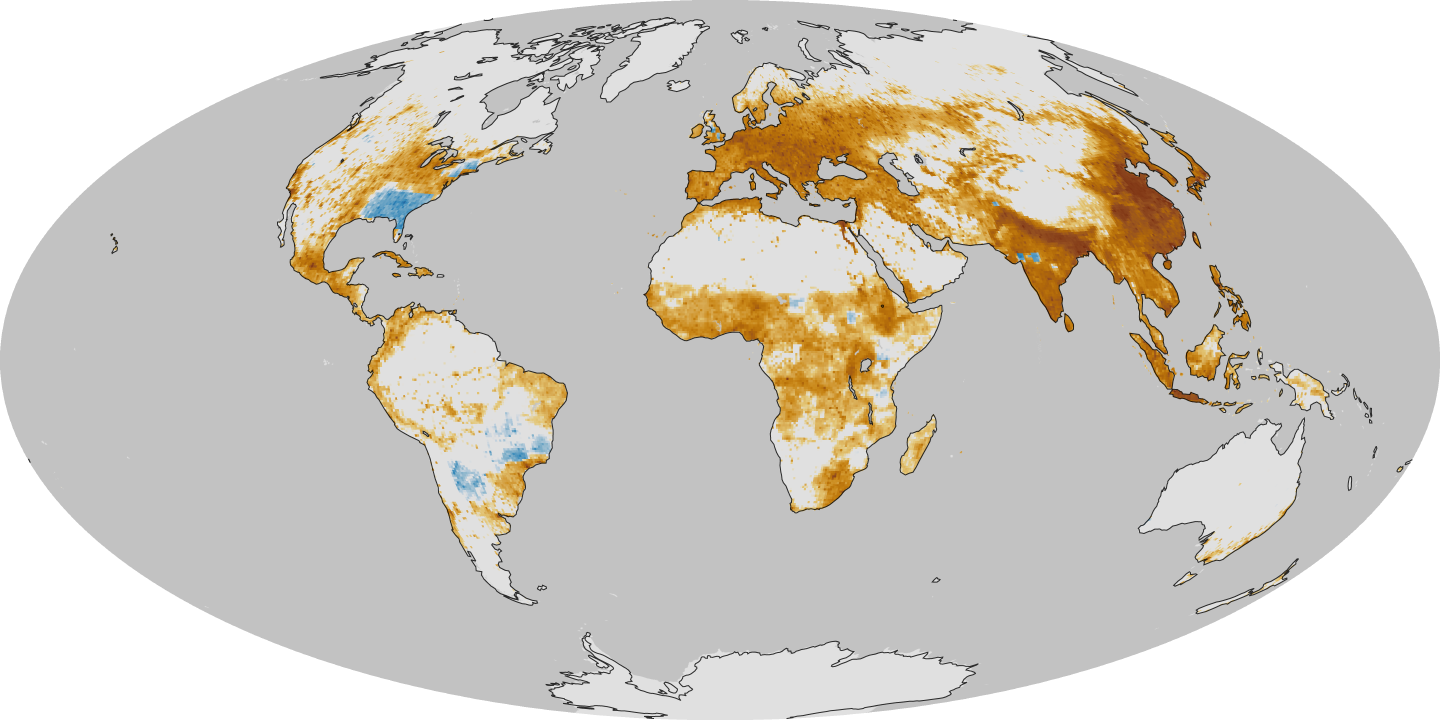
NASA recently recently released a map (below) showing the average number of deaths per year per 1,000 square kilometers (385 square miles) that can be attributed to fine particle matter pollution.

Researchers compared pollution levels over a 150-year span, beginning in 1850 and ending in 2000. The dark brown areas on the map, shown prominently in Asia, India, Europe and parts of Africa, indicate locations with the highest rates of premature deaths due to air pollution.

Blue areas, as seen in the southeast United States and parts of South America, indicate areas that have seen air quality improve and the number of deaths due to air pollution decline.

Why are so many areas getting worse? According to NASA, that can be attributed to increased industrialization and urbanization. As to the areas in blue that have seen air quality improve from 1850 to 2000, researchers suggest that a decrease in biomass burning is the cause.

The research used to create the map comes from University of North Carolina professor Jason West.  Published in Environmental Research Letters, the study estimated that roughly 2.1 million deaths per year could be attributed to fine particle matter pollution alone.

What’s fine particle matter? The Environmental Protection Agency (EPA) defines it as “a complex mixture of extremely small particles and liquid droplets.” Particle matter that is 10 micrometers in diameter or smaller is particularly worrisome “because those are the particles that generally pass through the throat and nose and enter the lungs,” according to the EPA.

~~~~~~~~

The Global Toll of Fine Particulate Matter

Color bar for The Global Toll of Fine Particulate Matter

Occasionally, short-term meteorological conditions merge with ongoing human emissions to produce extreme outbreaks of air pollution. In January 2013, a blanket of industrial pollution enveloped northeastern China. In June 2013, smoke from agricultural fires in Sumatra engulfed Singapore.

In most cases, the most toxic pollution lingers for a few days or even weeks, bringing increases in respiratory and cardiac health problems at hospitals. Eventually the weather breaks, the air clears, and memories of foul air begin to fade. But that’s not to say that the health risks disappear as well. Even slightly elevated levels of air pollution can have a significant effect on human health. Over long periods and on a global scale, such impacts can add up.

But exactly how much exposure to air pollution do people around the world get? And how much health damage is it causing? Since there are gaps in networks of ground sensors, University of North Carolina earth scientist Jason West is leading an effort to answer those questions using computer models that simulate the atmosphere.

In 2010, West and colleagues published an estimate of the global health effects of air pollution based on a single atmospheric model. More recently, West and colleagues thought they could improve their calculations by using results from a range of atmospheric different models—six in all—rather than relying on just one. In 2013, they published their results in Environmental Research Letters, concluding that 2.1 million deaths occur worldwide each year as a direct result of a toxic type of outdoor air pollution known as fine particulate matter (PM2.5).

The map above shows the model estimate of the average number of deaths per 1,000 square kilometers (386 square miles) per year due to air pollution. The researchers used the difference in pollution levels between 1850 and 2000 as a measure of human-caused air pollution. Dark brown areas have more premature deaths than light brown areas. Blue areas have experienced an improvement in air quality relative to 1850 and a decline in premature deaths. Fine particulate matter takes an especially large toll in eastern China, northern India, and Europe—all areas where urbanization has added considerable quantities of PM2.5 to the atmosphere since the start of the Industrial Revolution.

A few areas—such as the southeastern United States—saw PM2.5 concentrations decline relative to pre-industrial levels (shown in blue). In the southeastern United States, the decrease in PM2.5 is likely related to a decline in local biomass burning that has occurred over the last 160 years.

· References

Earth Observatory image by Robert Simmon based on data provided by Jason West. Caption by Adam Voiland.

Scientists say planet is warming at half the forecast rate

Wednesday, 18 September, 2013, 12:00am

Business

LAI SEE

Howard Winn

We see that recent leaks of the UN Intergovernmental Panel on Climate Change (IPCC) report due to be published later this month show that the planet has been heating up at half the rate claimed by scientists in the 2007 IPCC report.

In that report, scientists said the planet had been warming at 0.2 degrees Celsius every decade. But the new report states the rate has only been 0.12 degrees since 1951.

This is a marked departure from the apocalyptic scenarios that were forecast in earlier reports. It also has implications for policymakers that have spent billions in trying to mitigate this perceived problem.

In another striking departure, the report acknowledges that large areas of the planet were as warm between the period 950 and 1250 as they are now, despite the much lower levels of man-made carbon dioxide.

One of the central arguments of previous IPCC reports has been that man’s production of carbon dioxide has contributed to half of the planet’s global warming, with the rest coming from natural occurrences such as the change in sun spot activity and ocean warming cycles.

Another difficulty has been that while a quarter of the volume produced by human activity since 1750 had occurred in the past 10 years, the planet’s temperature has not risen in the past 17 years. Indeed, the new report says “models do not generally reproduce the observed reduction in the surface warming trend over the last 10 to 15 years”.

The IPCC has also scaled down its estimate for the rise in sea level by the end of the century from the somewhat scary one to two metres to 40 to 62 centimetres. The worry is that if climate models exaggerate global warming for past decades, what sort of guide are they for the future.

A recent Nature Climate Change study shows the main climate models have overestimated the rise in temperature of the past 15 years by more than 300 per cent.

Despite all this, the IPCC report will claim that scientists are now 95 per cent certain that humans caused more than half of the global rise in temperature since 1950, an increase from 90 per cent in the 2007 report.


Source URL (retrieved on Sep 18th 2013, 5:53am): http://www.scmp.com/business/article/1311843/scientists-say-planet-warming-half-forecast-rate

The inconvenient 17-year pause in global warming

Saturday, 14 September, 2013, 12:00am

Business

LAI SEE

Howard Winn

We see the fact that the earth’s temperature hasn’t risen for the past 17 years is causing ructions within the Intergovernmental Panel on Climate Change (IPCC). Its previous forecasts of catastrophic consequences unless the world reduces its use of fossil fuels have been the driving force behind the billions spent by governments and corporations on mitigating the perceived problem.

The IPCC is due to issue its fifth major report – the Fifth Assessment Report – since 1992 on the state of the earth’s environment and climate. According to leaked documents, the governments that finance the IPCC want a more adequate explanation for the 17-year “pause” in global warming than is currently to be found in the massive three-volume report. The dispute centres on the extent temperatures will rise in the future, and how much of the rise over the past 150 years – a total of 0.8 degrees Celsius – is due to human activity and how much to natural causes such as sun spot activity or ocean cycles. The IPCC’s draft report says it is 95 per cent confident that global warming is due to human activity, compared with 90 per cent in its 2007 report. Many scientists believe that level of confidence is unwarranted.

One of the more obvious difficulties to resolve is that although there has been an enormous production of carbon dioxide over the past 17 years, the temperature hasn’t changed. The Economist noted in a recent piece, “The world added roughly 100 billion tonnes of carbon to the atmosphere between 2000 and 2010. That is about a quarter of all the CO2 put there by humanity since 1750.” Then there is the inconvenient truth that the sea ice in the arctic is 60 per cent greater than this time last year when it stood at a record low. And this is before the winter freeze starts. When the Northwest Passage from the Atlantic to the Pacific opened up in August 2007 it caused headlines around the world. In 2007 Wieslaw Maslowski, a researcher at the Naval Postgraduate School, Monterey, California, famously predicted the Arctic would be free of ice by 2013. But the Northwest Passage has been closed all this year by pack ice, trapping some 20 yachts whose owners presumably believed it would be open for years to come.

Much of the difficulty in this debate is to do with the models that scientists use. Most of them don’t seem to work, and they don’t even work backwards. Maybe the earth and its climate are too complex for current models to handle. That said, Lai See would just like to make it clear that while we believe there are grounds for scepticism over the arguments produced in support of global warming, this does not detract from our belief in the importance of controlling the use of fuels that pollute the air we breathe, which is a different matter.


Source URL (retrieved on Sep 14th 2013, 7:12am): http://www.scmp.com/business/article/1309376/inconvenient-17-year-pause-global-warming

Explaining climate change science & rebutting global warming misinformation

Scientific skepticism is healthy. Scientists should always challenge themselves to improve their understanding. Yet this isn’t what happens with climate change denial. Skeptics vigorously criticise any evidence that supports man-made global warming and yet embrace any argument, op-ed, blog or study that purports to refute global warming. This website gets skeptical about global warming skepticism. Do their arguments have any scientific basis? What does the peer reviewed scientific literature say?

http://skepticalscience.com/images/button_newcomers.gif http://www.skepticalscience.com/pics/History_of_Climate_Science.jpg http://skepticalscience.com/images/button_big_picture.gif


The Economist Screws Up on the Draft IPCC AR5 Report and Climate Sensitivity

Posted on 19 July 2013 by dana1981

Earlier today, The Economist published a piece of irresponsible journalism regarding information in the draft Intergovernmental Panel on Climate Change Fifth Assessment Report (IPCC AR5).  The Economist saved us some effort by explaining the problems with their own article:

“There are several caveats. The table comes from a draft version of the report, and could thus change. It was put together by the IPCC working group on mitigating climate change, rather than the group looking at physical sciences. It derives from a relatively simple model of the climate, rather than the big complex ones usually used by the IPCC. And the literature to back it up has not yet been published.”

So folks at The Economist, please explain to us, why are you reporting on climate sensitivity information in this draft report about climate mitigation that uses a simple climate model and is based on unpublished literature?

Readers may recall that climate contrarian blogs behaved in a similar fashion when the IPCC AR5 draft report on the physical science was “leaked” last December.  The contrarians made a huge to-do about a figure that seemed to show global surface temperature measurements at the very low end of the IPCC model projections.  As we discussed at the time, in reality the IPCC temperature projections have been very accurate.  As Tamino noted, the draft IPCC graph itself was flawed, using a single year as the baseline (1990) rather than aligning the data and models based on the existing trend in 1990.  Fast forward a few months later, and we hear from IPCC reviewers that this graph has been revised accordingly, now correctly reflecting the accuracy of the IPCC surface temperature projections.  The lesson to be learned is that you shouldn’t report on draft documents that are subject to change!

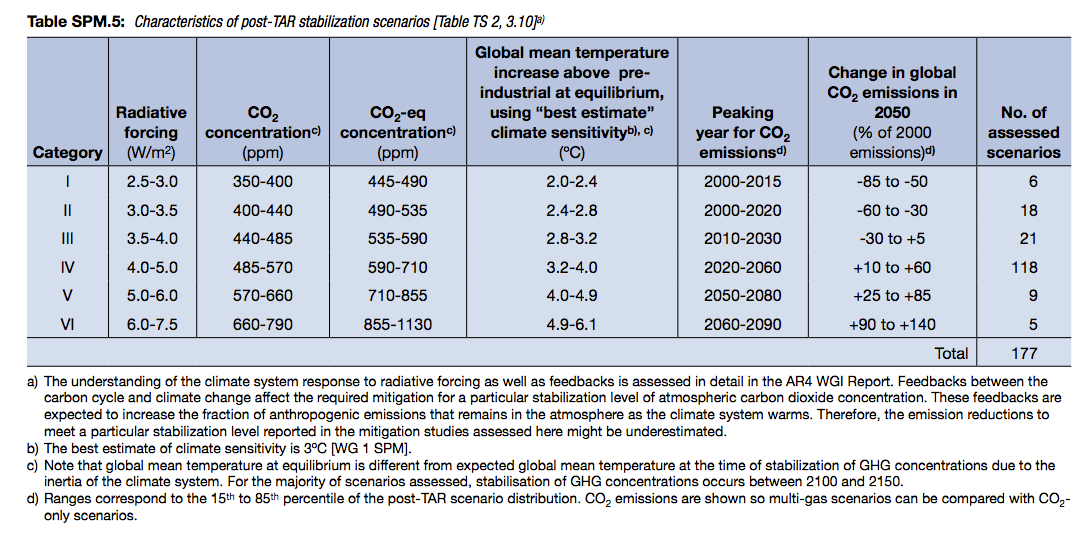
Thus problem #1 is that this article never should have been written, and doing so was a great example of irresponsible journalism, as climate scientist Kevin Trenberth told Climate Progress.  Problem #2 is that The Economist’s interpretation of the information from the draft IPCC report is wrong.  A similar table is shown in the 2007 IPCC Fourth Assessment Report (AR4) (Table SPM.5):

Table SPM.5

Read more…

6 comments


Science does inform policy making … sometimes

Posted on 18 July 2013 by gws

When I was a graduate student in the 1990s I attended many scientific seminars. I recall very few of them. One, however, stuck with me because it was revealing about the attitudes of some business people towards important scientific findings. In this case, it was about the infrared (IR) absorption properties of fluorinated hydrocarbons. The Montreal protocol was just a few years old at the time and scientists were looking into the future, investigating the possible effects of replacing those ozone depleting substances (ODSs) with new refrigerants, blowing agents, aerosol sprays, etc. At the end of her talk about those fluorocarbons and their future effects on climate the speaker was asked what the industry thought about her results. She shrugged, then indicated that they knew but did not care.

The science was clear at the time. As early as the 1970s, scientists showed that chlorofluorocarbons (CFCs) were not only a problem for the ozone layer, but that they possessed a property that made them powerful greenhouse gases: the chemical bond between carbon and fluorine is absorbing infrared radiation at wavelengths in a region called the atmospheric window (Figure 1). In this wavelength region, most infrared radiation from Earth’s surface escapes into space. In other words, from space Earth appears very bright at these wavelengths to someone with infrared vision, and darker the more IR radiation is absorbed in the atmosphere. As a result, an atmospheric gas able to absorb anywhere in that “window” has plenty of energy available.

AtmoTransWavelength

Read more…

2 comments


2013 SkS Weekly News Roundup #29A

Posted on 17 July 2013 by John Hartz

· Australian leader scraps tax on carbon emissions

· Caribbean launches new tool to deal with climate change

· CIA backs study on controlling global climate

· Climate change outpaces evolution

· Investors should strike while the planet is not too hot

· Models point to rapid sea-level rise from climate change

· Obama climate change plan faces long road ahead

· The costs of climate change and extreme weather in the U.S

· The forecast for 2018 is cloudy with record heat

· Tony Abbott caught dog-whistling to climate change denialists

· We are all climate change deniers

· Why don’t U.S. farmers believe in climate change?

Australian leader scraps tax on carbon emissions

Prime Minister Kevin Rudd of Australia announced a plan Tuesday to replace a deeply unpopular tax on carbon emissions with a market-based trading system a full year ahead of schedule.

The decision to scrap the politically toxic tax, which narrowly passed into law with the support of the minority Greens Party, is the most significant policy change unveiled by Mr. Rudd since he regained the leadership of the nation from Julia Gillard in a party coup last month. The announcement comes as a raft of new polls show his Labor Party running neck and neck with the opposition for elections scheduled for Sept. 14.

Australian Leader Scraps Tax on Carbon Emissions by Matt Siegel, New York Times, July 16, 2013

Read more…

5 comments


Debunking New Myths about the 97% Expert Consensus on Human-Caused Global Warming

Posted on 17 July 2013 by dana1981

A survey of over 12,000 peer-reviewed climate science papers by our citizen science team at Skeptical Science found a 97% consensus among papers taking a position on the cause of global warming in the peer-reviewed literature that humans are responsible.  Not surprisingly, our results have been subject to attacks from those who would prefer to continue to deny the reality of the expert consensus on human-caused global warming.

For example, on Sunday July 14th, 2013, Andrew Neil hosted UK Energy and Climate Change Secretary Ed Davey on the BBC show Sunday Politics.  Rather than discussing politics, Neil began the show by misrepresenting our consensus paper, making several false statements about it within the first 2 minutes of the show.

Read more…

13 comments


Carbon Dioxide’s invisibility is what causes global warming

Posted on 16 July 2013 by John Cook

Australia’s leader of the opposition Tony Abbott recently derided an emission trading scheme as “so-called market in the non-delivery of an invisible substance to no one”. This echoes an earlier statement where Abbott dismissed carbon dioxide as an “invisible, odourless, weightless, tasteless substance”. In this modern age, most people are aware of how something that is invisible to the eye can nevertheless have a significant impact. Examples include radiation from radioactive material, germs and well, gravity. In the case of carbon dioxide, it is actually its invisibility that is the key factor in how it causes global warming.

When sunlight reaches the Earth, it passes through our atmosphere. Greenhouse gases such as carbon dioxide are invisible to sunlight, also known as shortwave radiation because of its short wavelength. This allows the sunlight to pass through the atmosphere unhindered by greenhouse gases, and warm the Earth’s surface.

The warm surface of the Earth radiates infrared heat, also known as longwave radiation because of its long wavelength. Greenhouse gases absorb longwave radiation. This results in the atmosphere trapping some of the Earth’s heat as it tries to escape out to space. Heat-trapping gases such as carbon dioxide make the atmosphere warmer than it would be without any greenhouse gases.

Currently, we are adding greenhouse gases to the atmosphere through the burning of fossil fuels. As more greenhouse gases accumulate in the atmosphere, more heat is being trapped. This causes global warming. Consequently, the fact that carbon dioxide lets sunlight pass freely through the atmosphere is an integral aspect of the greenhouse effect. Carbon dioxide’s invisibility is a key part of what causes global warming.

http://www.skepticalscience.com/graphics/CO2_invisibility_med.jpg

Read more…

24 comments


They didn’t change the name from ‘global warming’ to ‘climate change’

Posted on 16 July 2013 by gpwayne

This post is a new ‘basic’ level rebuttal of the skeptical argument: “They changed the name from ‘global warming’ to ‘climate change’“

What The Science Says: The terms ‘global warming’ and ‘climate change’ have been used interchangeably for several decades.

What do these terms really mean?

Before we talk about the ‘name-change’ myth, it is worth considering what the terms actually mean.

‘Global warming’ is the temperature increase produced by adding greenhouse gases to the atmosphere. Energy arrives from the sun in the form of visible light and ultraviolet radiation.  The Earth then emits some of this energy as infrared radiation, which is prevented from radiating into space by greenhouse gases (GHGs). Just a tiny amount of GHGs – less than 1% of the atmosphere – keep the Earth around 33°C (59.4°F) warmer than it would be without them.

Greenhouse gases act like a blanket, keeping in some of the sun’s warmth. Increasing the amount of GHGs through burning fossil fuels is like wrapping the Earth in a thicker blanket. This increase is ‘global warming’:

http://www.skepticalscience.com/graphics/Temperature_Composite_500.jpg

Read more…

8 comments


Global warming games – playing the man not the ball

Posted on 15 July 2013 by John Abraham

I hate to talk about myself, so this first part will be short. A little biography is necessary to set the stage for this post. A few years ago, I heard well-known climate contrarian Christopher Monckton speak on human-caused climate change. Monckton has been a favorite hero of the anti-science movement and, for the rest of us, a source of amusement as he travels the world reciting basic scientific errors and misrepresenting his own credentials.

After hearing Monckton’s lecture, I posted a detailed rebuttal online showcasing his mischaracterization of the science and his obvious and elementary errors. In response, my university and I received a 99-page complaint letter, which ended with a request to pay $110,000 to the United States Association of the Sovereign Military Order of Malta. This was followed by attacks against me by Marc Morano, who was kind enough to publicly post my contact information on his website. Monckton went on to encourage listeners of the radical Alex Jones show to write to my university administration to “investigate” me.

What ever happened to that whole episode? Not much. A few hate messages that appear in my mailbox from time to time. They are easy to spot because they never have a return address and their speeling and punctuation,,, is just terrble! And has Monckton ever followed through with his promised? Nope… I am still waiting. This whole event, as a colleague told me, was the bite of a toothless Chihuahua. It helped that my University stood beside me and was not bullied by this sideshow.

My colleagues, however, have endured far worse attacks by the anti-science crowd. Take, for instance, Dr. Ben Santer and the attacks leveled against him in The Wall Street Journal. Or how about the numerous attacks against Dr. Michael Mann? He has been viciously attacked on blogs and in far right-wing media as his work on paleoclimate has been held up as the face of climate change.

Read more…

14 comments


2013 SkS Weekly Digest #28

Posted on 14 July 2013 by John Hartz

SkS Highlights

Empirical evidence that humans are causing global warming, a new basic level rebuttal by gpwayne, generated the loudest comment thread buzz of the articles posted this past week. Given how loudly the deniers beat the drum of the myth, “There is no actual empirical evidence that carbon dioxide emissions are causing global warming,” the interest in this post is not surprising.

Toon of the Week

2013 Toon 28

H/T to I Heart Climate Scientists Facebook page.

Read more…

0 comments


2013 SkS Weekly News Roundup #28B

Posted on 13 July 2013 by John Hartz

· Acidic oceans of the future show extinction

· Dangerous global warming could be reversed

· Fossil fuel addiction could trigger runaway global warming

· How water scarcity could jack up Europe’s power prices

· Insect discovery sheds light on climate change

· Japan braces for exceptionally hot summer

· Pumping water underground could trigger major earthquake

· Recessions make climate change costlier

· The global outlook for renewable power in one graph

· Wildfires may have bigger role in global warming

Acidic oceans of the future show extinction

Ocean acidification may create an impact similar to extinction on marine ecosystems, according to a study published Monday

The study, exploring naturally acidic waters near volcanic vents in the Mediterranean Ocean off Italy, suggests that ocean acidification as a result of human emissions can degrade entire ecosystems – not just individual species, as past studies have shown.

The result, scientists say, is a homogenized marine community dominated by fewer plants and animals.

Acidic oceans of the future show extinction, The Daily Climate, July 9, 2013

Read more…

1 comments


Patrick Michaels: Cato’s Climate Expert Has History Of Getting It Wrong

Posted on 13 July 2013 by dana1981

This is a re-post of a devastating debunking of Patrick Michaels‘ history of wrong climate predictions by Shauna Theel at Media Matters.

http://www.skepticalscience.com/pics/Predictions_150.jpgA review of claims made by the Cato Institute’s Patrick Michaels over the last quarter century shows that he has repeatedly been proven wrong over time. Michaels is one of a few contrarian climate scientists who is often featured in the media without disclosure of his funding from the fossil fuel industry.

Patrick Michaels’ Losing Bets

On Temperature Trends

Michaels “Bet” In 1999 There Would Be A “Statistically Significant Cooling Trend” From 1998 To 2008. In a Cato post that was later published as a Washington Times op-ed, according to Nexis, Patrick J. Michaels wrote that he would place a “bet” that “the 10 years ending on December 31, 2007, will show a statistically significant global cooling trend in temperatures measured by satellite”:

I’m willing to wager two things. First, I’ll bet that anyone who said global warming is an overblown bunch of hooey had a terrible time at this year’s holiday cocktail parties. Second, I’ll take even money that the 10 years ending on December 31, 2007, will show a statistically significant global cooling trend in temperatures measured by satellite.

[…]

Last year was so warm that it induces a statistically significant warming trend in the satellite data. Thus the second bet: Starting with 1998, there will almost certainly be a statistically significant cooling trend in the decade ending in 2007. [Cato, 1/18/99]

Satellite Records For That Decade Showed No Statistically Significant Trend. From 1998 to 2008, the University of Alabama in Huntsville satellite record shows a warming trend that is not statistically significant at the 95 percent level (a warming of 0.074°C per decade plus or minus 0.439°C). The Remote Sensing Systems satellite record shows a cooling trend that is not statistically significant at the 95 percent level (a change in temperature of -0.053°C per decade plus or minus 0.425 °C). The three surface temperature records showed a “warming trend” for that time period according to a Skeptical Science report on a 2008 paper by the Australian Bureau of Meteorology. [Calculated using Skeptical Science’s Temperature trend calculator, 7/1/13] [Skeptical Science, 1/10/13]

Michaels’ New Bet: “We Are Going To Go Nearly A Quarter Of A Century Without Warming.” In a Washington Times op-ed in January 2013, Michaels stated “it’s a pretty good bet that we are going to go nearly a quarter of a century without warming.” [The Washington Times, 1/17/13]

Read more…

49 comments


Climate Change and the Nature of Science: The Carbon “Tipping Point” is Coming

Posted on 12 July 2013 by Micha Tomkiewicz

A guest post by Professor Micha Tomkiewicz, reposted with permission from Climate Change Fork.

http://climatechangefork.blog.brooklyn.edu/files/2012/06/graph-1-june-25-blog1.jpg

http://climatechangefork.blog.brooklyn.edu/files/2012/06/graph-2-june-25-blog1.jpg

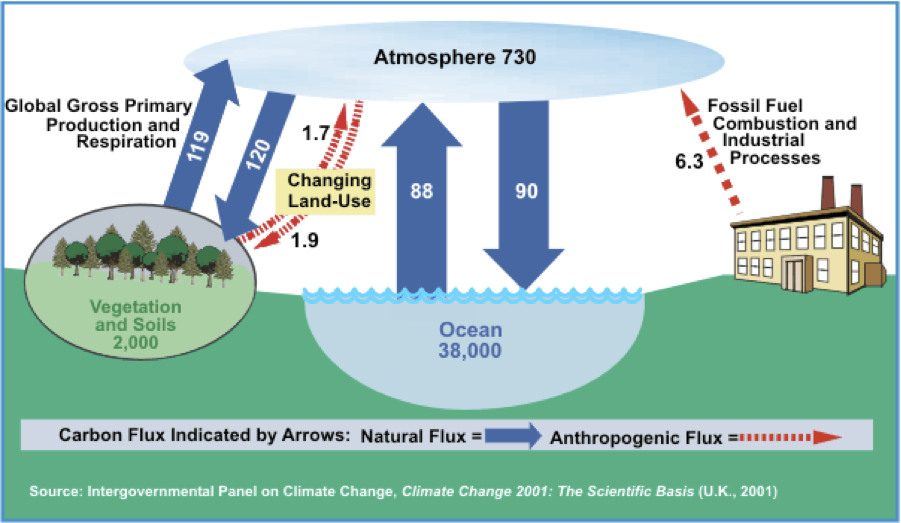
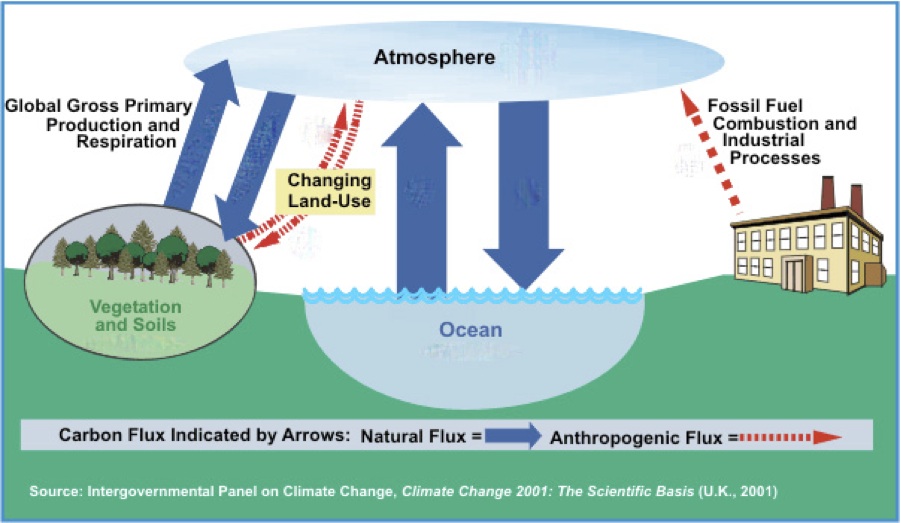
The two attached pictures are schematic diagrams of the circulation of carbon on Earth (IPAA Report (2001) – the Carbon Cycle).  If I Google “Carbon Cycle Diagram” in the image mode, I get close to a million entries.  Most of these entries look like the second image – not the first.  What is the difference?  The second one doesn’t have numbers (photoshopping on my part).

The numbers in the arrows of the first image represent fluxes of carbon per year in units of billion tons of carbon.  The numbers outside the arrows represent quantities in the same units of billion tons of carbon. The man-made (anthropogenic) contributions are shown by the dashed red arrows.

Read more…

14 comments


2013 SkS Weekly News Roundup #28A

Posted on 11 July 2013 by John Hartz

· American leadership on climate change

· Another Wall Street Journal article misses the target

· Climate change could make hurricanes stronger

· Climate change could spark small mammal invasion

· European capacity to grow food is plateauing

· Hurricanes are getting stronger in the Caribbean

· Krauthammer’s climate crack-up

· U.S., China unveil joint climate initiatives

· Use of coal to generate power rises in U.S.

· We are all aboard the Pequod

· Will more U.S. conservatives experience a ‘metamorphosis’?

· Yogi Berra and emerging ‘memes’ post-Obama climate speech

American leadership on climate change

Here’s a sure sign the U.S. is starting to get serious about climate change: some newspaper columnists are playing Chicken Little again. The latest case in point is Charles Krauthammer, who used his syndicated column last week to claim that the Obama Administration’s sensible plan to reduce carbon pollution amounts to “economic suicide.”

American Leadership on Climate Change by Fred Krupp, The Huffington Post, July 9, 2013

Read more…

3 comments


129°F is Close But No Cigar

Posted on 11 July 2013 by Rob Honeycutt

Everyone’s been talking about the heat this past week.  In article after article in the MSM the statement has been made:  “According to the NWS the highest temperature ever recorded was 134°F on July 10,1913 at Greenland Ranch, CA.”  Greenland Ranch is now the more widely known Furnace Creek CA station at the Visitor Center for Death Valley.

There were also some random reports that Furnace Creek actually beat the previous 134°F with a new record of 135.5°F.  The official temperature on June 30, according to NWS, was 129.2°F.

Some alarm bells went off reading that the highest recorded temperature was in 1913.  Let’s be skeptical on all sides and see where this leads us.

On the Weather Underground website I looked up the 1913 record and found the following footnote:

“The temperature of 134°F reported from Greenland Ranch on July 10, 1913 is most surely unreliable as is most of the pre-1920 Greenland Ranch heat data. The instrument shelter was unusually low to the ground and many of the record forms are inconsistent with other relevant stations and existing weather conditions. The hottest reliable temperature measured in Death Valley is 129°F which has occurred on four occasions: at Greenland Ranch on Jul. 20, 1960 and at Furnace Creek on Jul. 18, 1998, Jul. 20, 2005, and Jul. 7, 2007.These are also the hottest temperatures ever reliably measured anywhere in the world. For further discussion of the Greenland Ranch heat data see XXXXX. Amos (Mammoth Tank) recorded 130°F in Aug. 1887 but is most likely not a reliable reading.”

So, it seems there might be some question about the validity of that figure.  We’re not going to rule it out yet, just take it with a pinch of salt.

To get a general idea of the distribution of record high temps I pulled together a quick list of annual record high temps for the US since 1915 (because that’s what was most easily available on Weather Underground).  I converted the temps to Celsius to group them a little better, and this was the result.

http://www.skepticalscience.com/pics/record-highs.png

Read more…

0 comments


Charles Krauthammer’s flat-earther global warming folly

Posted on 10 July 2013 by dana1981

Fox News commentator Charles Krauthammer recently wrote an opinion piece that was published by many media outlets including The Washington Post, claiming that President Obama’s Climate Action Plan is a “folly.” In fact, the real follies lie in Krauthammer’s arguments.

Krauthammer’s article begins in a schizophrenic manner, claiming that “Global temperatures have been flat for 16 years — a curious time to unveil” a climate action plan, but then admitting that this “doesn’t mean there is no global warming.” Indeed it does not. In fact, over the past 16 years, the planet has accumulated an amount of heat equivalent to about 2 billion Hiroshima atomic bomb detonations. Krauthammer objects to the President’s comment that “We don’t have time for a meeting of the Flat Earth Society,” because we don’t understand everything about the Earth’s climate, like exactly why surface temperatures have warmed relatively slowly over the past 16 years (though we do have a good idea).

Of course, the choice of the 16-year window is a juicy cherry pick. It puts the starting point right at the formation of the 1997–1998 El Niño, one of the strongest in the past century. During El Niño events, heat is transferred from the oceans to the air, causing abnormally hot surface temperatures. Focusing on the slow surface air warming over the past 16 years is like arguing that your car is broken because it slowed down as you approached a stop sign. Krauthammer is focusing on an unrepresentative period during which the overall warming of the planet continued, but less heat was used in warming the air, and more in warming the ocean. However, climate research suggests that this is just a temporary change, and surface air warming will soon accelerate again.

Krauthammer also complains that “flat-earthers like Obama” have blamed heat waves on human-caused global warming. Indeed, recent research has shown that Australian heat waves and record-breaking monthly temperature records in general are now five times more likely to occur due to global warming, with much more to come. Papers have concluded that several individual heat records, like those in Texas and Oklahoma in 2011 and Moscow in 2010, would not have been broken if not for human-caused global warming. The video below from NASA shows how the distribution of summer temperatures has shifted towards hotter values over the past 60 years, making these heat records more likely to occur.

Read more…

15 comments


Empirical evidence that humans are causing global warming

Posted on 9 July 2013 by gpwayne

This post is a new ‘basic’ level rebuttal of the myth: “There is no actual empirical evidence that carbon dioxide emissions are causing global warming.”

What the Science Says: Less energy is escaping to space. Carbon dioxide (CO2) acts like a blanket; adding more CO2 makes the ‘blanket’ thicker

It is the Earth’s atmosphere that makes most life possible. To understand this, we can look at the moon. On the surface, the moon’s temperature during daytime can reach 100°C (212°F). At night, it can plunge to minus 173°C, or -279.4°F. In comparison, the coldest temperature on Earth was recorded in Antarctica: −89.2°C (−128.6°F). According to the WMO, the hottest was 56.7°C (134°F), measured on 10 July 1913 at Greenland Ranch (Death Valley).

Man could not survive in the temperatures on the moon, even if there was air to breathe. Humans, plants and animals can’t tolerate the extremes of temperature on Earth unless they evolve special ways to deal with the heat or the cold. Nearly all life on Earth lives in areas that are more hospitable, where temperatures are far less extreme.

Yet the Earth and the moon are virtually the same distance from the sun, so why do we experience much less heat and cold than the moon? The answer is because of our atmosphere. The moon doesn’t have one, so it is exposed to the full strength of energy coming from the sun. At night, temperatures plunge because there is no atmosphere to keep the heat in, as there is on Earth.

Read more…

94 comments


The Consensus Project self-rating data now available

Posted on 8 July 2013 by John Cook

I’ve just uploaded the ratings provided by the scientists who rated their own climate papers, published in our peer-reviewed paper “Quantifying the consensus on anthropogenic global warming in the scientific literature“. This is an opportunity to highlight one of the most important aspects of our paper. Critics of our paper have pointed to a blog post that asked 7 scientists to rate their own papers. We’d already done that, except rather than cherry pick a handful of scientists known to hold contrarian views, we blanket emailed over 8,500 scientists. This resulted in 1,200 scientists rating the level of endorsement of their own climate papers, with 2,142 papers receiving a self-rating.

While our analysis of abstracts found 97.1% consensus among abstracts stating a position on anthropogenic global warming (AGW), the method of self-rating complete papers independently found 97.2% consensus among papers self-rated as stating a position on AGW. This independent confirmation demonstrates how robust the scientific consensus is. Whether it’s Naomi Oreskes‘ original analysis of climate research in 2004, Doran and Kendall-Zimmerman (2009) surveying the community of Earth scientists, Anderegg et al. (2010) analysing public declarations on climate change, or our own independent methods, the overwhelming consensus consistently appears.

http://www.skepticalscience.com/graphics/Figure_3_col_med.jpg

Figure 1: Percentage of climate papers stating a position on AGW that endorse human-caused global warming. Year is the year of publication.

Read more…

13 comments


Climate Change Denial now available as Kindle ebook

Posted on 8 July 2013 by John Cook

Climate Change Denial by Haydn Washington and John CookSince April 2011 when Haydn Washington and I launched our book Climate Change Denial: Heads in the Sand, people have been asking me when the book will be available in ebook format. For two years, I’ve been answering “soon”. Finally, I can answer “now”! The Kindle Edition of Climate Change Denial is now available at the Amazon store.

Our book examines the phenomenon of climate change denial. It looks at the many techniques of literal denial, where ‘skeptics’ deny the evidence for man-made global warming. It exposes denial within governments, who make a lot of noise about climate change but fail to back it up with action. And it examines the denial within most of us, when we let denial prosper. This book explains the climate science and the social science behind denial.

Climate change can be solved – but only when we cease to deny that it exists. This book shows how we can break through denial, accept reality, and thus solve the climate crisis.

Our book was designed to engage scientists, university students, climate change activists as well as the general public seeking to roll back denial and act. It’s been pleasing to see that over the past few years, the book has been cited extensively in the peer-reviewed literature (30 times according to Google Scholar). To recap, here are reviews of our book:

Read more…

10 comments


2013 SkS Weekly Digest #27

Posted on 7 July 2013 by John Hartz

SkS Highlights

John Cook and Dana’s 4 Hiroshima bombs worth of heat per second metaphor has become a  “sticky image” worldwide. Needless to say, it garnered the highest number of comments of all the articles posted on SkS during the past week. If you have not yet read the article, you will want to do so. Toward the end of the article, John throws down the guantlet to all readers to come up with a stickier metaphor. To date, none of the commentors have done so.

Toon of the Week

2013 Toon 26

Read more…

0 comments


2013 SkS Weekly News Roundup #27B

Posted on 7 July 2013 by John Hartz

· Climate change alters soil bacteria distribution

· Climate change planning, prevention needed

· Climate change will hurt GOP appeal to young voters

· ‘Gasland‘ sequel accuses industry of corrupting government

· Global food supply under threat

· Has the Republican Party stopped denying climate science

· Summer bummer for your Fourth of July?

· The elements of destruction

· Trapping carbon dioxide underground: can we do it?

· World’s largest offshore windfarm opens in Thames estuary

Climate change alters soil bacteria distribution

A warmer planet means that heat-seeking microbes will elbow out those that prefer life a bit more chilly, with unknown effects on the planet’s ecology. Karen Hopkin reports.

Climate Change Alters Soil Bacteria Distribution by Karen Hopkin, Scientific American, July 7, 2013

Read more…

1 comments


2013 SkS Weekly News Roundup #27A

Posted on 6 July 2013 by John Hartz

· Antarctic flood produces ‘ice crater’

· Climate change, pipelines and Alberta floods

· El Nino was unusually active in possible link to climate change

· European Parliament acts to support emissions trading system

· Global warming trend and variations charted by cello

· Hotter, drier West (U.S) faces more huge fires

· Is environmental action impossible in corporate-dominated age?

· It’s climate change: I told you so

· Koch pledge tied to Congressional climate inaction in U.S.

· Obama seeks new U.S. role in climate debate

· UN charts “unprecedented” global warming since 2000

· UN Green Climate Fund ready by 2014

Antarctic flood produces ‘ice crater’

Scientists have seen evidence for a colossal flood under Antarctica that drained six billion tonnes of water, quite possibly straight to the ocean.

Antarctic flood produces ‘ice crater’ by Jonathan amos, BBC News, July 2, 2013

James Hansen: Fossil fuel addiction could trigger runaway global warming

http://www.guardian.co.uk/environment/earth-insight/2013/jul/10/james-hansen-fossil-fuels-runaway-global-warming

James Hansen: Fossil fuel addiction could trigger runaway global warming

Without full decarbonisation by 2030, our global emissions pathway guarantees new era of catastrophic climate change

Nasa image of planet Earth

Nasa image of planet Earth. Photograph: Ho/Reuters

The world is currently on course to exploit all its remaining fossil fuel resources, a prospect that would produce a “different, practically uninhabitable planet” by triggering a “low-end runaway greenhouse effect.” This is the conclusion of a new scientific paper by Prof James Hansen, the former head of NASA‘s Goddard Institute for Space Studies and the world’s best known climate scientist.

The paper due to be published later this month by Philosophical Transactions of the Royal Society A (Phil. Trans. R. Soc. A) focuses less on modelling than on empirical data about correlations between temperature, sea level and CO2 going back up to 66 million years.

Given that efforts to exploit available fossil fuels continue to accelerate, the paper’s principal finding – that “conceivable levels of human-made climate forcing could yield the low-end runaway greenhouse effect” based on inducing “out-of-control amplifying feedbacks such as ice sheet disintegration and melting of methane hydrates” – is deeply worrying.

The paper projects that global average temperatures under such a scenario could eventually reach as high as between 16C and 25C over a number of centuries. Such temperatures “would eliminate grain production in almost all agricultural regions in the world”, “diminish the stratospheric ozone layer”, and “make much of the planet uninhabitable by humans.”

Hansen and his co-authors find that:

“Estimates of the carbon content of all fossil fuel reservoirs including unconventional fossil fuels such as tar sands, tar shale, and various gas reservoirs that can be tapped with developing technology imply that CO2 conceivably could reach a level as high as 16 times the 1950 atmospheric amount.”

They calculate that there is “more than enough available fossil fuels” to generate emissions capable of unleashing “amplifying feedbacks” that could trigger a “runaway” greenhouse effect “sustained for centuries.” Even if just a third of potentially available fossil fuel resources were exploited, calculations suggest, this scenario would still be guaranteed, meaning decisions we make this century will determine the fate of generations to come.

James Hansen‘We don’t have a leader who is able to grasp [the issue] and say what is really needed. Instead we are trying to continue business as usual,’ said James Hansen in 2009. Photograph: Gareth Fuller/PA

“Governments are allowing and encouraging fossil fuel companies to go after every conceivable fuel”, said Hansen, “which is an obtuse policy that ignores the implications for young people, future generations and nature. We could make substantial parts of the Earth uninhabitable.”

The conclusions of Hansen’s latest paper are stark:

“Most remaining fossil fuel carbon is in coal and unconventional oil and gas. Thus, it seems, humanity stands at a fork in the road. As conventional oil and gas are depleted, will we move to carbon-free energy and efficiency – or to unconventional fossil fuels and coal?

… It seems implausible that humanity will not alter its energy course as consequences of burning all fossil fuels become clearer. Yet strong evidence about the dangers of human-made climate change have so far had little effect. Whether governments continue to be so foolhardy as to allow or encourage development of all fossil fuels may determine the fate of humanity.”

The new paper by James Hansen is just the latest confirming that we are on the verge of crossing a tipping point into catastrophic climate change. Other recent scientific studies show that the current global emissions trajectory could within three years guarantee a 2C rise in global temperatures, in turn triggering irreversible and dangerous amplifying feedbacks.

According to a scientific paper given at the Geological Society of London last month, climate records from Siberian caves show that temperatures of just 1.5C generate “a tipping point for continuous permafrost to start thawing”, according to lead author Prof Anton Vaks from Oxford University’s Department of Earth Sciences. Conventional climate models suggest that 1.5C is just 10-30 years away.

Permafrost thawing releases sub-ice undersea methane into the atmosphere – a greenhouse gas twenty times more potent that carbon dioxide. In June, NASA’s new five-year programme to study the Arctic carbon cycle, Carbon in Arctic Reservoirs Vulnerability Experiment (CARVE), declared:

“If just one percent of the permafrost carbon released over a short time period is methane, it will have the same greenhouse impact as the 99 percent that is released as carbon dioxide.”

Another paper suggests that conventional climate modelling is too conservative due to not accounting for complex risks and feedbacks within and between ecosystems. The paper published in Nature last Wednesday finds that models used to justify the 2C target as a ‘safe’ limit focus only on temperature rise and fail to account for impacts on the wider climate system such as sea level rise, ocean acidification, and loss of carbon from soils. It concludes that the 2C target is insufficient to avoid dangerous climate change.

The problem is that our current global emissions trajectory already commits us to a 2C rise anyway. Papers published by the Royal Society in 2011 showed that emissions pledges would still put the world on track for warming anywhere between 2.5C and 5C – and that a failure to deliver these pledges could see global temperatures rise by 7C by 2100. Amongst them, a Met Office study concluded that strong amplifying feedbacks – such as the oceans’ reduced ability to absorb atmospheric carbon dioxide leading to further warming – could see us reach 4C as early as 2060.

But as Hansen explained in a recent interview:

“Four degrees of warming would be enough to melt all the ice… you would have a tremendously chaotic situation as you moved away from our current climate towards another one. That’s a different planet. You wouldn’t recognise it… We are on the verge of creating climate chaos if we don’t begin to reduce emissions rapidly.”

After the last round of climate talks in Doha, a report by Climate Action Tracker concluded that the world is currently on path to see warming of 3C by 2040, triggering the melting of the Greenland ice sheet and Arctic permafrost.

This was corroborated last month by the International Energy Agency (IEA), which found that even with current climate policies in place, we are locked into a rise of between 2C and 5.3C. Two years ago, the IEA concluded that we had five years left to implement urgent energy reforms after which we would no longer be able to avoid dangerous climate change. We are now three years away from that point-of-no-return.

To make matters worse, the IEA’s analysis is based on conventional models which do not fully account for amplifying feedbacks such as methane releases from permafrost thawing. The IPCC’s forthcoming Fifth Assessment Report, like its predecessors, will specifically exclude the permafrost carbon feedback from its projections.

The implication is that policymakers are riding blind – we do not really know how close we are to a tipping point into catastrophe.

There is a solution. According to Hansen, we need to focus on a maximum target of 1C. “The goal of keeping warming close to 1C is to keep climate close to the Holocene range, thus avoiding any major amplifying feedbacks,” he said.

“The 1C goal requires rapid phase out of fossil fuel emissions, which would require a rising carbon fee. To continue to burn every fuel that can be found is the opposite approach – they are day and night.”

Such a rapid fossil fuel phaseout was proposed to the Parliamentary Environment Audit Committee early last year in the form of complete decarbonisation of power by 2030. Unfortunately, the UK bill to that effect was narrowly defeated in the House of Commons last month.

There is still hope – the bill is currently up for consideration by the House of Lords. If the bill eventually passes, Britain might still play a leading role in heralding the energy revolution that could help save the planet, while saving the nation up to £100 billion.

Dr Nafeez Ahmed is executive director of the Institute for Policy Research & Development and author of A User’s Guide to the Crisis of Civilisation: And How to Save It among other books. Follow him on Twitter @nafeezahmed

Dangerous global warming could be reversed, say scientists

http://www.guardian.co.uk/environment/2013/jul/11/dangerous-global-warming-reversed-scientists

Dangerous global warming could be reversed, say scientists

A combination of burning trees for energy and capturing and storing carbon dioxide could offset and even reverse emissions

Path of global warming

The bioenergy and CCS method is the most cost-effective way of tackling carbon emissions, say scientists. Photograph: Vinay Dithajohn/EPA

Global warming could be reversed using a combination of burning trees and crops for energy, and capturing and storing carbon dioxide underground (CCS), according to an analysis by scientists. But experts cautioned that trying such an approach after temperatures had passed dangerous levels could be problematic, as climate change reduced the number of trees available for “bioenergy”.

The bioenergy and CCS method was the most cost-effective way of tackling carbon emissions, said the team at Chalmers University of Technology in Sweden, publishing their research in the journal Environmental Research Letters on Thursday. Such an approach could offset and even reverse other emissions from fossil fuels, they claimed.

The lead author of the study, Prof Christian Azar, said it could help bring temperatures down even if they rose above the 2C level that world leaders have agreed to avoid: “Even if current political gridlock causes global warming in excess of 2C, we can reverse the temperature trend and reach targets later. This means that 2C targets, or even more ambitious targets, can remain on the table in international climate negotiations.”

He said that to achieve a reversal of temperatures, the combination of bioenergy and CCS would need to be combined with a huge expansion in renewable energy or nuclear power, in order to reduce emissions almost to zero. He also admitted that there was a political risk that the proposal’s ability to reverse rises at a late stage could be used as an excuse for short-term inaction on emissions.

CCS technology has been tested successfully on small-scale trials, but is still unproven at commercial scale anywhere in the world. Environmentalists have also questioned the carbon benefits of burning trees for power, saying that in some cases the “lifecycle” emissions are worse than coal.

Dr Vivian Scott of Scottish Carbon Capture Storage at the University of Edinburgh, who was not involved with the research, said that the basis for the research’s conclusion was sound, but he warned it should not be interpreted “as a ‘get out of jail free’ card in 50 years’ time” and the idea could be hamstrung by climate change itself.

“As shown in this work, Beccs [Bioenergy with Carbon Capture and Storage] could offer a way back from exceeding climate targets. However, there are potentially huge consequences to allowing an overshoot [of those targets]. A warmer climate for even a limited period could profoundly alter meteorological and ecological systems – changes which could perhaps even restrict the ability to produce the biomass on which we might be reliant to reduce the atmospheric carbon dioxide content,” he said.

He also said that reducing carbon emissions to zero could be a major challenge, given the track record of previous efforts to cut carbon: “Progress in addressing emissions has been woefully slow – the International Energy Agency recently announced that the average amount of carbon dioxide produced for each unit of energy generated has barely changed in the period 1990 – 2010 … in essence all the emissions mitigation efforts to date have achieved almost nothing”.

Carbon dioxide cuts cannot be solution to global warming

Article Comments: Jun 22nd 2013
3:52pm

HKU’s Prof Wyss gets it half right:


Water vapor significance in climate change
www.nasa.gov/topics/earth/features/vapor_warming.html


www.csiro.au/en/Outcomes/Climate/Climate-Change-Water-Vapour.aspx

‘While there is far more water vapor in the atmosphere than other greenhouse gases, the other greenhouse gases play an important role in influencing our climate. The increase in anthropogenic greenhouse gases is largely responsible for the observed warming of 0.74°C over the 20th century. This warming has had a ‘positive feedback’ as a warmer atmosphere can hold more water vapor – enhancing human induced warming by about 50 per cent.’

However just take a look at the readings for Tap Mun on the EPD website-an island with no trucks and massive NOx readings. Our major polluter in HKG is shipping + prevailing winds R easterlies hence the NOx and SOx on Tap Mun. The previous incompetent administration did zero to prohibit local sales of high sulfur bunker fuel nor to negotiate the imposition of an Emissions Control Zone in our waters which are the busiest in the world passing to Shenzhen and Shanghai as well as our port and southwards. Our diesel truck fuel is limited in parts per million sulfur yet bunker fuel is 2.75 -4% sulfur. USA has a 200 nautical mile ECA and the Baltic and North sea also have ECAs whereas here we were stuck with abuser Tsang and useless frequent flyer Edward Yau. OGV’s all carry dual tanks + they should be forced to use Lo sulfur fuel in our waters.

South China Morning Post

Published on South China Morning Post (http://www.scmp.com)

Home > Carbon dioxide cuts cannot be solution to global warming


Carbon dioxide cuts cannot be solution to global warming

Saturday, 22 June, 2013, 12:00am

Comment› Letters

Tania Willis’ letter (“Personal action now unavoidable to halt planet’s destruction”, June 1) quoted Al Gore and Jim Hansen in labelling carbon dioxide as the primary global warming pollutant. She has fallen short in showing why the 7.2 million people in Hong Kong must hold their breath because of the undesirable consequences claimed by her.

“Climate Change: A Summary of the Science”, based on the consensus opinion of Royal Society scientists and issued in September 2010, provides the best synopsis on the current science on climate change.

It shows where the science is well established and where there remains substantial uncertainty.

Measurements from the earth’s surface and space, together with modelling, show that, in addition to clouds, the gases that make the largest contribution to the greenhouse effect are water vapour, followed by carbon dioxide. There are smaller contributions from many other gases, including ozone, methane, nitrous oxide and chlorofluorocarbons.

Therefore the effectiveness of reducing the second most important greenhouse gas carbon dioxide alone is questionable. Carbon dioxide alarmists must also explain:

Why carbon dioxide is labelled as a pollutant when it is an essential, life-supporting part of earth’s ecosystem;

Why the current 400 parts per million level of atmospheric carbon dioxide is more important to global temperatures than clouds and water vapour;

Why global temperatures failed to correlate with the steady increase in carbon dioxide levels over the past 100 years;

Why changes in carbon dioxide levels lag temperature rise by some 800 years in Antarctica ice core records spanning 800,000 years;

Why the cessation of all commercial flights over Canada and the United States for three days after the September 11 terrorist attacks increased the diurnal temperatures measured over the US by more than 1 degree Celsius (this is explained by higher daytime temperatures and lower nighttime temperatures caused by the disappearance of contrails, Water vapour being the main component of contrails);

Why temperatures measured at the Hong Kong Observatory’s headquarters are nearly always higher than at its Waglan Island station, especially at night; and

Why the observed extreme weather events are within the range of known natural variability.

Because carbon dioxide is not the main cause of global warming, reducing carbon emission cannot be the solution to limiting the potentially catastrophic impact of climate change.

Wyss Yim, Pok Fu Lam

Topics:

Global Warming


Source URL (retrieved on Jun 22nd 2013, 3:53pm): http://www.scmp.com/comment/letters/article/1266266/carbon-dioxide-cuts-cannot-be-solution-global-warming

Report: CO2 not responsible for global warming

http://dailycaller.com/2013/05/30/report-co2-not-responsible-for-global-warming/?print=1

– The Daily Caller – http://dailycaller.com –

Report: CO2 not responsible for global warming

Posted By Michael Bastasch On 11:03 PM 05/30/2013 In Daily Caller News Foundation | No Comments

Chlorofluorocarbons (CFCs) — not carbon emissions — are the real culprit behind global warming, claims a  new study out of the University of Waterloo.

“Conventional thinking says that the emission of human-made non-CFC gases such as carbon dioxide has mainly contributed to global warming. But we have observed data going back to the Industrial Revolution that convincingly shows that conventional understanding is wrong,” said Qing-Bin Lu, a science professor at the University of Waterloo and author of the study.

“In fact, the data shows that CFCs conspiring with cosmic rays caused both the polar ozone hole and global warming,” Lu said.

Lu’s findings were published in the International Journal of Modern Physics B and analyzed data from 1850 to the present.

Lu’s study runs counter to the long-standing argument that carbon dioxide emissions were the driving force behind global warming. Recently scientists warned that carbon concentrations were nearing the 400 parts per million level. Scientists say that carbon dioxide levels must be lowered to 350 ppm to avoid the severe impacts of global warming.

“The 400-ppm threshold is a sobering milestone and should serve as a wake-up call for all of us to support clean-energy technology and reduce emissions of greenhouse gases before it’s too late for our children and grandchildren,” said Tim Lueker, an oceanographer and carbon cycle researcher who is a member of the Scripps CO2 Group.

Lu notes that data from 1850 to 1970 show carbon emissions increasing due to the Industrial Revolution. However, global temperatures stayed constant.

“The conventional warming model of CO2, suggests the temperatures should have risen by 0.6°C over the same period, similar to the period of 1970-2002,” reads the study’s press release.

CFCs “are nontoxic, nonflammable chemicals containing atoms of carbon, chlorine, and fluorine” that are used to make “aerosol sprays, blowing agents for foams and packing materials, as solvents, and as refrigerants” according to the National Oceanic and Atmospheric Administration.

The Montreal Protocol phased out the production of CFCs as they were believed to be linked to ozone depletion. According to the National Institutes of Health, CFCs are considered a greenhouse gas, like carbon dioxide, because they absorb heat in the atmosphere and send some of it back to the earth’s surface, which contributes to global warming.

“From the University of Waterloo, an extraordinary claim,’ writes global warming blogger Anthony Watt. “While plausible, due to the fact that CFC’s have very high [Global Warming Potential] numbers, their atmospheric concentrations compared to CO2 are quite low, and the radiative forcings they add are small by comparison to CO2.”

“This may be nothing more than coincidental correlation,” Watt added. “But, I have to admit, the graph is visually compelling. But to determine if his proposed cosmic-ray-driven electron-reaction mechanism is valid, I’d say it is a case of ‘further study is needed’, and worth funding.”

Follow Michael on Twitter

Content created by The Daily Caller News Foundation is available without charge to any eligible news publisher that can provide a large audience. For licensing opportunities of our original content, please contact licensing@dailycallernewsfoundation.org.

——————————————————————————–

Article printed from The Daily Caller: http://dailycaller.com

URL to article: http://dailycaller.com/2013/05/30/report-co2-not-responsible-for-global-warming/

Click here to print.

Copyright © 2011 Daily Caller. All rights reserved.

Arctic ice melt forces Russian scientists to abandon research station

http://blueandgreentomorrow.com/2013/05/24/arctic-ice-melt-forces-russian-scientists-to-abandon-research-station/

Arctic ice melt forces Russian scientists to abandon research station

Rapid ice melt in the Arctic has forced a Russian crew to evacuate their research station, according to the country’s natural resources and environment ministry.

North Pole 40 is what’s called a drifting station, in that it floats naturally on top of the ice floe. But its 16 staff have been ordered to abandon their posts because the ice was beginning to melt.

Research by the National Snow and Ice Data Centre in the US last year said that sea ice in the Arctic had reached its lowest ever level since satellite observations began in 1979. It claimed that just 1.58m square miles was covered by ice – 27,000 square miles less than the previous record, set in September 2007.

Further research by NASA and the European Space Agency concluded that the remaining ice declined 36% in volume between 2003 and 2012.

The Russians have sent in an excavator to collect the stranded researchers from the station. Vladimir Sokolov of the Arctic and Antarctic Research Institute in Saint Petersburg attributed the rapid loss to climate change.

“This has made the Arctic research significantly harder – the ice has become thinner and the weather conditions more difficult”, he told Agence France-Presse.

“The Arctic Ocean, just like the Antarctic, is the refrigerator of the Earth. It significantly affects the climate of our planet.

“If this refrigerator has a glitch and we do not know about it, it leads to mistakes in forecasts and affects the quality of decision-making on entire territories.”

Russia, which is one of only eight members of the Arctic Council, has a long history of Arctic research and exploration, having set up over 40 drifting stations since 1937. North Pole 40 begun operation in October 2012 following the closure of North Pole 39 the previous month.

Oil giants including BP and Exxon Mobil were this week accused of playing ‘Russian roulette’ with investors’ money because of their links with poor performing Russian energy firms that were drilling in the Arctic.

Sharp rise in carbon dioxide levels poses major global-warming threat

Sunday, 12 May, 2013, 12:00am

News›World

GLOBAL WARMING

The New York Times

https://www.scmp.com/sites/default/files/styles/486w/public/2013/05/12/bc3c77560443b62df7da3eb445546196_0.jpg?itok=tWG9LvMW[1]

The level of the most important heat-trapping gas in the atmosphere, carbon dioxide, has passed a long-feared milestone, scientists reported, reaching a concentration not seen on the earth for millions of years.

Scientific instruments showed that the gas had reached an average daily level above 400 parts per million – a sobering reminder that decades of efforts to bring human-produced emissions under control are faltering.

The best available evidence suggests that the amount of the gas in the air has not been this high for at least three million years, before humans evolved, and scientists believe the rise portends large changes in the climate and the level of the sea.

“It symbolises that so far we have failed miserably in tackling this problem,” said Pieter Tans, who runs the monitoring programme at the National Oceanic and Atmospheric Administration that reported the new reading.

Virtually every car ride, plane trip, and in most places flip of a light switch adds carbon dioxide to the air, and relatively little money is being spent to find and deploy alternative technologies.

China is now the largest emitter, but Americans have been consuming fossil fuels extensively for far longer, and experts say the United States is more responsible than any other nation for the high level.

The new measurement came from analysers atop Mauna Loa, the volcano on the big island of Hawaii that has long been ground zero for monitoring the worldwide trend on carbon dioxide. Devices there sample clean, crisp air that has blown thousands of kilometres across the Pacific Ocean, producing a record of rising carbon dioxide levels that has been closely tracked for half a century.

Carbon dioxide above 400ppm was first seen in the Arctic last year and had also risen above that level in hourly readings at Mauna Loa. But the average reading for an entire day surpassed that level at Mauna Loa for the first time.

“It feels like the inevitable march towards disaster,” Maureen Raymo, a scientist at the Lamont-Doherty Earth Observatory of Columbia University, said.

From studying air bubbles trapped in Antarctic ice, scientists know that, going back 800,000 years, the carbon dioxide level oscillated in a tight band, from about 180ppm in the depths of ice ages to about 280ppm during the warm periods between. The evidence shows that global temperatures and carbon-dioxide levels are tightly linked.

For the entire period of human civilisation, roughly 8,000 years, the carbon-dioxide level was relatively stable near that upper bound. But the burning of fossil fuels has caused a 41 per cent increase in the heat-trapping gas since the Industrial Revolution, and scientists say the climate is beginning to react, though they expect far larger changes in the future.

Indirect measurements suggest that the last time the carbon-dioxide level was this high was at least three million years ago, during an epoch called the Pliocene. Geological research shows that the climate then was far warmer than today, the ice caps were smaller and the sea might have been up to 25 metres higher.

Topics:

Global Warming

Carbon Dioxide

Carbon Emissions

Environment


Links:
[1] https://www.scmp.com/sites/default/files/2013/05/12/bc3c77560443b62df7da3eb445546196_0.jpg