Clear The Air News Blog Rotating Header Image

EPD

Measures to improve air quality Wish Wash no action talk only

http://7thspace.com/headlines/402632/lcq11_measures_to_improve_air_quality.html

11: Measures to improve air quality (yawn)

Hong Kong (HKSAR) – Following is a question by the Hon Tanya Chan and a written reply by the Secretary for the Environment, Mr Edward Yau, in the Legislative Council meeting today (December 21):

Questions:

Regarding efforts to improve air quality and update air quality reports, will the Government inform this Council:

(a) given that most environmental protection authorities in major countries worldwide make public their air pollution control measures and the effectiveness of these measures annually (e.g. Mainland’s Ministry of Environmental Protection published five brief periodic reports on emission reduction in respect of major pollutants in 2011), yet the Environmental Protection Department (EPD) in Hong Kong does not publish similar periodic reports at present, and that apart from the annual updating of the report entitled “Air Quality in Hong Kong”, the latest study report on the EPD web site was compiled two years ago, of the reasons why EPD has not updated study reports on air quality in Hong Kong or on air quality improvement for a long time;

(b) given that the SAR Government and the Guangdong Provincial Government have jointly implemented the air quality improvement measures under the Pearl River Delta Regional Air Quality Management Plan with a view to meeting the targets of reducing the emission of four major air pollutants, namely sulphur dioxide, nitrogen oxides, respirable suspended particulates and volatile organic compounds by 2010, whether the two Governments have set new emission reduction targets; if they have, of the new targets; if not, the reasons for that; and

(c) given that the Chief Executive (CE) stated in the 2010-2011 Policy Address that the Government and franchised bus companies were conducting a trial to retrofit Euro II and Euro III buses with selective catalytic reduction devices to reduce emission of nitrogen oxides from these buses, and that CE also announced in the 2011-2012 Policy Address the provision of subsidies to owners of liquefied petroleum gas taxis and light buses to help them replace catalytic converters in their vehicles, yet a study report indicated that selective catalytic reduction devices might increase the level of nitrogen oxides, whether such a situation has arisen in the trial scheme of retrofitting buses with catalytic reduction devices (trial scheme); as the authorities advised at the meeting of the Panel on Environmental Affairs of this Council held in July 2010 that they would endeavour to have the initial results of the trial scheme ready by end 2011, of the progress at present; whether the authorities have any plan to submit the report on the trial scheme to this Council?

Reply:

President,

(a) The Environmental Protection Department publicises the details and effectiveness of our air pollution control measures through the annual air quality report and the bi-annual reports submitted to the Panel on Environmental Affairs of Legislative Council (LegCo) on the progress of the various air quality improvement measures implemented in Hong Kong and Pearl River Delta (PRD) region under the PRD Regional Air Quality Management Plan. We have uploaded the reports published in 2011 to the following web pages of the Department for public access:

(i) Air Quality in Hong Kong 2010:

www.epd-asg.gov.hk/english/report/files/AQR2010e_final.pdf

(ii) Progress of Measures under PRD Regional Air Quality Management Plan:

www.epd.gov.hk/epd/english/news_events/legco/files/EA_Panel_110128a_eng.pdf

www.epd.gov.hk/epd/english/news_events/legco/files/EA_Panel_110128a_annex_eng.pdf

Moreover, we shall consult the LegCo and other stakeholders and upload the relevant information to the Department’s website for public access whenever we have plan to launch new air quality improvement measures. (yawn)

The progress of these measures will also be elaborated in the reports prepared under the PRD Regional Air Quality Management Plan.

(b) To continue improving the air quality in the PRD region, the two governments are working in earnest to implement the emission reduction measures under the PRD Regional Air Quality Management Plan, which focus on power plants, motor vehicles and the more polluting industrial processes. The two governments are now conducting the final assessment on achieving the 2010 emission reduction targets. On the basis of the final assessment, the two governments will seek to complete a joint study on the emission reduction arrangements for the next phase and set emission reduction targets to further improve regional air quality.

(c) Catalytic converters are devices making use of catalyst media used for reducing motor vehicle emissions. They come in different forms in terms of applications to different types of vehicle.

“Three-way catalytic converters” are applied to petrol and LPG vehicles. This type of converter oxidises harmful carbon monoxide and hydrocarbons to carbon dioxide and water, and reduces nitric oxide and nitrogen dioxide to nitrogen and oxygen. In general their emission reduction efficiency can be over 90%.If vehicle owners do not replace the worn out three-way catalytic converters in time, the vehicle emissions would be increased drastically. As for the “diesel oxidation catalysts” referred to in a research report published by academics of the Chinese University of Hong Kong earlier, they reduce suspended particulates (including PM2.5), carbon monoxide and hydrocarbons emissions through an oxidisation process.

During the process, it may oxidise some of the nitric oxide (NO) in the exhaust gas into nitrogen dioxide (NO2).

In recent years, vehicle manufacturers began to use selective catalytic reduction (SCR) devices to reduce nitrogen oxides (NOx) (including NO and NO2) from the emissions of diesel vehicles. According to overseas experience, it can effectively reduce the NOxemissions by about 60%. Since NO will further oxidise to NO2 in the atmosphere after being emitted from vehicles, reducing NOxemissions from vehicles (in particular franchised buses, which make up an important part of the vehicles running in urban areas) is the key to tackling the problem of local roadside NO2 pollution.

Regarding retrofitting Euro II and III franchised buses with SCR devices, we have retrofitted three buses (comprising two Euro II and one Euro III buses) with SCR devices for trial in September 2011.

We are now retrofitting another three buses (also comprising two Euro II and one Euro III buses) for trial. We expect that the retrofit can be completed in February 2012. We will review the initial results after the first six months of the trial to understand as soon as possible the feasibility of retrofitting these Euro II and III buses with SCR devices on a large-scale and their effectiveness in reducing air pollutants, and report the initial trial results to the Subcommittee on Improving Air Quality under the Legislative Council Panel on Environmental Affairs.

(yawn)

Source: HKSAR Government
LCQ9: Emission reduction measures of franchised buses

http://www.info.gov.hk/gia/general/201112/14/P201112140163.htm

Following is a question by the Hon Jeffrey Lam Kin-fung and a written reply by the Secretary for the Environment, Mr Edward Yau, in the Legislative Council today (December 14):

Question:

In his 2010-2011 Policy Address, the Chief Executive proposed to retrofit the Euro II and Euro III buses of franchised bus companies with catalytic reduction devices to meet Euro IV nitrogen oxide emission standards, and recommended the Government to fund the full cost of procuring six hybrid buses for use by franchised bus companies along the busy corridors in Hong Kong to test their operational efficiency. In this connection, will the Government inform this Council:

(a) whether it knows the respective numbers of Euro II and Euro III buses in the existing vehicle fleets of franchised bus companies in Hong Kong, and the number of buses already retrofitted with catalytic reduction devices;

(b) whether it has assessed the costs of retrofitting all the Euro II and Euro III buses currently in use with catalytic reduction devices; if it has, of the details, and the time required to complete retrofitting all such buses; if not, the reasons for that; and

(c) whether it knows the latest progress of the tests on hybrid buses; whether it has assessed when the tests will be completed; if it has, of the details; if not, the reasons for that?

Reply:

President,

Nitrogen oxides (NOx) emitted by franchised buses are one of the main reasons causing the exceedance of the Air Pollution Index at roadside. At present, over 60% of franchised buses are Euro II and Euro III vehicles which will only be completely replaced by 2019 and 2026 respectively. Since they are still in operation on the roads, if their emissions could be reduced as soon as possible, it would help improve the roadside air quality.

In some places in Europe, such as London and Belgium, they have retrofitted some of their buses with selective catalytic reduction (SCR) devices which reduce NOxemissions by about 60%. However, most public buses in these European cities are single-deckers whilst the majority of the franchised buses in Hong Kong are double-deckers. Besides, the high operation frequency and hilly terrains in Hong Kong all cause a relative increase in the engine load of local buses. Air conditioning is also required during hot summer time. Therefore, we have to conduct a trial to retrofit Euro II and Euro III buses with SCR devices to assess the technical feasibility and its effectiveness in emission reduction. If the Euro II and Euro III buses which were already equipped with diesel particulate filters (DPF) are retrofitted with SCR devices, their emission performance could be upgraded to Euro IV or Euro V level.

Our response to the Hon Jeffrey Lam Kin-fung’s questions is as follows:

(a) and (b) As at late September 2011, the franchised bus companies owned a total of 3 906 Euro II or Euro III buses. The respective number of these buses owned by the franchised bus companies is tabulated at the Annex.

We have retrofitted three buses (comprising two Euro II and one Euro III buses) with SCR devices for trial in September 2011. We are now retrofitting the other three buses (also comprising two Euro II and one Euro III buses) for trial, and we expect the retrofit to be completed in February 2012. We shall review the initial results after the first six months of the trial to ascertain as soon as possible the feasibility of retrofitting Euro II and Euro III buses with SCR devices on a large-scale and their effectiveness in reducing air pollutants. Subject to satisfactory trial results, the Government will fully subsidise the bus companies to retrofit Euro II and Euro III buses with SCR devices.

These six buses for trial involve three major bus models, representing about 1 800 Euro II and 450 Euro III buses. We have also started to look into the feasibility of retrofitting the other bus models with SCR devices with a view to launching a trial for these buses as soon as possible.

Given that some Euro II buses will retire in the next few years, we estimate that at the most about 3 700 Euro II and Euro III franchised buses would be retrofitted with SCR devices. Based on preliminary information provided by suppliers, the cost of large-scale retrofit of Euro II and Euro III franchised buses with SCR devices is estimated to be about $150,000 per bus. If all 3 700 buses were to be retrofitted with SCR devices, the total retrofit cost would be about $555 million.

The time required for retrofitting all suitable buses with SCR devices depends on the number of such buses and the actual timetable for retrofit to be drawn up by the bus companies. Nevertheless, we aim to roll out the large-scale retrofit as soon as possible once the success of the trial is confirmed.

(c) As for the hybrid bus trial, the franchised bus companies are procuring the buses. Allowing the time required for production and delivery, we expect that the hybrid bus trial in Hong Kong could commence in 2013 for a period of two years.

Ends/Wednesday, December 14, 2011
Issued at HKT 12:17

Idling ban up, running but going nowhere fast

South China Morning Post – Dec. 10, 2011

For first month of new law, wardens and environment officers will take softly-softly approach and issue warnings rather than hand out tickets

Law enforcement officers will adopt a lenient approach in the first month of the ban on idling engines, with verbal warnings given first before offenders are handed any HK$320 fixed-penalty tickets, environment officials said yesterday.

Up to 280 traffic wardens in uniform and 400 inspectors from the Environmental Protection Department will have the additional duty of enforcing the ban when it comes into force next Thursday.

Idling hot spots, including Causeway Bay and school areas, may be specifically targeted, while private car parks are a lower priority because enforcement will require prior consent from the property owners.

The public can file complaints to the department on suspected breaches.

The government drew up a draft ban in 2007, some six years after it was first proposed. But after negotiations with the transport industry, the resulting legislation passed in March represented a much toned-down version, with a series of exemptions.

The original ban covered all vehicles and roads all-year. It offered no grace period, no exemptions in extreme weather and excluded only the first two taxis waiting at a rank.

Now, all taxis at a taxi stand are exempt, as are the first two minibuses at stands. Drivers will also be allowed to idle their engines on days when the Observatory issues hot weather and rainstorm warnings.

Breaching the ban will attract a fixed penalty of HK$320. However, in the first month of the ban, an offender will initially be verbally warned. A ticket will be issued only if the offender ignores the warning.

From the second month, officers will be less tolerant. Drivers who dispute the enforcement can seek a court review.

Officials hope the ban will make drivers change their behaviour as they realise the benefits to be made from saving fuel.

Mok Wai-chuen, assistant director of environmental protection, said officers would first identify if a vehicle is idling by listening to the sounds, checking the engine vibration and looking at the parking meters. They will also make sure the vehicles is not subject to exemptions before they start counting the three minutes.

“Officers will not hide themselves from the drivers and vehicles and count the time as they have to complete the pre-counting checks,” he said, adding the officers will carefully record the location and time, as well as the information of the vehicles and drivers.

It is expected that most drivers will turn off their engines when they see the officers.

Drivers are also reminded that they are only given an aggregate of three minutes exemption in any one-hour period, even if they drive their vehicles to a different location within this period. Beyond the three minutes, drivers will be prosecuted.

If a driver continues to idle their vehicle, officers have the power to issue more penalty tickets.

Mok said a driver could not evade the engine-idling ban by switching cars or seats with someone as officers should have little problem recognising the driver and vehicle in question.

“If we find a car idling without a driver, we will wait until the driver comes back. If he or she doesn’t, police assistance will be sought,” he said.

Hung Cheung-yau, chairman of Hong Kong Traffic Wardens’ Union, said it was hard to tell if the ban would lead to more disputes with drivers.

“It is like issuing illegal parking tickets. Some disputes are inevitable. But we are used to it,” he said.

Hung said traffic wardens only assumed a complementary role in enforcing the ban. “We will deliver our primary duties like traffic control before we have time for the ban.”

DOS AND DON’Ts FOR IDLERS

Scope of the idling engine ban

It covers all vehicles, except electric or hybrid vehicles in electric mode; all year round on all roads, including private roads and car parks

Drivers will be exempted under the following conditions

1. Any idling for no more than three minutes in a continuous 60-minute period

2. All day when the very hot weather warning, or amber, red or black rainstorm warnings are issued

3. Idling due to traffic congestion, like queuing at a petrol station or car park, or an accident

4. Idling due to mechanical problems

5. Boarding or alighting of a passenger

Other exemptions

1. Taxis at taxi stand

2. First two red or green minibuses at bus stand

3. Any red minibus with any passenger on board, and the minibus immediately behind it

4. Private school light bus or coach with any passenger on board

5. Franchise bus with any passenger on board or ready for boarding

6. Vehicles of 12 medical, emergency or law enforcement bodies

7. Vehicles carrying live animals for public health protection or other operational activities

8. Security vehicles operated by licensed parties

9. PLA Garrison vehicles on operations or training

10. Any vehicle requiring idling to perform a purpose it is designed for (eg operating the tail board of a truck, or refuse collection vehicles)

Who will enforce the ban

Traffic wardens and inspectors from the Environmental Protection Department

Penalty

Fixed fine of HK$320 (more than one ticket can be issued if driver refuses to switch off engine for subsequent three-minute periods)

chifai.cheung@scmp.com

Idling-engine ban to start next week

South China Morning Post – Dec. 09, 2011

Up to 280 traffic wardens and 400 inspectors from the Environmental Protection Department will enforce an idling-engine ban to be introduced by the government next week.

For the first month after the ban takes effect next Thursday enforcement officers will issue a warning instead of a penalty ticket, Environmental Protection Department assistant director Mok Wai-chuen said on Wednesday. If the warning is ignored, drivers will be prosecuted.

The amount of the fine will be HK$320.

The ban will cover all vehicles and roads except where the exemptions apply.

These include a three-minute concession for all drivers once every hour and when a very hot weather or rainstorm warning is in force.

Taxis on a stand and the first two minibuses on a stand will be exempt as will electric and hybrid vehicles.

“Law enforcement officers will first identify if a vehicle is in idling mode by hearing the engine sound, vibration or the checking the meters in the vehicles,” Mok explained. “If affirmative, the officer will start counting the three minutes.”

Mok said changing drivers or switching cars could not evade the idling engine ban, which is aimed at cutting air pollution.

He said officers should have little problem recognising the drivers and vehicles in question.

“If we find a car idling without a driver, we will wait until the driver comes back. If he or she doesn’t, police assistance will be sought,” he said.

Hong Kong Traffic Wardens’ Union Chairman Hung Cheung-yau said it was hard to predict whether there would be more disputes with drivers.

“It is like issuing parking tickets. Some disputes are inevitable. But we are used to it,” he said.

Hung said the traffic wardens’ role in enforcing the ban would be complementary.

“We will deliver our primary duties like traffic control before we have time for the ban,” he said.

Lack of political will responsible for the polluted air we breathe in HK

South China Morning Post – Dec. 2, 2011

I refer to the letter by Pang Sik-wing of the Environmental Protection Department (“Defending cleaner air measures”, November 24) in response to a number of articles in Lai See.

It was a further masterpiece in the Environment Bureau’s long series of deceptions on air quality management. The full array of short-term and annual pollutant concentrations show that the population is exposed to dangerously high levels of health-damaging particulates and gases, up to several hundred per cent above World Health Organisation (WHO) maximum limits.

Present-day medical evidence shows that harmful effects in children occur even below these limits, and it is likely they will be revised downwards long before Hong Kong is compliant with present international advisories.

Air pollution is a major cause of serious morbidity and mortality and will continue to be for decades, especially for children, the deprived and those with other health problems, even if pollution is reduced dramatically in the near future. This will not happen because the government procrastinates and adopts minimalist measures which do not match the size and severity of the problem. That is why, in public health protection terms, there has been little meaningful change in our exposures from ambient and roadside pollutants for more than a decade.

In 2009 the environment minister claimed that the government had adopted WHO guidelines for the new air quality objectives (AQO). Nothing could be further from reality.

The department and its consultants mostly selected much less stringent “interim targets”. They also engaged in blind tinkering with short-term limits, allowing additional exceedances to accommodate the present high levels of pollution, instead of implementing the full guidelines and enforcing them to drive down pollution on the shortest possible timescales. This constitutes a major health hazard for everyone.

We need to at least start the process of rational air quality management but it is now clear that, whatever else may be introduced by way of pollutant mitigation, these totally inadequate AQOs will not deliver safer air and protect child health. Once these contrived proposals are enshrined in law, it will, as Mr Pang emphasises, be possible to approve highly polluting projects because they will not violate extremely lax standards.

Unless there is a radical change in political will, our bad air epidemic is set to continue for a very long time.

Anthony Hedley, school of public health, University of Hong Kong

Clearing the air over credit for source of pollution data

SCMP Laisee – 26 Nov 2011

Good to see Friends of the Earth pointing to the “disappointing and shameful” air quality in Hong Kong.

It is also a shame and somewhat disappointing it wasn’t so frank about acknowledging how it came by the data.

While the original source of the data was the Environmental Protection Department (EPD), Friends of the Earth first heard about the existence of measurements for PM2.5 in Hong Kong in an e-mail from another green group, Clear the Air.

Lai See saw this original data some time ago and it was sent by Clear the Air to the Legco panel on the environment on October 1.

When contacted, Clear the Air chairman James Middleton said the organisation was “somewhat miffed at the lack of acknowledgement” of Friends of the Earth’s source.

But, he added, “any press exposure that shows the horrendous state of lethal PM2.5 and ultrafines’ pollution here caused by incompetent government inaction, prevarication and lack of political will, is good exposure that will be picked up on by the international press and corporations thinking about setting up shop here.”

PM2.5 refers to particles suspended in the air of 2.5 micrometres in diameter. These are smaller and more dangerous to health than PM10, for which the EPD publishes measurements on its website.

The department is doing test-runs for PM2.5. These smaller particles enter the lungs and contribute to acute respiratory symptoms, increase the frequency of child bronchitis, cause premature death owing to their toxicity and carcinogens, and cause cardiovascular illnesses such as heart attacks and heart beat irregularities, according to studies by Harvard University and others.

Middleton says Clear the Air, with help from a donor, plans to buy a Dust Track unit. With a certified expert at the controls, the unit will take PM2.5 readings in our busiest streets which will be published later.

Access to full smog data still out of sight

South China Morning Post – 17 Nov. 2011

Environment minister says monitoring standards are being revised and won’t be improved overnight

The heated debate over public access to key smog-monitoring data has taken another turn, with the mainland’s top environment official putting a damper on hopes that more complete standards are imminent.

The remarks by Environment Minister Zhou Shengxian at an international seminar on Tuesday are the clearest sign to date explaining why the central government is dragging its heels on a commitment it has made repeatedly since the 2008 Olympics to improve transparency and outdated pollution standards.

Analysts say Zhou’s disappointing remarks also underscore the wide expectation gap between mainland authorities and a public that is increasingly worried about air quality.

“We are still studying and revising [pollution monitoring] standards concerning air quality, in a bid to bring them in line with international standards,” the China Business News quoted Zhou as saying. “But it will have to be a step-by-step process and cannot be accomplished overnight.”

The minister admitted that the conspicuous absence of smog-related fine particles, known as PM2.5 (airborne particles smaller than 2.5 microns in diameter), in the outdated pollution standards was largely to blame for discrepancies between public unease and official statistics.

The ministry yesterday announced revised draft rules for public consultation that add PM2.5 to measure air quality nationwide, among other revisions. An official from its standards department said the new rules would be implemented in 2016, but may be adopted sooner in some regions, according to a statement on the ministry website. It would also urge local governments to voluntarily bring in the new rules earlier.

Major mainland cities have frequently been hit by thick, choking smog in recent months, prompting public anger at the government’s inability to curb pollution and widespread scepticism over official pollution data which shows positive air-quality figures even on smoggy days.

In the capital, which was shrouded in a thick blanket of smog yet again yesterday – with a popular pollution reading from the US embassy describing air quality as “dangerous” to the entire population – the local environmental watchdog said air quality was only “slightly polluted” by national standards. Both Premier Wen Jiabao and Vice-Premier Li Keqiang also made rare admissions at the same seminar that the mainland’s decade-old air pollution standards need an urgent overhaul to meet public expectations.

PM2.5 is believed to pose greater health risks than bigger particles from dust and soot and can cause serious respiratory problems and even lung cancer, according to the World Health Organisation.

Peking University expert Zhang Yuanhang said that the inclusion of PM2.5 would mean a drop of up to 80 per cent in the number of “blue-sky” days recorded for many mainland cities, which would fuel public dissatisfaction, the Guangzhou Daily reported yesterday.

It is no secret that many mainland cities are technically capable of monitoring PM2.5 and have been doing so for years, but the public is yet to get access to such data.

jiangtao.shi@scmp.com

Additional reporting by Staff Reporter

No Action Talk Only meanwhile roadside polution levels in December will be high to very high at CWB,, Mongkok and Central roadside stations without the need of monitoring equipment to report this

Well, the United States already has strict emissions controls and PM2.5 LAWS !

EPD collaborates with United States EPA to expand opportunities in environmental protection

Hong Kong (HKSAR) – The Environmental Protection Department (EPD) today (October 26) signed a Statement of Intent with the United States Environmental Protection Agency (US EPA) that outlines a joint commitment for closer cooperation.

The joint statement was signed by Director of Environmental Protection, Ms Anissa Wong, on behalf of the department in the presence of Assistant Administrator of the US EPA, Mr Malcolm Jackson, at the Eco Expo Asia being held in Hong Kong. Under the agreement the EPD and the US EPA agree to leverage on their existing relationship to expand regional cooperation to promote “low carbon, high technology and low pollution” communities and expand capacity in environmental protection.

“Over the years, United States and Hong Kong environmental professionals have collaborated in capacity building and technical exchanges in many areas. The signing of thisStatement of Intent signifies the furtherance of our cooperation in environmental and sustainable development.We look forward to the exciting opportunities and fruitful exchanges under the strengthened partnership, which will help us move along the pathway of low pollution, low carbon development,” said Ms Wong.

By deepening collaboration between Hong Kong and the United States, the two agencies will seek to jointly address environmental challenges of mutual concern and drive further collaboration efforts in the region.

“Interdependent economies require sustainable development to continue to thrive. The US EPA and HK EPD recognise that pollution and environmental challenges are not confined by geographic or economic boundaries.

Through our collaboration we intend to promote and strengthen regional partnerships to advance shared environmental and health priorities,” said a spokesperson for the US EPA.

Collaboration between the two sides will focus on fundamental challenges, including air and water quality protection and waste management. Both sides believe that these efforts will protect the shared environment as well as support the development of practical and cost-effective environmental solutions that drive innovation and technology, environmental jobs, and economic opportunities.

Source: HKSAR Government

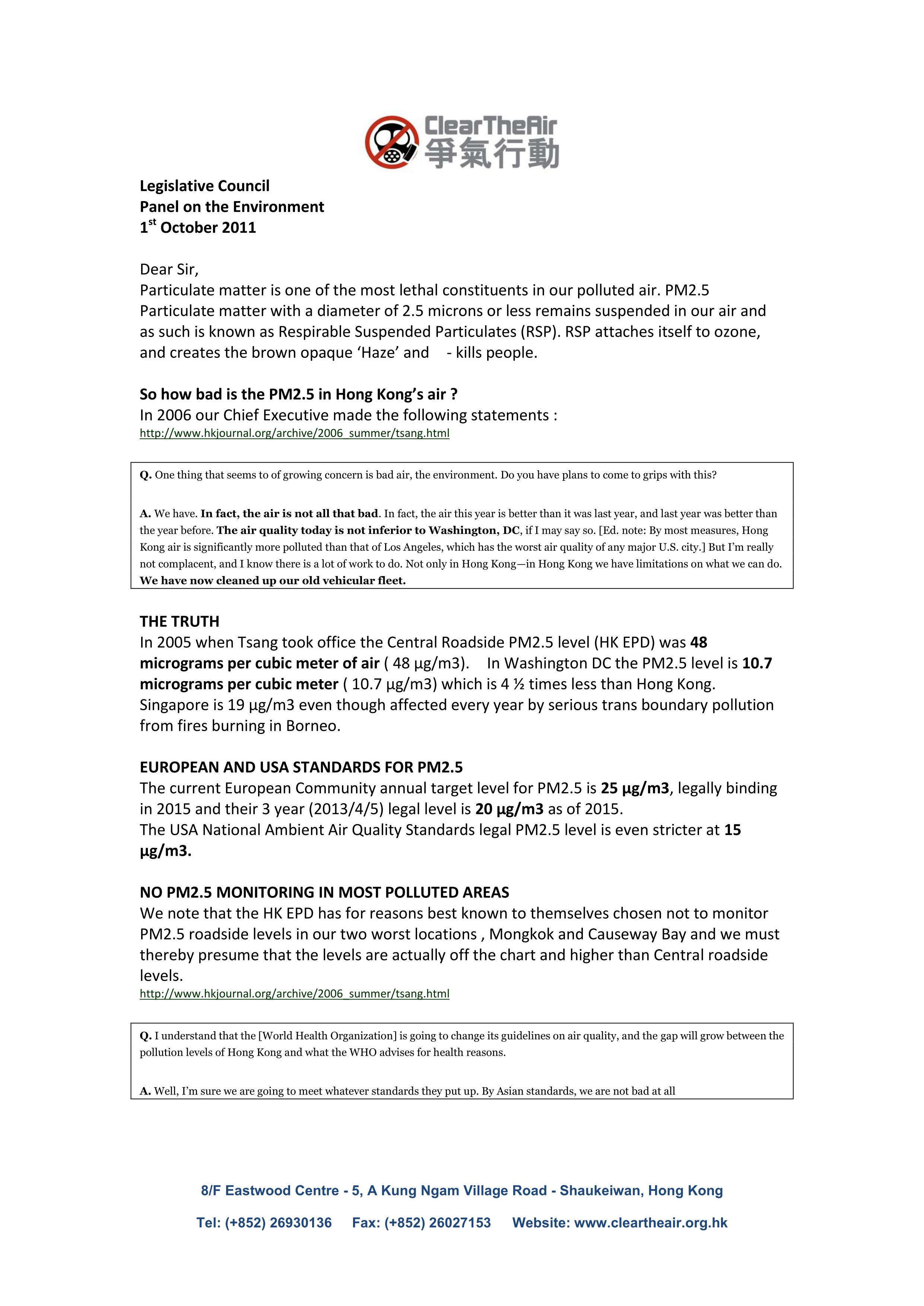
CTA Letter to the Panel on the Environment

Download full PDF : CTAletterPanelPM2.5

Reply from EPD

Dear Mr Furner,

Thanks for your enquiries about PM2.5 measurement on 28 August.

PM2.5 is a major part of PM10, accounting for 60% to 70% of the total mass concentration of the latter measured in Hong Kong.  The measurement of PM10 can therefore effectively reflect the levels of PM2.5.  As the sources of PM2.5 are also common to PM10, e.g., power plants, vehicles, industrial sources, etc., the government’s efforts to reduce PM10 concentrations can effectively reduce PM2.5 levels.

To understand the nature and characteristics of the PM2.5 in HK and their correlation with PM10, we have been conducting different projects including speciation studies (analysis of the chemical composition of PM2.5) and continuous measurement at 5 sites in HK.  From time to time, the PM2.5 data from these projects are provided to and used by public members including academics and media for studies and reporting, and are included in different publications and reports.  Here are a few of them :

To enhance our monitoring of PM2.5, we are working to extend the PM2.5 continuous measurement to all stations in Hong Kong with a view to making it a regularly monitored and reported pollutant.  We are now taking steps to install and test PM2.5 samplers in all monitoring stations.  The test runs of the samplers in the network are expected to be completed by end of this year.

From our previous studies and research findings from our local academics, a very significant proportion of particulates including PM10 and PM2.5 measured in Hong Kong are contributed by regional sources.  According to a study by the Hong Kong University of Science and Technology in 2005, the contribution of particulates from regions outside Hong Kong (including Pearl River Delta Region and regions outside PRD) could be some 60% on an annual basis and even higher at 70% during winter.  To alleviate the particulates problem, we have been working with Guangdong Provincial Government on a regional air quality management plan to reduce emissions in the PRD region and making substantial efforts to reduce local emissions of these particulates, in particular those from two major sources, namely power plants and motor vehicles.  Measures implemented in the past years include:

  • Power sector – banning new coal-fired generation units since 1997, imposing stringent emission caps on power plants since 2005, requiring power plants to increase the use of natural gas for electricity generation, requiring retrofitting of advanced air pollution control equipment to existing coal-fired generation units,
  • Motor vehicles – requiring the use of cleaner motor vehicle fuels such as LPG and the virtually sulphur-free Euro V diesel and petrol, mandating the retrofit of particulate reduction devices in pre-Euro diesel vehicles, subsidizing the replacement of old commercial diesel vehicles and providing tax incentives for environment-friendly vehicles.  Franchised bus companies have also retrofitted their Euro II and III buses with diesel particulate filters, which could reduce their particulates emissions by over 80%.

The above efforts have borne fruits.  Between 2005 and 2010, the annual PM2.5 concentrations in Hong Kong reduced by 26%.  The results of our speciation studies show that, between 2001 and 2009, the levels of elemental and organic carbon compounds (which are major constituents of PM2.5 coming from motor vehicles) at the roadside have reduced by more than 50%.  This clearly reflects that our control measures implemented in the past decade have very effectively reduced the PM2.5 emissions from our local vehicle fleet.

Despite the above improvements, the Government is endeavouring to introduce more new measures for improving the air quality including cutting of particulate emissions, such as requiring the power companies to maximize the use of the existing natural gas-fired generation units, thereby increasing the share of natural gas in local electricity generation to about 50%; and to prioritize the use of those coal-fired generation units equipped or retrofitted with advanced air pollution control equipment, so as to further tighten the already very stringent emission caps by about 30 to 50% from 2015; introducing relevant regulations to promote energy efficiency for electrical appliances and buildings; proposing emission standards for non-road mobile sources; implementing a host of new measures to reduce emissions from the transport sector, such as a ban on idling vehicles with running engines, a subsidy to encourage early replacement of Euro 2 diesel commercial vehicles with new ones, a trial of retrofitting franchised buses with “Selective Catalytic Reduction” devices to reduce emissions and the Government to fund the retrofit if the trial is proved to be successful; designating pilot Low Emission Zones at busy corridors in Causeway Bay, Central and Mong Kok and setting up a Pilot Green Transport Fund to encourage introducing innovative transport technology, etc.

Best regards,
C. F. Chow, (Mr.)

Senior Environmental Protection Officer, Acting
Environmental Protection Department